BookBrief
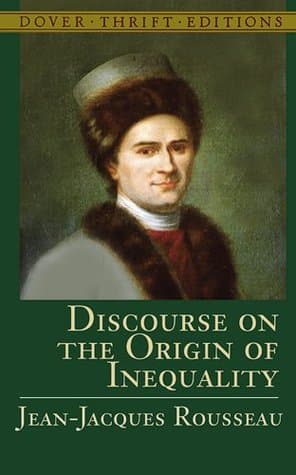
Discourse on the Origin of Inequality cover
Archivist's Choice

Discourse on the Origin of Inequality

Jean-Jacques Rousseau (2009)

Genre

Politics / History / Philosophy

Reading Time

180 min

Key Themes

See below

Track Your Reading

Sign in to track this book

Rousseau explores how humanity fell from a good, pre-social state into tyranny, showing how systems meant to protect us instead corrupt our nature through growing inequality.

Core Idea

Rousseau's "Discourse on the Origin of Inequality" suggests that early humans lived freely and were self-sufficient, guided by self-preservation and pity. This natural state had physical differences but no moral or political ranks. He argues that private property, farming, metalworking, and complex societies led to moral decline, dependence, and various inequalities. Society, through its rules and division of labor, encouraged vanity and competition. This eventually created a deceptive social contract that solidified the power of the wealthy over the poor, leading to a system of unfreedom and a loss of our true selves. The book claims that modern political and social structures are not natural. They are artificial constructs that worsen inequalities, moving humanity away from its original freedom and authenticity. Rousseau criticizes the idea of inherent social hierarchy. He suggests that all moral and political inequality comes from human customs and societal growth, not from divine will or natural law. This 'progress' has, ironically, led to human degradation and unhappiness.
Reading time
180 min
Difficulty
Hard
✓ Read this if...
You are interested in foundational texts of political philosophy, the historical development of inequality, or a critique of modern society's origins and its impact on human nature. Also if you enjoy exploring counter-intuitive arguments about progress and the social contract.
✗ Skip this if...
You prefer empirical, data-driven analyses over philosophical speculation and historical conjecture. Also if you are not prepared for dense, argumentative prose that requires careful reading and interpretation.

Core idea

The central argument and framework that powers the entire book.

Rousseau's "Discourse on the Origin of Inequality" suggests that early humans lived freely and were self-sufficient, guided by self-preservation and pity. This natural state had physical differences but no moral or political ranks. He argues that private property, farming, metalworking, and complex societies led to moral decline, dependence, and various inequalities. Society, through its rules and division of labor, encouraged vanity and competition. This eventually created a deceptive social contract that solidified the power of the wealthy over the poor, leading to a system of unfreedom and a loss of our true selves.

The book claims that modern political and social structures are not natural. They are artificial constructs that worsen inequalities, moving humanity away from its original freedom and authenticity. Rousseau criticizes the idea of inherent social hierarchy. He suggests that all moral and political inequality comes from human customs and societal growth, not from divine will or natural law. This 'progress' has, ironically, led to human degradation and unhappiness.

At a glance

Reading time

180 min

Difficulty

Hard

Read this if...

You are interested in foundational texts of political philosophy, the historical development of inequality, or a critique of modern society's origins and its impact on human nature. Also if you enjoy exploring counter-intuitive arguments about progress and the social contract.

Skip this if...

You prefer empirical, data-driven analyses over philosophical speculation and historical conjecture. Also if you are not prepared for dense, argumentative prose that requires careful reading and interpretation.

Key Takeaways

1

The Noble Savage: A Mythical Baseline

Humans in their natural state are inherently good and self-sufficient.

Quote

The first man who, having enclosed a piece of ground, bethought himself of saying 'This is mine,' and found people simple enough to believe him, was the real founder of civil society.

Rousseau describes a hypothetical 'state of nature' where humans, called 'noble savages,' lived solitary, amoral lives. They were guided by two main instincts: self-preservation (amour de soi) and pity (pitié). In this pre-social state, people were physically strong, mentally free, and lacked vices like vanity, envy, and greed. They met their basic needs directly from nature and had no concept of property, law, or moral duty. This state was amoral, meaning individuals could not be good or evil as society defines them. This idea is key...

Supporting evidence

Rousseau's 'hypothetical history' of humanity, where he speculates on the characteristics of early man based on reason rather than historical record, focusing on their physical capabilities and lack of complex mental faculties or social bonds.

Apply this

Reflect on modern societal pressures and how they might distort our natural inclinations. Consider if removing certain social constructs would reveal a more authentic, less competitive self.

state-of-naturenoble-savageamour-de-soipitié
2

The Corrupting Influence of Society

Social interaction and the development of reason lead to moral decay.

Quote

It is by working to make ourselves happy that we become capable of being unhappy.

Rousseau argues that the act of forming societies, initially for mutual protection against natural challenges, began humanity's decline. As people lived together, they developed new needs and desires beyond mere survival. The growth of language, reason, and comparison among individuals created a new kind of self-love, 'amour-propre.' This is driven by vanity, pride, and the desire for recognition and superiority. This shift from innocent self-preservation to a competitive, status-seeking life is where moral inequality began. Society, ...

Supporting evidence

Rousseau's description of early societies, where individuals began to compare themselves to others, leading to the development of vanity, shame, and the desire for esteem, which were absent in the state of nature.

Apply this

Critically evaluate how much of your self-worth is tied to external validation or comparison with others. Practice gratitude for what you have rather than focusing on what others possess.

amour-propresocial-contractmoral-inequalitycivil-society
3

Property: The Root of All Evil

The invention of private property fundamentally altered human relations and introduced inequality.

Quote

From the moment one man needed the help of another, and it was perceived that it was profitable for one man to have provisions for two, equality disappeared, property was introduced, work became indispensable, and vast forests were transformed into smiling fields which had to be watered with human sweat, and in which slavery and misery were soon seen to germinate and grow with the harvests.

Rousseau identifies the claim of private property as the turning point in humanity's descent into inequality and conflict. Before property, people were largely equal in their access to resources. Once land and goods became owned, a distinction between 'mine' and 'yours' appeared, leading to a division between rich and poor. This division was not just economic. It created a new hierarchy where the wealthy gained power, and the poor became dependent. The desire to accumulate and protect property drove the creation of laws and government...

Supporting evidence

Rousseau's vivid narrative of the first person to enclose land and declare it theirs, and the subsequent rapid development of agriculture, metallurgy, and the division of labor, all of which exacerbated inequality.

Apply this

Question the inherent fairness of current property laws and economic systems. Consider the ethical implications of extreme wealth concentration and its impact on societal well-being.

private-propertyeconomic-inequalitydivision-of-laborsocial-hierarchy
4

The Deceptive Social Contract

Governments are formed by the powerful to protect their acquired wealth and status, not universal rights.

Quote

The rich, in particular, must have felt how much a perpetual war, in which they alone defrayed all the expense, and in which the risk of life was common to all, was burdensome and disadvantageous to them.

Unlike later Enlightenment thinkers who saw the social contract as a mutual agreement for everyone's benefit, Rousseau views its historical origin as a clever trick by the rich. Facing the constant threat of losing their property and status in a chaotic, competitive society, the wealthy proposed establishing laws and government. They presented this as a way to protect everyone, including the poor, from harm. However, their true motive was to secure their gains and legitimize their dominance. The poor, naive and wanting peace, fell for...

Supporting evidence

Rousseau's argument that the rich, seeing their possessions threatened by the less fortunate, proposed a set of laws and a government, selling it as a means to protect all, but primarily protecting their own interests.

Apply this

Be skeptical of political rhetoric that claims to benefit all but disproportionately favors established powers. Analyze who truly benefits from new laws and policies.

social-contract-critiquepolitical-inequalitytyrannylegitimacy
5

The Three Stages of Inequality

Inequality progresses through stages, from wealth to power to despotism.

Quote

These are the different degrees of inequality, and the progress of its establishment. The first is the establishment of law and the right of property; the second, the institution of magistracy; and the third and last, the change from lawful power to arbitrary power.

Rousseau details a three-stage historical progression of inequality. The first stage is the establishment of law and property rights, which creates the rich-poor divide. The second stage is the institution of government, which solidifies the powerful-weak divide. Here, elected or appointed officials gain authority, further entrenching hierarchies. The final, most dangerous stage is the shift from legitimate power to arbitrary power, or despotism. This creates the master-slave divide. In this ultimate stage, everyone becomes equal agai...

Supporting evidence

Rousseau's explicit enumeration of the three stages of inequality, each marked by a specific institutional development and a corresponding deepening of social stratification.

Apply this

Recognize the subtle ways power can consolidate and become absolute. Advocate for checks and balances and resist the erosion of democratic institutions.

despotismpower-consolidationsocial-evolutiontyranny-of-the-few
6

Physical vs. Moral Inequality

Natural differences are benign; social constructs create destructive moral inequalities.

Quote

I conceive two kinds of inequality among men; one, which I call natural or physical, because it is established by nature, and consists in a difference of age, health, bodily strength, and the qualities of the mind or of the soul: and another, which may be called moral or political inequality, because it depends on a kind of convention, and is established, or at least authorised by the consent of men.

Rousseau distinguishes between two basic types of inequality. Natural or physical inequality includes inherent differences in age, health, strength, and intelligence. These are natural and, in the state of nature, were largely unimportant. A weaker person could still survive, and a stronger one did not necessarily dominate. However, moral or political inequality comes entirely from society and custom. It results from human agreements, laws, and institutions that give some individuals advantages over others in wealth, honor, and power....

Supporting evidence

Rousseau's clear definition and differentiation of 'natural' and 'moral' inequality at the beginning of the Discourse, setting the framework for his subsequent arguments.

Apply this

Challenge societal norms that valorize certain physical or intellectual traits while devaluing others. Focus on dismantling systemic barriers rather than blaming individuals for their 'natural' disadvantages.

natural-inequalitymoral-inequalitysocial-constructionconvention
7

The Loss of Authenticity (Alienation)

Society forces individuals to live in the opinions of others, losing their true selves.

Quote

The savage lives within himself; the man of society is always outside himself, and knows how to live only in the opinion of others; and it is, so to speak, from their judgment alone that he draws the feeling of his own existence.

One major consequence of societal development, according to Rousseau, is the loss of individual authenticity. In the state of nature, humans were self-sufficient and lived by their own feelings and needs. Society, however, introduces 'amour-propre' (vanity, pride), making individuals dependent on others' opinions and approval. People start to perform for an audience, adopting masks and roles to gain status, respect, or material advantage. This constant need for external validation leads to a deep separation from one's true self, as in...

Supporting evidence

Rousseau's description of how early social gatherings led to dancing, singing, and competition, and how those who performed best gained esteem, thus initiating the desire for public approval.

Apply this

Practice self-reflection to identify moments when you act for external validation rather than genuine desire. Cultivate genuine interests and relationships that are not based on superficial approval.

alienationauthenticityself-deceptionsocial-performance
8

The Paradox of Progress

Advancements in knowledge and technology exacerbate human misery and inequality.

Quote

Although the advantages of society appear to be so great, they are purchased at the price of the greatest evils.

Rousseau holds a pessimistic view of human progress. Unlike many Enlightenment thinkers who praised the advancement of arts and sciences, he argues that these developments, far from freeing humanity, have only tightened its chains. Innovations like agriculture and metalworking, while increasing productivity, also led to private property, division of labor, and the resulting rise of inequality and dependence. The refinement of reason and language, while allowing for complex thought, also enabled deception, manipulation, and the creatio...

Supporting evidence

Rousseau's detailed account of how the discovery of agriculture and metallurgy, seemingly positive advancements, directly led to the establishment of property, the need for laws, and the subsequent exploitation of the poor by the rich.

Apply this

Critically assess technological advancements and their potential societal costs, beyond immediate convenience. Consider if certain 'progress' might be eroding fundamental human well-being or equality.

progress-critiquetechnological-impactcivilization-critiqueunintended-consequences
9

The Futility of Return

A return to the state of nature is impossible; we must reform society.

Quote

The human race, having once quitted the state of nature, can never return to it.

Despite his harsh critique of civilization, Rousseau does not advocate a literal return to the primal state of nature. He acknowledges that humanity has moved too far in social development to ever truly go back. The complexities of language, reason, and social interdependence are now ingrained. Instead, the 'state of nature' is a critical philosophical tool—a theoretical baseline to measure societal corruption and understand inequality's origins. The implication is that since we cannot undo history, the only way forward is to lessen s...

Supporting evidence

Rousseau's clear statement that a return to the primitive state is not feasible, emphasizing that his 'hypothetical history' is an analytical tool rather than a literal historical proposal.

Apply this

Instead of idealizing a past that cannot be recovered, focus on actionable steps to improve current societal structures. Engage in democratic processes to advocate for more equitable policies and education.

social-reformpolitical-philosophyideal-stateenlightenment-thought
10

The Tyranny of Convention

Human suffering stems from adherence to artificial social norms and expectations.

Quote

The poor man, on the other hand, possesses nothing but his person, and is therefore obliged to sell himself to another, or to perish.

Rousseau ultimately argues that much human misery and injustice come not from natural flaws but from the arbitrary customs and institutions that society creates and then enforces as natural or necessary. Concepts like property, law, social hierarchy, and even the division of labor are human constructs that have become so ingrained they seem inevitable. These customs create artificial needs, encourage destructive competition, and legitimize the exploitation of some by others. The 'Discourse' urges us to question these accepted norms, s...

Supporting evidence

Rousseau's consistent argument throughout the text that the 'chains' of humanity are forged by human hands, through the establishment of conventions like property and government, which then become oppressive.

Apply this

Identify and challenge societal conventions that perpetuate inequality or limit individual freedom. Advocate for policies that redistribute power and resources, rather than simply maintaining the status quo.

social-normsconvention-critiquehuman-conditionpower-structures

Critical analysis

Notable Quotes

The first man who, having enclosed a piece of ground, bethought himself of saying This is mine, and found people simple enough to believe him, was the real founder of civil society.

Rousseau's hypothetical origin of private property and society.

Man is born free; and everywhere he is in chains.

The opening line of Rousseau's 'The Social Contract', but a core idea developed in 'Discourse on Inequality'.

The savage lives in himself; sociable man, always outside himself, is able to live only in the opinion of others, and, so to speak, derives the whole sentiment of his own existence solely from the judgment of others concerning him.

Comparing the self-sufficiency of natural man with the dependency of social man.

It is reason that engenders amour-propre, and it is reflection that strengthens it; it is reason that turns man back upon himself, and that separates him from everything that troubles and afflicts him. It is philosophy that isolates him, and that inspires him to say in secret, at the sight of a suffering man: Perish if you will, I am safe.

Rousseau's critique of reason and 'amour-propre' (vanity/self-esteem).

The first source of evil is inequality.

A direct statement about the fundamental problem in society.

Savage man, when he has eaten, is at peace with all nature, and the friend of all his fellow-creatures.

Describing the simple, contented state of natural man.

The rich, on their side, had no sooner recognized the origin of their power than they bethought themselves of cloaking it with new pretexts, and of appealing in their turn to the general good, in order to secure themselves against the very people they had enslaved.

How the wealthy justify and maintain their power.

It is easy to see that it is to the most fatal accidents that we owe our escape from the state of nature.

Suggesting that humanity's departure from the state of nature was not necessarily a positive progression.

All ran to meet their chains, in the belief that they were securing their liberty; for, although they had enough reason to perceive the advantages of a political establishment, they had not enough experience to foresee its dangers.

People willingly entering into civil society, unaware of the future loss of freedom.

From the moment one man needed the help of another, from the moment it appeared advantageous to one to possess provisions for two, equality disappeared, property was introduced, work became indispensable, and vast forests were transformed into smiling fields which had to be watered with the sweat of men, and in which slavery and misery were soon seen to germinate and grow with the harvests.

The transition from self-sufficiency to interdependence, leading to inequality and labor.

If nature intended us to be healthy, I almost dare affirm that the state of reflection is a state contrary to nature, and that the man who meditates is a depraved animal.

A controversial statement about the corrupting influence of excessive thought and civilization.

The more society is cultivated, the more it is corrupt.

A concise summary of Rousseau's view on the relationship between societal development and moral decay.

Pity is a natural sentiment, which, by moderating in each individual the activity of self-love, contributes to the mutual preservation of the whole species.

Rousseau's argument for pity (compassion) as a fundamental aspect of natural man.

Such is the fatal chain of causes and effects, by which equality, once lost, is never to be recovered.

Reflecting on the irreversible nature of lost equality once society develops.

Quiz

Test Your Knowledge

Ready to see how well you understood this book? Take our interactive quiz with 10 questions.

10
Questions
~5
Minutes
?
Best Score

Key Questions (FAQ)

Rousseau argues that humans are naturally good and benevolent, but become corrupt through the development of society and the introduction of various forms of inequality. He explores how civilization, rather than improving humanity, leads to moral and political decay.

About the author