BookBrief
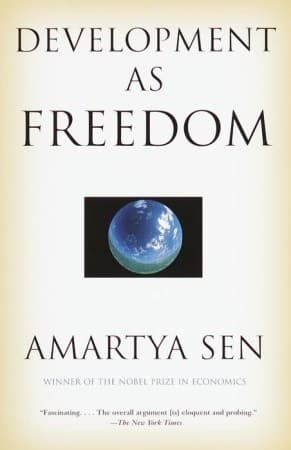
Development as Freedom cover
Archivist's Choice

Development as Freedom

Amartya Sen (1999)

Genre

Politics / Economics / Philosophy

Reading Time

9-12 hours

Key Themes

See below

Track Your Reading

Sign in to track this book

Amartya Sen says development is about expanding human freedoms, not just economic growth. He argues these freedoms are both the goal and the best way to achieve societal progress and well-being.

Core Idea

Amartya Sen's "Development as Freedom" changes how we think about development. It is not just about economic growth but about increasing people's real freedoms. He argues that we should measure development by how much individuals can live the lives they want, free from poverty, tyranny, lack of economic chances, social exclusion, and poor public services. Sen believes these freedoms are the main goals of development and also the main ways to achieve it. He uses the capability approach to show how political freedoms, economic opportunities, social chances, transparency, and protective security all help expand human capabilities and lead to real development. The book stresses how these freedoms connect and how public action, democracy, and markets help them grow. It also criticizes views of progress that focus only on income.
Reading time
9-12 hours
Difficulty
Hard
✓ Read this if...
You are interested in a profound, human-centric redefinition of development that goes beyond mere economic indicators, and want to understand the philosophical and practical arguments for linking freedom directly to progress.
✗ Skip this if...
You are looking for a purely economic textbook on development models or a light, introductory read on global poverty without engaging in deep philosophical and political arguments.

Core idea

The central argument and framework that powers the entire book.

Amartya Sen's "Development as Freedom" changes how we think about development. It is not just about economic growth but about increasing people's real freedoms. He argues that we should measure development by how much individuals can live the lives they want, free from poverty, tyranny, lack of economic chances, social exclusion, and poor public services. Sen believes these freedoms are the main goals of development and also the main ways to achieve it. He uses the capability approach to show how political freedoms, economic opportunities, social chances, transparency, and protective security all help expand human capabilities and lead to real development. The book stresses how these freedoms connect and how public action, democracy, and markets help them grow. It also criticizes views of progress that focus only on income.

At a glance

Reading time

9-12 hours

Difficulty

Hard

Read this if...

You are interested in a profound, human-centric redefinition of development that goes beyond mere economic indicators, and want to understand the philosophical and practical arguments for linking freedom directly to progress.

Skip this if...

You are looking for a purely economic textbook on development models or a light, introductory read on global poverty without engaging in deep philosophical and political arguments.

Key Takeaways

1

Development as Freedom

Freedom is both the primary end and the principal means of development.

Quote

The success of a society is to be evaluated primarily by the substantive freedoms that its members come to enjoy.

Sen's main idea is that development is about increasing the real freedoms people have, not just economic growth. This includes political liberties, economic opportunities, social services, transparency, and protective security. These freedoms are valuable on their own as the goals of development. They also work as the most effective ways to achieve more development. For example, educated people (educational freedom) are better able to innovate and join the economy (economic freedom), leading to better living standards and more choices...

Supporting evidence

Sen frequently uses the example of famines, arguing that they are not merely a result of food shortage but a failure of entitlements and freedoms, particularly information and political freedom. Democracies, even poor ones, have historically avoided large-scale famines due to public scrutiny and accountability.

Apply this

Policymakers should prioritize investments that directly expand individual capabilities and freedoms, such as universal education, healthcare, and civil liberties, rather than solely focusing on macroeconomic indicators. Evaluate development projects based on their impact on people's ability to live the lives they have reason to value.

human-capabilitiessubstantive-freedomsentitlements
2

Instrumental Freedoms

Five distinct types of instrumental freedoms contribute to general capability.

Quote

The instrumental role of freedoms links with the intrinsic importance of freedom in development.

Sen names five important freedoms: political freedoms, economic opportunities, social chances, transparency, and protective security. Political freedoms, including civil rights and voting rights, allow people to take part and hold leaders accountable. Economic opportunities relate to chances to use economic resources for buying, producing, and trading. Social chances, like education and healthcare, improve human abilities. Transparency makes dealings open and builds trust, preventing corruption. Protective security offers a social saf...

Supporting evidence

Sen discusses how East Asian economies, despite some authoritarian tendencies, often invested heavily in social opportunities (education and health), which significantly contributed to their economic success. He contrasts this with regions where such investments were neglected.

Apply this

When designing development strategies, ensure a balanced approach that nurtures all five instrumental freedoms. For example, a microfinance program (economic facility) should be complemented by literacy programs (social opportunity) and legal protections for borrowers (protective security and transparency).

political-freedomseconomic-facilitiessocial-opportunitiestransparency-guaranteesprotective-security
3

Capability Approach

Focus on what people are actually able to do and be, rather than just resources.

Quote

The focus here is on the freedom that people have to lead the kind of lives they have reason to value.

The Capability Approach is a main part of Sen's framework. It moves the focus from income or resources to 'functionings' (what people can be and do, like being healthy or joining community life) and 'capabilities' (the real chances to achieve these functionings). Two people with the same income might have very different capabilities because of things like disability, gender, or social rules. For instance, a person with a disability might need more resources to move around as easily as someone without a disability. So, real development...

Supporting evidence

Sen uses the example of income and health: an older person or someone with a chronic illness might have the same income as a young, healthy person but be far less 'capable' of achieving good health or social participation due to their condition. Simply increasing income for everyone doesn't address these disparities.

Apply this

Development programs should be tailored to specific contexts and individual needs, aiming to enhance capabilities rather than just distributing resources. For example, providing accessible infrastructure for people with disabilities or targeted educational support for marginalized groups.

functioningshuman-development-indexindividual-heterogeneity
4

Democracy's Developmental Role

Democracy is not merely a luxury but a crucial component of development.

Quote

The absence of famine in any country with a democratic form of government, with a relatively free press, is a striking fact.

Sen strongly argues that democracy is not just a Western idea or something only rich countries can afford; it is a key part of development. Its value is in letting citizens take part in public life and affect decisions that concern them. Democracy also motivates governments to respond to their people's needs. A free press and political opposition can point out upcoming problems, like famines, and push governments to act, preventing big disasters. This is very different from the 'Lee Thesis,' which suggested that authoritarian rule cou...

Supporting evidence

Sen's most famous example is the striking absence of major famines in functioning democracies throughout history, even in very poor ones like India after independence, compared to authoritarian regimes like China during the Great Leap Forward or various African dictatorships.

Apply this

Support for democratic institutions, freedom of speech, and a free press should be central to international development efforts, not just as political goals but as fundamental tools for preventing crises and ensuring responsive governance.

lee-thesispolitical-participationpublic-reason
5

Markets and Freedom

Market mechanisms are crucial for freedom, but require supportive institutions.

Quote

The freedom to exchange words, or to exchange political views, is a part of human freedom in general. The freedom to exchange goods and services is a part of it too.

Sen sees markets not just as ways to use resources well, but as key to individual freedom. Being able to trade willingly is a basic liberty. Denying people access to markets (for example, through too many rules, lack of property rights, or social exclusion) is denying freedom. However, he is not a pure free-market supporter. Markets alone are not enough; they need strong support from institutions like legal systems, property rights, a welfare state to fix market problems, and public education and health. Without these, markets can mak...

Supporting evidence

He discusses how the denial of market access to certain groups, such as women or lower castes, restricts their economic freedom and perpetuates poverty. Conversely, he acknowledges the dynamic growth fostered by market expansion in many parts of the world, but always with the caveat of needing social support structures.

Apply this

Policy should aim to broaden access to markets for all individuals while simultaneously investing in public goods and social safety nets to mitigate market failures and ensure equitable outcomes. This means promoting entrepreneurship alongside universal healthcare.

market-failureseconomic-liberalizationsocial-safety-nets
6

Public Action and Social Choice

Collective action and public reasoning are essential for expanding freedoms.

Quote

Public reasoning is an essential part of the exercise of freedom itself.

Sen emphasizes the important role of public action and social choices in shaping development outcomes. Development is not just something that happens to people; it is something they actively help create through group decisions, advocacy, and protest. Public discussion and reasoning are important for finding societal needs, setting goals, and holding governments accountable. This includes the role of media, public debate, and democratic processes in general. Expanding freedoms requires not just individual choices but also strong group ...

Supporting evidence

The successful implementation of land reforms, public health campaigns, or educational initiatives often depends on active public engagement and pressure, demonstrating that government action alone is insufficient without public buy-in and participation.

Apply this

Foster environments that encourage public debate, transparency, and citizen participation in policy-making. Invest in civic education and support independent media to facilitate informed public reasoning and collective action.

public-reasoningsocial-choice-theorycollective-action
7

Interconnectedness of Freedoms

Freedoms are not isolated; they reinforce each other in a virtuous cycle.

Quote

The different freedoms are not only instrumentally important, but they also reinforce each other.

A main idea from Sen is that the different freedoms he names are deeply connected and help each other. For example, getting an education (social opportunity) helps a person's ability to participate in the economy (economic opportunity) and to join political talks (political freedom). More political freedom can, in turn, lead to policies that improve social opportunities and protective security. This creates a good cycle where increasing one type of freedom helps increase others, leading to more complete human development. On the other...

Supporting evidence

Sen often refers to the 'Asian miracle' economies, where initial investments in social opportunities (education and health) laid the groundwork for rapid economic growth, which then allowed for further expansion of other freedoms.

Apply this

Development strategies should adopt a holistic approach, recognizing and leveraging the synergies between different types of freedoms. Avoid siloed interventions; instead, design integrated programs that address multiple dimensions of freedom simultaneously.

virtuous-cyclesynergyholistic-development
8

Poverty as Capability Deprivation

Poverty is more than just low income; it's a lack of real opportunities.

Quote

Poverty must be seen as the deprivation of basic capabilities rather than merely as lowness of incomes.

Sen changes how we define poverty. He moves beyond just measuring income to seeing poverty as a lack of basic capabilities. While low income often causes a lack of capabilities, it is not the only reason. Things like illiteracy, poor health, lack of public services, social exclusion, or political repression can limit a person's ability to live a life they value just as much, if not more, even if their income is above a certain level. This broader understanding of poverty means we need many different actions that go beyond just giving ...

Supporting evidence

He highlights how even in rich countries, certain groups can experience capability deprivation due to factors like mental illness, social isolation, or lack of access to public transport, despite having adequate income. Conversely, a poor community with strong social bonds and access to public healthcare might be 'richer' in terms of capabilities than an isolated wealthy individual.

Apply this

Poverty reduction strategies should include not only economic empowerment but also investments in universal education, healthcare, social inclusion programs, and the protection of civil and political rights. Develop multi-dimensional poverty indices that capture these deprivations.

multi-dimensional-povertyhuman-poverty-indexsocial-exclusion
9

Universality vs. Context

The principles of freedom are universal, but their application is context-dependent.

Quote

The general case for freedom does not, of course, imply that there are no difficulties in the choice and implementation of particular policies.

Sen argues that the idea of freedom as both the goal and way to achieve development applies everywhere, beyond specific cultures or history. He carefully disproves arguments that some societies are 'unsuited' for democracy or certain freedoms. However, he also recognizes that the specific policies and rules to achieve these freedoms must fit the local situation. There is no single solution that works for everyone; what works in one society might not in another. The process of public reasoning within each society is important for decid...

Supporting evidence

Sen critiques arguments like the 'Asian values' thesis, which suggested that Asian societies prioritize collective discipline over individual freedoms, arguing that such claims often overlook diverse historical traditions and internal debates within these cultures. He shows how different countries have achieved development through varying institutional paths.

Apply this

When designing development interventions, engage deeply with local communities and institutions to tailor solutions that are culturally appropriate and effective, while consistently upholding the core principles of expanding individual freedoms and capabilities.

asian-values-debatecultural-relativismcontextual-policy
10

Global Interdependence and Accountability

Development is a shared global responsibility, requiring international cooperation.

Quote

The contemporary world denies elementary freedoms to vast numbers – perhaps even the majority of people – and it is still possible to practically and optimistically regain a sense of social accountability.

In a world that is more and more connected, Sen points out that development and expanding freedoms are not just national issues. Global organizations, international trade rules, money flows, and aid systems greatly affect people's capabilities and freedoms, especially in developing countries. He calls for 'social accountability' worldwide, where richer nations and international organizations have a moral duty to help expand freedoms globally. This includes dealing with global inequalities, making sure trade practices are fair, and pro...

Supporting evidence

Sen discusses how international financial crises, global pandemics, or climate change disproportionately affect the poorest nations, undermining their freedoms and capabilities. He implicitly calls for a re-evaluation of institutions like the IMF and World Bank to prioritize human freedom.

Apply this

Advocate for and support international policies that promote equitable global trade, fair debt relief, responsible foreign aid, and global efforts to address shared challenges like climate change and pandemics, all aimed at expanding capabilities universally.

global-justiceinternational-cooperationglobal-governance

Critical analysis

Notable Quotes

Development can be seen, it is argued here, as a process of expanding the real freedoms that people enjoy.

Core thesis of the book, defining development in terms of freedom.

Freedom is both the primary end and the principal means of development.

Argument that freedom is both the goal and the mechanism of development.

The removal of substantial unfreedoms... is constitutive of development.

Emphasizing that development requires eliminating constraints like poverty and tyranny.

Poverty must be seen as the deprivation of basic capabilities rather than merely as lowness of incomes.

Critique of income-focused poverty measures, advocating a capability approach.

The expansion of freedom is viewed, in this approach, both as the primary end and as the principal means of development.

Restating the dual role of freedom in the development process.

The success of a society is to be evaluated, in this view, primarily by the substantive freedoms that its members enjoy.

Proposing freedom as the key metric for societal progress.

Political freedoms and civil rights are important for the conceptualization of development.

Highlighting the role of democratic institutions in development.

The capability to function is what matters for well-being and the standard of living.

Explaining the capability approach's focus on what people can actually do.

Development requires the removal of major sources of unfreedom: poverty as well as tyranny, poor economic opportunities as well as systematic social deprivation.

Listing key obstacles to development that must be addressed.

The perspective of freedom is concerned with the 'opportunity aspect' of well-being.

Distinguishing freedom as providing opportunities rather than just outcomes.

The enhancement of human capabilities and the expansion of human freedoms are the primary ends of development.

Summarizing the ultimate goals of development according to Sen.

The process of development, when judged by the enhancement of human freedom, is a deeply participatory process.

Arguing that development must involve people's active engagement.

The freedom-centered perspective has a generic similarity to the common concern with 'quality of life'.

Connecting the freedom approach to broader well-being concepts.

The expansion of freedom is not only the primary end of development, but also among its principal means.

Reiterating the instrumental and intrinsic value of freedom.

Quiz

Test Your Knowledge

Ready to see how well you understood this book? Take our interactive quiz with 10 questions.

10
Questions
~5
Minutes
?
Best Score

Key Questions (FAQ)

Amartya Sen argues that development should be understood as the expansion of human freedoms, not just economic growth. He posits that freedom is both the primary end and the principal means of development, enabling people to live lives they have reason to value.

About the author

Amartya Sen

Amartya Sen is a Nobel laureate in Economics, renowned for his contributions to welfare economics, social choice theory, and development economics. His influential books, including 'Development as Freedom' and 'The Idea of Justice,' challenge conventional economic thinking and advocate for a broader understanding of human capabilities and freedoms.