BookBrief
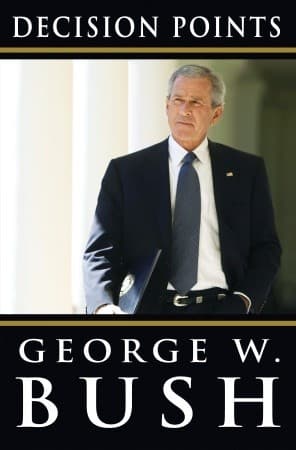
Decision Points cover
Archivist's Choice

Decision Points

George W. Bush (2010)

Genre

Politics / Biography / Leadership / Memoir / History

Reading Time

10-12 hours (based on 497 pages)

Key Themes

See below

Track Your Reading

Sign in to track this book

George W. Bush recounts his presidency's defining choices, from 9/11's aftermath to the Iraq War and Hurricane Katrina, in the Situation Room and Oval Office.

Core Idea

George W. Bush's 'Decision Points' is a personal account of his most important decisions as President. Bush looks back at the events that shaped his two terms, including the September 11th attacks, the wars in Afghanistan and Iraq, domestic issues like Hurricane Katrina, and his administration's work on AIDS relief and economic policy. The book shares an insider's view of leadership challenges, the complex reasons behind high-stakes choices, and the beliefs that guided his actions. It reveals the human side of major historical events and how presidential power leaves a lasting mark.
Reading time
10-12 hours (based on 497 pages)
Difficulty
Medium
✓ Read this if...
You are interested in a firsthand account of major presidential decisions from 2001-2009, particularly regarding 9/11, the Iraq War, and the inner workings of the White House during a period of significant global change. Ideal for those seeking insights into leadership under pressure and the personal reflections of a former head of state.
✗ Skip this if...
You are looking for an objective historical analysis or a critical examination of the Bush presidency. This is a memoir, presenting the author's own perspective and justifications, rather than a detached academic study or a comprehensive biography from multiple viewpoints.

Core idea

The central argument and framework that powers the entire book.

George W. Bush's 'Decision Points' is a personal account of his most important decisions as President. Bush looks back at the events that shaped his two terms, including the September 11th attacks, the wars in Afghanistan and Iraq, domestic issues like Hurricane Katrina, and his administration's work on AIDS relief and economic policy. The book shares an insider's view of leadership challenges, the complex reasons behind high-stakes choices, and the beliefs that guided his actions. It reveals the human side of major historical events and how presidential power leaves a lasting mark.

At a glance

Reading time

10-12 hours (based on 497 pages)

Difficulty

Medium

Read this if...

You are interested in a firsthand account of major presidential decisions from 2001-2009, particularly regarding 9/11, the Iraq War, and the inner workings of the White House during a period of significant global change. Ideal for those seeking insights into leadership under pressure and the personal reflections of a former head of state.

Skip this if...

You are looking for an objective historical analysis or a critical examination of the Bush presidency. This is a memoir, presenting the author's own perspective and justifications, rather than a detached academic study or a comprehensive biography from multiple viewpoints.

Key Takeaways

1

The Weight of 9/11

A President's defining crisis and the immediate pivot to war.

Quote

The most important decision a president makes is to send the country to war.

The September 11th attacks redefined Bush's presidency. He describes the immediate aftermath as a time of great uncertainty and determination, where national security became the top priority, overshadowing all other domestic goals. This moment solidified his belief that a proactive, aggressive approach to terrorism was necessary, directly leading to the 'War on Terror.' Bush recounts the chilling realization that the world had changed and that his role was to lead a nation under attack, making decisions with global consequences under ...

Supporting evidence

Bush's description of being informed of the attacks while reading to schoolchildren in Florida, the subsequent flight on Air Force One, and the immediate declaration that 'we're at war.'

Apply this

Understand how a singular, catastrophic event can completely reorient a leader's priorities and the direction of an entire administration, demanding rapid, high-stakes decision-making.

9-11war-on-terrorpresidential-crisis
2

The Iraq War: A Difficult Choice

The complex rationale and personal burden behind a controversial invasion.

Quote

I believed Saddam Hussein was a grave threat to the United States. I still do.

Bush details the intelligence that led to the Iraq War, focusing on the perceived threat of Saddam Hussein's weapons of mass destruction (WMD) program and his ties to terrorism. While acknowledging the later absence of WMDs, Bush defends his decision, calling it a necessary preemptive measure to protect American lives and promote democracy in the Middle East. He discusses the heavy personal responsibility of sending troops into war, reflecting on the intelligence failures and the high cost. However, he ultimately stands by his belief ...

Supporting evidence

His account of intelligence briefings, discussions with advisors like Dick Cheney and Colin Powell, and the specific concerns regarding WMDs and Saddam's non-compliance with UN resolutions.

Apply this

Leaders must make decisions based on the best available information, even when that information later proves flawed. It highlights the ethical complexities of pre-emptive military action and the lasting impact of such choices.

iraq-warweapons-of-mass-destructionpre-emptive-strike
3

The Surge: Defying Public Opinion

A high-stakes gamble to salvage a failing war strategy.

Quote

My deep concern that Iraq could turn into a defeat costlier than Vietnam, and how he decided to defy public opinion by ordering the troop surge.

Facing a worsening situation in Iraq and falling public approval, Bush recounts the difficult decision to implement the 'surge' of additional troops in 2007. This went against widespread calls for withdrawal and was a politically unpopular move. He explains his belief that failure in Iraq would have devastating long-term consequences for American credibility and regional stability, similar to the fallout from Vietnam. The surge was a last effort to provide security, stabilize the country, and create conditions for a responsible withdr...

Supporting evidence

Bush's discussions with General David Petraeus, the internal White House debates, and the stark contrast between his decision and prevailing public and political sentiment at the time.

Apply this

True leadership sometimes requires making unpopular decisions that are believed to be in the best long-term interest, even when facing significant political and public opposition. It underscores the courage to change course when a strategy isn't working.

iraq-surgemilitary-strategypolitical-courage
4

Katrina: A Stain on the Legacy

The personal impact of a perceived leadership failure.

Quote

Why the worst moment of the presidency was hearing accusations that race played a role in the federal government’s response to Hurricane Katrina, and a critical assessment of what he would have done differently during the crisis.

Hurricane Katrina is one of Bush's most personally painful episodes, not just for the damage it caused, but for the widespread perception of a slow and inadequate federal response. He admits to mistakes and offers a critical assessment of what he would have done differently, especially regarding early federal intervention and communication. The accusation that race played a role in the delayed response deeply affected him, showing the immense pressure on a president to deliver immediate and effective aid during a national disaster, an...

Supporting evidence

His reflections on the initial slow understanding of the scale of the disaster, the criticism directed at FEMA, and his personal distress over the accusations of racial bias.

Apply this

Crisis management requires proactive leadership, clear communication, and the ability to cut through bureaucratic red tape. It also reveals how a president's legacy can be profoundly shaped by natural disasters and the public's perception of the government's efficacy.

hurricane-katrinadisaster-responsepresidential-accountability
5

Faith and Personal Transformation

The profound influence of religion on his life and leadership.

Quote

His decision to quit drinking and the journey that led him to his Christian faith.

Bush openly discusses his personal journey to sobriety and the central role his Christian faith played in this change. This decision, made years before his presidency, is presented as a foundational moment that gave him purpose, discipline, and a moral compass. He explains how his faith provided strength during challenging times in the White House, influencing his leadership, his resilience to criticism, and his understanding of his place in history. It shows how a leader's personal beliefs can shape their public decisions.

Supporting evidence

His detailed account of quitting alcohol, his relationship with Billy Graham, and how his faith provided solace and guidance during the intense pressures of the presidency.

Apply this

Recognize how personal values and spiritual beliefs can serve as a profound anchor for leaders, providing resilience and shaping their decision-making framework, particularly in moments of extreme stress.

personal-faithsobrietymoral-compass
6

The Global Fight Against AIDS

A humanitarian legacy often overshadowed by foreign policy.

Quote

One of his greatest achievements, and a source of immense pride, was the President's Emergency Plan for AIDS Relief (PEPFAR).

Amidst the focus on war and national security, Bush highlights PEPFAR as one of his proudest achievements. He details the administration's commitment to fighting the global AIDS epidemic, particularly in Africa, through significant funding and a comprehensive strategy. This initiative, often less publicized than his foreign policy decisions, shows a deep humanitarian concern and an ability for bipartisan collaboration on a large scale. It reveals a side of his presidency focused on saving lives and making a tangible, positive impact o...

Supporting evidence

The specific details of PEPFAR's creation, its funding levels, and its measurable impact on saving millions of lives in developing countries.

Apply this

Leaders have the capacity to drive significant humanitarian initiatives that can have a lasting global impact, even when overshadowed by other political events. It shows the importance of pursuing diverse policy goals.

pepfarglobal-healthhumanitarian-aid
7

Balancing Security and Liberty

The controversial post-9/11 decisions on counterterrorism.

Quote

His administration’s counterterrorism programs, including the CIA’s enhanced interrogations and the Terrorist Surveillance Program.

Bush addresses the controversial decisions surrounding enhanced interrogation techniques and the Terrorist Surveillance Program (TSP). He frames these as difficult choices made under extreme pressure to prevent further attacks on American soil. While acknowledging the controversy and ethical debates, he states that these measures, deemed legal by his administration, were effective in gathering critical intelligence and ultimately protected the nation. This section offers his defense of these programs, emphasizing the 'ticking time bom...

Supporting evidence

Bush's justification for the use of enhanced interrogation techniques based on legal advice and the perceived intelligence gleaned, and the rationale behind the warrantless surveillance program.

Apply this

Leaders are often forced to grapple with profound ethical dilemmas where national security interests clash with civil liberties. It highlights the lasting debate on the appropriate limits of governmental power in times of crisis.

enhanced-interrogationterrorist-surveillance-programnational-security
8

The Presidential Circle

The critical role of advisors and family in decision-making.

Quote

His relationships with his wife, daughters, and parents, including heartfelt letters between the president and his father on the eve of the Iraq War.

Bush emphasizes the valuable support and advice he received from his inner circle, including his family and key cabinet members. He highlights the dynamic with his father, George H.W. Bush, and the poignant exchange of letters before the Iraq War, revealing deep respect and reliance on paternal wisdom. The book shows that presidential decisions are rarely made alone, but are shaped by a trusted network of advisors who challenge, support, and inform. This reveals the human element of the presidency, where personal relationships and tru...

Supporting evidence

Examples of advice from Dick Cheney, Colin Powell, Condoleezza Rice, and particularly the personal correspondence and conversations with his father.

Apply this

Effective leadership requires building a strong, trusted team and being open to diverse perspectives, even from family. It illustrates the importance of having a robust support system to navigate the immense pressures of power.

presidential-advisorsfamily-supportleadership-team
9

Regrets and Reflections

Acknowledging failures and defining success beyond public opinion.

Quote

Why the failure to bring Osama bin Laden to justice ranks as his biggest disappointment and why his success in denying the terrorists their fondest wish—attacking America again—is among his proudest achievements.

Bush candidly discusses his biggest disappointment — the failure to capture Osama bin Laden during his presidency — and contrasts it with his proudest achievement: preventing another major terrorist attack on American soil after 9/11. This shows a leader grappling with the limits of power and defining success on his own terms, often independent of public approval. He acknowledges the weight of his decisions and the criticisms, but ultimately finds comfort in what he sees as safeguarding the nation. It is a powerful reflection on how p...

Supporting evidence

His direct statement about bin Laden's escape from Tora Bora and the subsequent efforts, contrasted with the lack of another 9/11-scale attack during his tenure.

Apply this

Leaders must be able to live with their decisions, both successes and failures, and define their own metrics for achievement, especially when public opinion is volatile. It shows the humility and resilience required to lead.

osama-bin-ladencounterterrorism-successpresidential-legacy

Critical analysis

Notable Quotes

I was not a person who was given to introspection. But after I stopped drinking, I began to see myself in a new way. I began to understand that I was a person who had been running from something, and that something was myself.

Reflecting on his journey to sobriety and self-discovery.

Leading is hard. You have to make decisions that people don’t like. You have to deal with criticism. But you also have to believe in what you’re doing.

Discussing the challenges and necessary conviction in leadership.

My job was to protect the American people. And I was going to do everything in my power to do so. That meant going after the terrorists wherever they hid.

Explaining his primary duty and response in the aftermath of 9/11.

I was never going to allow the perfect to be the enemy of the good.

Describing his pragmatic approach to policy and governance.

Freedom is not America's gift to the world, it is God's gift to humanity.

Articulating his philosophy on universal human rights and freedom.

I believe that the best way to spread peace is to spread freedom.

Connecting the concepts of freedom and global peace.

One of the hardest parts of the job is making tough decisions, knowing that some people will disagree with you, and that some of those disagreements will be passionate.

Reflecting on the emotional toll and public scrutiny of presidential decisions.

I understood that the world had changed forever on September 11, 2001. And my job was to lead our country through that change.

Acknowledging the transformative impact of 9/11 and his role.

The great thing about America is that you can disagree with the president and still be a patriot.

Emphasizing the importance of dissent and patriotism in a democracy.

I learned that when you're the president, you have to be willing to make decisions that are unpopular but right.

Highlighting the necessity of conviction over popularity in presidential leadership.

I believe that every human life is precious, and that we have a responsibility to protect the vulnerable.

Stating his belief in the sanctity of life and social responsibility.

History will judge. And I'm comfortable with that.

Expressing his acceptance of historical scrutiny regarding his presidency.

Compassionate conservatism is not just a slogan; it's a philosophy that believes in the power of faith-based and community organizations to solve some of our nation's toughest problems.

Defining his political philosophy of 'compassionate conservatism'.

You can't lead if you don't know where you're going.

A simple but profound statement on the importance of clear vision in leadership.

Quiz

Test Your Knowledge

Ready to see how well you understood this book? Take our interactive quiz with 10 questions.

10
Questions
~5
Minutes
?
Best Score

Key Questions (FAQ)

'Decision Points' offers a candid, first-person account from George W. Bush, detailing the critical decisions that shaped both his personal life and his eight-year presidency, including major historical events and personal turning points.

About the author