BookBrief
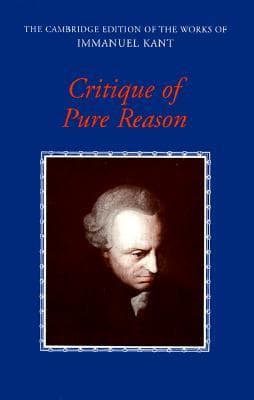
Critique of Pure Reason cover
Archivist's Choice

Critique of Pure Reason

Immanuel Kant (2015)

Genre

Reference / Science / Philosophy

Reading Time

1500 min

Key Themes

See below

Track Your Reading

Sign in to track this book

Kant's 'Critique of Pure Reason' changed philosophy by examining how human reason works, showing how our minds create experience and setting limits on what we can know.

Core Idea

Immanuel Kant's "Critique of Pure Reason" started a 'Copernican Revolution' in philosophy. It says our knowledge of the world comes from more than just experience; the human mind's structures shape it. Kant proposed 'synthetic a priori' judgments—knowledge that is true by necessity and expands our understanding. He showed these are possible because the mind uses categories (like cause and effect) and forms of intuition (space and time) to organize sensory data. This framework means we only know the 'phenomenal' world (the world as it appears to us), not the 'noumenal' world (things as they are). This sets limits on what pure reason can achieve in metaphysics.
Reading time
1500 min
Difficulty
Hard
✓ Read this if...
You are a serious student of philosophy interested in epistemology, metaphysics, and the foundations of modern thought, and are prepared for a rigorous intellectual challenge.
✗ Skip this if...
You prefer light reading, are looking for practical self-help, or have little patience for dense, abstract philosophical argumentation.

Core idea

The central argument and framework that powers the entire book.

Immanuel Kant's "Critique of Pure Reason" started a 'Copernican Revolution' in philosophy. It says our knowledge of the world comes from more than just experience; the human mind's structures shape it. Kant proposed 'synthetic a priori' judgments—knowledge that is true by necessity and expands our understanding. He showed these are possible because the mind uses categories (like cause and effect) and forms of intuition (space and time) to organize sensory data. This framework means we only know the 'phenomenal' world (the world as it appears to us), not the 'noumenal' world (things as they are). This sets limits on what pure reason can achieve in metaphysics.

At a glance

Reading time

1500 min

Difficulty

Hard

Read this if...

You are a serious student of philosophy interested in epistemology, metaphysics, and the foundations of modern thought, and are prepared for a rigorous intellectual challenge.

Skip this if...

You prefer light reading, are looking for practical self-help, or have little patience for dense, abstract philosophical argumentation.

Key Takeaways

1

The Copernican Revolution in Philosophy

Knowledge revolves around the subject, not the object.

Quote

Hitherto it has been assumed that all our knowledge must conform to objects... We must therefore make trial whether we may not have more success in the tasks of metaphysics, if we suppose that objects must conform to our knowledge.

Kant's main idea is his 'Copernican Revolution' in philosophy. Before Kant, people thought our minds just took in information from an independent reality, and our knowledge simply reflected that reality. Kant reversed this. He argued that the structure of our minds actively organizes sensory data. We do not just see the world as it is 'in itself' (the noumenal world); instead, we see a world filtered and structured by our innate categories of understanding and forms of intuition (space and time). This means knowledge is not a direct g...

Supporting evidence

This is the central thesis introduced in the 'Preface to the Second Edition,' where Kant explicitly likens his philosophical shift to Copernicus's astronomical revolution, moving the center of the universe from the Earth to the Sun.

Apply this

Recognize that your perception of reality is fundamentally mediated by your cognitive structures. When encountering differing viewpoints, consider how different individuals might be applying varying mental frameworks, rather than assuming one has direct access to an unmediated truth. This encourages intellectual humility and empathy.
copernican-revolutiontranscendental-idealismnoumenal-worldphenomenal-world
2

The Synthetic A Priori: The Holy Grail of Knowledge

Discovering knowledge that is both universal and expands our understanding.

Quote

How are synthetic judgments a priori possible?

Kant aimed to connect rationalism (knowledge from pure reason, a priori) and empiricism (knowledge from experience, a posteriori). He distinguished between analytic and synthetic judgments, and a priori and a posteriori knowledge. Analytic judgments are true by definition ('All bachelors are unmarried men'), while synthetic judgments add new information ('All bodies are heavy'). A priori knowledge does not depend on experience ('2+2=4'), while a posteriori knowledge comes from experience ('The sky is blue'). Kant said the challenge fo...

Supporting evidence

Kant provides examples like '7 + 5 = 12' and 'a straight line between two points is the shortest' as synthetic a priori judgments, arguing they are not merely tautological but synthesize concepts in a way that experience alone cannot fully ground as universally necessary.

Apply this

When evaluating claims, categorize them: Is it analytic (true by definition)? Synthetic a posteriori (empirical observation)? Or potentially synthetic a priori (a fundamental principle structuring experience)? This framework helps discern the source and certainty of knowledge. For instance, scientific laws, while empirical, often rest on underlying synthetic a priori principles that make their universality possible.

analytic-synthetic-distinctiona-priori-a-posteriorijudgment
3

Space and Time as Forms of Intuition

These are not external realities, but innate structures of our perception.

Quote

Space is not an empirical concept that has been derived from outer experiences... Time is not an empirical concept that has been derived from any experience whatever.

Against common sense and earlier philosophy, Kant argued that space and time are not objective features of the world existing independently of us. They are not empirical concepts from experience either. Instead, they are 'pure forms of intuition'—subjective, innate structures of our perception. Our minds are set up to perceive everything spatially and temporally. We cannot imagine an object outside of space or an event outside of time. These are necessary conditions for any experience. They are the 'lenses' through which we see the wo...

Supporting evidence

Kant's 'Transcendental Aesthetic' is dedicated to arguing for space and time as pure forms of intuition, showing how their a priori nature explains the certainty of mathematical knowledge (e.g., Euclidean geometry and arithmetic).

Apply this

When considering the 'objective' nature of reality, remember that your fundamental perception of location and duration is a product of your mind's structure. This can lead to a deeper appreciation for how different beings (or even advanced AI) might experience reality in fundamentally different ways, challenging anthropocentric assumptions about the universe's inherent structure.

transcendental-aestheticpure-forms-of-intuitionsensibilityphenomenal-world
4

The Categories of Understanding: Shaping Experience

Our minds actively organize raw sensory data into intelligible concepts.

Quote

Thoughts without content are empty, intuitions without concepts are blind.

Beyond the forms of intuition (space and time), our understanding uses 'categories' to organize sensory data into coherent experience. These categories are basic, innate concepts like cause, substance, unity, plurality, necessity, and possibility. They do not come from experience; they are the conditions for experience to make sense. For example, we do not 'learn' cause from repeated observations; instead, our minds apply the category of cause to interpret event sequences as cause-and-effect. Without these categories, our sensory inpu...

Supporting evidence

Kant dedicates the 'Transcendental Analytic' to systematically deriving and explaining the twelve categories of understanding, such as causality, substance, and reciprocity, which he argues are necessary for any coherent experience.

Apply this

When analyzing information or making decisions, recognize that your mind is inherently seeking patterns, cause-and-effect relationships, and stable substances. This awareness can help you critically examine whether an observed pattern is genuinely 'out there' or if your mind is imposing a category where it might not perfectly fit, leading to more nuanced and less biased interpretations.

transcendental-analyticcategories-of-understandingcausalitysubstanceunityjudgment
5

The Limits of Pure Reason: No Metaphysical Knowledge of the Noumenal

Reason cannot transcend experience to know God, soul, or the universe 'as it is'.

Quote

The proud names of ontology, psychology, cosmology, and theology, which once lorded it in metaphysics, must now yield to the more modest titles of a mere critique of pure reason.

Kant's critique is a critique of reason's overreach. While reason structures our experience of the phenomenal world, it cannot extend beyond possible experience to gain knowledge of the 'noumenal' world—the world of things as they are, God, the immortal soul, or the cosmos. When reason tries this, it falls into 'transcendental illusions' or 'antinomies' (contradictory but equally valid arguments). For example, reason can argue both for and against the universe being finite. This does not mean these concepts do not exist, but that they...

Supporting evidence

Kant's 'Transcendental Dialectic' systematically exposes the 'antinomies' of pure reason (e.g., freedom vs. determinism, finite vs. infinite universe) and the 'paralogisms' concerning the soul, demonstrating how reason generates irresolvable contradictions when attempting to apply categories beyond experience.

Apply this

Cultivate intellectual humility regarding ultimate questions. Recognize that while concepts like God, freedom, or ultimate purpose are profoundly important, they likely fall outside the realm of what can be definitively proven or disproven by theoretical reason. This frees you to explore these questions through practical reason (ethics) or faith, rather than endless, fruitless theoretical debate.

transcendental-dialecticnoumenal-worldantinomiestranscendental-illusionlimits-of-reason
6

The Unity of Apperception: The 'I Think'

A unified self is necessary for any coherent experience.

Quote

It must be possible for the 'I think' to accompany all my representations; for otherwise something would be represented in me that could not be thought at all, which is equivalent to saying that the representation would either be impossible, or else at least be nothing to me.

The 'Transcendental Unity of Apperception,' or the 'I think,' is central to Kant's system. This refers to the necessary condition that all our experiences and thoughts must be attributable to a single, unified subject—'me.' Without this unifying principle, our experiences would be fragmented and disconnected, and we could not even form the concept of an 'object' (as a stable entity with multiple properties). The 'I think' is not an empirical self or a substantial soul (which Kant says we cannot know noumenally), but a formal condition...

Supporting evidence

The 'Transcendental Deduction of the Categories' in the *Critique* argues that the unity of apperception is the supreme principle from which all categories of understanding are derived and validated, demonstrating its indispensable role in making experience possible.

Apply this

Reflect on how your sense of self provides the continuous thread through all your experiences, thoughts, and feelings. When observing cognitive fragmentation (e.g., due to stress or distraction), recognize the challenge it poses to coherent understanding and decision-making, highlighting the importance of mental integration for effective functioning.

transcendental-apperceptionunity-of-consciousnesstranscendental-deductionself-consciousness
7

Knowledge is Phenomenal, Not Noumenal

We know the world as it appears to us, not as it is in itself.

Quote

What things may be in themselves, we do not know, but only their appearances.

A main part of Kant's transcendental idealism is the difference between phenomena and noumena. The 'phenomenal world' is the world of experience, the world as it appears to us, structured by our forms of intuition and categories of understanding. This is the only world we can know and about which we can make objective scientific claims. The 'noumenal world,' or the 'thing-in-itself,' is reality independent of our minds—how things are intrinsically, without human perception or conceptualization. Kant says we can think about the noumena...

Supporting evidence

The entire 'Transcendental Aesthetic' and 'Transcendental Analytic' build towards this conclusion, demonstrating that all our knowledge is conditioned by the mind's structure, thereby establishing the phenomenal nature of human experience.

Apply this

When discussing 'truth' or 'reality,' be mindful of whether you're referring to the world as experienced and understood by humans (phenomenal) or attempting to speak about an ultimate, unmediated reality (noumenal). This distinction helps avoid unproductive debates and grounds discussions in what is genuinely knowable and verifiable within human experience.

phenomenal-worldnoumenal-worldthing-in-itselftranscendental-idealism
8

The Primacy of Practical Reason

Though theoretical reason is limited, moral freedom and duty are knowable through practical reason.

Quote

I have therefore found it necessary to deny knowledge, in order to make room for faith.

While Critique of Pure Reason limits theoretical knowledge, it prepares for the importance of 'practical reason'—our moral ability. Kant argues that even though we cannot know freedom, God, or immortality theoretically (as noumenal concepts), we must assume them as necessary for morality to matter. If we are not free, moral responsibility is impossible. If there is no ultimate justice (God/immortality), the highest good may not be achievable. So, pure reason, in its practical (moral) use, leads to these concepts, not as objects ...

Supporting evidence

Though primarily developed in the *Critique of Practical Reason*, this idea is foreshadowed in the 'Transcendental Dialectic' where Kant acknowledges that the antinomies of pure reason, while unsolvable theoretically, open a space for practical freedom.

Apply this

Recognize that some of the most profound truths about human existence – like moral duty, freedom, and purpose – might not be discoverable through empirical science or pure logic alone, but rather through the demands of your moral consciousness. This encourages engaging with ethical questions not as secondary to knowledge, but as foundational to human experience.

practical-reasonmoral-lawfreedompostulates-of-practical-reasoncategorical-imperative
9

The Architectonic of Pure Reason

Philosophy should be a systematic, interconnected whole, not a mere aggregate.

Quote

By an architectonic I understand the art of systems. As systematic unity is what first raises ordinary knowledge to the rank of science, that is, makes a system out of a mere aggregate of knowledge, architectonic is the doctrine of what is scientific in our knowledge, and therefore necessarily belongs to the doctrine of method.

Kant was building a comprehensive system, not just presenting ideas. He believed philosophy, like a well-designed building, must have an 'architectonic' structure—a rational, interconnected framework where each part has a purpose and helps the whole. The Critique itself is well-organized, with its 'Aesthetic,' 'Analytic,' and 'Dialectic' forming a logical progression. This focus on systematic unity challenged the fragmented approaches of many earlier philosophers and aimed to make metaphysics a rigorous science. His architectonic vi...

Supporting evidence

The very structure of the *Critique*, divided into the 'Transcendental Aesthetic,' 'Transcendental Analytic,' and 'Transcendental Dialectic,' with their further subdivisions, exemplifies Kant's commitment to an architectonic, systematic presentation of pure reason.

Apply this

When tackling complex problems or building knowledge, strive for systematic understanding rather than just accumulating isolated facts. Seek out the underlying principles, connections, and overall structure that integrate individual components into a coherent whole. This approach fosters deeper comprehension and more robust frameworks for thought.

architectonicsystematic-unitytranscendental-methodscience-of-metaphysics
10

The Subject as the Condition of Objectivity

The mind's structure is what makes objective knowledge possible, not an obstacle to it.

Quote

The conditions of the possibility of experience in general are likewise conditions of the possibility of the objects of experience.

A radical idea in Kant's philosophy is that the subjective structures of our minds (space, time, and the categories) do not prevent objective knowledge. Instead, they are necessary for it. Because all rational beings share these universal cognitive structures, we can have a common, objective experience of the world. The world as we know it is objective because these subjective forms universally structure it. Without the mind's active role, there would be no 'objects' as we understand them, only raw, unintelligible sensations. Theref...

Supporting evidence

The entire 'Transcendental Deduction of the Categories' aims to prove that the categories, though subjective in origin, are objectively valid for all objects of possible experience because they are necessary for experience itself.

Apply this

When discussing 'objective reality' or 'truth,' consider that our shared human experience of objectivity is grounded in universal cognitive structures. This insight can help bridge divides, as it suggests a common ground for understanding, even as it acknowledges the mind's active role in shaping that understanding. It also encourages critical thinking about what 'objectivity' truly means, moving beyond naive realism.

objectivitysubjectivitytranscendental-deductionconditions-of-possibilityphenomenal-world

Critical analysis

Notable Quotes

Thoughts without content are empty, intuitions without concepts are blind.

Introduction to Transcendental Logic, discussing the necessity of combining sensory experience with conceptual understanding.

I had to deny knowledge in order to make room for faith.

Preface to the second edition, explaining the limits of pure reason to allow for moral and religious belief.

All our knowledge begins with the senses, proceeds then to the understanding, and ends with reason.

Introduction, outlining the structure of human cognition from perception to rational thought.

The light dove, cleaving the air in her free flight, and feeling its resistance, might imagine that its flight would be still easier in empty space.

Preface, using a metaphor to criticize rationalist philosophers who ignore the necessary constraints of experience.

Concepts without percepts are empty; percepts without concepts are blind.

Transcendental Analytic, rephrasing the earlier quote to emphasize the interdependence of understanding and sensibility.

Hitherto it has been assumed that all our knowledge must conform to objects. But all attempts to extend our knowledge of objects by establishing something in regard to them a priori, by means of concepts, have, on this assumption, ended in failure. We must therefore make trial whether we may not have more success in the tasks of metaphysics, if we suppose that objects must conform to our knowledge.

Preface to the second edition, introducing the "Copernican Revolution" in philosophy.

The understanding can intuit nothing, the senses can think nothing. Only through their union can knowledge arise.

Transcendental Aesthetic, explaining the synthesis required for cognition.

Out of the crooked timber of humanity, no straight thing was ever made.

Often misattributed to this work but actually from "Idea for a Universal History with a Cosmopolitan Purpose"; included here as a notable underappreciated reference to human nature in Kant's broader philosophy.

Reason must approach nature with the view, indeed, of receiving information from it, not, however, in the character of a pupil, who listens to all that his master chooses to tell him, but in that of a judge, who compels the witnesses to answer questions which he has himself formulated.

Preface to the second edition, describing the active role of reason in scientific inquiry.

It is, therefore, correct to say that the senses do not err—not because they always judge rightly, but because they do not judge at all.

Transcendental Logic, distinguishing between sensory perception and judgment by the understanding.

The transcendental unity of apperception is that unity through which all the manifold given in an intuition is united in a concept of the object.

Transcendental Deduction, discussing the self-consciousness necessary for objective experience.

Metaphysics is a dark ocean without shores or lighthouse, strewn with many a philosophic wreck.

Preface, using a metaphor to describe the historical challenges and failures of metaphysical inquiry.

Act only according to that maxim whereby you can at the same time will that it should become a universal law.

Often associated with Kant's moral philosophy in "Groundwork of the Metaphysics of Morals"; included here as an underappreciated connection to his critical project on reason's limits.

The starry heavens above me and the moral law within me.

Conclusion of "Critique of Practical Reason", but referenced in discussions of awe and reason's scope; included as a famous quote reflecting Kant's dual interests.

Quiz

Test Your Knowledge

Ready to see how well you understood this book? Take our interactive quiz with 10 questions.

10
Questions
~5
Minutes
?
Best Score

Key Questions (FAQ)

The Critique of Pure Reason is Immanuel Kant's foundational work that investigates the nature and limits of human reason. It examines how we acquire knowledge, arguing that certain concepts precede experience and make it possible, while cautioning against using pure reason to draw conclusions about the natural world.

About the author