BookBrief
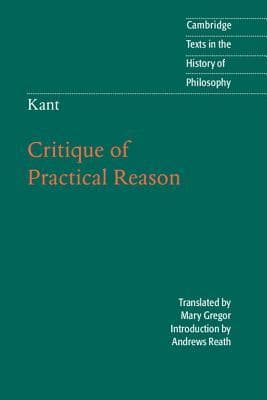
Critique of Practical Reason cover
Archivist's Choice

Critique of Practical Reason

Immanuel Kant (2012)

Genre

Politics / Psychology / Reference / Philosophy

Reading Time

12 hours

Key Themes

See below

Track Your Reading

Sign in to track this book

Kant's 'Critique of Practical Reason' explains how human will, guided by pure reason and not desires, can create universal moral law and define freedom.

Core Idea

Kant's "Critique of Practical Reason" sets up a universal moral philosophy. It argues that morality comes from pure practical reason, not from experience, desires, or the search for happiness. The main idea is the Categorical Imperative: an absolute rule to act only in ways you would want to become a universal law. This idea says human freedom is autonomy, meaning we can make our own laws through reason. The book claims true moral worth comes from acting out of duty, respecting moral law, rather than from outcomes or personal wishes. It also says practical reason must guide our understanding of freedom, immortality, and God, which are needed for a consistent moral world.
Reading time
12 hours
Difficulty
Hard
✓ Read this if...
You are deeply interested in the foundations of modern ethics, moral philosophy, and the Enlightenment's view of human autonomy and reason, and are prepared for rigorous, abstract argumentation.
✗ Skip this if...
You prefer practical, prescriptive ethical advice, shy away from dense philosophical prose, or are looking for an empirically-based or consequentialist approach to morality.

Core idea

The central argument and framework that powers the entire book.

Kant's "Critique of Practical Reason" sets up a universal moral philosophy. It argues that morality comes from pure practical reason, not from experience, desires, or the search for happiness. The main idea is the Categorical Imperative: an absolute rule to act only in ways you would want to become a universal law. This idea says human freedom is autonomy, meaning we can make our own laws through reason. The book claims true moral worth comes from acting out of duty, respecting moral law, rather than from outcomes or personal wishes. It also says practical reason must guide our understanding of freedom, immortality, and God, which are needed for a consistent moral world.

At a glance

Reading time

12 hours

Difficulty

Hard

Read this if...

You are deeply interested in the foundations of modern ethics, moral philosophy, and the Enlightenment's view of human autonomy and reason, and are prepared for rigorous, abstract argumentation.

Skip this if...

You prefer practical, prescriptive ethical advice, shy away from dense philosophical prose, or are looking for an empirically-based or consequentialist approach to morality.

Key Takeaways

1

The Categorical Imperative: The Moral Compass

Act only according to maxims that you could universalize without contradiction.

Quote

Act only according to that maxim whereby you can at the same time will that it should become a universal law.

Kant's most famous ethical idea, the Categorical Imperative, says that moral actions are those you could want to become universal laws without logical problems. It tests for consistency and fairness. It asks if your personal reasons for acting could apply to everyone, everywhere, all the time, without ruining the action's purpose or creating an impossible situation. This is not about results or personal wishes; it is about how rational and universal the action itself is. If a rule fails this test, it is not morally allowed. This frame...

Supporting evidence

Kant provides several formulations, including the 'Formula of Universal Law' and the 'Formula of Humanity,' illustrating with examples like making a false promise, where universalizing lying would make promises meaningless.

Apply this

Before making a decision, ask: 'What if everyone did this all the time?' If the outcome is self-defeating or undesirable for a rational agent, then the action is likely immoral. For instance, when considering whether to cheat on a test, ask if you'd want a world where everyone cheated on tests; the concept of a 'test' would become meaningless.

categorical-imperativeuniversal-lawmaxim
2

Freedom as Autonomy: Self-Legislation

True freedom lies in acting according to laws you give yourself, not external forces.

Quote

A free will and a will under moral laws are one and the same.

For Kant, freedom is not just having no outside limits. It is a deep self-governance—autonomy. We are truly free when our will is guided by reason, acting according to moral law (which we find through reason), instead of being swayed by desires, urges, or outside pressures (heteronomy). This means that when we choose to act morally, we are not just following a rule. We are actively using our rational ability to decide our own rules for action. This view raises humans to moral agents who can govern themselves, separating us from animal...

Supporting evidence

Kant distinguishes between 'heteronomy of the will' (being determined by external objects or inclinations) and 'autonomy of the will' (being a law unto oneself, determined by pure practical reason).

Apply this

Reflect on your motivations. Are you acting out of a sense of duty and a reasoned principle, or are you merely reacting to desires, peer pressure, or potential rewards/punishments? Strive to align your actions with principles you genuinely believe everyone should follow, rather than just what feels good or is convenient.

autonomyheteronomywillfreedom
3

Duty for Duty's Sake: Moral Worth

The moral worth of an action lies in the intention to act from duty, not from inclination or consequence.

Quote

An action done from duty has its moral worth, not in the purpose to be attained by it, but in the maxim according to which it is decided upon.

Kant argues that an action has true moral worth only if it is done 'from duty.' This means the main reason is respect for the moral law itself, not for personal gain, pleasure, or even sympathy. If you help someone because it makes you feel good, or because you expect a reward, the action, while perhaps good, lacks real moral worth in Kant's strict view. The moral person must choose the action because it is the right thing to do, no matter their personal feelings or expected results. This is a strong claim, suggesting that pure intent...

Supporting evidence

Kant uses the example of a shopkeeper who charges fair prices not out of honesty, but to maintain a good reputation. While the action is 'in conformity with duty,' it is not done 'from duty' and thus lacks true moral worth.

Apply this

When considering an ethical choice, try to strip away all personal desires or potential benefits. Ask yourself: 'Am I doing this because it's the right thing to do, purely because the moral law demands it, or am I doing it for some other reason?' Strive to act from an unadulterated sense of duty.

dutyinclinationmoral-worthgood-will
4

The Primacy of Practical Reason: Morality Over Happiness

Moral obligation is a higher pursuit than the mere attainment of happiness.

Quote

The true destination of reason must be to produce a will that is good in itself, and not merely good as a means to some further end.

Kant changes the purpose of practical reason. While earlier philosophies often saw reason as a tool to achieve happiness or other practical goals, Kant says its highest job is to find and create moral law. Our rational ability is not mainly for figuring out the best way to pleasure; it is for understanding and doing our duties. This means morality is not less important than happiness. In fact, moral conduct might sometimes require giving up happiness. The search for a 'good will'—a will guided by duty—is the ultimate human effort. Whi...

Supporting evidence

Kant argues that if nature's purpose was merely happiness, instinct would suffice; reason's existence points to a higher purpose: the production of a good will.

Apply this

When faced with a choice between personal comfort/happiness and a clear moral obligation, prioritize the moral obligation. Understand that your rational capacity's highest calling is to discern and act upon what is right, even if it means personal sacrifice.

practical-reasonhappinessgood-willmoral-law
5

The Kingdom of Ends: Respect for Persons

Treat humanity, whether in yourself or others, always as an end and never merely as a means.

Quote

So act that you use humanity, whether in your own person or in the person of any other, always at the same time as an end, never merely as a means.

This way of stating the Categorical Imperative is very powerful. It establishes the basic dignity and value of every rational being. It means we must never use others as mere tools to reach our own goals, nor should we treat ourselves that way. Every person, because they can be rational and autonomous, has intrinsic worth (dignity) and must be respected as valuable in themselves. This idea forms the basis for modern human rights. It stresses universal respect, asking us to see the goals and rationality of others as valuable and worth ...

Supporting evidence

Kant illustrates this with examples of lying or making false promises, which treat the other person as a mere means to one's own ends, rather than respecting their rational capacity to assent to the action.

Apply this

Before interacting with someone, especially in a professional or transactional context, ask yourself: 'Am I treating this person as a valuable individual with their own goals and rationality, or am I just seeing them as a tool to get what I want?' Strive for genuine collaboration and mutual respect, and avoid deception or manipulation.

kingdom-of-endsdignitymeans-and-endsrespect
6

Postulates of Practical Reason: Faith in a Moral Universe

Moral duty necessitates belief in freedom, immortality, and God.

Quote

Morality, in so far as it rests upon the concept of man as a free agent who, just because he is free, binds himself through his reason to unconditioned laws, needs neither the idea of another being above him, in order to recognize his duty, nor an incentive other than the law itself, in order to fulfil his duty.

While Kant famously separated morality from evidence, he saw that moral law itself leads us to certain 'postulates' — necessary assumptions we must make to understand our moral experience. These are freedom of the will (without which moral duty is meaningless), the immortality of the soul (to allow for endless progress toward perfect moral goodness, the 'summum bonum'), and the existence of God (as the one who ensures a fair world where goodness is ultimately rewarded with happiness, connecting moral and natural orders). These are not...

Supporting evidence

Kant argues that if there is a moral law, we must be free to obey it. If perfect virtue is commanded, but unattainable in a finite life, then immortality is a rational postulate. If virtue doesn't align with happiness in this life, God is postulated to ensure it eventually does.

Apply this

Recognize that your commitment to moral action implicitly assumes a universe where such action is meaningful. This can provide a framework for understanding profound questions of existence, even without empirical proof, by grounding them in your deepest moral convictions.

postulatessummum-bonumfreedom-of-willimmortalitygod
7

Critique of Empirical Ethics: The Flaws of Feeling

Moral principles cannot be derived from experience, feelings, or consequences.

Quote

All moral concepts have their seat and origin completely a priori in reason, and this just as much in the most common reason as in that which is speculative in the highest degree.

Kant strongly rejects any attempt to base morality on observations, feelings, or expected results. He argues that if moral laws came from experience (like what makes people happy, or what society approves), they would be uncertain, personal, and lack the universal necessity that true moral commands have. Feelings like sympathy, though often leading to good actions, are too unreliable to be the basis for duty. Morality, for Kant, must be purely 'a priori'—found through pure reason, separate from experience. This ensures its universal r...

Supporting evidence

Kant points out that what makes one person happy might not make another happy, and feelings can change, making them unsuitable for universal moral laws.

Apply this

When evaluating a moral problem, resist the urge to rely solely on your gut feelings, personal preferences, or predicted outcomes. Instead, try to abstract the situation and apply the test of the Categorical Imperative, focusing on the rational principle behind the action.

a-prioriempirical-ethicsfeelingsconsequences
8

Respect for the Law: The Feeling of Reverence

The only morally permissible feeling is a rational reverence for the moral law itself.

Quote

The feeling of respect for the moral law is, therefore, the only moral feeling which can be known entirely a priori.

While Kant generally keeps feelings from being the source of morality, he notes one unique feeling that comes from the moral law: reverence (Achtung). This is not a feeling like joy or sadness, but a rational feeling of awe and humility we have when we think about the greatness and absolute authority of moral law. It is a recognition of our own rational ability to be bound by such a law, and also a recognition of the limits of our sensory nature. This feeling acts as a personal reason, not to do our duty, but to respect the du...

Supporting evidence

Kant explains that respect for the law is not an external feeling but one produced by reason itself, a consciousness of the subordination of one's will to the law.

Apply this

Cultivate a profound respect for moral principles. When you understand what is right through reason, strive to feel a deep, internal reverence for that principle, allowing it to inspire and reinforce your commitment to acting morally, rather than viewing duty as a burden.

reverenceachtmoral-feelingrespect-for-law
9

The Highest Good (Summum Bonum): Virtue and Happiness

The ultimate aim of practical reason is a world where perfect virtue is matched with proportionate happiness.

Quote

Virtue and happiness together constitute the possession of the highest good in a person, and happiness distributed in exact proportion to morality (as the worth of a person and his worthiness to be happy) constitutes the highest good of a possible world.

While individual moral actions must come purely from duty, Kant says the 'summum bonum' (highest good) is the ultimate, main goal for rational beings. This highest good is not just happiness, nor just virtue. It is the perfect blend of virtue and happiness, where happiness is given out exactly according to moral worth. Since this perfect match rarely happens in the world, and perfect virtue is an endless task, pursuing the summum bonum requires the postulates of immortality (for endless moral progress) and God (to guarantee the ultima...

Supporting evidence

Kant argues that reason naturally seeks to unite these two elements. The moral law commands us to strive for the highest good, implying its possibility and thus the postulates.

Apply this

Live a virtuous life, acting from duty, and trust that in the grand scheme of a morally ordered universe, this virtue will ultimately be reconciled with happiness. This provides a philosophical grounding for hope and sustained moral effort, even when immediate rewards are absent.

summum-bonumvirtuehappinesshighest-good
10

Moral Law as a Fact of Reason: Inescapable Imperative

The moral law is not proven, but given as an undeniable fact of our rational consciousness.

Quote

The moral law is given, as it were, as a fact of pure reason of which we are a priori conscious.

Kant does not 'prove' moral law like a math problem or a scientific claim. Instead, he presents it as a 'fact of reason'—an undeniable, clear truth we find through our own rational awareness. We immediately know our duty to act morally, even if we sometimes fail. This immediate awareness, this 'categorical imperative' within us, is the starting point of his ethical system. It is not based on anything else; it simply is. This approach avoids endless philosophical questions and grounds morality in an inherent feature of human rational...

Supporting evidence

Kant argues that if we deny the moral law, we deny our own rationality and the very possibility of moral deliberation. The 'ought' implies the 'can'.

Apply this

Trust your inherent sense of right and wrong, particularly when it aligns with universalizable principles. Recognize that the demand for moral action isn't an external imposition but an intrinsic aspect of your rational nature. This can strengthen your resolve to act ethically, even when it's difficult.

fact-of-reasona-priori-consciousnessmoral-imperativerationality

Critical analysis

Notable Quotes

Two things fill the mind with ever new and increasing admiration and awe, the more often and more steadily we reflect upon them: the starry heavens above me and the moral law within me.

Conclusion of the work, reflecting on the grandeur of the cosmos and the inherent moral compass.

Duty! Thou sublime and mighty name that embraces nothing charming or insinuating, but rather demands submission, and yet does not seek to move the will by threatening anything that would arouse aversion or terror, but merely holds forth a law which of itself finds access to the mind, and gains reluctant reverence (though not always obedience), a law before which all inclinations are dumb, even though they secretly work against it: what origin is worthy of thee, and where is to be found the chief root of thy noble descent which proudly rejects all kinship with the inclinations, and from which to be descended is the indispensable condition of the worth of human beings?

Exploring the nature and authority of duty, contrasting it with inclinations.

Act in such a way that you treat humanity, whether in your own person or in the person of any other, never merely as a means to an end, but always at the same time as an end.

Formulation of the Categorical Imperative, emphasizing respect for persons.

The moral law is therefore the sole determining ground of a pure will.

Stating the fundamental principle that guides a morally good will.

A good will is not good because of what it effects or accomplishes, because of its fitness for attaining some proposed end; it is good only because of its willing, i.e., it is good in itself.

Defining the intrinsic goodness of the will, independent of consequences.

Happiness is the condition of a rational being in the world, to whom in the whole of his existence everything goes according to his wish and will.

Defining happiness and its relation to the moral law, often seen as a consequence rather than a direct aim of duty.

Freedom and unconditional practical law reciprocally imply each other.

Highlighting the essential connection between moral freedom and the moral law.

Morality is not properly the doctrine of how we should make ourselves happy, but how we should become worthy of happiness.

Distinguishing between seeking happiness and striving for moral worth.

Reason, in its practical use, has to do with determining the will.

Explaining the role of reason in guiding moral action and decision-making.

The concept of good and evil must not be determined before the moral law, but only after it and by means of it.

Emphasizing that the moral law defines what is good and evil, rather than the other way around.

All interest is either an interest of inclination or an interest of reason.

Categorizing the different motivations that can drive human actions.

The greatest good is the union of virtue and happiness, in which happiness is proportional to morality.

Describing the 'highest good' as a state where virtue is rewarded with happiness.

The consciousness of this fundamental law is a fact of reason.

Referring to the immediate awareness of the moral law within us.

Quiz

Test Your Knowledge

Ready to see how well you understood this book? Take our interactive quiz with 10 questions.

10
Questions
~5
Minutes
?
Best Score

Key Questions (FAQ)

Kant's 'Critique of Practical Reason' elaborates on his moral theory, arguing that morality is derived from reason rather than empirical experience. It posits the existence of a categorical imperative, a universal moral law that applies to all rational beings regardless of their desires or inclinations.

About the author