BookBrief
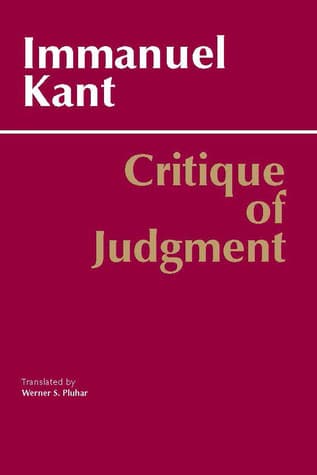
Critique of Judgment cover
Archivist's Choice

Critique of Judgment

Immanuel Kant (2012)

Genre

Politics / Creativity / Philosophy

Reading Time

1500+ min (This is a very long and complex philosophical text, requiring multiple re-reads and deep contemplation.)

Key Themes

See below

Track Your Reading

Sign in to track this book

Kant's 'Critique of Judgment' explores how our minds see beauty and purpose in nature, showing the human need to find order and meaning, even if a divine designer cannot be rationally proven.

Core Idea

Kant's *Critique of Judgment* connects his theoretical philosophy (how we know) and his practical philosophy (how we act) by looking at how we judge beauty and purpose in nature. He says that our experience of beauty is a unique 'purposiveness without a purpose,' where we see an object as if it were designed, but without needing to say there is a designer or a specific end. This subjective experience, surprisingly, asks for universal agreement; we expect others to agree with our judgment of beauty, even though it is not based on objective ideas. This universal subjectivity, based on the free play of our imagination and understanding, suggests a harmony between our thinking and the world. It also hints at a moral side, preparing us for moral rules.
Reading time
1500+ min (This is a very long and complex philosophical text, requiring multiple re-reads and deep contemplation.)
Difficulty
Hard
✓ Read this if...
You are deeply interested in the philosophical foundations of aesthetics, the nature of beauty and the sublime, the connection between art, nature, and morality, or you want to understand the culmination of Kant's critical project and how he attempts to unify his earlier critiques.
✗ Skip this if...
You are new to philosophy, unfamiliar with Kant's prior works (*Critique of Pure Reason*, *Critique of Practical Reason*), or are looking for a light introduction to aesthetic theory. This book is dense, highly technical, and requires significant prior philosophical understanding.

Core idea

The central argument and framework that powers the entire book.

Kant's Critique of Judgment connects his theoretical philosophy (how we know) and his practical philosophy (how we act) by looking at how we judge beauty and purpose in nature. He says that our experience of beauty is a unique 'purposiveness without a purpose,' where we see an object as if it were designed, but without needing to say there is a designer or a specific end. This subjective experience, surprisingly, asks for universal agreement; we expect others to agree with our judgment of beauty, even though it is not based on objective ideas. This universal subjectivity, based on the free play of our imagination and understanding, suggests a harmony between our thinking and the world. It also hints at a moral side, preparing us for moral rules.

At a glance

Reading time

1500+ min (This is a very long and complex philosophical text, requiring multiple re-reads and deep contemplation.)

Difficulty

Hard

Read this if...

You are deeply interested in the philosophical foundations of aesthetics, the nature of beauty and the sublime, the connection between art, nature, and morality, or you want to understand the culmination of Kant's critical project and how he attempts to unify his earlier critiques.

Skip this if...

You are new to philosophy, unfamiliar with Kant's prior works (*Critique of Pure Reason*, *Critique of Practical Reason*), or are looking for a light introduction to aesthetic theory. This book is dense, highly technical, and requires significant prior philosophical understanding.

Key Takeaways

1

Aesthetic Judgment as Universal Subjectivity

Beauty isn't objective, but our experience of it demands universal agreement.

Quote

The beautiful is that which, without a concept, is cognized as the object of a necessary satisfaction.

Kant says that judgments of beauty are subjective, yet they carry a demand for universal agreement. When we call something beautiful, we are not just stating a personal preference; we expect others to agree, even though no objective idea or rule dictates its beauty. This 'subjective universality' happens because the experience of beauty involves the free play of our thinking (imagination and understanding) in a harmonious, purposeless way. It is a feeling of pleasure not tied to any particular interest, idea, or use. This 'disinterest...

Supporting evidence

Kant's analysis of the 'four moments' of the judgment of taste: disinterestedness, universality without a concept, purposiveness without a purpose, and necessity without a concept. He distinguishes it from the agreeable (mere personal preference) and the good (concept-driven moral or utilitarian judgment).

Apply this

When evaluating art or design, recognize that your 'gut feeling' of beauty, while personal, often taps into a shared human capacity for harmonious perception. Engage with others' aesthetic judgments not as right or wrong, but as expressions of this universal subjective faculty, fostering dialogue rather than dogmatic pronouncements. Cultivate an appreciation for the 'free play' of form rather than utility.

judgment-of-tastedisinterestednesssubjective-universality
2

The Sublime: Overwhelmed by Nature's Grandeur

Experiencing the sublime reveals the mind's superiority over nature's vastness.

Quote

Sublimity, therefore, does not reside in any thing of nature, but only in our mind, in so far as we can become conscious that we are superior to nature within us, and thereby also to nature outside us (in so far as it influences us).

Beyond beauty, Kant introduces the sublime, an aesthetic experience caused by things that are vast, powerful, or shapeless, overwhelming our ability to understand. Unlike beauty, which offers harmonious pleasure, the sublime first brings a feeling of awe, fear, or even pain as our imagination tries to grasp its size (e.g., a stormy ocean, tall mountains). However, this initial discomfort gives way to a pleasure, not in the object itself, but in realizing our own reason's ability to go beyond sensory limits. It is a moment when our rat...

Supporting evidence

Kant's distinction between the 'mathematical sublime' (magnitude, e.g., endless desert) and the 'dynamical sublime' (power, e.g., volcano eruption). He explains how the mind, in failing to grasp these phenomena sensuously, turns inward to discover its own infinite rational capacities.

Apply this

Seek out experiences of natural grandeur (mountains, oceans, starry nights) not just for their beauty, but to confront your own limitations and recognize the immense power of your rational mind. Use these moments to reflect on human resilience, moral freedom, and the capacity for abstract thought, rather than merely the physical attributes of the scene.

sublimemathematical-sublimedynamical-sublimereason-over-nature
3

Purposiveness Without a Purpose

We perceive design in nature without inferring an actual designer.

Quote

The concept of purposiveness, although it is a concept of nature, must not be derived from the observation of purposes in nature, but must be derived from the subjective condition of our judgment.

One of Kant's challenging ideas is 'purposiveness without a purpose' (Zweckmäßigkeit ohne Zweck). When we see natural organisms, their complex structures and functions often appear as if they were designed for a specific end – a bird's wing for flight, an eye for seeing. This perception of 'teleology' or design is not an objective quality of nature, nor does it prove an intelligent designer, according to Kant. Instead, it is a basic principle of our own judgment, a way our minds organize and understand the natural world. Our understan...

Supporting evidence

Kant's extensive discussion of biological organisms, such as the intricate design of an animal's body or the self-organizing growth of a plant. He argues that while we *must* view these as purposeful for scientific understanding, this is a regulative principle of judgment, not a constitutive proof of a divine artisan.

Apply this

When studying complex systems, whether biological or social, adopt a 'teleological' perspective to understand their functions and relationships, recognizing this as a powerful cognitive tool. However, refrain from inferring an actual conscious designer or ultimate purpose. Use this framework to uncover emergent properties and intricate interdependencies without resorting to supernatural explanations.

teleologypurposivenessregulative-principledesign-in-nature
4

Judgment as a Bridge Between Reason and Nature

Aesthetic and teleological judgments link our moral freedom to the natural world.

Quote

The faculty of judgment is the mediating link between understanding and reason.

Kant's 'Critique of Judgment' is important in his philosophy, linking the areas explored in his first two critiques: the deterministic world of nature (Critique of Pure Reason) and the realm of moral freedom (Critique of Practical Reason). Judgment, especially aesthetic and teleological judgment, helps us find harmony and purpose in nature that fits with our moral goals. The experience of beauty, for example, provides an analogy for moral goodness, as both are disinterested and universally valid. Similarly, the 'as if' purposiveness o...

Supporting evidence

Kant explicitly states the goal of the Third Critique is to unify his system. He links the 'disinterested pleasure' of beauty to the 'disinterested respect' for the moral law, and the 'purposiveness of nature' to the possibility of achieving moral ends within the natural world.

Apply this

Recognize that your appreciation for beauty and order in the world is not merely superficial but a profound connection to your moral and rational being. Seek out moments of aesthetic harmony or perceived natural purpose as affirmations of a potential congruence between human freedom and the natural order, reinforcing your commitment to ethical action within the world.

unity-of-reasonbridge-critiquesmoral-analogyfreedom-and-nature
5

Genius as Nature's Gift to Art

True artistic genius creates rules, rather than following them.

Quote

Genius is the talent (gift of nature) that gives the rule to art.

Kant says that artistic genius is not just skill or imitation, but a unique, inborn talent that allows someone to create original works of art for which no rule or idea existed before. The genius does not follow established rules; they create them, offering a model that others can imitate but never fully copy. This originality is like nature acting through the artist, providing 'spirit' (Geist) that gives life to the work and inspires new ideas. Art needs taste (judgment) to refine and shape it, but genius provides the initial spark, ...

Supporting evidence

Kant contrasts genius with mere talent, imitation, and learning. He uses examples from poetry and painting, emphasizing that genius is a gift of nature, not a product of education, though it requires cultivation. The work of genius is 'exemplary' and serves as a new standard.

Apply this

When engaging in creative endeavors, strive for originality and allow for intuitive, unconceptualized inspiration, rather than merely perfecting existing techniques. Recognize that true innovation often means breaking from established norms and creating new pathways for expression, even if the initial output feels raw or defies categorization. Nurture your unique 'spirit' rather than just your craft.

artistic-geniusoriginalityspirit-in-artexemplary-art
6

Taste as the Discipline of Genius

Judgment (taste) refines genius, making its creations universally communicable.

Quote

Taste, like judgment in general, is the faculty of judging a priori, by means of a concept, whether a given object is beautiful or ugly.

Genius provides the raw, original 'spirit' of art, but taste (aesthetic judgment) is needed to refine and shape that raw material into something universally understandable and beautiful. Taste acts as a 'discipline' for genius, making sure that the artist's originality does not become mere oddity or incomprehensibility. It filters the 'spirit' through subjective universality, allowing the work to connect with others by finding a harmonious balance and form. Without taste, genius might produce something new but unpleasing; without geni...

Supporting evidence

Kant discusses how taste 'clips the wings' of genius, preventing it from producing 'monstrosities' or 'extravagances.' He explains that while genius is about invention, taste is about selection and refinement, ensuring the work can be appreciated by a universal audience.

Apply this

In your creative process, allow for moments of spontaneous, uninhibited creation (genius), but always follow with a critical, reflective stage (taste). Step back from your work and consider how it will be perceived by others, seeking to refine and clarify your expression so that its unique message can be universally appreciated, rather than remaining solely personal.

tasteartistic-judgmentdiscipline-of-artrefinement
7

The Moral Implications of Beauty

Beauty serves as a symbol of morality, fostering a disposition towards the good.

Quote

Beauty is the symbol of the morally good.

Kant states that beauty is a 'symbol of the morally good.' This does not mean that beautiful things are moral, but that the experience of beauty develops a mental state similar to our moral feeling. Both aesthetic pleasure and moral approval are disinterested, universally communicable, and involve a free, harmonious play of our faculties. When we appreciate beauty, we use a capacity for judgment that is free from personal interest or outside force, much like our moral decisions. This shared structure means that engaging with beauty ca...

Supporting evidence

Kant draws parallels between the four moments of aesthetic judgment and moral judgment: both are disinterested, demand universal assent, involve freedom, and are 'necessary' in their own way. He argues that the pleasure in beauty is a 'moral feeling' in its potential for elevation.

Apply this

Actively seek out and engage with art and natural beauty, not just for pleasure, but as a practice that cultivates your moral sensibilities. Reflect on how the harmony and purposelessness of beauty resonate with ideals of justice, fairness, and universal principles, using these aesthetic experiences to deepen your ethical understanding and commitment.

beauty-and-moralitymoral-feelingaesthetic-educationsymbolic-connection
8

The Limits of Reason in Proving God

While we perceive design, reason cannot prove a divine designer; faith remains.

Quote

The teleological judgment is merely a regulative principle for our faculty of judgment, for bringing the particular laws of nature under universal ones, and not a constitutive principle for proving the existence of an intelligent author of the world.

Despite seeing apparent design and purpose in nature, especially in organisms, Kant strictly says that our judgment cannot logically prove an intelligent creator or God. The 'teleological judgment' is a regulative principle for our understanding – it helps us organize and understand nature 'as if' it were designed, which is valuable for scientific study. However, it is not a constitutive principle that shows objective truths about nature's ultimate cause. Any attempt to use this perception of design to argue for a supernatural dimensi...

Supporting evidence

Kant's critique of the 'physico-theological argument' (argument from design). He concedes its persuasive power for common understanding but demonstrates its logical insufficiency to prove a transcendent God, showing it relies on an illicit leap from 'as if' to 'is.'

Apply this

When confronted with arguments for God's existence based on the complexity or apparent design of the natural world, appreciate the cognitive impulse behind such reasoning, but recognize its philosophical limitations. Separate scientific inquiry (which benefits from assuming purposiveness) from theological claims, understanding that the latter rests on faith rather than demonstrable reason.

limits-of-reasonteleological-argumentfaith-vs-reasonregulative-vs-constitutive
9

The Antinomy of Teleological Judgment

Nature's apparent purpose creates a tension between mechanistic and teleological explanations.

Quote

The first maxim of judgment is: all generation of material things and their forms must be judged as possible according to merely mechanical laws. The second maxim is: some products of material nature cannot be judged as possible according to merely mechanical laws.

Kant identifies an 'antinomy' (a contradiction between two seemingly valid ideas) in teleological judgment. On one hand, scientific understanding pushes us to explain all natural phenomena, including organisms, through mechanical, cause-and-effect laws. On the other hand, the complex organization of living beings seems impossible to reduce to purely mechanical explanations; they appear to work with an internal purpose, where parts exist for the sake of the whole. Kant resolves this by saying that both ideas are regulative principles f...

Supporting evidence

Kant articulates the two maxims of judgment regarding nature's causality and purposiveness. He shows how neither can fully explain organic life on its own, leading to an apparent contradiction that is resolved by viewing them as subjective guiding principles for investigation.

Apply this

When approaching complex systems (e.g., ecological systems, biological organisms, even social structures), embrace a multi-perspectival approach. Recognize the value of both reductionist, mechanistic analysis and holistic, teleological understanding. Don't force one explanation to fully subsume the other, but rather use both as complementary tools to gain a richer, albeit incomplete, comprehension.

antinomymechanistic-explanationteleological-explanationregulative-maxims
10

Aesthetic Education for Human Flourishing

Cultivating taste and appreciation for beauty refines our humanity.

Quote

Taste is, in the final analysis, the faculty of judging a priori whether a given object is beautiful or ugly, and thus of judging it in relation to the feeling of pleasure or displeasure.

While often seen as abstract, Kant's 'Critique of Judgment' implies the importance of aesthetic education in human development. Cultivating taste and appreciating beauty is not just about telling what is pretty; it is about refining our judgment itself. This refinement involves learning to make disinterested judgments, to find pleasure in form and harmony, and to communicate these experiences universally. This practice sharpens our thinking, promotes a sense of commonality with others, and even indirectly prepares us for moral judgmen...

Supporting evidence

Kant's emphasis on the 'communicability' of aesthetic judgments, the link between beauty and morality, and the role of genius and taste in shaping culture all point to the societal and individual benefits of aesthetic engagement. He sees it as a bridge to the moral realm.

Apply this

Prioritize aesthetic engagement in your life: visit art galleries, listen to diverse music, spend time in nature. Actively reflect on *why* you find certain things beautiful or sublime, articulating your judgments and discussing them with others. This practice will not only enrich your personal life but also sharpen your critical thinking and foster a deeper connection to shared human values.

aesthetic-educationhuman-flourishingcultivation-of-tastedisinterested-judgment

Critical analysis

Notable Quotes

Beauty is the symbol of morality.

In the 'Critique of Judgment', Kant connects aesthetic judgment to moral ideas, arguing that beauty serves as a bridge between nature and freedom.

The beautiful is that which pleases universally without a concept.

Kant defines beauty as an object of disinterested pleasure that is universally valid, independent of personal desires or conceptual understanding.

Genius is the innate mental aptitude through which nature gives the rule to art.

Kant discusses genius as a natural talent that produces original works of art, setting aesthetic standards rather than following rules.

The sublime is that in comparison with which everything else is small.

Kant distinguishes the sublime from the beautiful, describing it as an experience of overwhelming magnitude or power that evokes awe and respect.

Judgment in general is the faculty of thinking the particular as contained under the universal.

Kant introduces judgment as a cognitive ability that subsumes specific instances under general principles, central to both aesthetic and teleological judgments.

Art is distinguished from nature as making is from acting or operating in general.

Kant contrasts art, which involves intentional production, with natural processes, emphasizing human creativity and purpose.

The purposiveness of nature is a concept that makes it possible to judge nature as a system of ends.

In the teleological judgment section, Kant explores how we perceive nature as if it were designed with purposes, without asserting actual design.

Taste is the faculty of judging an object or a mode of representation by means of a delight or aversion apart from any interest.

Kant defines taste as the ability to make aesthetic judgments based on disinterested pleasure, free from personal or practical concerns.

The beautiful prepares us to love something, even nature, without interest.

Kant suggests that aesthetic experience cultivates a disinterested appreciation that can extend to moral attitudes toward nature and others.

In all fine art the essential element is form.

Kant emphasizes that in art, aesthetic value lies in the formal qualities of an object, rather than its content or sensory appeal.

The judgment of taste is not a cognitive judgment, hence not a logical one, but aesthetic.

Kant distinguishes aesthetic judgments from cognitive ones, arguing they are based on feeling rather than concepts or knowledge.

Nature is beautiful because it looks like art, and art can only be called beautiful if we are conscious of it as art while yet it looks like nature.

Kant explores the interplay between art and nature, suggesting that beauty arises when each mirrors the other in a harmonious way.

The sublime moves, the beautiful charms.

Kant contrasts the emotional effects of the sublime, which involves agitation and respect, with the calm pleasure of the beautiful.

Freedom and the moral law are the only concepts that give reality to the idea of the supersensible.

Kant connects aesthetic and teleological judgments to his moral philosophy, suggesting they point toward a supersensible realm of freedom.

Quiz

Test Your Knowledge

Ready to see how well you understood this book? Take our interactive quiz with 10 questions.

10
Questions
~5
Minutes
?
Best Score

Key Questions (FAQ)

The Critique of Judgment (1790) is Immanuel Kant's philosophical work that establishes a priori principles for the faculty of judgment. It explores aesthetic sensibility (beauty in nature) and teleology (apparent purpose in organisms), arguing that our minds naturally seek order and purpose in nature.

About the author