BookBrief
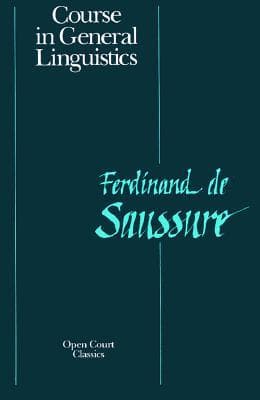
Course in General Linguistics cover
Archivist's Choice

Course in General Linguistics

Ferdinand de Saussure (1959)

Genre

Reference / Science / Philosophy

Reading Time

360 min

Key Themes

See below

Track Your Reading

Sign in to track this book

Saussure's posthumous work revealed language's hidden structure, breaking from historical linguistics and starting structuralism, which changed how we understand signs, systems, and meaning.

Core Idea

Ferdinand de Saussure's *Course in General Linguistics* views language as a structured system of signs, not just a list of names. He distinguishes *langue* (the abstract system shared by a community) from *parole* (individual speech acts), arguing that *langue* is the proper focus of linguistic study. Saussure states that linguistic signs are arbitrary, made of a signifier (sound) and a signified (concept), and get meaning from their differences within the system. This structuralist approach studies language at a specific time (synchronic) rather than its historical development (diachronic), seeing language as a social system of values based on how its elements interact.
Reading time
360 min
Difficulty
Hard
✓ Read this if...
You are a student of linguistics, philosophy, semiotics, or literary theory and want to understand the foundational text of structuralism and modern linguistics. You are interested in the theoretical underpinnings of how language functions as a system.
✗ Skip this if...
You are looking for a practical guide to language learning, a book on historical linguistics, or an easy-to-digest introduction to language. The text is dense and highly theoretical, not an empirical study.

Core idea

The central argument and framework that powers the entire book.

Ferdinand de Saussure's Course in General Linguistics views language as a structured system of signs, not just a list of names. He distinguishes langue (the abstract system shared by a community) from parole (individual speech acts), arguing that langue is the proper focus of linguistic study. Saussure states that linguistic signs are arbitrary, made of a signifier (sound) and a signified (concept), and get meaning from their differences within the system. This structuralist approach studies language at a specific time (synchronic) rather than its historical development (diachronic), seeing language as a social system of values based on how its elements interact.

At a glance

Reading time

360 min

Difficulty

Hard

Read this if...

You are a student of linguistics, philosophy, semiotics, or literary theory and want to understand the foundational text of structuralism and modern linguistics. You are interested in the theoretical underpinnings of how language functions as a system.

Skip this if...

You are looking for a practical guide to language learning, a book on historical linguistics, or an easy-to-digest introduction to language. The text is dense and highly theoretical, not an empirical study.

Key Takeaways

1

Language as a System of Signs

Understanding language requires analyzing it as a self-contained system, not just a historical collection.

Quote

Language is a system of signs that express ideas, and is therefore comparable to a system of writing, the alphabet of deaf-mutes, symbolic rites, forms of politeness, military signals, etc. It is simply the most important of these systems.

Saussure changed linguistics by arguing that language is not just names for things, but a complex system of signs. Each sign has two parts: a 'signifier' (the sound or written form) and a 'signified' (the idea it represents). The connection between them is arbitrary, meaning there is no natural link. This arbitrariness allows language to be a social agreement within a community. To understand language, one must study the internal relationships and structures of this system, not just its history or what it refers to externally. This sh...

Supporting evidence

Saussure's core definition of the linguistic sign and its arbitrary nature, contrasted with previous views that saw words as simply labels for pre-existing concepts.

Apply this

When analyzing any system of meaning (e.g., fashion, mythology, advertising), look beyond individual elements to understand the underlying structure and the arbitrary relationships between its components. Consider how meaning is generated by difference within the system.

linguistic-signarbitrarinessstructuralism
2

Langue vs. Parole

Distinguishing between the abstract language system and its individual instances of use.

Quote

Language is a system of signs that express ideas, and is therefore comparable to a system of writing, the alphabet of deaf-mutes, symbolic rites, forms of politeness, military signals, etc. It is simply the most important of these systems.

Saussure introduced the difference between 'langue' and 'parole.' 'Langue' is the abstract language system, the shared grammar, vocabulary, and rules that exist in the minds of a speech community. It is the potential for speech. 'Parole' is the individual act of speaking or writing, the actual utterance. It is how 'langue' appears in specific cases. Saussure argued that linguistics should focus on 'langue' because it is systematic and can be studied scientifically, while 'parole' is too varied. This allowed for a systematic study of l...

Supporting evidence

Saussure's analogy of 'langue' as the score of a symphony (the potential, systematic whole) and 'parole' as the individual performances (the actual, varied realizations).

Apply this

When studying any social phenomenon, differentiate between the underlying rules, conventions, or structures (the 'langue') and the individual acts or expressions (the 'parole'). For instance, analyze the rules of chess ('langue') versus a specific game being played ('parole').

langueparolesystem-vs-performance
3

Synchrony vs. Diachrony

Analyzing language at a specific point in time is distinct from studying its historical evolution.

Quote

The true and only object of linguistics is language studied in and for itself.

One of Saussure's new ideas was the difference between synchronous and diachronic linguistics. 'Synchrony' means studying a language system at one point in time, without looking at its history. It is like a snapshot of the language, analyzing its internal relationships as they are now. 'Diachrony' means studying how language changes over time, looking at how words and grammar evolve. Saussure argued that these two approaches are different and should not be mixed. He criticized earlier methods for being too diachronic, which hid the sy...

Supporting evidence

Saussure's analogy of a chess game: a synchronic study analyzes the state of the board at a given moment, while a diachronic study tracks the moves that led to that state. Both are valid but distinct inquiries.

Apply this

When analyzing any complex system (e.g., an organization, a cultural trend), first understand its current structure and relationships (synchrony) before attempting to trace its historical development (diachrony). A clear understanding of the present state is crucial for meaningful historical analysis.

synchronydiachronyhistorical-linguistics
4

The Arbitrary Nature of the Sign

There is no natural or inherent connection between a word and the concept it represents.

Quote

The bond between the signifier and the signified is arbitrary.

The arbitrary nature of the linguistic sign is central to Saussure's theory. It means that the link between a sound (signifier, e.g., the word 'tree') and the idea it brings to mind (signified, e.g., the mental image of a tree) is not based on any natural reason. This is clear because different languages use different sounds for the same idea (e.g., 'tree' in English, 'arbre' in French, 'Baum' in German). This arbitrariness shows that language is a social convention, a collective agreement. It also means meaning comes from the system ...

Supporting evidence

The existence of multiple languages, each with its own unique set of words for the same objects or concepts, is the primary evidence for the arbitrary nature of the sign.

Apply this

When analyzing symbols, cultural practices, or even brand names, recognize that their meaning is largely arbitrary and culturally constructed. Focus on how meaning is established through social convention and differentiation within a system, rather than seeking an inherent connection to reality.

arbitrarinesssignifiersignified
5

Value and Difference

Meaning is not intrinsic but arises from the differential relations within the language system.

Quote

In language there are only differences without positive terms.

Saussure argued that a linguistic sign's 'value' is not set by its individual traits or its link to something real, but by its relationships to other signs within the system. Meaning comes from 'difference.' For example, the meaning of 'sheep' in English is partly defined by how it differs from 'lamb,' 'ewe,' or 'mutton.' In French, 'mouton' includes both the animal and its meat, showing a different system of differentiation and thus a different 'value.' This means language is a system where each term's value comes only from the other...

Supporting evidence

The example of 'mouton' in French, which covers both the live animal and its meat, whereas English differentiates between 'sheep' and 'mutton,' demonstrating how different language systems carve up reality differently through their internal distinctions.

Apply this

When analyzing any system (e.g., a classification system, a social hierarchy, a set of artistic styles), look for how the 'value' or meaning of each element is defined by its contrast and relationship to other elements within that system, rather than by its isolated characteristics.

linguistic-valuedifferencerelational-meaning
6

Syntagmatic and Associative Relations

Signs combine in linear sequences and evoke mental associations.

Quote

The linearity of the signifier is something that must be taken into consideration.

Saussure identified two basic types of relationships between linguistic units: syntagmatic and associative (or paradigmatic). 'Syntagmatic relations' are linear, based on words arranged in a sequence in a sentence. For example, in 'The cat sat on the mat,' each word's position and link to its neighbors create meaning. These relations are 'in praesentia' – the elements are together in the utterance. 'Associative relations,' on the other hand, are 'in absentia.' They are mental links between words that share something, even if they do n...

Supporting evidence

The example of a grammatical sentence (syntagm) versus a list of related words like 'education, instruction, learning, apprenticeship' (associative series).

Apply this

When analyzing communication or narratives, consider both the explicit sequence of elements (syntagmatic) and the implicit network of related concepts, synonyms, or antonyms that are evoked (associative). In marketing, this means both the ad's storyline and the brand's associated mental concepts.

syntagmaticassociativeparadigmaticlinearity
7

Language as a Social Fact

Language exists as a collective institution, independent of individual will.

Quote

Language is a system of signs that express ideas, and is therefore comparable to a system of writing, the alphabet of deaf-mutes, symbolic rites, forms of politeness, military signals, etc. It is simply the most important of these systems.

Saussure said that 'langue' – the language system – is a social institution, a collective product that exists independently of any individual's will. No person can unilaterally change a language's rules; it is a shared agreement kept by the community. This social aspect makes language stable enough for communication, while also allowing for slow, collective change over time (though these changes are diachronic, not synchronic). This view places language as a social fact, influencing later theories that looked at how collective ideas s...

Supporting evidence

The impossibility of an individual inventing a new language and expecting others to understand it, or unilaterally changing the meaning of a word.

Apply this

When studying social norms, cultural traditions, or institutional practices, recognize their collective, supra-individual nature. Understand that these systems are maintained by shared agreement and resist individual attempts at radical change, much like language.

social-factcollective-consciousnesslinguistic-community
8

The Immutability and Mutability of the Sign

While resistant to individual change, language systems evolve collectively over time.

Quote

The linguistic sign is arbitrary, but it is not freely chosen. It is immutable.

Saussure argued for both the unchanging and changing nature of the linguistic sign. On one hand, the sign is 'unchanging' because an individual speaker cannot arbitrarily change the link between a signifier and a signified. The social agreement of language is too strong for individual will to alter it. This ensures stability and mutual understanding. On the other hand, language 'changes' over time. The sign's arbitrary nature means there is no inherent reason for it to stay fixed. Through collective use and gradual shifts across gener...

Supporting evidence

The example of historical linguistic change, such as the evolution of Latin into various Romance languages, demonstrating gradual but profound shifts in vocabulary and grammar over centuries, despite individual speakers having no control over the process.

Apply this

When observing cultural trends or social institutions, recognize that while they may appear fixed and resistant to individual intervention, they are also subject to slow, collective evolution over long periods. Understand that what seems immutable today may be mutable over generations.

immutabilitymutabilitylinguistic-change
9

Language as Form, Not Substance

Language organizes amorphous thought and sound into structured meaning.

Quote

Language is a form and not a substance.

Saussure famously stated that language is 'form, not substance.' This means language does not just label existing ideas or sounds; instead, it actively shapes the otherwise undefined areas of thought and sound. Before language, thought is a 'nebulous mass,' and sound is a continuous flow. Language carves out distinct ideas from this 'thought-substance' and connects them with distinct sounds from the 'sound-substance.' The relational system – the differences – creates meaning and structure, rather than any quality of the sounds or thou...

Supporting evidence

The idea that different languages 'carve up' the color spectrum differently (e.g., some languages having one word for blue/green), demonstrating how language imposes form on a continuous sensory experience.

Apply this

When analyzing how a particular field or discipline understands the world, consider how its specialized vocabulary and conceptual frameworks (its 'form') shape and limit what can be thought or expressed, rather than simply reflecting an objective 'substance.'

form-vs-substancestructuring-thoughtlinguistic-relativity
10

The Primacy of Oral Language

Written language is a secondary representation of spoken language, not its origin.

Quote

Language and writing are two distinct systems of signs; the second exists for the sole purpose of representing the first.

Saussure established that spoken language is primary over written language. He argued that writing is a 'secondary system of signs' meant only to represent spoken language. This corrected the common idea that writing is more fundamental than speech. Saussure highlighted that spoken language is a natural human ability, learned instinctively, while writing is an artificial, learned convention. He warned against the 'tyranny of the letter,' where linguists might analyze language through its written form, missing the true phonetic and str...

Supporting evidence

The fact that all human societies possess spoken language, but not all possess a writing system, and that children learn to speak naturally before they learn to write.

Apply this

When evaluating communication, always consider the original medium and context. Don't let the written representation of something (e.g., a transcript of a speech, a musical score) overshadow the nuances and complexities of its primary, often oral or performative, form.

oral-primacywriting-systemphoneticsspeech-vs-writing

Critical analysis

Notable Quotes

Language is a system of interdependent terms in which the value of each term results solely from the simultaneous presence of the others.

Defining the nature of language as a structured system.

The linguistic sign is arbitrary.

Introducing the fundamental principle of the arbitrary relationship between signifier and signified.

The bond between the signifier and the signified is arbitrary.

Elaborating on the arbitrary nature of the sign, specifically the link between sound-image and concept.

Language is a form and not a substance.

Distinguishing language as a structure of relations rather than a collection of material entities.

The linguistic sign is bilateral.

Describing the sign as having two inseparable parts: concept (signified) and sound-image (signifier).

Synchronic linguistics will be concerned with the relations that unite coexisting terms in a system, as perceived by the same collective consciousness.

Defining the scope and focus of synchronic analysis in linguistics.

Diachronic linguistics, on the contrary, will study relations between successive terms not perceived by the same collective consciousness, which are substituted for one another without forming a system among themselves.

Defining the scope and focus of diachronic analysis, contrasting it with synchronic.

The true and unique object of linguistics is language studied in and for itself.

Emphasizing the autonomy and self-contained nature of linguistic study.

In language there are only differences without positive terms.

Explaining that linguistic meaning arises from distinctions between signs, not from inherent qualities.

Language is a social institution.

Highlighting the collective and conventional nature of language.

The meaning of a word is determined by its relations to other words within the system.

Further clarifying the relational nature of meaning within a linguistic system.

The linguistic system is a series of differences of sounds combined with a series of differences of ideas.

Summarizing the dual nature of the linguistic system as a structure of differential units.

Speech is an individual act of will and intelligence.

Distinguishing 'parole' (speech) as an individual realization from 'langue' (language system).

Language is a self-contained whole and a principle of classification.

Describing language as an autonomous system that organizes thought.

Quiz

Test Your Knowledge

Ready to see how well you understood this book? Take our interactive quiz with 10 questions.

10
Questions
~5
Minutes
?
Best Score

Key Questions (FAQ)

Ferdinand de Saussure's 'Course in General Linguistics' is a foundational text in modern linguistics, compiled posthumously from his students' notes. It introduces a revolutionary approach to the study of language, moving beyond historical analysis to establish language as a self-contained system of signs.

About the author