BookBrief
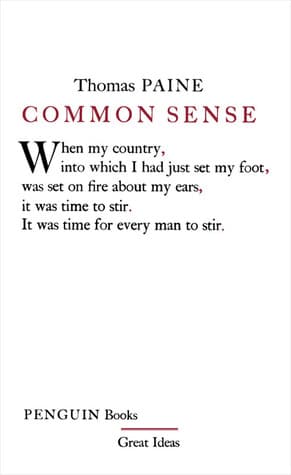
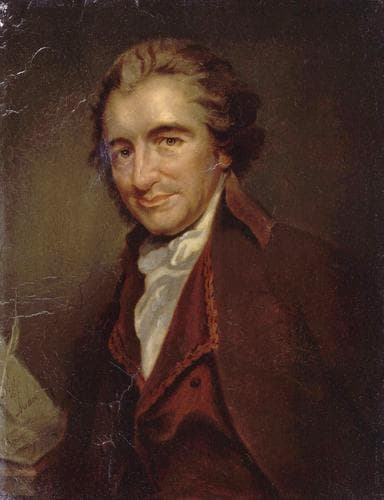
Common Sense cover
Archivist's Choice

Common Sense

Thomas Paine (1776)

Genre

Politics / History / Philosophy

Reading Time

90 min

Key Themes

See below

Track Your Reading

Sign in to track this book

In "Common Sense," Thomas Paine argues forcefully for American independence, dismantling the idea of monarchy and urging the colonies to create a new republican future.

Core Idea

Thomas Paine's "Common Sense" argues for American independence from British rule. It states that government is a necessary evil meant only to protect life, liberty, and property. Paine attacks monarchy and hereditary succession as absurd, unnatural, and tyrannical. He believes America's resources and economy make it self-sufficient, and that staying with Britain harms its prosperity and moral standing.
Reading time
90 min
Difficulty
Easy
✓ Read this if...
You want to understand the foundational arguments for American independence, appreciate the power of persuasive political rhetoric, or grasp how a single pamphlet galvanized a revolution.
✗ Skip this if...
You are looking for a nuanced historical account of the American Revolution, a deep dive into political theory, or a lengthy academic treatise.

Core idea

The central argument and framework that powers the entire book.

Thomas Paine's "Common Sense" argues for American independence from British rule. It states that government is a necessary evil meant only to protect life, liberty, and property. Paine attacks monarchy and hereditary succession as absurd, unnatural, and tyrannical. He believes America's resources and economy make it self-sufficient, and that staying with Britain harms its prosperity and moral standing.

At a glance

Reading time

90 min

Difficulty

Easy

Read this if...

You want to understand the foundational arguments for American independence, appreciate the power of persuasive political rhetoric, or grasp how a single pamphlet galvanized a revolution.

Skip this if...

You are looking for a nuanced historical account of the American Revolution, a deep dive into political theory, or a lengthy academic treatise.

Key Takeaways

1

Government as a Necessary Evil

Paine argues that government, while necessary, is inherently a restraint on natural liberty and should be structured to minimize harm.

Quote

Society in every state is a blessing, but Government, even in its best state, is but a necessary evil; in its worst state an intolerable one.

Paine draws a clear line between society and government. Society, he says, comes from our needs and brings happiness by connecting us. Government, however, comes from our flaws and is a necessary evil, a 'badge of lost innocence,' needed only because our morals are not enough to stop bad behavior. Its only job is to protect life, liberty, and property, and it should be judged only on how well it does this. Any government that goes beyond this minimal role, or fails to protect its citizens, becomes tyrannical and illegitimate. This ide...

Supporting evidence

Paine uses the analogy of a group of isolated individuals forming a society, where initial natural liberty eventually gives way to the need for rules and a governing body as their numbers grow and complexities arise, illustrating government's origin not from divine decree but from practical necessity and human failings.

Apply this

When evaluating any proposed law or governmental action, ask: Is this truly necessary to protect life, liberty, or property? Does it minimize infringement on individual freedom? Does it serve the common good or a select interest?

social-contractlimited-governmentstate-of-nature
2

Monarchy: An Absurdity and an Evil

Hereditary monarchy is denounced as an irrational, unjust, and inherently corrupt system detrimental to human progress.

Quote

Of more worth is one honest man to society and in the sight of God, than all the crowned ruffians that ever lived.

Paine strongly attacks monarchy, especially inherited rule. He calls it absurd because it assumes one family, regardless of skill or ability, should rule for generations. This system often puts fools or tyrants in power, creating an unstable society where people are controlled by an individual chosen by birth, not by choice or competence. He points to history, showing how monarchies have suffered from civil wars, corruption, and oppression. Also, the idea of a king being 'sacred' or chosen by God is, to Paine, a dangerous belief that ...

Supporting evidence

Paine cites biblical accounts, specifically the story of Gideon and Samuel, to demonstrate that monarchy was not divinely ordained and was, in fact, warned against by God as a form of human pride and oppression. He also points to England's own history of civil strife and bloodshed directly stemming from hereditary succession.

Apply this

Challenge any claims of inherent authority based on birthright, tradition, or unearned privilege. Demand that leaders be chosen based on merit, competence, and accountability to the people they serve, not on inherited status.

hereditary-successiontyrannyrepublicanism
3

America's Natural Right to Independence

Paine asserts that America's geographical separation and unique circumstances make independence from Britain not just desirable, but inevitable and morally imperative.

Quote

To be always running three or four thousand miles with a tale or a petition, waiting four or five months for an answer, which when obtained requires five or six more to explain it in, will in a few years be looked upon as folly and childishness.

Paine argues against the idea that America benefits from being connected to Great Britain. He says that any perceived benefits are outweighed by the costs: involvement in European wars, economic exploitation, and the difficulty of being governed by a distant power. He highlights America's vast resources and potential to be self-sufficient, suggesting its natural path is to become a leading nation, not a subordinate colony. The idea that Britain is America's 'parent country' is dismissed as a false sentimental belief; if anything, Brit...

Supporting evidence

Paine highlights the economic disadvantages, such as America being dragged into British wars that have no bearing on its own interests, and the logistical absurdity of transatlantic governance. He also points to the sheer size and population of the colonies, arguing they are mature enough to stand on their own.

Apply this

When confronted with arguments for maintaining an unfavorable status quo, critically evaluate if the 'benefits' are truly beneficial or merely traditional. Assess whether existing dependencies are hindering growth, self-determination, and the pursuit of a distinct identity.

self-determinationcolonialismnationalism
4

The Urgency of Action

Paine stresses that the present moment is critical for declaring independence, warning against the dangers of delay and reconciliation.

Quote

The present time, likewise, is that peculiar time, which never happens to a nation but once, viz., the time of forming itself into a government.

Paine argues that now is the time for America to declare independence, and that waiting or trying to reconcile with Britain is pointless and risky. He believes that the longer America remains under British rule, the harder separation will become, possibly leading to more conflict or a weakening of the revolutionary spirit. He rejects any hope for a peaceful solution, stating that Britain's repeated aggressive actions have made reconciliation impossible and undesirable. This 'now or never' plea gives his arguments a strong sense of urg...

Supporting evidence

Paine points to the recent battles (Lexington and Concord) and the British military presence as undeniable proof that reconciliation is not an option. He also warns that future generations will bear the burden of inaction, facing the same struggles but with less unity and strength.

Apply this

Identify critical junctures in personal or collective decision-making where delaying action could lead to missed opportunities or exacerbated problems. Recognize when a decisive break from an unsustainable situation is required, rather than prolonged negotiation.

kairosrevolutionpolitical-will
5

America as a Beacon of Freedom

Paine envisions an independent America as a moral exemplar, a refuge for liberty, and a new beginning for humanity.

Quote

We have it in our power to begin the world over again. A situation, similar to the present, hath not happened since the days of Noah until now. The birthday of a new world is at hand.

Beyond just political separation, Paine gives the American cause global importance. He argues that America has a unique chance—a fresh start—to create a government based purely on reason, liberty, and human rights, free from the corruptions of European monarchies and aristocracies. This new nation would not only secure freedom for its own citizens but also serve as a refuge for the oppressed worldwide and an inspiring example for other nations. This vision provides a strong moral reason for independence, framing it as a duty to humani...

Supporting evidence

Paine contrasts the 'old world' with its entrenched tyrannies and superstitions with the 'new world' where reason and natural rights can flourish. He explicitly states that 'the cause of America is in a great measure the cause of all mankind.'

Apply this

Consider how individual and collective actions can contribute to a larger, aspirational vision for society. Frame goals not just in terms of personal gain but in their potential to create a better world or inspire others.

exceptionalismenlightenmentutopianism
6

The Power of Common Sense

Paine's writing style and direct address to the common person underscore his belief in universal reason and the accessibility of political truth.

Quote

I have heard it asserted by some, that as America hath flourished under her former connection with Great Britain, the same connection is necessary towards her future happiness, and will always have the same effect. Nothing can be more fallacious than this kind of argument.

The pamphlet's title, 'Common Sense,' shows Paine's belief that the truths of good government and natural rights are not complex ideas but clear to any rational person. He purposely avoids complex legal terms or classical references, choosing instead plain, direct language that the average colonist could understand. By appealing to 'common sense,' Paine empowers his readers, suggesting they have the ability to understand and judge political matters themselves, which undermines the authority of elites who claimed exclusive wisdom. This...

Supporting evidence

Paine systematically debunks common arguments for loyalty to Britain using straightforward logic and relatable analogies (e.g., a child outgrowing a parent, the absurdity of an island governing a continent). His conversational, yet forceful, tone is evidence of his direct appeal.

Apply this

When evaluating complex issues, strip away jargon and ask: What is the simplest, most logical explanation? Does this argument hold up to basic reasoning? Trust your own rational faculties rather than blindly deferring to 'experts' or tradition.

rhetoricpublic-sphererationalism
7

A Call to Arms (and Unity)

Paine argues that military preparedness and colonial unity are essential for achieving and maintaining independence.

Quote

Our strength is continental, not provincial. Let us then, as a band of brothers, united in affection, and united in interest, make a common cause, and bid defiance to a common foe.

While mainly a philosophical and political argument, 'Common Sense' also includes practical advice about military readiness and cooperation among the colonies. Paine understands that independence cannot be won or secured without a strong, united defense. He advocates for the immediate creation of a continental navy and a well-organized militia, arguing that relying on Britain's protection is no longer possible. Importantly, he stresses that the diverse colonies must overcome their local differences and unite for a single cause, recogn...

Supporting evidence

Paine outlines specific proposals for building a navy, estimating its cost and potential. He also highlights the strategic advantage of America's vast coastline and abundant timber for shipbuilding, contrasting it with Britain's dwindling resources.

Apply this

Recognize that significant challenges often require collective action and the setting aside of minor differences for a greater, shared goal. Understand that true independence often requires the capacity for self-defense and strategic planning.

collective-securitymilitary-strategyfederalism
8

The Promise of Republican Government

Paine proposes a specific vision for an American republic, emphasizing representation, frequent elections, and a focus on the common good.

Quote

Let a continental conference be held, to frame a new Charter of the United Colonies, (by which means the succession of the office of President will be kept from falling into the hands of any dangerous man).

Paine does not just criticize monarchy; he offers a constructive alternative: a republican government. He outlines a system of governance based on frequent elections, proportional representation, and a rotating presidency to prevent any one person or group from gaining too much power. His model emphasizes a clear separation of powers and a commitment to the rule of law, ensuring that government remains accountable to the people. This forward-looking proposal gave a concrete vision for the new nation, moving beyond mere protest to offe...

Supporting evidence

Paine sketches out a provisional government structure, suggesting a continental congress with delegates from each colony, and a president chosen from among them, with specific rules for election and rotation. This detailed, albeit brief, blueprint provides tangible direction.

Apply this

When designing or evaluating governance structures, prioritize mechanisms that ensure accountability, prevent the concentration of power, and facilitate broad representation. Advocate for systems that are adaptable and responsive to the will of the people.

republicrepresentationchecks-and-balances
9

Economic Freedom and Unrestricted Trade

Paine argues that independence will unleash America's economic potential by freeing it from restrictive British trade policies.

Quote

Our plan is commerce, and that, well attended to, will secure us the peace and friendship of all Europe; because it is the interest of all Europe to have America a free port.

Paine understood the economic effects of independence. He argues that Great Britain's trade policies severely limited America's trade opportunities, forcing it into unfavorable relationships. An independent America, he claims, would be free to trade with all nations, maximizing its economic growth and prosperity. This freedom of trade would not only enrich the new nation but also encourage peaceful relations with European powers, as it would be in their shared interest to trade with a neutral, open American port. This economic argumen...

Supporting evidence

Paine highlights that Britain's protection of America was primarily self-serving, aimed at maintaining a monopoly on American trade. He emphasizes that an independent America could trade its abundant raw materials (e.g., timber, iron) globally, rather than being restricted to British markets.

Apply this

Evaluate economic relationships to determine if they are truly mutually beneficial or if they impose undue restrictions. Seek opportunities for diversification and open exchange to maximize growth and reduce dependency.

free-trademercantilismeconomic-independence
10

The Moral Imperative of Freedom

Ultimately, Paine frames the struggle for independence as a fundamental moral choice between servitude and the inherent right to self-governance.

Quote

Every spot of the old world is overrun with oppression. Freedom hath been hunted round the globe. Asia and Africa have long expelled her. Europe regards her as a stranger, and England hath given her warning to depart. O! receive the fugitive, and prepare in time an asylum for mankind.

At its core, 'Common Sense' is a moral argument. Paine states that continuing to submit to British rule is not just inconvenient but morally wrong, a betrayal of natural rights and human dignity. He presents the struggle as a battle between liberty and tyranny, urging Americans to embrace their destiny as protectors of freedom. The pamphlet's passionate tone and direct appeals to conscience aimed to awaken moral outrage against oppression, turning a political disagreement into a righteous cause. This moral framework was crucial for in...

Supporting evidence

Paine's evocative language, such as depicting freedom as a 'fugitive' seeking refuge in America, appeals directly to the reader's sense of justice and moral duty. He repeatedly emphasizes the 'natural rights' of man as paramount.

Apply this

When facing difficult decisions, consider the underlying moral principles. Ask: Does this choice uphold fundamental rights and dignity? Does it contribute to a more just and free society? Align actions with deeply held ethical convictions.

natural-rightsmoral-philosophyhuman-dignity

Critical analysis

Notable Quotes

Society in every state is a blessing, but Government, even in its best state, is but a necessary evil; in its worst state, an intolerable one.

Paine distinguishes between society and government at the beginning of his argument.

Small islands not capable of protecting themselves, are the proper objects for kingdoms to take under their care; but there is something absurd, in supposing a continent to be perpetually governed by an island.

Paine challenges the notion of Britain's continued rule over America.

The cause of America is in a great measure the cause of all mankind.

Paine elevates the American struggle to a universal fight for liberty.

A government of our own is our natural right.

Paine asserts the inherent right of the colonies to self-governance.

The sun never shined on a cause of greater magnitude.

Paine emphasizes the historical significance of the American revolutionary cause.

We have it in our power to begin the world over again.

Paine calls for a fresh start, free from the old world's monarchical systems.

Of more worth is one honest man to society and in the sight of God, than all the crowned ruffians that ever lived.

Paine contrasts the value of an honest citizen with that of a monarch.

For as in absolute governments the King is law, so in free countries the law ought to be King.

Paine argues for the supremacy of law over any individual ruler.

To say that the continent can not be long governed by an island, is to discover an error in nature, rather than in argument.

Paine uses a geographical argument to highlight the absurdity of British rule.

The blood of the slain, the weeping voice of nature cries, 'TIS TIME TO PART.

Paine uses powerful imagery to argue for immediate separation from Britain after recent hostilities.

Government by kings was first introduced into the world by pagans, from whom the children of Israel copied the custom.

Paine attacks the divine right of kings by tracing its historical origins, associating it with paganism.

But where, say some, is the King of America? I'll tell you, friend, he reigns above, and doth not make havoc of mankind like the Royal Brute of Britain.

Paine humorously and sarcastically dismisses the need for an earthly monarch in America, pointing to God instead.

Every spot of the old world is overrun with oppression.

Paine contrasts the oppressive nature of European governments with the potential for freedom in America.

Nothing can be a greater proof that a government is bad, than that a country must be fortified to defend that government.

Paine argues that a government needing extensive military defense against its own people or external threats reveals its inherent flaws.

Quiz

Test Your Knowledge

Ready to see how well you understood this book? Take our interactive quiz with 10 questions.

10
Questions
~5
Minutes
?
Best Score

Key Questions (FAQ)

Common Sense is a fervent plea for American independence from British rule. Paine argues against monarchy and hereditary succession, advocating for a republican government where citizens have a direct say in their governance and promoting principles of personal freedom and social equality.

About the author