“We are the Clouds, the divine Clouds, and we take on every shape we please.”
— The chorus of Clouds introduces themselves to Strepsiades.

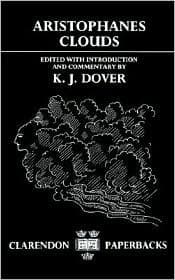
Sign in to track this book
In Aristophanes' 'Clouds,' an aging Athenian farmer, Strepsiades, enrolls his spendthrift son, Pheidippides, in Socrates' Thinkery to learn how to manipulate the legal system and evade debts, only to discover that the new sophistry corrupts traditional morality and familial piety.
“We are the Clouds, the divine Clouds, and we take on every shape we please.”
— The chorus of Clouds introduces themselves to Strepsiades.
“I will teach you to speak unjustly and overcome the just argument.”
— Socrates explains his teachings to Strepsiades.
“Zeus? What Zeus? Don't be silly; there is no Zeus.”
— Socrates denies the existence of traditional gods.
“The Worse Argument can defeat the Better, if it is skillfully used.”
— Socrates describes the power of rhetoric.
“Think subtly, and consider what is to your advantage.”
— Socrates advises Strepsiades on practical thinking.
“I am beaten by my own son, who has learned to argue unjustly.”
— Strepsiades laments after his son uses sophistry against him.
“The Clouds are the only true deities, for they give rain and nourishment.”
— Socrates promotes a naturalistic view of divinity.
“You must enter the Thinkery and learn the new wisdom.”
— Socrates invites Strepsiades to his school.
“Old men should not try to learn new tricks.”
— Strepsiades struggles with Socrates' teachings.
“I will burn down the Thinkery and drive out the impostors.”
— Strepsiades takes revenge on Socrates at the end.
“The tongue is mightier than the sword in the courts of Athens.”
— Reflecting on the power of rhetoric in society.
“We Clouds watch over all, rewarding the wise and punishing fools.”
— The chorus asserts their moral authority.
“What is just is what the stronger can make seem just.”
— A sophistical argument presented in the play.
“Socrates hangs in a basket to be closer to the Clouds and pure thought.”
— Description of Socrates' eccentric behavior.
“The new education corrupts the youth and dishonors the gods.”
— A traditionalist critique of Socrates' teachings.
Ready to see how well you understood this book? Take our interactive quiz with 10 questions.

Aristophanes, son of Philippus, of the deme Kydathenaion, was a comic playwright or comedy-writer of ancient Athens and a poet of Old Attic Comedy. Eleven of his forty plays survive virtually complete. These provide the most valuable examples of a genre of comic drama known as Old Comedy and are used to define it, along with fragments from dozens of lost plays by Aristophanes and his contemporaries.

Jeff Olson
4.4
Thomas Sowell
4.4

Walter Brueggemann
4.3

Rhonda Byrne
4.3

Robin Wall Kimmerer
4.3
George S. Clason
4.3

Elliot Aronson
4.3

Joseph Campbell
4.3