BookBrief
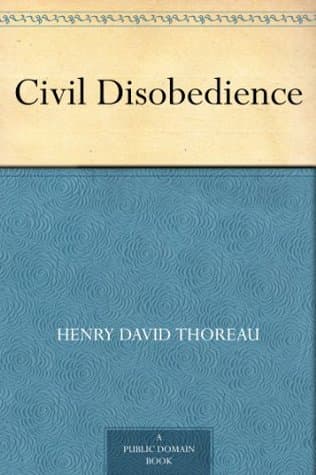
Civil Disobedience cover
Archivist's Choice

Civil Disobedience

Henry David Thoreau (1800)

Genre

Politics / History / Philosophy

Reading Time

60 min

Key Themes

See below

Track Your Reading

Sign in to track this book

Thoreau's essay argues that individual conscience must guide citizens to resist unjust laws through nonviolent action.

Core Idea

Thoreau argues that people must prioritize their conscience over unjust laws and an immoral government. He believes that true freedom and justice come when citizens refuse to passively accept systems that support slavery or unjust wars. He advocates for active, nonviolent resistance by withdrawing support, especially financial. The essay states that a government is illegitimate when it acts against its citizens' moral beliefs. Thoreau thinks that effective reform comes from principled individuals acting on their convictions, rather than waiting for the majority to change its mind. This embodies the idea that the 'best government' is the one that 'governs least.'
Reading time
60 min
Difficulty
Medium
✓ Read this if...
You are interested in the philosophical foundations of nonviolent resistance, individual liberty, and the relationship between the citizen and the state, especially concerning moral obligations.
✗ Skip this if...
You are looking for a practical guide to political activism or believe that unquestioning obedience to law is always paramount.

Core idea

The central argument and framework that powers the entire book.

Thoreau argues that people must prioritize their conscience over unjust laws and an immoral government. He believes that true freedom and justice come when citizens refuse to passively accept systems that support slavery or unjust wars. He advocates for active, nonviolent resistance by withdrawing support, especially financial. The essay states that a government is illegitimate when it acts against its citizens' moral beliefs. Thoreau thinks that effective reform comes from principled individuals acting on their convictions, rather than waiting for the majority to change its mind. This embodies the idea that the 'best government' is the one that 'governs least.'

At a glance

Reading time

60 min

Difficulty

Medium

Read this if...

You are interested in the philosophical foundations of nonviolent resistance, individual liberty, and the relationship between the citizen and the state, especially concerning moral obligations.

Skip this if...

You are looking for a practical guide to political activism or believe that unquestioning obedience to law is always paramount.

Key Takeaways

1

The Best Government Governs Least

Thoreau argues for a minimal state, believing the ideal government is one that barely governs at all.

Quote

'That government is best which governs least.'

Thoreau's main idea is a deep skepticism toward government. He sees government as often inefficient and corrupt, hindering individual liberty and moral action. He believes that a strong, self-reliant citizenry, guided by conscience, is more capable of managing its affairs and improving society than any top-down government. The state, he thinks, is a 'machine' that can become an instrument of injustice if individuals serve it without critical thought. The 'best' situation is not anarchy, but a government so aligned with the people's wi...

Supporting evidence

The opening lines of the essay directly state this famous maxim, and the entire piece is an elaboration on why less government is more desirable.

Apply this

Evaluate policies and systems not by their stated intentions but by their actual impact on individual freedom and moral agency. Support local, community-driven solutions over large-scale governmental mandates where possible.

minimal-stateindividual-libertygovernmental-skepticism
2

Conscience Over Law

Individuals have a moral imperative to prioritize their own conscience above unjust laws.

Quote

'It is not so much the duty of a man to establish justice, as it is to do himself no injustice.'

Thoreau states that a person's highest loyalty should be to their own moral conscience, not to the state or the majority. When laws are unjust, a person has a moral duty to resist them, even if it means breaking the law and facing consequences. He rejects the idea that one must wait for the majority to agree on injustice before acting, arguing that true moral progress often starts with a principled stand by a few. To obey an unjust law is to become an accomplice to injustice, thus harming oneself. This is about fundamental moral princ...

Supporting evidence

Thoreau's refusal to pay the poll tax in protest of slavery and the Mexican-American War is the central anecdote, demonstrating his belief in acting on conscience.

Apply this

Actively reflect on the moral implications of laws and policies. If a law conflicts with a deeply held moral principle, consider what forms of nonviolent resistance are appropriate and effective, rather than passively complying.

moral-imperativeindividual-conscienceunjust-lawnonviolent-resistance
3

The Majority is Not Always Right

Democracy's rule by the majority can be a tyranny, overriding individual rights and moral truths.

Quote

'Why has every man a conscience, then? I think that we should be men first, and subjects afterward.'

Thoreau questions the inherent rightness of majority rule. While democracy is often praised for its representation, he argues that a large number of people agreeing on something does not make it morally correct or just. Majorities can be swayed by self-interest, prejudice, or inertia, leading to policies that oppress minorities or support injustices like slavery or war. He emphasizes that individuals must not give up their critical thinking or moral judgment to the collective will. Real progress comes from individuals who think for th...

Supporting evidence

His critique of the American government's support for slavery and the Mexican-American War, both supported by a significant segment of the populace, highlights this point.

Apply this

Be wary of appeals to popularity or 'common sense' when evaluating moral or political issues. Cultivate independent thought and be prepared to articulate and defend your ethical positions, even if they are unpopular.

tyranny-of-majoritydemocratic-critiqueindividual-reason
4

The Power of Nonviolent Resistance

Withdrawal of cooperation is a potent tool for individuals to challenge an unjust state.

Quote

'Under a government which imprisons any unjustly, the true place for a just man is also a prison.'

Thoreau's essay is a key text for the theory and practice of nonviolent civil disobedience. He argues that by refusing to cooperate with unjust systems, individuals can put significant pressure on the state. This is not about violent overthrow, but about a moral and practical withdrawal of consent and support. He believes that if enough 'just men' refuse to pay taxes, serve in unjust wars, or comply with oppressive laws, the government will be forced to reconsider its actions. Imprisonment, in this context, is not a defeat but a power...

Supporting evidence

His own imprisonment for refusing to pay the poll tax served as a direct example of this principle, despite being brief.

Apply this

Identify areas where your cooperation or compliance inadvertently supports unjust systems. Explore ways to ethically withdraw that support, understanding that this may involve personal sacrifice. Study historical examples of successful nonviolent movements.

civil-disobediencepassive-resistancemoral-proteststate-resistance
5

Action Over Opinion

Mere intellectual dissent is insufficient; true moral opposition requires concrete action.

Quote

'I came into this world, not chiefly to make this a good place to live in, but to live in it, be it good or bad.'

Thoreau criticizes those who intellectually oppose injustice but fail to act on their beliefs. He sees much of society as complicit through inaction, content to express disapproval without changing their behavior or actively resisting. For him, true moral integrity requires that one's actions match one's beliefs. It is not enough to wish for change; one must be the change. He challenges readers to move beyond conversation or voting and to engage in tangible acts of defiance when faced with serious moral wrongs. The 'good citizen' is...

Supporting evidence

He specifically calls out those who 'talk of the abolition of slavery' but 'do nothing effectual to that end,' contrasting them with his own direct refusal to support the state.

Apply this

Examine areas where your beliefs might not align with your actions. Identify one specific, tangible step you can take to bring your actions into greater alignment with your moral convictions, even if small.

moral-actionintellectual-dissentintegrityactive-resistance
6

The True Cost of Compliance

Obeying unjust laws extracts a heavy toll on one's moral character and societal well-being.

Quote

'All voting is a sort of gaming, like checkers or backgammon, with a slight moral tinge to it, a playing with right and wrong, with moral questions.'

Thoreau argues that the cost of passively accepting an unjust government is far greater than the inconvenience of resistance. He believes that submitting to injustice weakens individual moral character, creating a sense of resignation and complicity. When citizens become mere 'machines' of the state, they lose their ability for independent moral judgment and action, becoming instruments of evil rather than agents of good. This moral decline ultimately weakens society, making it less able to address its core problems. The 'cost' is not...

Supporting evidence

His disdain for voting as a sufficient form of protest, likening it to 'gaming,' demonstrates his view that superficial engagement doesn't absolve one of moral responsibility.

Apply this

Regularly assess whether your daily actions and passive compliance contribute to systems you find morally objectionable. Consider the long-term moral implications of inaction versus the immediate personal costs of resistance.

moral-costcomplicityethical-erosionpassive-obedience
7

Simplicity and Self-Sufficiency as Tools of Freedom

Reducing material needs enhances an individual's capacity for independent thought and action.

Quote

'I found that, if I had been in jail for refusing to pay my tax, nobody else knew why I was there... I saw that, if there was a wall of stone between me and my townsmen, there was a still more difficult one to climb or break through, before they could get to be as free as I was.'

Thoreau links material simplicity to moral and political freedom. By reducing dependence on the state and the economic system, an individual gains greater independence and resilience, making them less vulnerable to coercion. His own simple lifestyle, detailed in 'Walden,' gave him the time and mental space to reflect critically and act on his conscience without fear of losing basic comforts. This freedom from material ties allows one to take principled stands without the overwhelming fear of economic consequences, strengthening one's ...

Supporting evidence

His personal experience of imprisonment, where he felt freer than his townsmen who were bound by societal conventions and material concerns, underpins this idea.

Apply this

Examine your own material dependencies. Consider how simplifying aspects of your life might reduce your vulnerability to external pressures and free up resources (time, energy, money) for more meaningful, principled action.

simplicityself-relianceautonomymaterial-independence
8

The Individual as the Source of Reform

Societal change originates not from institutions, but from the moral awakening of individuals.

Quote

'It is not a man's duty, as a matter of course, to devote himself to the eradication of any, even the most enormous wrong; he may still properly have other concerns to engage him; but it is his duty, at least, to wash his hands of it, and, if he gives it no thought longer, not to give it practically his support.'

Thoreau places the responsibility for societal improvement on the individual. He believes that true reform does not come from benevolent governments or powerful institutions, but from the awakened consciences of individual citizens. When enough individuals refuse to participate in injustice, demand better, and live by higher moral principles, the collective will of the people shifts, eventually forcing the state to adapt or crumble. This perspective empowers the common person, asserting that their personal moral choices have deep publ...

Supporting evidence

His argument that even one honest man refusing to participate can change the system, combined with his own example, demonstrates this belief.

Apply this

Focus on personal integrity and moral consistency in your own life, understanding that your individual choices contribute to the broader societal fabric. Don't wait for institutions to lead; be a leader through your own principled actions.

individual-agencysocietal-reformmoral-awakeningpersonal-responsibility
9

Government as a 'Wooden Gun'

The power of government often stems from the public's perception and acquiescence, not inherent strength.

Quote

'The government is a sort of semi-human tiger or a machine, a wooden gun, never acting with the conscience of a man.'

Thoreau often calls government a 'machine' or a 'wooden gun,' suggesting that its power is often more perceived than real, and largely depends on the consent and participation of its citizens. He believes the state has no inherent moral authority or true 'conscience,' but operates on force or the unthinking obedience of its subjects. If individuals collectively realize this and withdraw their cooperation, the 'machine' stops, and the 'wooden gun' proves harmless. This perspective demystifies governmental power, making it seem less inv...

Supporting evidence

His description of the state as a 'wooden gun' (or a 'machine') that can be rendered ineffective when men of conscience refuse to be its tools.

Apply this

Critically examine the perceived power of authorities and institutions. Understand that their influence often relies on your consent and participation. Look for ways to challenge perceived authority when it conflicts with moral principles, recognizing its potential fragility.

governmental-powerconsent-of-governedstate-fragilityperceived-authority
10

The Price of Freedom is Eternal Vigilance (and Action)

Freedom requires constant moral engagement and a willingness to resist injustice, not just during crises.

Quote

'Even voting for the right is doing nothing for it. A wise man will not leave the right to the mercy of chance, nor wish it to prevail through the power of the majority.'

Thoreau's essay is a timeless call for continuous moral vigilance. He implies that freedom is not a static state given by a benevolent government, but an ongoing achievement that requires active participation and a readiness to challenge the status quo. It is not enough to be 'good' when convenient; true freedom requires a consistent commitment to acting on one's conscience, even when difficult or unpopular. He warns against complacency, suggesting that even in stable times, injustice can grow if individuals stop critically examining ...

Supporting evidence

His insistence that voting is insufficient and that one must not leave 'the right to the mercy of chance' emphasizes the need for continuous, active engagement beyond episodic political acts.

Apply this

Cultivate a habit of ongoing critical inquiry into societal norms and governmental actions. Don't wait for a major crisis to engage your moral compass; practice consistent, small acts of principled living and resistance to maintain your freedom and integrity.

eternal-vigilanceactive-freedommoral-engagementcontinuous-resistance

Critical analysis

Notable Quotes

That government is best which governs least.

Opening statement on the ideal form of government.

The only obligation which I have a right to assume is to do at any time what I conceive to be right.

Justifying individual conscience over state law.

Under a government which imprisons any unjustly, the true place for a just man is also a prison.

Arguing for active resistance against injustice, even if it means imprisonment.

It is not a man's duty, as a matter of course, to devote himself to the eradication of any, even the most enormous wrong; he may still properly have other concerns to engage him; but it is his duty, at least, to wash his hands of it, and, if he gives it no thought longer, not to give it practically his support.

Defining the minimum duty of an individual towards an unjust system.

I was not born to be forced. I will breathe after my own fashion. Let us see who is the strongest.

Expressing a defiant stance against governmental coercion.

They who know of no purer sources of truth, who have traced up no stream higher, stand, and wisely stand, by the Bible and the Constitution, and drink at it there with reverence and humility; but they who behold where it comes trickling into this lake or that pond, and see their very spring and fountain-head, are prepared to be more or less irreverent and humble in their contemplation of the former.

Distinguishing between those who adhere to established texts and those who seek deeper truths.

The progress from an absolute to a limited monarchy, from a limited monarchy to a democracy, is a progress toward a true respect for the individual.

Tracing the historical evolution of government towards greater individual respect.

There will never be a really free and enlightened State until the State comes to recognize the individual as a higher and independent power, from which all its own power and authority are derived, and treats him accordingly.

Forecasting the conditions for a truly enlightened state.

I do not wish to quarrel with any man or nation. I do not wish to split hairs, to make fine distinctions, or set myself up as better than my neighbors. I seek rather, I may say, even an excuse for conforming to the laws of the land.

Clarifying that his resistance is not born of malice but principle.

Cast your whole vote, not a strip of paper merely, but your whole influence.

Advocating for active and complete engagement in protest, beyond mere symbolic gestures.

Is there not a sort of blood shed when the conscience is wounded? Through this wound a man's real manhood and immortality flow out, and he bleeds to an everlasting death.

Describing the moral cost of compromising one's conscience.

I quietly declare war with the State, after my fashion, though I will still make what use and get what advantage of her I can, as is usual in such cases.

Describing his personal declaration of war against the state, with a touch of pragmatism.

If a thousand men were not to pay their tax-bills this year, that would not be a violent and bloody measure, as it would be to pay them, and enable the State to commit violence and shed innocent blood. This is, in fact, the definition of a peaceable revolution, if any such is possible.

Proposing tax resistance as a non-violent revolutionary act.

I saw that, if there was a wall of stone between me and my townsmen, there was a still more difficult one to climb or break through, before they could get to be as free as I was.

Reflecting on his imprisonment and the greater freedom he felt compared to his 'free' townsmen.

Quiz

Test Your Knowledge

Ready to see how well you understood this book? Take our interactive quiz with 10 questions.

10
Questions
~5
Minutes
?
Best Score

Key Questions (FAQ)

Thoreau argues that individuals have a moral obligation to refuse to cooperate with an unjust government. He believes that conscience should take precedence over laws, and that true freedom comes from living in accordance with one's principles, even if it means breaking the law.

About the author