BookBrief
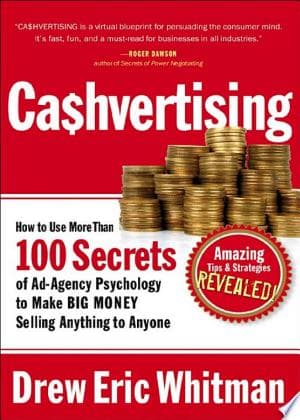
Cashvertising cover
Archivist's Choice

Cashvertising

Drew Eric Whitman (2008)

Genre

General

Reading Time

180-240 min

Key Themes

See below

Track Your Reading

Sign in to track this book

Learn Madison Avenue's psychological secrets to create ads that make people buy, whether you run a big corporation or a small shop.

Core Idea

Cashvertising argues that good advertising is a science based on human psychology, not an art. It states that certain persuasion principles work for any product or industry. The book breaks these principles into specific, practical techniques. It emphasizes that understanding deep human desires and using psychological triggers is more important for advertising success than creativity, budget, or brand recognition. By focusing on direct sales tactics, every ad dollar can lead to measurable sales and profits.
Reading time
180-240 min
Difficulty
Medium
✓ Read this if...
You are a small business owner, marketer, copywriter, or entrepreneur looking for practical, direct-response advertising techniques to increase sales and conversions without a massive budget. You want to understand the psychological triggers that make people buy.
✗ Skip this if...
You are looking for a theoretical exploration of branding, digital marketing trends, or abstract advertising philosophy. This book is not for those seeking a purely academic or high-level strategic overview without a focus on immediate, measurable results.

Core idea

The central argument and framework that powers the entire book.

Cashvertising argues that good advertising is a science based on human psychology, not an art. It states that certain persuasion principles work for any product or industry. The book breaks these principles into specific, practical techniques. It emphasizes that understanding deep human desires and using psychological triggers is more important for advertising success than creativity, budget, or brand recognition. By focusing on direct sales tactics, every ad dollar can lead to measurable sales and profits.

At a glance

Reading time

180-240 min

Difficulty

Medium

Read this if...

You are a small business owner, marketer, copywriter, or entrepreneur looking for practical, direct-response advertising techniques to increase sales and conversions without a massive budget. You want to understand the psychological triggers that make people buy.

Skip this if...

You are looking for a theoretical exploration of branding, digital marketing trends, or abstract advertising philosophy. This book is not for those seeking a purely academic or high-level strategic overview without a focus on immediate, measurable results.

Key Takeaways

1

The Primacy of the Headline

Your headline is the gatekeeper of engagement; neglect it, and your message dies unseen.

Quote

Sixty percent of people read only headlines. Your headline must stop them or your advertising will likely fail.

Whitman states that the headline is the most important part of any ad. In a world full of information, people quickly scan things, and their attention is brief. A weak headline acts as a barrier, making sure even good ad copy goes unread. The headline's only job is to get immediate attention and make the reader want to read more. It filters out those not interested and draws in the target audience with a promise, a question, or a bold statement. This is not just about clever words; it's about using psychology to create curiosity and s...

Supporting evidence

The statistic that 'sixty percent of people read only headlines' underscores the urgency and importance of this element, suggesting that most of your ad's potential impact rests on these crucial opening words.

Apply this

Dedicate disproportionate time to crafting headlines. Brainstorm 20-30 headlines for every piece of copy. Test different angles: benefit-driven, curiosity-driven, news-driven, and question-based. Always aim for clarity, specificity, and a strong value proposition that resonates with your target audience's deepest desires or fears.


headline-craftingattention-grabbingcopywriting-fundamentals
2

The Power of Visual Proof

Images with captions significantly boost engagement, providing context and credibility that text alone often lacks.

Quote

Captions under photos get 200 percent greater readership than non-headline copy.

Beyond headlines, Whitman highlights the power of visuals, especially with good captions. This is not just about looks; it uses a basic part of human perception. People are naturally drawn to images, and a good photo or drawing can share information, emotion, and trust faster than plain text. The caption then acts as a link, explaining the image's importance, reinforcing the ad's message, and pulling the reader further into the story. This combination creates a strong effect, where the visual gets attention and the caption provides th...

Supporting evidence

The startling fact that 'captions under photos get 200 percent greater readership than non-headline copy' provides concrete evidence of the effectiveness of this technique, demonstrating a significant uplift in engagement.

Apply this

Always include relevant, high-quality images in your advertising. Ensure every image has a compelling caption that explains its significance, highlights a benefit, or offers a mini-story. Don't just describe the image; use the caption to sell, inform, or persuade. For product ads, show the product in use; for service ads, show the results or the people providing the service.

visual-marketingimage-captionsad-design-principles
3

The Irresistible Allure of a Deal

Explicitly stating a sale price is a direct psychological trigger that significantly increases ad attention.

Quote

Ads with sale prices draw 20 percent more attention.

Whitman points out a basic truth about consumer behavior: people want good value and a good deal. Clearly advertising a 'sale price' is not just about lowering prices; it's about signaling an opportunity that might be missed. This uses the psychological principles of scarcity and urgency, even if the sale isn't temporary. A reduced price immediately makes the ad stand out in a crowded space. It suggests a clear benefit to the reader, avoiding the need for much persuasion by directly addressing their desire to save money or get more va...

Supporting evidence

The statistic 'Ads with sale prices draw 20 percent more attention' quantifies the direct impact of this strategy, making it a clear, actionable recommendation for advertisers.

Apply this

Whenever possible, prominently feature sale prices, discounts, or special offers in your advertising. Use clear, bold typography for the price. Consider comparing it to the original price to emphasize the savings. Frame the offer in terms of value or opportunity rather than just a markdown. Use phrases like 'Limited Time Offer,' 'Save X%,' or 'Special Introductory Price.'

sales-psychologypricing-strategiesvalue-proposition
4

Size Matters (But Not Always How You Think)

Larger ads capture more attention, but their effectiveness doesn't scale linearly, offering strategic placement options.

Quote

Half-page ads pull about 70 percent of full-page ads; quarter-page ads pull about 50 percent of full-page ads.

While it might seem that bigger ads always work better, Whitman notes that the return on investment for ad size is not always direct. A full-page ad certainly gets attention, but a half-page ad can have much of that impact at a lower cost. This idea is important for advertisers with limited budgets, allowing them to use their money wisely. It suggests that while making ads bigger is generally good, there are points where it stops being as effective. Understanding these ratios helps advertisers make smart choices about ad placement and...

Supporting evidence

The specific pull rates – 'Half-page ads pull about 70 percent of full-page ads; quarter-page ads pull about 50 percent of full-page ads' – provide a practical guideline for media planning and budget allocation.

Apply this

Don't automatically assume a full-page ad is the only effective option. Evaluate your budget and objectives. If a full page is too expensive, consider a half-page ad to achieve significant impact for less. For smaller budgets, a well-designed quarter-page ad can still be effective, especially if combined with a powerful headline and image. Focus on maximizing the impact within the chosen size rather than just increasing size for its own sake.

ad-placementmedia-buyingadvertising-roi
5

The Vibrancy of Color

Color isn't just aesthetic; it's a powerful tool that significantly enhances ad effectiveness and reader engagement.

Quote

Four-color ads are up to 45 percent more effective than black and white.

Whitman emphasizes that color in advertising is more than just decoration; it is a smart psychological tool. Color ads naturally stand out more in print, immediately catching the eye and giving a sense of quality, energy, and modernity. Beyond just being seen, color can create emotions, build brand identity, and highlight key information. The increased effectiveness is not just about getting attention; it's about creating a richer, more engaging experience that can lead to better memory and stronger persuasive power. In a world where ...

Supporting evidence

The data point that 'Four-color ads are up to 45 percent more effective than black and white' provides a compelling, quantifiable reason to invest in color advertising.

Apply this

Whenever budget allows, opt for full-color advertising over black and white. Use color strategically to highlight calls to action, important benefits, or product features. Choose colors that align with your brand identity and evoke the desired emotional response from your target audience. Don't just add color; use it purposefully to enhance readability and impact.

color-psychologybrand-identityvisual-impact
6

Psychology Over Budget

Effective advertising hinges on understanding human behavior, not just large spending.

Quote

These techniques are based on human psychology. They work no matter where you're located, no matter what kind of product or service you sell, and no matter where you advertise. In fact, most don't cost a penny to use.

This is a main point of 'Cashvertising': the most effective advertising strategies come from timeless principles of human psychology, not necessarily large budgets. Whitman frees advertisers from the idea that only big agencies with lots of money can create good campaigns. He argues that understanding how people think, what motivates them, and what makes them buy is more valuable than just spending money on ad placements. Many of the 'secrets' he shares are about writing messages that deeply connect with universal human desires and fe...

Supporting evidence

Whitman explicitly states that the techniques 'don't cost a penny to use' and are effective 'no matter where you're located, no matter what kind of product or service you sell,' emphasizing the psychological foundation.

Apply this

Prioritize learning about consumer psychology. Read books, observe behavior, and understand the core desires (e.g., security, belonging, power) and fears (e.g., loss, rejection, pain) that drive your target audience. Craft your messages to directly address these psychological triggers, rather than just listing features. Focus on benefits and emotional outcomes, not just product specifications.

consumer-psychologybehavioral-economicspersuasion-techniques
7

Believability is Paramount

Without trust, even the most compelling claims fall flat; credibility is the bedrock of persuasion.

Quote

How to make people believe what you say.

Whitman suggests that even the best-written ad copy is useless if the audience doesn't believe it. In a time of doubt and too much information, advertisers must actively build and keep trust. This is not just about avoiding lies, but about presenting information in a way that feels real, supported, and reliable. Trust can be built through testimonials, statistics, expert endorsements, guarantees, and even the ad's tone and professionalism. Without trust, any promises made will be met with doubt, making the entire persuasive effort ine...

Supporting evidence

The book explicitly lists 'How to make people believe what you say' as a key learning outcome, highlighting its foundational importance to effective advertising.

Apply this

Incorporate elements of social proof (testimonials, reviews), data (statistics, research), and authority (expert endorsements, awards) into your ads. Offer strong, clear guarantees. Use a sincere, confident, and transparent tone. Avoid hyperbole or claims that sound too good to be true. Be specific with your claims, as vagueness erodes trust.

credibility-buildingsocial-prooftrust-marketing
8

The Art of 'Sneaky' Persuasion

Effective advertising subtly guides prospects to action using psychological triggers, not overt force.

Quote

Sneaky' ways to persuade people to respond.

Whitman suggests that true persuasion is not about negative manipulation, but about understanding the subtle psychological triggers that encourage a desired response. These 'sneaky' methods are not deceptive; they use natural human tendencies and biases. This could involve framing choices, using scarcity or urgency, anchoring effects, or starting with a question that prepares the reader for a 'yes.' The goal is to make the desired action feel like the most natural, beneficial, or logical next step for the potential customer, rather th...

Supporting evidence

The book's promise to teach 'Sneaky' ways to persuade people to respond directly points to the use of psychological tactics rather than aggressive, overt selling.

Apply this

Employ psychological triggers such as urgency (limited-time offers), scarcity (limited stock), social proof (what others are doing), and reciprocity (offering value upfront). Use clear, compelling calls to action that make it easy for the prospect to respond. Frame benefits in terms of loss aversion (what they'll miss out on) rather than just gains. Use open loops to maintain curiosity.

persuasion-tacticscognitive-biasescall-to-action
9

Mastering the Magnetic Headline

Headlines must act as powerful magnets, drawing in the target audience with irresistible promises or questions.

Quote

Effective tricks for writing 'magnetic' headlines.

Repeating the headline's important role, Whitman specifically focuses on making them 'magnetic.' This means more than just being read; it means creating an irresistible pull that makes skipping the main ad copy almost impossible. A magnetic headline doesn't just announce; it promises a solution, sparks curiosity, presents a surprising fact, or directly addresses a core problem. It is short, convincing, and speaks directly to the reader's self-interest. By mastering these 'tricks,' advertisers can ensure their message cuts through nois...

Supporting evidence

The explicit mention of 'Effective tricks for writing 'magnetic' headlines' as a key skill taught by the book underscores the actionable nature of this takeaway.

Apply this

Utilize proven headline formulas: 'How to [Benefit] Without [Pain]', 'The Secret of [Desire]', 'Warning: Are You Making This [Mistake]?', 'Get [Desired Result] in [Timeframe]'. Focus on strong verbs, specific numbers, and clear benefits. Test different headline types (e.g., question, command, news, benefit) to see which resonates most with your audience.

headline-formulascopywriting-techniquesattention-economy
10

Avoiding Costly Advertising Mistakes

Knowing what NOT to do is as crucial as knowing what to do, preventing wasted effort and resources.

Quote

What mistakes to avoid...at all costs!

Whitman implies that many advertising failures come from mistakes that could have been avoided, rather than a lack of brilliance. Finding and fixing common errors directly improves ad performance. These mistakes can include unclear calls to action, general messages, focusing on features instead of benefits, using weak headlines, or not understanding the target audience. By highlighting these 'don'ts,' the book offers a protective strategy, saving advertisers from wasting time and money on ineffective campaigns. This proactive approach...

Supporting evidence

The book's explicit promise to teach 'What mistakes to avoid...at all costs!' signifies the importance of understanding and sidestepping common errors.

Apply this

Regularly audit your ads for common mistakes: weak headlines, vague calls to action, feature-focused instead of benefit-focused copy, lack of urgency, or targeting the wrong audience. Get feedback from others. Always have a clear objective for each ad. Ensure your message is simple, direct, and easy to understand. Avoid jargon and industry-speak.

advertising-pitfallscampaign-optimizationeffective-advertising

Critical analysis

Notable Quotes

People don’t buy products or services. They buy solutions to their problems.

Fundamental principle of advertising.

Every ad should be a complete sales presentation.

Emphasizing the importance of comprehensive ad copy.

The greatest copywriters in the world are not great writers. They are great salesmen.

Highlighting the sales-driven nature of effective copywriting.

Emotion sells, logic justifies.

Explaining the psychological process of purchasing decisions.

Never assume your prospect knows anything about your product, service, or offer.

Advising against making assumptions about customer knowledge.

The purpose of a headline is to stop prospects and get them to read your first sentence.

Defining the primary role of a headline.

People are interested in themselves, not in you or your company.

Stressing the importance of focusing on customer benefits.

Give your prospects a reason to believe.

Advocating for credible evidence and proof in advertising.

The more you tell, the more you sell.

Arguing for longer, more detailed ad copy.

Always include a call to action.

Emphasizing the necessity of telling customers what to do next.

Your customer is not a statistic. Your customer is a person with feelings, desires, and problems.

Humanizing the target audience for more effective marketing.

Benefits sell, features don't.

A core principle for framing product offerings.

Fear of loss is a stronger motivator than desire for gain.

Discussing a powerful psychological trigger in advertising.

Every ad must have a unique selling proposition (USP).

Highlighting the need for a distinct competitive advantage.

The selling power of testimonials is immense.

Advocating for the use of social proof.

Quiz

Test Your Knowledge

Ready to see how well you understood this book? Take our interactive quiz with 10 questions.

10
Questions
~5
Minutes
?
Best Score

Key Questions (FAQ)

Cashvertising reveals little-known advertising and marketing secrets based on human psychology, used by top agencies, to persuade people to buy. It provides practical tips, tricks, and strategies for creating powerful ads, brochures, sales letters, and websites.

About the author

Drew Eric Whitman is a marketing expert and author of the influential book 'Cashvertising: How to Use More Sales and Advertising Techniques to Sell Anything at Any Time.' His work focuses on practical, actionable advertising strategies, drawing from extensive research and real-world case studies. Whitman's insights have made him a respected voice in the advertising and marketing community.