BookBrief
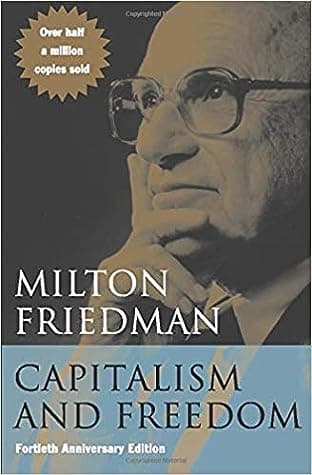
Capitalism and Freedom cover
Archivist's Choice

Capitalism and Freedom

Milton Friedman (1962)

Genre

Business / History / Economics / Finance / Philosophy

Reading Time

5-7 hours

Key Themes

See below

Track Your Reading

Sign in to track this book

Milton Friedman argues that competitive capitalism is essential for economic prosperity and individual liberty, stating that a free market is the only way to get government benefits without facing its threats.

Core Idea

Milton Friedman's "Capitalism and Freedom" argues that economic freedom is necessary for political freedom. He states that a free market, with voluntary exchange and limited government, does not just efficiently distribute resources but also protects against tyranny. Friedman believes that when the state expands its economic role beyond setting rules and enforcing contracts, it will take away individual liberties, regardless of its good intentions. The book supports a classical liberal view, pushing for policies that maximize individual choice and responsibility in areas like education, social welfare, monetary policy, and occupational licensing. Friedman criticizes government programs and regulations that he sees as controlling and ineffective, suggesting market-based solutions as better ways to create prosperity and freedom.
Reading time
5-7 hours
Difficulty
Medium
✓ Read this if...
You are interested in the philosophical and practical arguments for limited government, free markets, and individual liberty, or you want to understand the foundational ideas of modern libertarian and conservative economic thought.
✗ Skip this if...
You are firmly convinced that significant government intervention is necessary for social welfare and economic stability, or you are looking for a critique of capitalism rather than its defense.

Core idea

The central argument and framework that powers the entire book.

Milton Friedman's "Capitalism and Freedom" argues that economic freedom is necessary for political freedom. He states that a free market, with voluntary exchange and limited government, does not just efficiently distribute resources but also protects against tyranny. Friedman believes that when the state expands its economic role beyond setting rules and enforcing contracts, it will take away individual liberties, regardless of its good intentions.

The book supports a classical liberal view, pushing for policies that maximize individual choice and responsibility in areas like education, social welfare, monetary policy, and occupational licensing. Friedman criticizes government programs and regulations that he sees as controlling and ineffective, suggesting market-based solutions as better ways to create prosperity and freedom.

At a glance

Reading time

5-7 hours

Difficulty

Medium

Read this if...

You are interested in the philosophical and practical arguments for limited government, free markets, and individual liberty, or you want to understand the foundational ideas of modern libertarian and conservative economic thought.

Skip this if...

You are firmly convinced that significant government intervention is necessary for social welfare and economic stability, or you are looking for a critique of capitalism rather than its defense.

Key Takeaways

1

The Inseparable Link: Economic and Political Freedom

Competitive capitalism is not just an economic system, but a prerequisite for political liberty.

Quote

Economic freedom is an indispensable means toward the achievement of political freedom.

Friedman argues that economic freedom is not just a good result of a free society but its very basis. He states that a free market, with competitive capitalism, spreads power and gives individuals other ways to earn money and have influence. This prevents power from being concentrated in the government. Without economic choices, individuals rely on the government for their living, making disagreement or opposition very difficult. This connection means that any loss of economic freedom will endanger political freedom, as the state gain...

Supporting evidence

Friedman frequently references totalitarian regimes (e.g., Soviet Union, Nazi Germany) where state control over the economy directly led to the suppression of political freedoms, demonstrating that without private property and free exchange, political dissent is stifled.

Apply this

Evaluate government policies not only on their stated economic goals but also on their potential impact on individual economic autonomy and the decentralization of power. Support policies that expand market choices and reduce state monopolies.
economic-freedompolitical-freedomcapitalism
2

The Perils of Paternalism: The State as Benevolent Despot

Government intervention, even with good intentions, often undermines individual responsibility and freedom.

Quote

The great advances of civilization, whether in architecture or painting, in science or literature, in industry or agriculture, have never come from centralized government.

Friedman doubts the government's ability to act as a kind, all-knowing guardian of its citizens. He believes that when the state takes on the role of 'protector' or 'provider' beyond its basic duties, it takes away individual liberty. Policies meant to 'help' individuals often have unintended negative results, create dependence, and reduce personal choice and responsibility. The difficulty of central planning, combined with bureaucrats' self-interest, means that government solutions are often inefficient, unchangeable, and ultimately ...

Supporting evidence

Friedman critiques specific government programs like Social Security, arguing that while well-intentioned, they reduce individual savings and responsibility, and create a system of forced participation rather than voluntary provision for old age.

Apply this

Before advocating for new government programs, critically assess whether the problem could be solved more effectively through market mechanisms, private charity, or individual initiative. Prioritize solutions that empower individuals rather than relying on state mandates.

paternalismlimited-governmentunintended-consequences
3

The Role of Government: Rules, Not Rulers

Government's legitimate functions are limited to enforcing contracts, protecting property, and maintaining order.

Quote

The consistent liberal of the nineteenth century was a individualist and a believer in laissez faire. He was a believer in limited government, and he believed that the state should not interfere in economic affairs.

Friedman supports a very limited role for government, defining its main legitimate functions as those needed to create and maintain a system for voluntary exchange. This includes enforcing contracts, protecting private property rights, providing for national defense, and administering justice. Beyond these basic tasks, he argues that government involvement distorts market signals, wastes resources, and ultimately reduces overall well-being and freedom. He particularly criticizes government attempts to redistribute wealth or manage eco...

Supporting evidence

Friedman points to the success of market economies when property rights are secure and contracts enforceable, contrasting this with the stagnation often seen in economies with extensive government control and unclear legal frameworks.

Apply this

Advocate for policies that strengthen legal frameworks, protect individual rights, and reduce government involvement in areas where private markets or voluntary associations can function effectively. Question any expansion of government power beyond these core functions.

limited-governmentrule-of-lawproperty-rights
4

Money Matters: The Dangers of Central Bank Discretion

Monetary policy should be governed by clear rules, not the discretionary decisions of central bankers.

Quote

Inflation is always and everywhere a monetary phenomenon.

Friedman famously said that inflation is mainly a monetary issue, caused by too much money growing compared to the amount of goods and services produced. He strongly criticizes central banks' power to change the money supply, arguing that such power always leads to economic instability, inflation, and boom-and-bust cycles. Instead, he suggests a fixed monetary rule, like a steady, predictable increase in the money supply (e.g., 3-5% annually), to provide a stable financial environment. This rule-based approach would remove political i...

Supporting evidence

Friedman and Anna Schwartz's seminal work, 'A Monetary History of the United States,' meticulously details how discretionary monetary policy contributed to the Great Depression and other economic downturns, arguing for a more predictable, rule-based approach.

Apply this

Support calls for greater transparency and accountability in central banking, and advocate for policies that limit discretionary power in favor of clear, predictable monetary rules. Understand the long-term inflationary impact of excessive money printing.

monetary-policyinflationcentral-bankingmonetarism
5

Education Vouchers: Empowering Parents, Improving Schools

Introducing market mechanisms into education can enhance quality and equity by giving parents choice.

Quote

The parent is the one who is responsible for the child; the parent is the one who is in the best position to make decisions about the child's education.

Friedman argues for a major change in the education system through school vouchers. He believes that the current system of publicly funded and run schools creates a monopoly, leading to inefficiency, a lack of new ideas, and a one-size-fits-all approach that does not meet different student needs. Vouchers would let parents use public funds to send their children to any approved school—public or private—which would create competition among schools. This competition, he believes, would force schools to improve their quality, innovate, a...

Supporting evidence

Friedman points to the success of market-driven sectors in responding to consumer demands, contrasting it with the perceived stagnation and bureaucratic inertia of public education systems, which lack competitive pressures.

Apply this

Advocate for educational reforms that empower parents with choice, such as voucher programs or charter schools, to foster competition and innovation in the education sector. Research and support initiatives that decentralize educational decision-making.

education-reformschool-vouchersparental-choicemarket-mechanisms
6

Occupational Licensing: A Barrier to Opportunity

Government-mandated occupational licensing often serves to protect incumbents, not the public.

Quote

Occupational licensure is a major source of monopoly power and a major barrier to entry in many occupations.

Friedman examines occupational licensing, arguing that while it is often presented as a way to protect the public from unskilled workers, it often limits new competitors. These rules, he suggests, are usually pushed by existing workers to limit supply, raise prices, and protect their own financial interests, rather than truly ensuring quality. This creates artificial scarcity, limits consumer choice, and unfairly harms people from lower economic backgrounds who face big obstacles to enter licensed professions. Friedman supports minima...

Supporting evidence

Friedman highlights examples of professions, from doctors to hairdressers, where licensing requirements are excessively stringent and often unrelated to actual competence, serving primarily to reduce competition and inflate wages for those already licensed.

Apply this

Support efforts to reform or repeal unnecessary occupational licensing laws. Research the licensing requirements in various professions and advocate for less restrictive alternatives like certification or voluntary accreditation.

occupational-licensingbarriers-to-entrymonopoly-powerderegulation
7

Social Security: A Compulsory and Inefficient System

The government-run Social Security system is an inefficient, intergenerational transfer that reduces individual freedom.

Quote

Social Security is a compulsory system whereby the young are forced to support the old.

Friedman strongly criticizes Social Security, seeing it not as a true insurance program but as a mandatory tax and transfer system. He argues that it forces individuals to participate in a system that may not match their personal preferences for savings and retirement planning. Furthermore, he believes that it changes individual savings behavior, discourages private saving for old age, and creates a reliance on government. Friedman believes that individuals, given freedom, would make more efficient and personalized choices for their r...

Supporting evidence

Friedman contrasts Social Security with private insurance markets, highlighting how the former lacks the actuarial soundness and voluntary nature of the latter, effectively making it a 'pay-as-you-go' system reliant on future generations.

Apply this

Advocate for reforms that introduce greater individual choice and control over retirement savings, such as allowing individuals to opt out of Social Security into private alternatives, or promoting personal savings vehicles.

social-securitycompulsory-savingsintergenerational-transferretirement-planning
8

The Fallacy of Social Responsibility: Profit as Purpose

The primary social responsibility of business is to increase its profits within the rules of the game.

Quote

There is one and only one social responsibility of business—to use its resources and engage in activities designed to increase its profits so long as it stays within the rules of the game.

While not a specific chapter in 'Capitalism and Freedom,' Friedman's later, consistent views on corporate social responsibility come from its principles. He argues that the main duty of business executives is to maximize profits for their shareholders, within legal and ethical limits. Any attempt by corporations to pursue 'social good' beyond this, using shareholder money, is essentially a form of taxation without representation, taking resources from their rightful owners. He believes that individuals, not corporations, are the prope...

Supporting evidence

Friedman contrasts the clear accountability of profit-seeking with the vague and often politically motivated pursuits of 'social responsibility,' arguing that the latter can lead to corporate executives acting as unelected social engineers.

Apply this

When evaluating corporate actions, prioritize those that clearly benefit shareholders and operate within legal and ethical frameworks. Be skeptical of companies that claim to pursue 'social good' at the expense of profit, as this can often mask inefficiencies or self-serving agendas.

corporate-social-responsibilityshareholder-valueprofit-motivefree-market-ethics
9

Foreign Aid: A Misguided Benevolence

Government-to-government foreign aid often harms recipient nations and serves donor interests.

Quote

Foreign aid is a method by which poor people in rich countries subsidize rich people in poor countries.

Friedman strongly criticizes government-to-government foreign aid, arguing that it often makes poverty worse rather than better in recipient nations. He believes that such aid typically supports corrupt or authoritarian governments, stops private sector growth, and creates dependence, rather than fostering real economic growth. The aid, he suggests, rarely reaches those truly in need and instead serves the political and economic interests of the donor country or the ruling groups of the recipient country. He instead supports private c...

Supporting evidence

Friedman cites numerous examples where foreign aid has failed to improve living standards, instead fueling corruption, funding white elephant projects, and undermining local entrepreneurial efforts in developing countries.

Apply this

Support policies that promote free trade and open markets with developing nations, rather than relying on government-to-government aid. When considering international assistance, prioritize private charities or direct person-to-person initiatives.

foreign-aideconomic-developmentfree-tradegovernment-corruption
10

The Power of Voluntary Exchange: The Invisible Hand in Action

Voluntary transactions in a free market are inherently efficient and mutually beneficial.

Quote

The great virtue of a free market is that it permits an extraordinary degree of diversity while at the same time promoting coordination through voluntary exchange.

At the core of Friedman's ideas is a firm belief in the power of voluntary exchange. He argues that when individuals are free to interact and trade with each other without force, both parties benefit, or they would not participate. This 'invisible hand' of self-interest, working within clear rules and property rights, leads to an efficient use of resources, new ideas, and overall societal prosperity. Voluntary exchange allows for specialization, creates wealth, and encourages cooperation, all without the need for central planning or g...

Supporting evidence

Friedman frequently uses the example of a simple market transaction, like buying a loaf of bread, to illustrate how countless individuals, acting in their own self-interest, contribute to a complex, coordinated process that benefits everyone involved, without any central command.

Apply this

Seek out opportunities for voluntary exchange in your personal and professional life. Be wary of policies that restrict voluntary transactions or impose involuntary exchanges, as these often lead to inefficiencies and reduced welfare.

voluntary-exchangeinvisible-handfree-marketeconomic-efficiency

Critical analysis

Notable Quotes

The great advances of civilization, whether in physics or biology, medicine or sociology, have never come from an attempt to achieve a specific social goal.

Friedman argues against the idea that scientific or societal progress is best driven by government-directed, goal-oriented research.

The consistent liberal, of the 19th century brand, was a believer in freedom, in the individual, in the rule of law, in limited government.

Friedman redefines 'liberalism' by contrasting its historical meaning with its contemporary (mid-20th century) usage, advocating for the classical liberal tradition.

Economic freedom is an indispensable means toward the achievement of political freedom.

This is a core thesis of the book, emphasizing the causal link between economic liberty and political liberty.

Government has three primary functions: to protect us from foreign enemies, to protect us from our fellow citizens, and to provide certain public works and institutions that cannot be provided through the market.

Friedman outlines his minimalist view of the appropriate role of government.

There is one and only one social responsibility of business—to use its resources and engage in activities designed to increase its profits so long as it stays within the rules of the game, which is to say, engages in open and free competition without deception or fraud.

This famous quote asserts the primary responsibility of corporations to their shareholders, not to broader social goals.

The most important single central fact about the free market is that no exchange takes place unless both parties benefit.

Friedman explains the voluntary and mutually beneficial nature of transactions in a free market.

Inflation is always and everywhere a monetary phenomenon.

Though more associated with his monetary theory, this fundamental principle underpins his economic arguments against government overspending and central bank policies.

A society that puts equality—in the sense of equality of outcome—ahead of freedom will end up with neither equality nor freedom.

Friedman differentiates between equality of opportunity and equality of outcome, arguing that pursuing the latter undermines both.

Competition is a more effective protection against discrimination than the law.

Friedman argues that in a free market, businesses that discriminate based on non-economic factors will be at a disadvantage.

The role of government in a free society is to do something that the market cannot do for itself, namely, to determine, arbitrate, and enforce the rules of the game.

Friedman clarifies that even in a free market, a government is necessary to establish and uphold the legal framework.

The case for a free society rests on the argument that it gives the individual the greatest possible opportunity to pursue his own objectives.

Friedman emphasizes the individualistic foundation of his philosophy and the purpose of a free society.

The problem of social organization is how to set up an arrangement under which it is possible for people to pursue their own interests and at the same time promote the general interest.

Friedman introduces the fundamental challenge of aligning individual self-interest with societal well-being, which the free market mechanism aims to address.

Concentrated power is not rendered harmless by the good intentions of those who create it.

Friedman warns against the dangers of concentrated power, whether in government or other institutions, regardless of the motivations behind its creation.

The greatest enemy of freedom is the absence of alternatives.

Friedman stresses the importance of choice and competition in maintaining individual liberty, whether in markets or other spheres.

Quiz

Test Your Knowledge

Ready to see how well you understood this book? Take our interactive quiz with 10 questions.

10
Questions
~5
Minutes
?
Best Score

Key Questions (FAQ)

The book argues that competitive capitalism is not only a mechanism for achieving economic freedom but also an essential prerequisite for political freedom. Friedman explores how market mechanisms can allow individuals to cooperate without coercion.

About the author