“There are no friends in politics, only allies.”
— A recurring theme in the book, often voiced or exemplified by Caesar himself, reflecting the pragmatic and often ruthless nature of Roman politics.

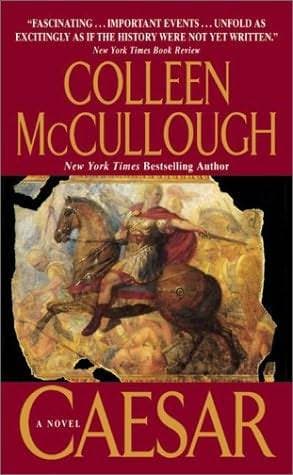
Colleen McCullough (1997)
Genre
Politics / History / Historical Fiction
Reading Time
20-25 hours
Key Themes
See below
Sign in to track this book
As Caesar conquers Gaul, senators in Rome, fearing his ambition, plot to destroy the general whose power might save or enslave the Republic.
In 54 BCE, Gaius Julius Caesar is busy with his Gallic Wars, winning battles against various Celtic tribes, including the Nervii and the Eburones under Ambiorix. His legions, especially the Tenth, are loyal and well-led. These conquests expand Roman territory and bring wealth, but they also cause growing worry and anger in Rome. Senators like Cato the Younger and Marcus Calpurnius Bibulus see Caesar's ambition and popularity as a direct threat to the Republic. Pompey Magnus, once Caesar's ally, begins to distance himself, influenced by the senatorial group that fears Caesar's return to Rome with his army.
Back in Rome, politics are dangerous. Publius Clodius Pulcher, a street politician and Caesar's former supporter, is killed by Titus Annius Milo, causing riots and a power vacuum. This chaos allows Caesar's enemies in the Senate to push their agenda. Cato and Bibulus, along with the optimates, propose laws to recall Caesar from Gaul, making him a private citizen and open to charges for alleged abuses during his consulship. Caesar's remaining allies, like the tribune Curio, try to block these moves, suggesting compromises that would have both Caesar and Pompey give up their commands, but these efforts fail against the opposition.
While Roman politics are troubled, a new threat appears in Gaul. Vercingetorix, a chieftain of the Arverni, unites many Gallic tribes into a large confederation, forming a strong resistance against Roman rule. He uses scorched-earth tactics, burning his own towns and food to deny resources to Caesar's legions, and shows great strategic skill. This rebellion tests Caesar, forcing him to use all his military genius and his men's loyalty to prevent losing Gaul. The size of this uprising is new, threatening to undo years of Roman conquest.
The Gallic Wars culminate at Alesia, a strong hillfort where Vercingetorix and his main army are located. Caesar performs one of military history's most daring feats: building a massive circumvallation (a wall around the city) to blockade Vercingetorix, and at the same time building a contravallation (an outer wall) to defend against a huge Gallic relief army. His legions are significantly outnumbered, facing attacks from both inside and outside their defenses. The battle is brutal and long, testing the Roman soldiers' endurance and discipline. Caesar personally leads charges, inspiring his men through sheer will and strategic brilliance.
Despite being outnumbered, Caesar's double-siege at Alesia holds. The Gallic relief army is defeated, and Vercingetorix, seeing no hope and wanting to spare his starving people, decides to surrender. He rides out of Alesia and lays down his arms before Caesar, a moment of defeat for the Gauls and triumph for Rome. With Vercingetorix captured, the remaining Gallic resistance is crushed, and Gaul becomes a Roman province. Caesar's reputation as a military commander is cemented, but his power only increases the fear and anger among his senatorial opponents in Rome.
The Senate, influenced by Cato and Pompey, issues an ultimatum: Caesar must disband his army and return to Rome as a private citizen to face charges. Knowing this means political ruin and likely execution, Caesar faces an impossible choice. In January 49 BCE, after much thought and with his loyal legions' support, he decides to cross the Rubicon River, the legal border separating his province of Cisalpine Gaul from Italy, with his army. His famous declaration, 'Alea iacta est' (The die is cast), marks the point of no return. This act challenges the Republic and starts a civil war against Pompey and the senatorial forces.
Caesar's fast advance through Italy surprises Pompey and the Optimates. Pompey, unprepared for Caesar's speed and the loyalty of the Italian cities, decides to abandon Rome and Italy, retreating across the Adriatic Sea to Greece with his legions and most of the Senate. Caesar, unable to pursue immediately without a fleet, takes control of Italy and then launches a campaign to secure Spain, defeating Pompey's legions there. After securing his rear, Caesar transports his army across the Adriatic in a dangerous winter crossing, setting up a direct fight with Pompey in Greece.
The main battle between Caesar and Pompey happens at Pharsalus in 48 BCE. Pompey commands a much larger army, strengthened by senatorial legions and Eastern allies, and holds a strong defensive position. Caesar, though outnumbered, relies on his veteran legions' discipline and experience and his own tactical skill. He plans brilliantly, including a hidden fourth line of infantry to counter Pompey's cavalry flank attack. The battle is fierce, but Caesar's strategy wins. Pompey's forces are routed, suffering heavy losses, and Pompey himself flees the battlefield, ending his command and the senatorial cause in Greece.
After his defeat at Pharsalus, Pompey seeks safety in Egypt, hoping for help from the young Pharaoh Ptolemy XIII, a nominal ally of Rome. However, Ptolemy's advisors, believing it would gain favor with the victorious Caesar, betray and assassinate Pompey as he disembarks from his ship. When Caesar arrives in Egypt pursuing Pompey, he is given Pompey's severed head, a gesture that horrifies him. Caesar then gets involved in the civil war between Ptolemy XIII and his sister, Cleopatra VII. Impressed by Cleopatra's intelligence and charm, Caesar sides with her, eventually defeating Ptolemy's forces and securing Cleopatra's place on the throne, with whom he begins a famous affair.
After leaving Egypt, Caesar continues to eliminate the remaining Optimates who have regrouped under Cato the Younger and Metellus Scipio in Africa. He wins another decisive victory at the Battle of Thapsus in 46 BCE, where Cato commits suicide rather than face Caesar. Later, Pompey's sons, Gnaeus and Sextus, raise a final large army in Spain. Caesar, though tired, again leads his legions to battle, ending in the brutal Battle of Munda in 45 BCE, where he achieves a final, complete victory over the last Republican resistance. With all his major opponents defeated, Caesar returns to Rome as the undisputed master of the Roman world.
Upon his return, Caesar is given the title of Dictator for Life by a compliant Senate, consolidating absolute power. He begins an ambitious reform program, including calendar reform (the Julian calendar), land redistribution for veterans and the poor, public works projects to create jobs, and the reorganization of provincial administration. He expands the Senate, filling it with his loyalists and even Gauls, further lessening the influence of the old Roman aristocracy. While these reforms benefit many, his accumulation of power and perceived disregard for Republican traditions deeply alarm many senators, who fear he intends to establish a monarchy.
Despite warnings, Caesar increasingly dismisses personal security, believing his popularity and reforms protect him. A conspiracy, led by Marcus Junius Brutus and Gaius Cassius Longinus, involving dozens of senators who call themselves 'Liberators,' forms to assassinate him and restore the Republic. On March 15, 44 BCE (the Ides of March), Caesar goes to a Senate meeting at the Theatre of Pompey. The conspirators surround him and stab him multiple times. His final moments show his realization of betrayal, especially upon seeing Brutus among the attackers. Caesar's assassination throws Rome into more chaos and civil war, setting the stage for his adopted son, Octavian, to rise to power.
The Protagonist
From a powerful general in Gaul, Caesar transforms into the undisputed master of Rome, ultimately becoming Dictator Perpetuo before his assassination, a victim of his own ambition and the fear he instilled in the old guard.
The Antagonist
From a powerful and respected general, Pompey's influence wanes as Caesar's rises, leading to his defeat in civil war and a tragic, ignominious death.
The Supporting
A loyal friend and respected senator, Brutus becomes convinced that Caesar's ambition threatens the Republic, leading him to participate in the assassination, a decision that ultimately defines his tragic fate.
The Supporting
Cato remains an unwavering opponent of Caesar, choosing death over submission to a dictator, solidifying his legacy as a tragic defender of a dying Republic.
The Supporting
Vercingetorix rises to unite the Gauls against Rome, achieving initial successes before his ultimate, tragic defeat and surrender to Caesar at Alesia.
The Supporting
From a contested queen, Cleopatra secures her throne with Caesar's aid, becoming his political partner and mother of his child, her ambition forever intertwined with Rome's fate.
The Supporting
Antony rises as Caesar's trusted general and political enforcer, remaining fiercely loyal even after Caesar's death, positioning him as a major player in the subsequent power struggles.
The Supporting
Cassius evolves from a resentful senator into the primary architect of Caesar's assassination, driven by an unyielding desire to preserve the Republic.
This theme explores the conflict between individual ambition, especially Caesar's drive for glory and power, and the Roman Republic's traditional values and institutions. Caesar's successes in Gaul and his accumulation of power directly challenge the checks and balances designed to prevent any one man from becoming too powerful. The Senate's fear, particularly from figures like Cato, is that Caesar's ambition will destroy the Republic and lead to a monarchy. The crossing of the Rubicon symbolizes this clash, as Caesar chooses personal power over adherence to the Republic's laws, leading to civil war and the Republic's end. The assassination itself is a desperate, but ultimately useless, attempt to restore the Republic by removing the man who posed its greatest threat.
“The die is cast.”
The story is full of shifting loyalties and betrayals. Caesar inspires strong loyalty among his legions, who follow him through difficult campaigns and into civil war, showing an almost family-like bond. Conversely, Rome's political scene is a constant struggle of alliances and betrayals, seen in the end of the First Triumvirate and Pompey's alignment with the optimates against Caesar. The most striking example of this theme is Caesar's assassination by Brutus, a man Caesar considered a friend and had favored greatly. This act of betrayal, driven by conflicting ideals, highlights the brutal personal cost of political struggle in ancient Rome and how fragile trust can be when power is at stake.
“Et tu, Brute?”
Caesar's military genius drives the story. His campaigns in Gaul, especially the siege of Alesia, show his strategic brilliance, tactical innovation, and ability to inspire his troops against great odds. These victories bring glory and wealth to Rome, but they also create an army loyal to Caesar himself, rather than the Senate. This personal army becomes the main tool of his ambition, allowing him to defy the Republic and win the civil war. The consequences of this military skill are significant: while it expands Roman rule, it also weakens the Republic's civilian authority, showing how military power can destabilize a political system.
“Better to be first in a village than second in Rome.”
The book details the great personal and political costs of seeking and holding ultimate power. Caesar's rise to Dictator for Life comes at the cost of years of brutal warfare, countless soldiers' lives, and the destruction of the Republic he served. While he achieves unmatched authority, he also becomes isolated and surrounded by enemies, both open and hidden. His reforms, though good for many, are seen as dictatorial by others, fueling the conspiracy against him. Ultimately, his absolute power leads directly to his assassination, showing that even the most powerful individuals are vulnerable to the forces they unleash, and that the highest office can demand the ultimate sacrifice.
“Men readily believe what they wish.”
A symbolic and literal boundary whose crossing signifies an irreversible decision.
The Rubicon River serves as a critical plot device, representing the legal boundary between Caesar's province and Italy. His decision to cross it with his legions is not merely a geographical act but a profound symbolic one, signifying an irreversible commitment to civil war and a direct challenge to the authority of the Roman Senate. It marks the point of no return for Caesar, irrevocably altering the course of Roman history and setting the stage for the dramatic conflicts that follow. The phrase 'crossing the Rubicon' has since become an idiom for making a decisive, irrevocable step.
Foreshadowing devices used to heighten tension and underscore Caesar's fate.
Throughout the narrative, various omens, prophecies, and warnings are presented, particularly leading up to Caesar's assassination. These include dreams, unusual natural phenomena, and direct warnings from soothsayers (like the famous 'Beware the Ides of March'). These devices serve to heighten dramatic tension, create a sense of impending doom, and underscore the tragic inevitability of Caesar's fate. They also reflect the Roman belief in divine intervention and fate, suggesting that Caesar's destiny, though shaped by his ambition, was perhaps also preordained, making his demise feel both earned and inescapable.
Caesar's wars are used not only for conquest but also to gain political leverage and popular support.
Caesar's extensive military campaigns, particularly in Gaul, are presented not just as acts of conquest but as crucial political tools. His victories bring him immense wealth, prestige, and a fiercely loyal army, all of which he leverages to outmaneuver his political rivals in Rome. The glory of his conquests endears him to the Roman populace, while the resources gained help fund his political machine. This device highlights how military success in the late Republic could be directly translated into political power, ultimately allowing a general to challenge and eventually overcome the civilian government, blurring the lines between military and political authority.
The power of speech used to sway public opinion and influence political outcomes.
In the Roman Republic, rhetoric and oratory were potent weapons, and the book frequently showcases their use. Characters like Caesar, Cicero (though less prominent in this specific book), Cato, and various tribunes employ powerful speeches to rally support, demonize opponents, defend their actions, and influence the Senate and the Roman people. Caesar himself is a master orator, able to inspire his troops and charm the masses. This device underscores the importance of public opinion and persuasive argument in Roman politics, where verbal battles could be as decisive as military ones, shaping alliances and fueling animosity.
“There are no friends in politics, only allies.”
— A recurring theme in the book, often voiced or exemplified by Caesar himself, reflecting the pragmatic and often ruthless nature of Roman politics.
“Power is not given, it is taken.”
— Caesar's internal monologue or a conversation with a close advisor, highlighting his ambition and understanding of how to achieve dominance.
“The die is cast.”
— Caesar's famous utterance upon crossing the Rubicon, a pivotal moment marking his defiance of the Senate and the start of civil war.
“Better to be first in a village than second in Rome.”
— Caesar's reflection on his early career and his drive for supreme leadership, even if it meant starting small.
“A man's worth is measured by his enemies.”
— A sentiment expressed by various characters, including Caesar, emphasizing the respect gained even from formidable adversaries.
“Rome is not a city, but an idea.”
— Caesar or another Roman contemplating the enduring legacy and symbolic power of the Republic, transcending its physical boundaries.
“The greatest glory is not in never falling, but in rising every time we fall.”
— Caesar's inner thoughts during periods of setbacks and defeats, showcasing his resilience and determination.
“To be truly free, one must be able to choose one's own chains.”
— A philosophical musing by a character, perhaps Caesar or a Stoic, on the nature of freedom within political constraints.
“The Republic is a mask, behind which men plot for their own gain.”
— A cynical observation by a character, revealing the disillusionment with the ideals of the Roman Republic and the reality of political maneuvering.
“Victory has a hundred fathers, but defeat is an orphan.”
— A common Roman saying, often applied to the political aftermath of battles, where success attracts many claimants, but failure finds none.
“No man is so foolish as to prefer war to peace, for in peace sons bury their fathers, but in war fathers bury their sons.”
— A statement made by a character (possibly Caesar) reflecting on the horrors and costs of war, despite his military prowess.
“Fortune favors the bold.”
— A guiding principle for Caesar throughout his campaigns and political maneuvers, justifying his daring actions.
“The greatest danger is to stand still while the world moves.”
— Caesar's rationale for constant innovation and expansion, rejecting complacency and embracing change.
“History is written by the victors.”
— A character's cynical remark about the subjective nature of historical accounts, acknowledging that the narrative is controlled by those who prevail.
Ready to see how well you understood this book? Take our interactive quiz with 10 questions.

Colleen Margaretta McCullough was an Australian author known for her novels, her most well-known being The Thorn Birds and The Ladies of Missalonghi.

Brett Casper
5.0

Dirk Uffelmann
4.7

Winston S. Churchill
4.5

Chimamanda Ngozi Adichie
4.5
Will Durant
4.4

Thomas Sowell
4.4

W.E.B. Du Bois
4.3

Alan Moore
4.3