BookBrief
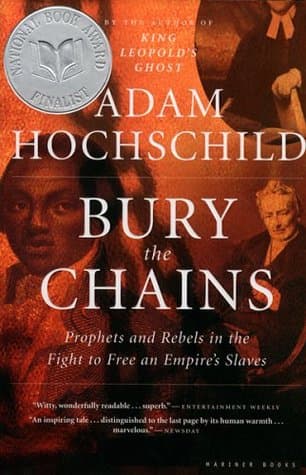
Bury the Chains cover
Archivist's Choice

Bury the Chains

Adam Hochschild (2004)

Genre

Politics / History

Reading Time

12-15 hours

Key Themes

See below

Track Your Reading

Sign in to track this book

Twelve determined men in a London printing shop started the world's first grassroots movement, using boycotts and celebrity endorsements to end the British Empire's slave trade against strong opposition.

Core Idea

Adam Hochschild's "Bury the Chains" traces the British abolitionist movement from its beginning. It shows how a small, committed group of activists, driven by moral outrage and new public persuasion methods, ended slavery in the British Empire. The book argues that their success came from using eyewitness accounts, careful storytelling, and constant pressure against powerful opponents. This shows how organized moral advocacy can change deeply rooted global injustices.
Reading time
12-15 hours
Difficulty
Medium
✓ Read this if...
You are interested in the history of social movements, the abolition of slavery, or how ordinary people can effect monumental political and moral change through sustained effort and innovative tactics.
✗ Skip this if...
You prefer a concise overview rather than a detailed, extensively researched historical narrative, or if you are not interested in the specifics of 18th and 19th-century British political and social history.

Core idea

The central argument and framework that powers the entire book.

Adam Hochschild's "Bury the Chains" traces the British abolitionist movement from its beginning. It shows how a small, committed group of activists, driven by moral outrage and new public persuasion methods, ended slavery in the British Empire. The book argues that their success came from using eyewitness accounts, careful storytelling, and constant pressure against powerful opponents. This shows how organized moral advocacy can change deeply rooted global injustices.

At a glance

Reading time

12-15 hours

Difficulty

Medium

Read this if...

You are interested in the history of social movements, the abolition of slavery, or how ordinary people can effect monumental political and moral change through sustained effort and innovative tactics.

Skip this if...

You prefer a concise overview rather than a detailed, extensively researched historical narrative, or if you are not interested in the specifics of 18th and 19th-century British political and social history.

Key Takeaways

1

The Power of a Small, Dedicated Core

A handful of committed individuals can spark a global movement.

Quote

Twelve men, united by their hatred of slavery, came together in a London printing shop and began the world's first grass-roots movement.

The British abolitionist movement, despite its large scope and eventual success, started with a very small group of committed people. Hochschild details how these twelve men, from different backgrounds, formed a committee that would begin a decades-long fight. Their dedication, planning, and willingness to work hard against great odds show that big social change often begins not with wide support, but with the focused work of a passionate few. This core group's ability to clearly state a moral vision and keep working was key to turnin...

Supporting evidence

The formation of the 'Committee for the Abolition of the Slave Trade' in 1787 by twelve men, including Granville Sharp, Thomas Clarkson, and Josiah Wedgwood.

Apply this

When facing seemingly insurmountable social or political challenges, identify and empower a small, highly committed group of individuals to initiate and drive the core strategy. Focus on clarity of purpose and sustained effort rather than immediate mass appeal.


grassroots-activismsocial-changefounding-principles
2

Innovating Public Persuasion

Abolitionists pioneered modern campaigning tactics to sway public opinion.

Quote

The movement's leaders pioneered a variety of techniques that have been adopted by citizens' movements ever since, from consumer boycotts to wall posters and lapel buttons to celebrity endorsements.

Hochschild shows how British abolitionists were not just morally driven, but also smart innovators in public persuasion. They knew that intellectual arguments alone were not enough; they needed to connect with people and motivate action. Their methods, new for their time, included using visual aids like the 'Am I Not a Man and a Brother?' medallion, spreading pamphlets and posters widely, and organizing large petitions. They also arranged boycotts of slave-produced sugar and used the public profiles of people like Josiah Wedgwood. The...

Supporting evidence

The widespread distribution of the 'Am I Not a Man and a Brother?' medallion by Josiah Wedgwood; Thomas Clarkson's extensive travels collecting artifacts of the slave trade; the sugar boycott; mass petition campaigns.

Apply this

When advocating for a cause, don't rely solely on facts. Develop a multi-faceted communication strategy that includes compelling visuals, relatable narratives, and diverse channels to reach and emotionally engage a broad audience. Consider innovative ways to involve the public directly.

public-relationscampaign-strategypropaganda-history
3

The Power of Eyewitness Testimony

First-hand accounts humanized the abstract horror of slavery.

Quote

The abolitionists understood that to move people, they needed to make the suffering of enslaved Africans tangible and personal.

One of the abolitionists' most effective tools was collecting and sharing eyewitness accounts from former slaves and repentant slave ship captains. Hochschild highlights people like Olaudah Equiano, whose autobiography gave a harsh, personal look at the brutality of the Middle Passage and plantation life. These personal stories, often vivid and emotional, went beyond abstract talks about economic use or property rights. They made the British public face the human cost of slavery, removing its polite terms and showing its cruelty. This...

Supporting evidence

The impactful autobiography of Olaudah Equiano; testimony from former slave ship surgeon Alexander Falconbridge; Thomas Clarkson's collection of instruments of torture from slave ships.

Apply this

To make a complex issue resonate, prioritize and amplify the voices of those directly affected. Personal stories and first-hand experiences are often more persuasive than statistics or abstract arguments, as they build empathy and connection.

oral-historyempathy-buildinghuman-rights-advocacy
4

The Unyielding Opposition

Powerful economic interests fight relentlessly against social reform.

Quote

The slave trade was deeply entrenched in British commerce, and those who profited from it fought with immense resources and cunning.

Hochschild does not avoid detailing the strong opposition the abolitionists faced. The slave trade was a main part of the British economy, bringing great wealth to merchants, planters, and even parts of the aristocracy. These powerful groups formed a well-funded and politically connected counter-movement. They used tactics from lobbying Parliament and bribing journalists to spreading false information and starting riots. They argued for economic necessity, property rights, and even that slavery was 'kind.' The size and ruthlessness of...

Supporting evidence

The lobbying efforts of West India planters and merchants in Parliament; the support for the slave trade by figures like Lord Liverpool; propaganda depicting slaves as lazy or content.

Apply this

Anticipate strong, well-resourced opposition when challenging entrenched economic or political systems. Understand their arguments, funding sources, and political influence to strategically counter their efforts and prepare for a sustained, difficult struggle.

economic-interestspolitical-lobbyingcounter-movements
5

The Role of Moral Outrage

Moral conviction can override economic rationality and political inertia.

Quote

What drove the abolitionists was not economic calculation but a profound sense of moral disgust at the 'peculiar institution'.

A compelling part of Hochschild's story is the focus on the moral reason that drove the abolitionist movement. Despite the huge economic benefits from slavery and the political convenience of keeping things as they were, more and more of British society saw the institution as wrong and an offense to God. This moral outrage, carefully built by abolitionist information and personal stories, eventually outweighed arguments of economic use and national interest. It shows that when a moral cause is clearly stated and deeply felt by enough ...

Supporting evidence

The Quaker community's early moral stance against slavery; the widespread adoption of the 'Am I Not a Man and a Brother?' emblem appealing to universal human dignity; sermons and religious tracts condemning slavery.

Apply this

When building a movement, articulate the moral core of your cause clearly and passionately. Appeal to universal values and human dignity to inspire deep commitment and transcend purely practical or economic objections.

moral-philosophyethical-leadershipsocial-justice
6

The Importance of Sustained Pressure

Social change is a marathon, not a sprint, requiring decades of persistence.

Quote

The fight for abolition was a long, grinding war, not a single decisive battle. Victory came only through decades of unyielding pressure.

The story in 'Bury the Chains' covers decades, from the first committee meeting in 1787 to the eventual end of slavery across the British Empire in 1833. This long struggle highlights an important lesson: big social change rarely happens quickly or easily. The abolitionists faced many failures, legislative defeats, and times when the public lost interest. Yet, they kept going, changing their strategies, finding new supporters, and constantly rebuilding momentum. Their steady commitment over generations, even when success seemed far of...

Supporting evidence

The long gap between the abolition of the slave trade (1807) and the abolition of slavery itself (1833); the repeated parliamentary defeats of abolition bills; the continued activism of figures like William Wilberforce and Thomas Clarkson over decades.

Apply this

Prepare for a long-term commitment when pursuing large-scale social change. Develop strategies for maintaining momentum, adapting to setbacks, and sustaining activist engagement over extended periods, understanding that patience and persistence are key.

long-term-activismresiliencepolitical-endurance
7

The Global Reach of Injustice

The fight against slavery revealed the interconnectedness of global exploitation.

Quote

The chains of slavery stretched from the sugar plantations of the Caribbean to the textile mills of Lancashire, connecting distant lives in a web of exploitation.

Hochschild shows how the British slave trade was not an isolated evil but a part of a large global economic system. The sugar eaten in London, the cotton processed in Manchester, and the profits made by British merchants were all directly linked to the brutal exploitation of enslaved Africans in the Caribbean and Americas. The abolitionists, by revealing these connections, made the public face their involvement in a global system of injustice. This interconnectedness shows how seemingly local or distant exploitation often has wide-rea...

Supporting evidence

The economic links between British industrial centers and slave-produced goods; the role of the Royal Navy in protecting slave ships; the global reach of the British Empire's economic interests.

Apply this

When addressing social injustices, trace their global connections and understand how local issues are often symptoms of larger systemic problems. Frame the issue within a global context to build broader solidarity and advocate for comprehensive solutions.

global-economycolonialismsystemic-injustice
8

The Complexity of Abolition

Even 'victory' involved compromises and continued injustices.

Quote

The abolition of slavery in the British Empire was a triumph, but one achieved through compromise, leaving many questions of justice unresolved.

While celebrating the great achievement of British abolition, Hochschild also gives a detailed view of its end. The final act of abolition in 1833, while ending chattel slavery, was not a perfectly fair solution. It included payment for slave owners (a huge amount of money) but none for the formerly enslaved. Also, it brought in a period of 'apprenticeship' that often mirrored many conditions of slavery. This shows that even hard-won victories in social justice are rarely complete and often involve tough compromises that can continue ...

Supporting evidence

The £20 million compensation paid to slave owners by the British government; the 'apprenticeship' system implemented after 1833, which delayed full freedom for many.

Apply this

Recognize that legislative victories are often just one step in a longer journey toward justice. Critically evaluate the compromises made and advocate for continued action to address residual inequalities and ensure full, equitable outcomes for all affected parties.

transitional-justicehistorical-redresspolicy-compromise
9

Everyday Heroes and Unsung Voices

The movement relied on countless ordinary people taking extraordinary stands.

Quote

Beyond the famous names, thousands of ordinary citizens, from Quakers to working-class women, played vital roles in the fight against slavery.

Hochschild skillfully expands the focus beyond well-known figures like Wilberforce and Clarkson, emphasizing the important contributions of countless ordinary people. He highlights the Quakers' early and consistent moral stand, the women who organized sugar boycotts and petition drives, and the working-class people who signed petitions despite their own difficulties. These uncelebrated heroes, through their daily acts of defiance, moral belief, and sustained effort, formed the real foundation of the movement. Their collective action s...

Supporting evidence

The widespread participation in the sugar boycott; the tens of thousands of signatures on parliamentary petitions; the consistent anti-slavery stance of the Quaker community.

Apply this

Empower and recognize the contributions of all participants in a movement, not just the prominent leaders. Foster a sense of collective ownership and highlight how even seemingly small individual actions contribute to larger goals.

collective-actioncitizen-activismgrassroots-organizing
10

The Power of Narrative Framing

How a cause is presented can dictate its public reception and success.

Quote

The abolitionists were masters at framing the argument, shifting it from abstract economics to undeniable human suffering.

A main idea from Hochschild's work is the abolitionists' cleverness in presenting their cause. At first, slavery was often discussed in terms of economic benefit, property rights, or colonial policy. The abolitionists purposefully and effectively changed this story. They focused constantly on the moral wrongness of the institution, the basic humanity of enslaved people, and the brutal physical realities of the slave trade. By using strong images (like the kneeling slave medallion), personal stories, and clear moral arguments, they ref...

Supporting evidence

The 'Am I Not a Man and a Brother?' medallion; the detailed accounts of cruelty in pamphlets and books; the focus on the Middle Passage's horrors.

Apply this

When advocating for a cause, carefully consider how it is framed. Identify the most compelling moral or human-centered arguments and craft narratives that resonate emotionally, shifting the public discourse away from purely transactional or abstract considerations.

storytellingpublic-discourserhetoric

Critical analysis

Notable Quotes

The abolitionists were not content to wait for the slow evolution of public opinion. They believed that slavery was a moral abomination that demanded immediate and unconditional eradication.

Describing the radical nature of early abolitionist demands.

They were, in essence, the first true human rights movement, seeing the black slave not as a piece of property but as a fellow human being, endowed with inalienable rights.

Highlighting the groundbreaking aspect of the abolitionist movement.

The chains were not only physical; they were also mental, economic, and political, binding both slave and master in a system that corrupted all it touched.

Expounding on the pervasive nature of slavery's impact.

To be an abolitionist in early nineteenth-century Britain or America was to invite opprobrium, ridicule, and often violence.

Illustrating the personal cost and danger faced by early abolitionists.

The power of a few dedicated individuals to shift the moral compass of an entire nation is one of the enduring lessons of the anti-slavery struggle.

Reflecting on the impact of individual activism.

They understood that a great evil could not be chipped away at incrementally; it had to be confronted head-on, with an uncompromising demand for justice.

Explaining the abolitionist strategy of immediate emancipation.

The stories of those who fought against slavery are not merely historical footnotes; they are a testament to the enduring human capacity for empathy and courage.

Emphasizing the inspirational legacy of the abolitionists.

The sheer scale of human suffering inflicted by the slave trade is almost beyond comprehension, yet it was meticulously documented by those who sought its end.

Discussing the horrors of the slave trade and the role of documentation in abolition.

It was a battle not just against an economic system, but against deeply ingrained prejudices and the comforting lies that sustained them.

Describing the multifaceted nature of the anti-slavery struggle.

The abolitionists forced society to look at its own reflection, and in that reflection, to see the monstrous injustice it had long tolerated.

Highlighting the role of abolitionists in revealing societal hypocrisy.

The struggle for freedom, wherever it occurs, owes a debt to these pioneers who dared to imagine a world without chains.

Positioning the abolitionists as foundational figures for future freedom movements.

They were masters of public relations and political maneuvering, long before those terms were even invented, understanding the power of narrative and organized protest.

Crediting abolitionists with innovative campaigning techniques.

The courage to speak truth to power, even when that truth is unpopular and dangerous, remains the bedrock of any meaningful social change.

General reflection on the principles demonstrated by the abolitionist movement.

Their victory, though incomplete and hard-won, serves as a powerful reminder that even the most entrenched evils can be overcome by unwavering moral resolve.

Concluding thought on the legacy and lessons of the abolitionist movement.

Quiz

Test Your Knowledge

Ready to see how well you understood this book? Take our interactive quiz with 10 questions.

10
Questions
~5
Minutes
?
Best Score

Key Questions (FAQ)

'Bury the Chains' by Adam Hochschild tells the gripping story of the British abolitionist movement, detailing how a small group of activists launched the world's first grassroots social justice campaign to end slavery in the British Empire. It chronicles their innovative methods and the powerful forces they overcame.

About the author