BookBrief
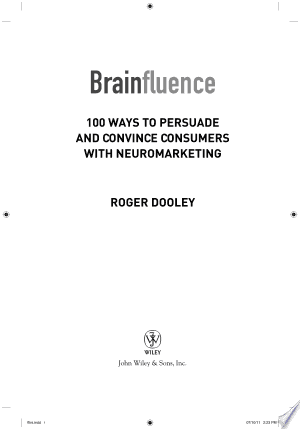
Brainfluence cover
Archivist's Choice

Brainfluence

Roger Dooley (2011)

Genre

General

Reading Time

240 min

Key Themes

See below

Track Your Reading

Sign in to track this book

Use neuroscience to create marketing messages that resonate with consumers, turning browsers into buyers.

Core Idea

Brainfluence translates neuroscience and psychology research into practical marketing and sales strategies. It shows how understanding unconscious biases, cognitive shortcuts, and emotional drivers in decision-making helps businesses optimize their messaging, pricing, product design, and customer experience. This can increase conversion rates and customer loyalty. The book offers a framework for using principles like scarcity, social proof, loss aversion, and sensory marketing to influence consumer behavior and improve business results.
Reading time
240 min
Difficulty
Medium
✓ Read this if...
You are a marketer, salesperson, or business owner looking for science-backed techniques to improve your persuasive abilities and understand customer psychology.
✗ Skip this if...
You are looking for a deep dive into the theoretical neuroscience behind cognitive biases rather than practical applications, or if you prefer purely creative marketing approaches without a scientific basis.

Core idea

The central argument and framework that powers the entire book.

Brainfluence translates neuroscience and psychology research into practical marketing and sales strategies. It shows how understanding unconscious biases, cognitive shortcuts, and emotional drivers in decision-making helps businesses optimize their messaging, pricing, product design, and customer experience. This can increase conversion rates and customer loyalty. The book offers a framework for using principles like scarcity, social proof, loss aversion, and sensory marketing to influence consumer behavior and improve business results.

At a glance

Reading time

240 min

Difficulty

Medium

Read this if...

You are a marketer, salesperson, or business owner looking for science-backed techniques to improve your persuasive abilities and understand customer psychology.

Skip this if...

You are looking for a deep dive into the theoretical neuroscience behind cognitive biases rather than practical applications, or if you prefer purely creative marketing approaches without a scientific basis.

Key Takeaways

1

Primacy and Recency Rule

People remember what they encounter first and last most vividly.

Quote

When you want to communicate something important, put it first or last. The middle is for filler.

The serial position effect, specifically primacy and recency, means people remember information at the beginning and end of a sequence better than information in the middle. This is a powerful tool for marketers. In a presentation, ad, or customer service interaction, the opening and closing statements are most important. The brain prioritizes these points, making them more memorable. This means your strongest selling points, calls to action, or core brand message should always be in these key positions to maximize their impact on mem...

Supporting evidence

Dooley references numerous studies on the serial position effect, demonstrating how lists of items are remembered with higher accuracy at their extremes. He applies this to marketing communications, suggesting that crucial information should always be placed at the beginning or end of a message.

Apply this

When designing a landing page, place your most compelling headline and a strong call to action at the top (primacy) and reiterate the core benefit or offer with another clear CTA at the very bottom (recency). In a sales pitch, start with your most impactful problem statement or benefit, and end with a clear, concise next step.


serial-position-effectprimacy-effectrecency-effect
2

The Power of Scarcity

Limited availability drives urgency and perceived value.

Quote

If you want people to desire something, make it scarce. Our brains are wired to value what's rare.

Scarcity is a strong psychological trigger for action. When something is seen as limited, either in quantity or time, its desirability and perceived value increase significantly. This is not just a rational assessment; it taps into our fear of missing out (FOMO) and a basic drive to get resources before they are gone. Marketers can use this by clearly communicating limited stock, time-sensitive offers, or exclusive access. The key is genuine scarcity or a believable illusion of it; false scarcity can backfire and damage trust. When us...

Supporting evidence

Dooley cites examples like 'limited time offers,' 'only X left in stock,' and 'early bird discounts' as effective applications of scarcity. He discusses how these tactics tap into our psychological biases, making us act faster to avoid losing an opportunity.

Apply this

For an e-commerce store, display 'Only 3 left!' next to a product that's selling well. For a service, offer a 'first 50 sign-ups get a bonus' incentive. For an event, use 'Ticket sales end Friday!' to encourage early registration.

scarcity-principlefear-of-missing-outurgency
3

Anchoring and Price Perception

Initial price points heavily influence how subsequent prices are perceived.

Quote

The first number you show someone can profoundly shape their perception of all numbers that follow.

Anchoring is a cognitive bias where an initial piece of information (the 'anchor') affects later judgments. In marketing, this is most clear in pricing. When consumers see a high initial price, even if it is a decoy or a 'list price,' it sets a high anchor. Subsequent, lower prices then seem more attractive and reasonable by comparison. This is not about deception but about framing value. By strategically introducing a higher reference point, marketers can make their actual target price seem like a much better deal, subtly guiding the...

Supporting evidence

Dooley discusses how car dealerships often show a fully loaded, high-priced model first to make mid-range models seem like a bargain. He also references studies where even irrelevant numbers can influence subsequent estimations, demonstrating the subconscious power of anchoring.

Apply this

Offer a 'premium' package at a significantly higher price point alongside your 'standard' and 'deluxe' options. Even if few buy the premium, it makes the 'deluxe' package seem more reasonably priced. Similarly, show the 'original price' struck out next to a discounted price.

anchoring-biasprice-perceptioncognitive-bias
4

The Power of Social Proof

People are more likely to do what they see others doing.

Quote

When in doubt, we look to others. Show your customers that many people like them are already using and loving your product.

Social proof is a basic human tendency to follow the actions and beliefs of others, especially when we are unsure. In marketing, this means using testimonials, reviews, endorsements, and popularity metrics to reassure potential customers. Seeing that others have already bought, used, and benefited from a product or service reduces perceived risk and builds trust. The more specific and relatable the social proof (e.g., 'customers like you'), the more effective it is. This is not just about vanity metrics; it is about providing psycholo...

Supporting evidence

Dooley highlights the effectiveness of 'best-seller' lists, customer reviews on e-commerce sites, and celebrity endorsements. He explains how seeing a crowd at a restaurant makes it seem more appealing, illustrating the subconscious influence of others' choices.

Apply this

Feature customer testimonials prominently on your website, especially those with photos and specific benefits. Display the number of units sold or positive reviews. Use 'Join X happy customers!' in your call to action. Highlight user-generated content.

social-proofconformitytrust-buildingfomo
5

Emotional vs. Rational Brain

Decisions are primarily driven by emotion, then rationalized.

Quote

The primitive brain makes decisions quickly and emotionally, then hands it off to the rational brain to justify the choice.

Despite believing we make rational decisions, the 'old brain' (limbic system and brainstem), which handles emotions and survival instincts, often makes purchasing decisions before the 'new brain' (neocortex) justifies them. Marketers who appeal directly to emotions like fear, desire, joy, or belonging are more effective than those who only list features and benefits. Focus on how your product makes people feel or solves an emotional problem, rather than just what it does. Once the emotional connection is made, provide the logical argu...

Supporting evidence

Dooley references numerous studies showing how emotional appeals in advertising outperform purely logical ones. He discusses the 'lizard brain' concept – our primitive, emotional decision-making center – and how it prioritizes immediate gratification and avoiding pain.

Apply this

Instead of saying 'Our car has excellent fuel economy,' say 'Imagine the freedom of fewer stops at the gas station, more adventures with your family.' Focus ad copy on the emotional benefits and transformation, not just the technical specs.

emotional-marketinglimbic-systemneuromarketingdecision-making
6

The Power of Loss Aversion

People are more motivated to avoid a loss than to achieve an equivalent gain.

Quote

The pain of losing ten dollars is far greater than the pleasure of finding ten dollars. Frame your offers to emphasize what customers stand to lose.

Loss aversion is a strong cognitive bias where the psychological impact of a loss is about twice as strong as the impact of an equivalent gain. This means people will work harder to prevent losing something they already have or expect to have, than they will to gain something new. Marketers can use this by framing offers in terms of avoiding a loss. Instead of 'gain X benefit,' focus on 'don't miss out on X' or 'avoid Y problem.' This taps into a deep human aversion to diminishing resources or opportunities, creating a stronger drive ...

Supporting evidence

Dooley discusses classic behavioral economics experiments demonstrating loss aversion, such as people being unwilling to give up a mug they were given, even for a slightly higher cash value. He applies this to marketing by suggesting language that emphasizes what customers will *lose* if they don't act.

Apply this

Instead of 'Sign up today to get a 10% discount,' try 'Don't lose your chance for a 10% discount – offer ends soon!' For a service, highlight the potential problems or inefficiencies a business will *avoid* by using your solution.

loss-aversioncognitive-biasframing-effectfomo
7

Simplicity and Cognitive Ease

The brain prefers easy processing; reduce cognitive load.

Quote

If it's hard to understand, it's hard to buy. Make your message, your process, and your product effortlessly simple.

Our brains are inherently lazy, always trying to save energy by avoiding complex thought. This preference for 'cognitive ease' means that simpler messages, intuitive interfaces, and straightforward processes are more appealing and effective. Overwhelming customers with too many choices, jargon, or complicated steps creates friction and leads to abandonment. Marketers should aim for clarity, conciseness, and seamless user experiences. Reduce clicks, simplify language, and minimize visual clutter. The less mental effort needed to unders...

Supporting evidence

Dooley emphasizes the importance of clear, simple language and design. He talks about how complex forms or confusing website navigation lead to high bounce rates and abandoned carts, illustrating the brain's aversion to excessive mental effort.

Apply this

Streamline your website checkout process to as few steps as possible. Use plain language in your product descriptions, avoiding industry jargon. Offer limited, curated choices instead of an overwhelming array of options. Use clear, contrasting calls to action.

cognitive-easesimplicityuser-experiencefrictionless-design
8

The Power of Sensory Marketing

Engaging multiple senses creates stronger, more memorable brand experiences.

Quote

Don't just appeal to the eyes and ears. The most memorable experiences engage all the senses, creating deeper connections.

Marketing often focuses on visual and auditory stimuli, but the brain processes information from all five senses to create its reality. Engaging multiple senses simultaneously can create a richer, more immersive, and more memorable brand experience, leading to stronger emotional connections and recall. Consider how scent, touch, and even taste (when applicable) can reinforce your brand message. A subtle, pleasant scent in a retail store, the feel of premium packaging, or even the sound a product makes when used, all contribute to a ho...

Supporting evidence

Dooley discusses studies on scent marketing in retail, where specific aromas increased sales and dwell time. He also mentions the importance of tactile elements in packaging and the auditory branding (jingles, product sounds) that create distinct brand identities.

Apply this

For a physical store, consider a signature scent. For a product, invest in high-quality packaging that feels good to the touch. For a brand, develop a distinct sound logo or jingle. Restaurants should focus on plating and even the sound of sizzling food.

sensory-marketingbrand-experienceolfactory-marketinghaptic-feedback
9

Framing and Context Matters

How information is presented significantly alters its interpretation.

Quote

The same information, framed differently, can lead to entirely different conclusions in the customer's mind.

The way information is presented, or 'framed,' significantly impacts how it is perceived and interpreted by the brain. A product described as '90% fat-free' sounds more appealing than 'contains 10% fat,' even though the objective information is the same. This is not about manipulating facts, but about highlighting the most favorable aspects and aligning them with customer desires or concerns. Framing can shift attention, evoke different emotional responses, and guide customers towards a preferred interpretation. Understanding this bia...

Supporting evidence

Dooley uses classic examples like '90% fat-free' vs. '10% fat' to illustrate framing. He also discusses how focusing on 'saving money' vs. 'investing in quality' can appeal to different customer segments, showcasing the power of contextual presentation.

Apply this

When selling a security system, frame it as 'peace of mind and protection for your family' rather than just 'alarm system features.' For a subscription, emphasize 'cost of a daily coffee' rather than the monthly total. Highlight positive attributes over negative ones.

framing-effectcognitive-biascontextual-marketingpersuasion
10

The Decoy Effect

Introducing a strategically inferior third option can boost sales of a target product.

Quote

Sometimes, to make your preferred option shine, you need to introduce a slightly worse option that makes the choice obvious.

The decoy effect, or asymmetric dominance effect, happens when consumers' preference for one option over another changes when a third, 'decoy' option is presented. The decoy is designed to be clearly inferior to one option (the 'target') but not necessarily to the other (the 'competitor'). This makes the target option seem much more attractive and a better value by comparison, even if the decoy is rarely chosen itself. It is a powerful tool for nudging customers towards a specific product or service, making their decision feel more ra...

Supporting evidence

Dooley references the classic Economist subscription example: an online-only option, a print-only option (the decoy, priced similarly to the online+print), and an online+print option. The decoy made the online+print option seem like an incredible deal, boosting its sales significantly.

Apply this

Offer three pricing tiers: Basic ($10), Pro ($50, with only slightly more features than Basic), and Premium ($55, with significantly more features than Pro). The 'Pro' option acts as a decoy, making the 'Premium' option seem like a much better value for only a little more money.

decoy-effectasymmetric-dominancechoice-architecturepricing-strategy

Critical analysis

Notable Quotes

The human brain is a prediction machine. It constantly tries to anticipate what will happen next.

Introduction to how the brain processes information and makes decisions.

Emotion is the on-ramp to attention and memory.

Discussing the role of emotion in marketing and persuasion.

People don't buy products; they buy better versions of themselves.

Explaining the underlying motivations for consumer purchases.

Scarcity works because it triggers a primal fear of loss.

Analyzing the effectiveness of scarcity as a persuasion technique.

The brain values certainty over ambiguity.

Highlighting the brain's preference for clear, unambiguous information.

Reciprocity isn't just about giving back; it's about feeling obligated to give back.

Elaborating on the psychological mechanism behind the principle of reciprocity.

We are wired to pay attention to what's new and different.

Discussing the brain's novelty bias and its implications for marketing.

The easier something is to process, the more we like it.

Explaining the concept of cognitive fluency and its impact on preference.

Social proof isn't just about showing that others like something; it's about showing that people *like you* like something.

Refining the understanding of social proof and its effectiveness.

The brain loves stories because they are memorable and relatable.

Advocating for the use of storytelling in communication and marketing.

Pain points are opportunities in disguise.

Encouraging a focus on understanding and addressing customer problems.

Repetition builds familiarity, and familiarity builds trust.

Explaining the power of consistent messaging and branding.

Don't just sell features; sell the transformation.

Advising marketers to focus on benefits and outcomes rather than just product attributes.

The human brain is lazy. Make it easy for people to say yes.

Emphasizing the importance of reducing friction in the customer journey.

Quiz

Test Your Knowledge

Ready to see how well you understood this book? Take our interactive quiz with 10 questions.

10
Questions
~5
Minutes
?
Best Score

Key Questions (FAQ)

Neuromarketing is the application of neuroscience and behavioral research to understand consumer decision patterns and responses to marketing stimuli. It's important because it helps businesses measure consumer preferences, reactions, and motivations, leading to more effective marketing strategies.

About the author