BookBrief
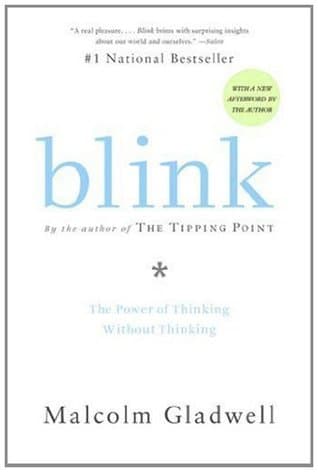
Blink: The Power of Thinking Without Thinking cover
Archivist's Choice

Blink: The Power of Thinking Without Thinking

Malcolm Gladwell (2004)

Genre

Business / Leadership / Science / Philosophy / Self-Help

Reading Time

240 min

Key Themes

See below

Track Your Reading

Sign in to track this book

Explore the hidden power of quick judgments and how 'thin-slicing' information helps skilled decision-makers succeed instantly, often without conscious thought.

Core Idea

Blink argues that quick cognition, or 'thin-slicing,' is a strong and often more accurate way to understand the world and make decisions than long, detailed analysis. Our unconscious minds can find important patterns from little information in an instant, leading to quick judgments that are frequently insightful and effective. However, this intuitive power can be biased or misled by context and preconceptions. We need to understand its strengths and limits to develop better, more reliable intuition.
Reading time
240 min
Difficulty
Easy
✓ Read this if...
You are curious about the mechanics of intuition, snap judgments, and unconscious decision-making, and how these processes can be harnessed or misunderstood in everyday life and professional settings.
✗ Skip this if...
You prefer highly detailed, academic psychological studies, or are looking for a prescriptive, step-by-step guide to improving decision-making rather than a narrative exploration of the topic.

Core idea

The central argument and framework that powers the entire book.

Blink argues that quick cognition, or 'thin-slicing,' is a strong and often more accurate way to understand the world and make decisions than long, detailed analysis. Our unconscious minds can find important patterns from little information in an instant, leading to quick judgments that are frequently insightful and effective. However, this intuitive power can be biased or misled by context and preconceptions. We need to understand its strengths and limits to develop better, more reliable intuition.

At a glance

Reading time

240 min

Difficulty

Easy

Read this if...

You are curious about the mechanics of intuition, snap judgments, and unconscious decision-making, and how these processes can be harnessed or misunderstood in everyday life and professional settings.

Skip this if...

You prefer highly detailed, academic psychological studies, or are looking for a prescriptive, step-by-step guide to improving decision-making rather than a narrative exploration of the topic.

Key Takeaways

1

The Power of Thin-Slicing

Our brains make accurate judgments from minimal information in an instant.

Quote

The ability of our unconscious to find patterns in situations and behavior based on very narrow slices of experience.

Thin-slicing is the unconscious ability to find key information from a small amount of experience. It is the brain's capacity to find patterns and make accurate quick judgments based on seconds of observation, often without us realizing it. This is not guesswork; it is a sophisticated, fast pattern recognition system refined through experience and evolution. Gladwell argues that these instant decisions can be as, or even more, reliable than prolonged, deliberate analysis, especially where deep expertise exists. The quality of these qu...

Supporting evidence

Gladwell details the work of psychologist John Gottman, who can predict with over 90% accuracy whether a marriage will last after observing a couple interact for just a few minutes, identifying key 'Four Horsemen' behaviors (criticism, contempt, defensiveness, stonewalling).

Apply this

Trust your gut feelings more, especially in areas where you possess deep expertise. Practice active observation to train your unconscious to pick up on critical cues more effectively. When faced with a decision, quickly identify the absolute essential variables rather than getting bogged down in exhaustive data.
thin-slicingunconscious-cognitionpattern-recognition
2

The Locked Door: The Pitfalls of Overthinking

Excessive analysis can hinder, rather than help, effective decision-making.

Quote

There are moments, particularly in times of stress, when haste does not make waste, when our snap judgments and first impressions can offer a much more meaningful means of making sense of the world.

While thin-slicing is powerful, conscious overthinking often weakens its effectiveness, a phenomenon Gladwell calls 'the locked door.' This refers to times when we have an intuitive understanding or an accurate quick judgment, but our conscious mind, looking for logical reasons or more data, dismisses it. This can lead to worse outcomes, especially in high-pressure or unclear situations. The conscious mind, while good for complex, step-by-step problem-solving, can be a disadvantage when speed and intuitive pattern recognition are most...

Supporting evidence

The unfortunate case of the New Coke launch, where extensive focus group data, designed to analytically assess preferences, failed to capture the nuanced, emotional connection consumers had with the original Coca-Cola, leading to a massive commercial failure.

Apply this

Learn to distinguish between situations that require careful deliberation and those where your immediate intuition is likely more accurate. Practice mindfulness to become more aware of your initial reactions before your conscious mind starts to rationalize them away. Don't always feel compelled to explain every decision; sometimes, 'I just know' is a valid reason.

overthinkingcognitive-biasintuitive-decision-making
3

The Power of the Unconscious

Our instantaneous judgments often stem from a deeply informed, unconscious process.

Quote

Our unconscious is a powerful force, but it's also a delicate one. It's good at making snap judgments, but it's also susceptible to all kinds of influences.

Gladwell argues that our quick judgments are not random or magical, but rather the result of a sophisticated, efficient unconscious mind. This 'adaptive unconscious' quickly and silently processes large amounts of information, using our experiences, knowledge, and biases to form immediate conclusions. It is a system built for speed and efficiency, helping us navigate complex social and physical environments without feeling overwhelmed. The quality of this unconscious processing depends heavily on the quality of our experiences and tra...

Supporting evidence

The Getty Museum's acquisition of the 'kouros' statue. Expert art historians and archaeologists immediately felt a 'gut feeling' that it was a fake, despite scientific tests initially suggesting authenticity. Their unconscious had processed subtle cues (e.g., the fingernails, the patina) that didn't align with their vast experience of ancient Greek sculpture.

Apply this

Cultivate expertise in your field, as deep knowledge trains your unconscious to make better snap judgments. Pay attention to how your body reacts to situations – sometimes, a physical feeling is your unconscious trying to communicate. Be aware that your unconscious can also harbor biases, so actively seek diverse perspectives to challenge your initial reactions.

adaptive-unconsciousexpertiseintuition
4

The Folly of First Impressions

Initial judgments, while powerful, can be profoundly shaped by subtle and often irrelevant biases.

Quote

The first impression can be a powerful thing, but it can also be a misleading thing.

While thin-slicing can be very accurate, it is not perfect. Gladwell shows how our first impressions, especially of people, can be greatly affected by superficial cues and unconscious biases. Things like appearance, tone of voice, or even a person's name can trigger stereotypes and associations that lead to inaccurate or unfair judgments. These biases operate without our conscious awareness, making them hard to detect and correct. Understanding this vulnerability is important for making fairer and more objective decisions, especially ...

Supporting evidence

The case of Warren Harding, who was elected president largely because he 'looked presidential.' His imposing stature and dignified appearance created a powerful first impression that overshadowed his actual qualifications and intellectual shortcomings, leading to a largely ineffective presidency.

Apply this

Actively challenge your first impressions, especially when they involve people. Implement 'blind' processes (e.g., blind auditions, anonymized resumes) where possible to remove superficial cues. Cultivate empathy and seek out information that contradicts your initial assumptions to counteract unconscious biases.

unconscious-biasfirst-impressionsstereotypesprejudice
5

Structured Spontaneity: The Art of Knowing When to Trust Your Gut

True expertise involves knowing when to rely on intuition and when to pause for analysis.

Quote

The key to good decision making is not to make them too quickly, but to make them at the right speed.

The book does not advocate for impulsive decision-making; instead, it aims to explain when quick judgments are most reliable. This 'structured spontaneity' is a mark of true expertise. Experts do not just react; they have developed a sophisticated mental framework that lets them instantly interpret complex situations and respond correctly. This framework is built through years of practice and exposure to various scenarios, training the unconscious mind to recognize patterns. The best decision-makers have learned to quickly filter info...

Supporting evidence

Firefighters, particularly incident commanders, make life-or-death decisions in chaotic, rapidly evolving situations. They don't have time for extensive deliberation; instead, they rely on 'recognition-primed decision-making,' where their experience allows them to instantly recognize a situation and recall an appropriate response.

Apply this

For critical decisions, cultivate deep domain expertise. Engage in deliberate practice that exposes you to a wide range of scenarios, training your intuition. In high-stakes situations, trust your trained gut, but always be prepared to course-correct if new information emerges.

expertiserecognition-primed-decision-makingdeliberate-practice
6

The Importance of Context and Environment

The setting and subtle cues profoundly influence our snap judgments.

Quote

Our unconscious thoughts and feelings are not entirely private. They are influenced by the world around us.

Gladwell illustrates how the environment and subtle contextual cues can greatly change our quick judgments and behaviors, often without our conscious awareness. This shows that our quick reactions are not purely internal; they interact deeply with our surroundings. Seemingly minor details, from the order of information presented to background noise, can prepare us to think or act in specific ways. Understanding this environmental influence is important for designing better decision-making processes and for being aware of how external ...

Supporting evidence

The controversial shooting of Amadou Diallo, an unarmed man, by four plainclothes NYPD officers. Gladwell suggests that the officers' split-second decision was influenced by a 'priming' effect – the high-stress, dangerous environment of the Bronx at night, combined with the officers' training and expectations, led them to misinterpret Diallo's actions.

Apply this

Be mindful of the environment in which you make important decisions; try to create a calm, neutral space. When evaluating situations, consciously consider what external factors might be influencing your perception. Design environments (e.g., meeting rooms, workspaces) to elicit desired behaviors and reduce negative biases.

contextual-influenceenvironmental-cuespriming-effect
7

Mind-Reading and the Power of Expression

Subtle non-verbal cues reveal true intentions and emotions.

Quote

The ability to mind-read, to correctly interpret the feelings and intentions of others, is not a magical gift but a skill that can be learned and honed.

Our ability to 'mind-read'—to quickly and accurately infer others' thoughts and feelings—is a prime example of thin-slicing in social interactions. Gladwell shows that this skill relies heavily on interpreting subtle, often brief non-verbal cues: microexpressions, body language, tone of voice, and even pauses in speech. These 'thin slices' of behavior can reveal more about a person's true state than their spoken words. Developing this sensitivity is important for effective communication, negotiation, and building strong relationships....

Supporting evidence

Psychologist Paul Ekman's work on microexpressions, showing that universal facial expressions of emotion (anger, fear, disgust, surprise, happiness, sadness, contempt) flash across our faces in fractions of a second, often before we're consciously aware of them, and can be accurately read by trained observers.

Apply this

Actively observe people's non-verbal cues in conversations – pay attention to their eyes, mouth, posture, and vocal tone. Practice identifying microexpressions. Be aware of your own non-verbal communication and how it might be perceived by others. Engage in active listening to pick up on subtle vocal shifts.

non-verbal-communicationmicroexpressionsemotional-intelligence
8

The Tyranny of the Immediate

Fixating on the present can blind us to larger patterns and long-term consequences.

Quote

Sometimes, the very thing that makes us good at thin-slicing in one context can make us blind in another.

Gladwell subtly warns that while thin-slicing is powerful, relying too much on immediate impressions can lead to missing the broader context or failing to predict future outcomes. Focusing too intensely on the 'now' can prevent us from seeing wider trends or the combined effect of small decisions. This 'tyranny of the immediate' happens when our rapid pattern recognition is so effective at a small level that it fails to zoom out and consider bigger implications. It is a reminder that even the most expert intuition needs to be balanced...

Supporting evidence

The example of poker players who become exceptionally good at reading tells and making instantaneous decisions based on current game state, but might still struggle with long-term strategic planning or managing their bankroll effectively over many sessions.

Apply this

After making a snap judgment, take a moment to consider its potential long-term consequences. Periodically step back from immediate tasks to reflect on the broader context and strategic goals. Don't let short-term 'wins' blind you to potential long-term risks or opportunities.

short-sightednessstrategic-thinkinglong-term-perspective
9

Training the Blink: Cultivating Better Intuition

Our snap judgments can be improved through deliberate practice and feedback.

Quote

The only way to improve our ability to thin-slice is to practice, to make mistakes, and to learn from them.

The good news is that our ability for effective thin-slicing is not fixed; it can be greatly improved. Gladwell emphasizes that developing better intuition involves deliberate practice and getting accurate, timely feedback. This means exposing oneself to a wide range of relevant experiences, actively reflecting on the results of quick judgments, and learning to tell the difference between reliable intuitive hits and mere biases or random guesses. It is about building a strong internal database of patterns and responses, allowing the a...

Supporting evidence

Gladwell's discussion of tennis coaches who can 'read' a player's serve and predict a double-fault before the ball is even hit. This ability is honed through countless hours of observing serves, recognizing subtle tells in body mechanics, and receiving immediate feedback on the outcome of each serve.

Apply this

Seek out experiences that challenge your intuition and provide clear feedback. After making a snap decision, reflect on why you made it and what the outcome was. Keep a journal of your intuitive decisions and their results to identify patterns and areas for improvement. Actively seek mentorship from those with highly developed intuition in your field.

deliberate-practicefeedback-loopintuitive-development
10

Transparency vs. Accuracy: The Unexplainable Genius

The most accurate snap judgments are often the hardest to rationally articulate.

Quote

The task of making sense of a split-second decision is not a trivial one.

One of the most thought-provoking ideas in 'Blink' is that the best quick judgments, born from deep expertise and sophisticated thin-slicing, are often the hardest to explain logically. When an expert 'just knows' something, their unconscious has processed many variables and recognized a pattern that would be very difficult, if not impossible, for the conscious mind to explain step-by-step. This creates a tension between the need for transparency (being able to explain a decision) and the pursuit of accuracy (making the best possible ...

Supporting evidence

The art experts who instantly recognized the Getty kouros as a fake couldn't immediately pinpoint *why*. They had a gut feeling that something was 'off' based on years of experience, but articulating the precise reasons took time and conscious effort, and even then, it felt incomplete compared to their initial conviction.

Apply this

When you have a strong intuitive hit, don't dismiss it just because you can't immediately articulate its logical basis. In team settings, foster an environment where 'gut feelings' from experts are respected, even if they can't be fully explained at first. Learn to trust your own expertise, even when it feels ineffable.

ineffable-knowledgeexpert-intuitiontransparency-dilemma

Critical analysis

Notable Quotes

The adaptive unconscious is like a giant computer that quickly and quietly processes a lot of information for us, and the computer is designed to do a specific job.

Explaining the concept of 'thin-slicing' and the brain's rapid, unconscious decision-making.

We have, as human beings, a storytelling problem. We're a bit too quick to come up with explanations for things we don't really have an explanation for.

Discussing how people over-rationalize their unconscious decisions, even when they lack real insight.

Our unconscious is a powerful force. But it's also a delicate one. It's good at what it does only if we respect its limits.

Highlighting the importance of understanding both the strengths and weaknesses of rapid cognition.

The key to good decision making is not knowledge. It is understanding. We are drowning in information, while starving for wisdom.

Arguing that raw data isn't as crucial as the ability to interpret and make sense of it quickly.

Truly successful decision making relies on a balance between deliberate and instinctive thinking.

Emphasizing that neither extreme (pure analysis or pure intuition) is optimal on its own.

The first two seconds of looking at a work of art are what matter most.

Referring to the expert art connoisseur's ability to 'thin-slice' authenticity almost instantly.

When we thin-slice, we are taking a very narrow slice of experience and making a judgment from it.

Defining the core concept of 'thin-slicing' and its power in various situations.

We often know more than we can tell.

Explaining that our unconscious mind processes information and forms judgments before our conscious mind can articulate them.

Sometimes the best way to solve a problem is to not think about it.

Illustrating situations where overthinking can hinder effective rapid cognition and intuitive decision-making.

The power of the blink is that it is not about what we say, but about what we don't say.

Highlighting the unspoken cues and unconscious biases that influence our snap judgments.

The really good decision makers are the ones who know how to manage their blink.

Suggesting that effective leadership and decision-making involve understanding and refining one's intuitive processes.

To be good at thin-slicing, you have to be able to filter out the irrelevant and focus on the relevant.

Explaining the skill involved in rapid cognition, which is not just speed but also discernment.

We have been taught that the best way to arrive at a decision is to gather as much information as possible and to spend as much time as possible in careful consideration.

Challenging traditional wisdom about decision-making, setting the stage for the book's core argument.

The truth about snap judgments is that they are not always wrong. In fact, sometimes they are more accurate than careful deliberation.

A central thesis of the book, contrasting the value of intuition with prolonged analysis.

Quiz

Test Your Knowledge

Ready to see how well you understood this book? Take our interactive quiz with 10 questions.

10
Questions
~5
Minutes
?
Best Score

Key Questions (FAQ)

'Thin-slicing' refers to our ability to find patterns in events based on very narrow slices of experience. It's the unconscious process of filtering essential information from a vast amount of data, allowing for rapid and often accurate judgments.

About the author