BookBrief
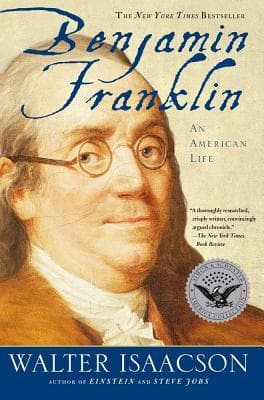
Benjamin Franklin: An American Life cover
Archivist's Choice

Benjamin Franklin: An American Life

Walter Isaacson (2003)

Genre

Business / Politics / Biography / History

Reading Time

12 Minutes

Key Themes

See below

Track Your Reading

Sign in to track this book

Core Idea

Walter Isaacson's biography of Benjamin Franklin paints a comprehensive portrait of one of America's most versatile and influential founding fathers. The book argues that Franklin's genius lay not just in his scientific discoveries or political acumen, but in his unique ability to embody and shape the nascent American identity. Franklin's pragmatic approach, his commitment to self-improvement and public service, his entrepreneurial spirit, and his talent for diplomacy made him a pivotal figure in the Enlightenment and the American Revolution, ultimately defining many of the values that would come to be seen as distinctly American.
Difficulty
Medium

Core idea

The central argument and framework that powers the entire book.

Walter Isaacson's biography of Benjamin Franklin paints a comprehensive portrait of one of America's most versatile and influential founding fathers. The book argues that Franklin's genius lay not just in his scientific discoveries or political acumen, but in his unique ability to embody and shape the nascent American identity. Franklin's pragmatic approach, his commitment to self-improvement and public service, his entrepreneurial spirit, and his talent for diplomacy made him a pivotal figure in the Enlightenment and the American Revolution, ultimately defining many of the values that would come to be seen as distinctly American.

At a glance

Difficulty

Medium

Key Takeaways

1

The Art of Self-Invention

Franklin continuously crafted his public persona, embodying the American ideal of upward mobility.

Quote

The most interesting thing that Franklin invented, and continually reinvented, was himself. America's first great publicist, he was, in his life and in his writings, consciously trying to create a new American archetype.

Isaacson argues that Franklin's greatest invention was himself. He was a master of self-promotion, carefully building his public image from a tradesman to a respected statesman. This deliberate self-creation, documented in his autobiography and writings, established a narrative of self-improvement and entrepreneurship that became central to the American character. This helps us understand not just Franklin, but the new nation's identity. His journey from humble beginnings to international fame was a carefully planned performance, desi...

Supporting evidence

Franklin's autobiography, 'Poor Richard's Almanack,' and his public letters where he often presented himself as a self-made man, emphasizing hard work and virtue.

Apply this

Understand that personal branding and narrative construction are powerful tools for influence and achieving goals, a lesson as relevant today in the digital age as it was in the 18th century.
2

Pragmatism Over Purity

Franklin prioritized practical solutions and tangible progress over rigid ideological purity.

Quote

He sought practical ways to make stoves less smoky and commonwealths less corrupt.

Isaacson shows Franklin's strong pragmatism. Unlike some of his more ideological contemporaries, Franklin cared less about abstract philosophy and more about observable results. Whether inventing a better stove, organizing a fire department, or negotiating political compromises, his approach was always about finding what worked. This practical focus is clear in his scientific work, civic improvements, and diplomacy. This emphasis on usefulness and tangible benefit, rather than lofty theories, makes him unique among the Founding Father...

Supporting evidence

His inventions (bifocals, lightning rod, Franklin stove), his role in establishing civic institutions (library, fire department), and his diplomatic successes in securing French alliance.

Apply this

In problem-solving, prioritize adaptable, workable solutions that yield real-world improvements over adhering strictly to theoretical models or dogmatic principles.

3

The Power of Civic Engagement

Franklin believed in collective action and founded numerous public institutions to improve society.

Quote

He organized neighborhood constabularies and international alliances, local lending libraries and national legislatures.

A key part of Franklin's philosophy, as Isaacson describes it, was his belief in civic participation and collective action. He didn't just identify problems; he actively created organizations to solve them. From the Junto, a self-improvement group, to Philadelphia's first lending library, fire department, and hospital, Franklin showed an unmatched dedication to community building. This active approach to improving public welfare through organized effort is one of his most lasting contributions. He saw these organizations as essential ...

Supporting evidence

Founding of the Junto, the Library Company of Philadelphia, Union Fire Company, Pennsylvania Hospital, and his efforts in establishing postal services.

Apply this

Actively participate in community development and consider founding or supporting organizations that address societal needs, recognizing the impact of collective effort.

4

Diplomacy as Persuasion

Franklin's charm, wit, and strategic understanding of human nature made him America's most effective diplomat.

Quote

He was the only man who shaped all the founding documents of America: the Albany Plan of Union, the Declaration of Independence, the treaty of alliance with France, the peace treaty with England, and the Constitution.

Isaacson portrays Franklin as an exceptional diplomat. His success came not from military power but from his understanding of human nature, his wit, and his ability to build personal relationships. His time in France, where he became a celebrity, was crucial in getting support for the American Revolution. He knew how to use his 'homespun' American image while charming the French elite. This point is especially strong because it shows that diplomacy is often more about persuasion and connection than force, a lesson still relevant in in...

Supporting evidence

His successful negotiation of the Treaty of Alliance with France (1778) and the Treaty of Paris (1783) ending the Revolutionary War, detailed in his extensive correspondence from Europe.

Apply this

Cultivate strong interpersonal skills, empathy, and a strategic understanding of cultural nuances to effectively negotiate and build alliances in professional and personal contexts.

5

The Democratic Spirit

Franklin championed the common person and distrusted inherited privilege, advocating for middle-class values.

Quote

He trusted the hearts and minds of his fellow 'leather-aprons' more than he did those of any inbred elite. He saw middle-class values as a source of social strength, not as something to be derided. His guiding principle was a 'dislike of everything that tended to debase the spirit of the common people.'

Isaacson emphasizes Franklin's democratic beliefs, which set him apart from some of his more aristocratic peers. Franklin truly believed in the intelligence and ability of ordinary people and actively sought to empower them through education and opportunity. His 'dislike of everything that tended to debase the spirit of the common people' was a driving force behind his civic efforts and political philosophy. This insight is one of the book's strongest, explaining why Franklin remains such an accessible figure, embodying the American i...

Supporting evidence

His efforts to establish widespread public education, his advocacy for broader suffrage, and his personal identification as a 'leather-apron' tradesman.

Apply this

Advocate for policies and practices that empower ordinary citizens and promote meritocracy over inherited status, fostering an inclusive and equitable society.

6

Entrepreneurial Drive and Business Acumen

Franklin's early career as a printer reveals his foundational business strategies and ambition.

Quote

An ambitious urban entrepreneur who rose up the social ladder, from leather-aproned shopkeeper to dining with kings...

Isaacson details Franklin's beginnings as a clever and ambitious entrepreneur in the printing business. His success was not just about printing; it involved strategic diversification, building a network, and understanding market demand. He expanded his printing business across colonies, used 'Poor Richard's Almanack' as a powerful marketing tool, and used his publications to promote his civic ideals. This early business sense gave him the financial independence and organizational skills that would later help him in his scientific and ...

Supporting evidence

His establishment of a successful printing press in Philadelphia, his expansion into other colonial cities through partnerships, and the profitability of 'Poor Richard's Almanack'.

Apply this

Apply entrepreneurial principles like strategic networking, market understanding, and continuous innovation to career development and business ventures.

7

Science as Public Service

Franklin's scientific pursuits were driven by curiosity and a desire to improve daily life.

Quote

He proved by flying a kite that lightning was electricity, and he invented a rod to tame it.

Isaacson stresses that Franklin's scientific curiosity was directly linked to his desire for public benefit. His experiments with electricity, which led to the lightning rod, were not just academic but aimed at practical protection for homes and lives. Similarly, his bifocals and the Franklin stove were direct answers to everyday problems. This highlights a key part of his genius: the ability to turn abstract scientific understanding into real improvements for the common good. This approach shows a unique mix of intellectual rigor and...

Supporting evidence

His experiments with electricity, invention of the lightning rod, bifocals, and the Franklin stove, all designed to solve practical problems.

Apply this

Approach scientific or technical challenges with a mindset of seeking solutions that benefit society and improve quality of life.

8

The Imperfect Family Man

Franklin's extraordinary public life often came at the cost of complex and sometimes strained personal relationships.

Quote

He chronicles Franklin's tumultuous relationship with his illegitimate son and grandson, his practical marriage, and his flirtations with the ladies of Paris.

While Isaacson celebrates Franklin's public achievements, he also depicts the complexities and sometimes painful aspects of his personal life. His difficult relationship with his loyalist son, William, who became a Royal Governor, is a sad example of how political divides could break families apart. His marriage to Deborah was practical, enduring long separations, and his time in Paris included flirtations that show a more human side. This nuanced portrayal is important; it reminds us that even historical figures were fallible, balanc...

Supporting evidence

The detailed account of his son William's loyalist stance and subsequent estrangement, and the extensive correspondence with Deborah detailing their long-distance marriage.

Apply this

Recognize that exceptional public service often involves personal trade-offs and that historical figures, like all people, had complex and sometimes imperfect personal lives.

9

Humor as a Tool of Influence

Franklin used wit and satire not just for entertainment, but as a strategic instrument for persuasion and social commentary.

Quote

And he helped invent America's unique style of homespun humor, democratic values, and philosophical pragmatism.

Isaacson shows how Franklin's famous wit and 'homespun humor' were more than just personality traits; they were a deliberate tool. From satirical essays published under different names to his charming anecdotes in diplomatic settings, humor helped disarm opponents, explain complex ideas simply, and subtly influence public opinion. This strategic use of humor allowed him to connect with diverse audiences, critique society, and build rapport, making him an exceptionally effective communicator. This insight reveals a sophisticated unders...

Supporting evidence

His satirical pieces like 'An Edict by the King of Prussia' and 'Rules by Which a Great Empire May Be Reduced to a Small One,' and his use of wit in his diplomatic correspondence.

Apply this

Develop and strategically employ humor and wit in communication to build rapport, convey messages effectively, and disarm potential opposition.

10

The Enduring Archetype

Franklin's carefully constructed persona and values continue to define aspects of the American character.

Quote

By bringing Franklin to life, Isaacson shows how he helped to define both his own time and ours.

Isaacson's main argument, present throughout the biography, is that Franklin not only lived an extraordinary life but actively shaped the core of the American character. His emphasis on self-improvement, civic duty, pragmatism, and democratic values became the foundation of an emerging national identity. The book suggests that Franklin's deliberate self-creation as a 'new American archetype' has had a lasting impact, even in the 21st century. This is the book's strongest overall insight, showing how one person's life and philosophy ca...

Supporting evidence

The consistent references to Franklin's influence on American ideals of industry, self-reliance, and democratic participation, as seen in popular culture and historical narratives.

Apply this

Reflect on how personal values and actions contribute to broader cultural narratives and strive to embody principles that positively influence future generations.

Critical analysis

Notable Quotes

Quiz

Test Your Knowledge

Ready to see how well you understood this book? Take our interactive quiz with 10 questions.

10
Questions
~5
Minutes
?
Best Score

Key Questions (FAQ)

This biography by Walter Isaacson explores the multifaceted life of Benjamin Franklin, portraying him as a dynamic and relatable figure rather than a marble statue. It delves into his rise as an urban entrepreneur, his contributions as a scientist, inventor, diplomat, writer, and business strategist, and his role in shaping America's founding documents and character.

About the author