BookBrief
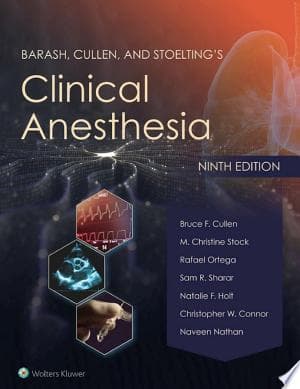
Barash, Cullen, and Stoelting's Clinical Anesthesia cover
Archivist's Choice

Barash, Cullen, and Stoelting's Clinical Anesthesia

Bruce F. Cullen (2023)

Genre

General

Reading Time

12 Minutes

Key Themes

See below

Track Your Reading

Sign in to track this book

This guide gives anesthesiologists up-to-date information on pharmacology, physiology, and surgical procedures for optimal patient care.

Core Idea

Barash, Cullen, and Stoelting's Clinical Anesthesia serves as a definitive, comprehensive, and current reference for the practice of anesthesiology. It systematically covers the full spectrum of anesthesia, from fundamental scientific principles to advanced clinical management across various surgical specialties and patient populations. The book emphasizes evidence-based practice, integrating the latest research, guidelines, and technological advancements to provide practitioners with the knowledge and tools necessary for safe, effective, and patient-centered anesthetic care.
Difficulty
Hard

Core idea

The central argument and framework that powers the entire book.

Barash, Cullen, and Stoelting's Clinical Anesthesia serves as a definitive, comprehensive, and current reference for the practice of anesthesiology. It systematically covers the full spectrum of anesthesia, from fundamental scientific principles to advanced clinical management across various surgical specialties and patient populations. The book emphasizes evidence-based practice, integrating the latest research, guidelines, and technological advancements to provide practitioners with the knowledge and tools necessary for safe, effective, and patient-centered anesthetic care.

At a glance

Difficulty

Hard

Key Takeaways

1

Pharmacology as the Anesthesiologist's Palette

Mastering drug interactions and patient-specific responses is paramount for safe and effective anesthesia.

Quote

The judicious selection and titration of anesthetic agents, guided by an understanding of their pharmacodynamics and pharmacokinetics, form the cornerstone of safe patient management.

This book shows that understanding pharmacology means more than memorizing drug names and doses. It's about knowing how drugs interact with the body and each other. The text describes how anesthetic drugs work, how the body processes them, and their side effects. It stresses the need to tailor drug plans to each patient's health, age, and surgery. For example, knowing that some opioids stay in the body longer in patients with kidney problems helps prevent breathing issues after surgery. This detailed view of pharmacology is the book's...

Supporting evidence

Detailed chapters on 'Pharmacology of Inhaled Anesthetics,' 'Intravenous Anesthetics,' and 'Neuromuscular Blocking Drugs' provide comprehensive data on drug mechanisms, metabolism, and clinical considerations.

Apply this

Anesthesiologists must continuously update their pharmacological knowledge, paying close attention to new drug developments and patient-specific factors that modify drug responses. This includes pre-operative medication reconciliation and intra-operative dose adjustments.


2

Physiological Homeostasis Under Siege

Anesthesia profoundly alters normal physiological functions, demanding constant vigilance and corrective action.

Quote

Anesthesia is a controlled physiological insult, requiring the anesthesiologist to anticipate and mitigate deviations from normal homeostasis.

The book covers the effects of anesthesia on every major organ system. It explains how anesthetic drugs, surgical stress, and patient position can affect the heart, lungs, kidneys, liver, and brain. For instance, the chapter on 'Cardiovascular Physiology and Anesthesia' explains how some anesthetics can weaken the heart and widen blood vessels, requiring careful fluid and blood pressure management. This part of the book shows that keeping the body stable is an active process of monitoring, interpreting data, and acting. It states that...

Supporting evidence

Extensive chapters on 'Respiratory Physiology and Anesthesia,' 'Cardiovascular Physiology and Anesthesia,' and 'Renal Physiology and Anesthesia' detail the impact of anesthetic agents and surgical stress on organ systems.

Apply this

Anesthesiologists should proactively monitor physiological parameters, interpret trends, and intervene rapidly to maintain homeostasis. This involves anticipating potential complications based on the patient's pre-existing conditions and the planned surgical procedure.

3

Comorbidity: The Anesthetic Challenge

Pre-existing diseases significantly complicate anesthetic management, requiring tailored approaches.

Quote

The patient's pre-existing medical conditions dictate many of the critical decisions made before, during, and after anesthesia.

A repeated idea in the book is how existing diseases affect anesthesia plans. Chapters cover managing patients with heart disease, lung disease, diabetes, kidney failure, and brain disorders. The book offers specific ways to prepare these patients for surgery, choose anesthetic methods, and manage problems during and after surgery. For example, for a patient with severe aortic stenosis, the book would advise maintaining blood volume and pressure, avoiding big drops in blood vessel resistance, and carefully giving anesthetic drugs. Thi...

Supporting evidence

Dedicated sections on 'Anesthesia for Patients with Cardiovascular Disease,' 'Anesthesia for Patients with Pulmonary Disease,' and 'Anesthesia for Patients with Endocrine Disease' provide detailed management strategies.

Apply this

Thorough pre-operative evaluation, including a detailed medical history and physical examination, is essential to identify and optimize co-existing diseases. Anesthesiologists must be prepared to adapt their anesthetic plan dynamically based on these conditions.

4

Surgical Procedures: Tailoring Anesthesia to the Operation

Anesthetic management must be meticulously adapted to the specific demands and risks of each surgical procedure.

Quote

Anesthetic care is inextricably linked to the surgical procedure, demanding a deep understanding of the surgical field, potential complications, and patient positioning.

The book covers anesthetic considerations for many surgical areas, including heart, brain, chest, abdomen, bone, and pediatric procedures. It notes that the choice of anesthesia, monitoring, and specific actions often depends on the surgery's invasiveness, expected blood loss, need for specific surgical conditions (e.g., muscle relaxation), and potential for post-operative pain. For example, brain surgeries need careful control of brain pressure and blood flow, while heart surgery requires careful management of heart function and bloo...

Supporting evidence

Chapters such as 'Anesthesia for Cardiac Surgery,' 'Anesthesia for Neurosurgery,' and 'Pediatric Anesthesia' provide procedure-specific guidance and considerations.

Apply this

Anesthesiologists must engage in thorough pre-operative discussions with surgeons to understand the specifics of the procedure, anticipated challenges, and potential complications. This collaborative approach ensures optimal patient care.

5

Monitoring: The Anesthesiologist's Sixth Sense

Advanced monitoring techniques are indispensable for real-time assessment and timely intervention.

Quote

Effective monitoring transforms raw physiological data into actionable insights, guiding critical decisions in real time.

This book highlights the importance of advanced monitoring for patient safety and good results. Beyond basic vital signs, it covers advanced heart and blood flow monitoring (e.g., arterial lines, central venous pressure, pulmonary artery catheters, cardiac output), brain monitoring (e.g., EEG, BIS, evoked potentials), breathing mechanics, and muscle function. The text explains how each monitoring method works, when to use it, its limits, and how to read the data. For instance, understanding arterial line waveforms can give early warni...

Supporting evidence

Dedicated chapters like 'Basic Anesthetic Monitoring' and 'Advanced Hemodynamic Monitoring' thoroughly cover the principles, applications, and interpretation of various monitoring modalities.

Apply this

Anesthesiologists should select appropriate monitoring based on patient acuity and surgical invasiveness, continuously interpret monitor data in context, and be proficient in troubleshooting monitoring equipment.

6

Regional Anesthesia: Beyond General Anesthetics

Loco-regional techniques offer distinct advantages, often improving patient outcomes and reducing systemic drug exposure.

Quote

The judicious application of regional anesthetic techniques can significantly enhance post-operative analgesia, reduce opioid consumption, and accelerate recovery.

While thorough on general anesthesia, the book also focuses on regional anesthetic techniques. It covers spinal, epidural, and peripheral nerve blocks, detailing their anatomy, how local anesthetics work, when to use them, when not to use them, and possible problems. The text points out the benefits of regional anesthesia, such as better post-operative pain control, fewer opioid side effects, and faster recovery in many cases. For example, a femoral nerve block for knee surgery can provide good pain relief with minimal drug exposure t...

Supporting evidence

Chapters on 'Spinal, Epidural, and Caudal Anesthesia' and 'Peripheral Nerve Blocks' provide detailed anatomical descriptions, technique guidance, and outcome data.

Apply this

Anesthesiologists should be proficient in a range of regional anesthetic techniques, selecting them when appropriate to improve patient comfort, reduce opioid requirements, and facilitate faster recovery.

7

Crisis Management and Patient Safety

Anticipation, rapid recognition, and systematic management of crises are critical for patient survival.

Quote

The ability to anticipate, recognize early, and manage swiftly an anesthetic crisis distinguishes expert practice.

The book emphasizes patient safety, especially through its focus on crisis management. It covers common anesthesia emergencies like anaphylaxis, malignant hyperthermia, difficult airways, cardiac arrest, and major bleeding. For each crisis, the text outlines how to diagnose it, immediate steps to take, and follow-up care. This part acknowledges that problems can happen, and the anesthesiologist's ability to respond well is key. The value of this insight is its practical use, offering a way for organized, quick responses that reduce ha...

Supporting evidence

Discussions on managing 'Anaphylaxis,' 'Malignant Hyperthermia,' and 'Difficult Airway' are integrated into relevant chapters, providing step-by-step management protocols.

Apply this

Anesthesiologists should regularly participate in simulation training for crisis management, develop mental checklists for common emergencies, and foster a culture of safety and open communication within the operating room team.

8

Post-Anesthesia Care: The Continuum of Anesthesia

Anesthetic responsibility extends beyond the operating room, impacting post-operative recovery and outcomes.

Quote

The quality of recovery from anesthesia profoundly influences patient satisfaction, morbidity, and length of hospital stay.

This book shows that anesthetic care continues after surgery. It extends into the recovery room and beyond, affecting pain management, nausea and vomiting, breathing problems, and overall recovery. Chapters discuss common recovery room issues, ways to prevent and manage post-operative problems, and criteria for discharge. For example, the text would detail plans for managing post-operative nausea and vomiting (PONV), including preventive drugs and rescue treatments. This complete view of patient care, covering the whole surgical journ...

Supporting evidence

Sections on 'Post-Anesthesia Care Unit' and 'Postoperative Pain Management' detail the management of immediate post-operative issues and strategies for pain control.

Apply this

Anesthesiologists should actively participate in post-operative rounds, ensure adequate pain control, and monitor for and manage common post-anesthetic complications to facilitate a smooth recovery.

9

Technology and Innovation in Anesthesiology

Embracing technological advancements enhances safety, precision, and patient-specific care.

Quote

The evolution of anesthesiology is intrinsically linked to advancements in technology, from sophisticated monitoring devices to novel drug delivery systems.

While core principles stay the same, the book acknowledges how technology constantly changes anesthesiology. This includes discussions on advanced drug delivery systems (e.g., target-controlled infusions), sophisticated ventilation methods, point-of-care ultrasound for regional blocks and vascular access, and electronic health records for data management. For instance, using ultrasound for peripheral nerve blocks has greatly improved success rates and reduced problems compared to nerve stimulator techniques alone. The book includes th...

Supporting evidence

Discussions on 'Ultrasound in Anesthesia,' 'Advanced Ventilatory Strategies,' and 'Target-Controlled Infusions' are woven into relevant chapters, showcasing modern technological applications.

Apply this

Anesthesiologists should actively seek training in new technologies, critically evaluate their utility and limitations, and integrate them judiciously into their practice to enhance patient care and safety.

10

Ethical Considerations and Professionalism

Anesthesiology demands a strong ethical foundation and unwavering commitment to patient advocacy.

Quote

Beyond technical proficiency, the practice of anesthesiology is underpinned by a profound ethical responsibility to safeguard the patient's well-being.

Though not an ethics textbook, 'Clinical Anesthesia' includes ethical considerations and the importance of professionalism. This appears in discussions about informed consent for anesthesia, managing conflicts of interest, ensuring patient privacy, and acting in the patient's best interest, especially with complex decisions or difficult situations. The book's focus on careful pre-operative assessment and risk evaluation, for example, naturally reflects an ethical commitment to patient safety and autonomy. While not in separate chapter...

Supporting evidence

Principles of informed consent are discussed in sections related to pre-operative evaluation. The consistent focus on patient safety and optimal outcomes throughout the book implicitly supports ethical practice.

Apply this

Anesthesiologists must prioritize patient autonomy and well-being, engage in clear communication, obtain informed consent, and continuously uphold professional and ethical standards in all aspects of their practice.

Critical analysis

Notable Quotes

Quiz

Test Your Knowledge

Ready to see how well you understood this book? Take our interactive quiz with 10 questions.

10
Questions
~5
Minutes
?
Best Score

Key Questions (FAQ)

This comprehensive textbook covers the full spectrum of clinical issues and options in anesthesiology, including pharmacology, physiology, co-existing diseases, and surgical procedures.

About the author

Bruce F. Cullen is a distinguished anesthesiologist and editor, co-authoring the highly regarded textbook 'Barash, Cullen, and Stoelting's Clinical Anesthesia.' This comprehensive work is a cornerstone in anesthesiology education and practice, reflecting Cullen's expertise and significant contributions to the field of medical literature.