“The earth is a small place, after all.”
— Phileas Fogg's reflection on the shrinking world as a result of new transportation.

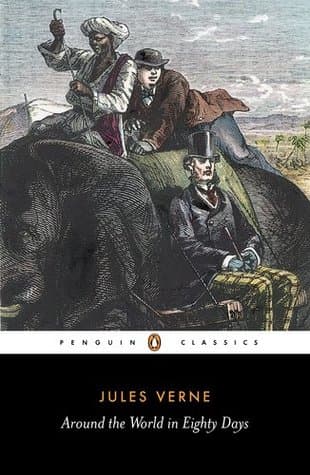
Jules Verne (1973)
Genre
Lifestyle / Fantasy / Historical Fiction / Science Fiction
Reading Time
252 min
Key Themes
See below
Sign in to track this book
Phileas Fogg bets his fortune he can circle the globe in 80 days, embarking on a rapid journey by train, elephant, and more, challenging Victorian expectations of time and travel.
On October 2, 1872, Phileas Fogg, a precise gentleman, fires his old valet for a small mistake. He hires Jean Passepartout, a Frenchman looking for a quiet life, that same day. Later, at the Reform Club, Fogg discusses a newspaper article claiming one can travel around the world in 80 days. His fellow club members, including Ralph, Stuart, Fallentin, Sullivan, and Flanagan, doubt this is possible due to unforeseen delays. Fogg calmly states it is possible and wagers half his fortune, £20,000, that he can do it. He must leave at once and return to the Reform Club by December 21, 1872, at 8:45 PM. Fogg and a surprised Passepartout leave London that evening.
Phileas Fogg and Passepartout take a train to Dover, then a steamer, the Mongolia, to Brindisi and Suez. Fogg sticks to his exact schedule, playing whist and showing no rush. Passepartout is at first excited but soon sees Fogg's constant focus on the schedule. Unknown to them, Detective Fix, a Scotland Yard detective, sees Fogg in Suez. Fix has been sent to find a bank robber who recently stole £55,000 from the Bank of England. Fogg's sudden trip and large amount of money make him a prime suspect. Fix tries to delay Fogg's passport check, hoping for an arrest warrant, but Fogg's efficiency prevents this, and they sail for Bombay.
In Bombay, Passepartout mistakenly enters a forbidden temple without removing his shoes, disrespecting it. This leads to angry priests chasing him, but he escapes. The journey continues by train toward Calcutta. However, the railway line suddenly ends near Kholby, leaving a 50-mile gap before Allahabad. Fogg quickly buys an elephant named Kiouni and hires a guide, paying a very high price. During their elephant trek through the jungle, they see a procession preparing for a Sati ritual, where a young Indian woman, Aouda, is to be burned alive on her dead husband's pyre. Fogg decides they must save her. Passepartout, using a clever trick, snatches Aouda from the pyre, and they flee, continuing their journey with the rescued woman.
After reaching Allahabad and getting back on the train to Calcutta, they are confronted by Detective Fix, who arrests Fogg and Passepartout for the temple incident in Bombay. Fogg calmly posts bail, and they go to court. Thanks to Fogg's quick payment of a large fine, they are released, avoiding major delays. With Aouda now with them, they board the steamer Rangoon, heading for Hong Kong. During the trip, Fogg wins several whist games, increasing his money. Aouda, grateful for her rescue, starts to feel for Fogg, while Passepartout remains wary of Fix, who still follows them, always hoping for an arrest warrant from London.
In Hong Kong, the group learns that Aouda's distant relative, whom they hoped to find, has moved to Holland. Fogg decides to take Aouda to Europe. Fix, desperate to keep Fogg in British territory until his warrant arrives, meets Passepartout and gets him drunk and drugged in an opium den. Fix admits his suspicion that Fogg is the bank robber, aiming to stop Passepartout from telling Fogg about their intended steamer, the Carnatic, leaving early for Yokohama. Passepartout, confused, misses the Carnatic. Fogg, realizing Passepartout is gone and the ship has sailed, must find another way, eventually chartering a pilot boat, the Tankadere, to Shanghai, hoping to catch a steamer to Yokohama from there.
Fogg, Aouda, and Fix (who secretly boards the Tankadere) face a bad typhoon on their way to Shanghai. Fogg, calm as usual, handles the dangerous conditions, finally reaching Shanghai just in time to board the General Grant, a steamer to Yokohama. Meanwhile, Passepartout, waking up alone in Hong Kong and realizing he missed the Carnatic, manages to board the same ship by himself, assuming Fogg would have found another way. He arrives in Yokohama with no money and joins a Japanese acrobatic group to earn some. Fogg and Aouda, looking for him, attend a show and are surprised to see Passepartout on stage. They have a happy, if awkward, reunion.
The reunited group, including Fix, boards the steamer General Grant for their trip across the Pacific to San Francisco. During the journey, Passepartout confronts Fix about his true intentions, learning of the detective's firm belief that Fogg is the bank robber. Passepartout is angry but decides not to tell Fogg to avoid more problems. The trip is mostly calm, allowing Fogg to continue his whist games and stay calm. Fix, however, grows more anxious as they near America, still without the important arrest warrant, fearing Fogg will escape his power once they leave British land.
In San Francisco, the travelers immediately board a train for New York. The journey across America brings many problems. They see a political rally and a fight, briefly delaying them. Later, Sioux Indians attack the train. Passepartout bravely uncouples the engine from the rest of the train to save the passengers, but he is captured. Fogg, determined to save his valet, leads a small group of soldiers in pursuit. They rescue Passepartout, but the delay means they miss their connecting steamer, the Henrietta, in New York, further risking Fogg's wager.
Arriving in New York only to find their planned steamer, the Henrietta, has already left, Fogg refuses to give up. He finds the ship's captain, Andrew Speedy, and offers to pay a huge sum to charter the ship to Liverpool. Captain Speedy, at first unwilling to change his cargo route, is eventually convinced by Fogg's sheer will and money. During the Atlantic crossing, they encounter a bad storm. Running low on coal, Fogg, practical as always, buys the ship from Captain Speedy and tells Passepartout to start burning the wooden parts of the ship, including the mast and cabins, as fuel to keep speed. They arrive in Queenstown, Ireland, just in time to catch a train to Dublin and then a steamer to Liverpool.
Upon their arrival in Liverpool, just as Fogg thinks he is moments from finishing his journey, Detective Fix finally gets his arrest warrant. He arrests Phileas Fogg, taking him to a prison cell. Fogg, calm on the outside, is deeply upset by this final, impossible delay. Passepartout is furious at Fix. However, after only a few hours, the real bank robber, James Strand, is caught elsewhere. Fix, mortified, releases Fogg, who, despite his calm manner, is now racing against an almost impossible clock. They immediately board a special train for London, but it seems they are too late.
Fogg, Passepartout, and Aouda arrive back in London, seemingly five minutes past the deadline of 8:45 PM on December 21st. Fogg has lost his wager and is ruined financially. He goes home, accepting his fate with quiet dignity. The next day, Aouda, touched by Fogg's kindness and sacrifice, and having grown to love him, proposes marriage. She tells him his financial ruin doesn't matter, and she wants to be with him. Fogg, surprised, accepts her proposal, realizing he has found something more valuable than any bet.
Passepartout, sent to arrange their marriage, returns home in a frantic state. He bursts into Fogg's study, shouting that they made a mistake in their calculations. By traveling eastward, they had gained a day, crossing the international date line. It is not Sunday, December 22nd, but Saturday, December 21st! They still have ten minutes to spare. Fogg, with Aouda and Passepartout, rushes to the Reform Club. He arrives at 8:44 PM, just in time, winning his amazing wager and securing his fortune. Fogg has not only traveled around the world in eighty days but has also found love and friendship, showing that true wealth is more than just money.
The Protagonist
Fogg begins as an emotionally detached man driven by logic and routine, but through his journey, he discovers the value of human connection, love, and friendship.
The Supporting
Passepartout transforms from a man seeking tranquility to an adventurous and brave companion, learning to embrace the unpredictable nature of life.
The Supporting
Aouda transitions from a helpless victim to a confident, loving woman who finds agency and a new life through Fogg's actions.
The Antagonist
Fix remains largely static in his belief until the very end, where he is forced to confront his error and release Fogg.
The Supporting
A minor character, Cromarty's arc is limited to his observation and temporary companionship with Fogg.
The Supporting
Speedy's role is transactional; he is convinced by Fogg's determination and money, changing his course and later selling his ship.
The Mentioned
Their role is largely static; they are the recipients of Fogg's bet and witness his return.
The Mentioned
Strand's 'arc' is entirely off-screen; his capture resolves the main external conflict of Fix's pursuit.
This theme is central to the novel, showing how human cleverness, resourcefulness, and strong will can overcome huge problems. Phileas Fogg's constant determination to stick to his schedule, even during natural disasters, mechanical failures, and human interference, drives the plot. His choice to buy an elephant in India, charter a pilot boat in Hong Kong, or even buy and burn a steamer for fuel in the Atlantic, all show this theme. It supports the idea that with enough resolve and ingenuity, people can conquer what seem like limitations in their world.
““Mr. Fogg was not traveling, he was describing a circumference. He was a solid body, describing an orbit around the terrestrial globe, according to the laws of rational mechanics.””
The novel constantly contrasts Phileas Fogg's careful order and punctuality with the world's unpredictable chaos. Fogg's life follows a strict schedule, and he tries to apply this order to his journey. However, the world constantly creates problems: unfinished railways, temple disrespect, Indian attacks, typhoons, and Detective Fix's mistaken pursuit. The story looks at how Fogg reacts to this chaos, often with clever solutions that keep him moving, and also how he changes by having to adapt to the unpredictable nature of life and human emotion.
““The earth is small enough for a man to go around it in eighty days.””
While the journey starts as a bet for money, the story subtly moves to highlight the importance of relationships. Fogg, at first a solitary and emotionally distant man, slowly forms strong bonds with Passepartout and Aouda. His decision to risk his bet and his life to save Aouda from Sati, and later to rescue Passepartout from the Sioux, shows a growing value for human lives over his schedule or financial gain. The climax, where he believes he has lost his fortune but gains Aouda's love, emphasizes that true wealth is in companionship and affection, a realization that leads to his real victory.
““For what gain would it be to him, had he won the wager, had he lost his honour?””
Verne's novel celebrates 19th-century advances in transportation and communication, which made such a journey possible. The detailed descriptions of steamships, railways, and telegraphs show a world quickly becoming more connected and accessible. The very idea of the bet relies on these technological improvements. The story not only entertains but also teaches readers about different cultures and places, highlighting the wonder of global travel and how human progress shrinks distances between continents.
““The world is a vast place, but it has been rendered smaller by the inventions of man.””
The central bet that propels Phileas Fogg on his journey.
The wager of £20,000 to circumnavigate the globe in 80 days is the primary inciting incident and driving force of the entire plot. It establishes the high stakes, the strict deadline, and Fogg's unwavering motivation. Without this financial and reputational challenge, Fogg would never leave his routine life. The ticking clock created by the wager generates constant tension and urgency, forcing Fogg and his companions to overcome every obstacle with speed and ingenuity.
The off-screen crime that leads to Detective Fix's mistaken pursuit.
The theft of £55,000 from the Bank of England by an unidentified robber serves as a crucial plot device. It provides the rationale for Detective Fix's relentless pursuit of Phileas Fogg, creating the major external conflict that dogs Fogg throughout his journey. The mistaken identity adds layers of irony and suspense, as the reader knows Fogg is innocent but Fix's actions constantly threaten to derail the wager. The eventual capture of the true robber, James Strand, is the ultimate resolution to this long-running misunderstanding.
The strict 80-day deadline that creates constant urgency.
The 80-day deadline, meticulously tracked by Fogg, is a pervasive plot device that injects constant tension and urgency into the narrative. Every delay, every missed connection, every unforeseen event, amplifies the pressure on Fogg. It forces him to make desperate decisions, such as burning the Henrietta, and keeps the reader on edge, wondering if he will succeed. The final twist of the gained day hinges entirely on this precise timekeeping, making the clock not just a deadline, but a key player in the story's resolution.
The unexpected discovery that Fogg gained a day by traveling eastward.
The realization that Fogg and his companions have gained a day by traveling eastward and crossing the International Date Line is a classic Deus ex Machina. It is a sudden, unexpected twist that resolves the seemingly insurmountable problem of Fogg arriving late. While scientifically accurate for global travel, its timing and discovery by Passepartout at the very last moment serve to provide a triumphant, albeit sudden, resolution to the central conflict. It allows Fogg to win his bet and provides a satisfying, last-minute victory against all odds.
“The earth is a small place, after all.”
— Phileas Fogg's reflection on the shrinking world as a result of new transportation.
“As for Phileas Fogg, it seemed as if he had never stirred from London.”
— Describing Fogg's calm demeanor even amidst his extraordinary journey.
“He was a man who, beyond a doubt, did things by the book, and to the letter.”
— Introducing Phileas Fogg's meticulous and precise nature.
“The sun, which was now sinking rapidly, gave to the sky a crimson tint.”
— A descriptive passage while traveling, highlighting the beauty of the journey.
“Chance, which is but the last word for destiny.”
— A philosophical observation on the role of luck and fate in their adventures.
“He had only to follow the sun, and he would arrive at his destination.”
— Passepartout's simple understanding of their eastward journey.
“It is true that the world is much smaller since the invention of steam.”
— A direct reference to the impact of industrialization on travel and global perception.
“To carry out such a project, one must have a will of iron.”
— Reflecting on the determination required for Fogg's impossible wager.
“The true English gentleman does not make a scene.”
— A commentary on Phileas Fogg's stoicism and adherence to social norms.
“He had, in fact, gained a day on his journey, and this was for the following reason.”
— The explanation of the crucial time difference gained by traveling eastward.
“The greatest changes are wrought by the smallest accidents.”
— A thought on how minor events can dramatically alter the course of things.
“It's a good thing, a very good thing, to travel.”
— A general endorsement of the benefits and joy of travel.
“He was, indeed, a man of clockwork precision.”
— Another description emphasizing Phileas Fogg's methodical nature.
“No longer was it possible to cross the Indian Ocean in less than twelve days.”
— Highlighting the speed and efficiency of modern travel during that era.
Ready to see how well you understood this book? Take our interactive quiz with 10 questions.
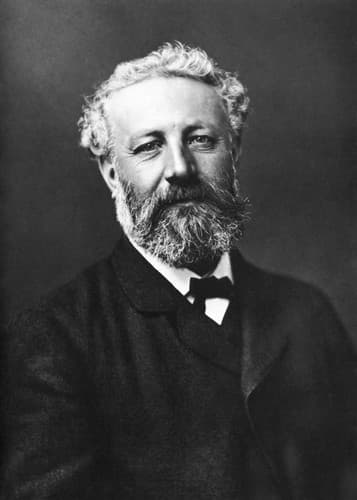
Jules Gabriel Verne was a French novelist, poet, and playwright. His collaboration with the publisher Pierre-Jules Hetzel led to the creation of the Voyages extraordinaires, a series of bestselling adventure novels including Journey to the Center of the Earth (1864), Twenty Thousand Leagues Under the Seas (1870), and Around the World in Eighty Days (1872). His novels, always well documented, are generally set in the second half of the 19th century, taking into account the technological advances of the time.