“It is a sin to think words no others think and to write them down, unless they be words of the law, or words that the Teachers bid you think and write.”
— Equality 7-2521 reflecting on the societal rules and the suppression of individual thought.

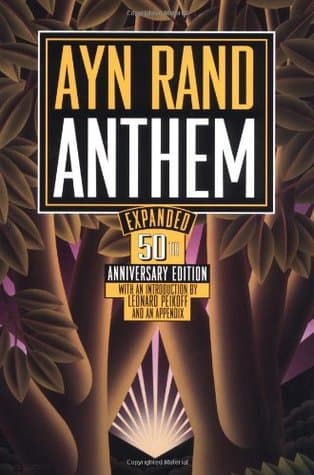
Ayn Rand (1938)
Genre
Politics / Science Fiction / Philosophy
Reading Time
90 min
Key Themes
See below
Sign in to track this book
In a future where being an individual is a crime, Equality 7-2521 defies the collective 'we' to find the lost power of 'I' and personal freedom.
“It is a sin to think words no others think and to write them down, unless they be words of the law, or words that the Teachers bid you think and write.”
— Equality 7-2521 reflecting on the societal rules and the suppression of individual thought.
“We are nothing. Mankind is all. By the grace of our brothers are we allowed our lives. We exist but through them and for them.”
— A common mantra and fundamental belief taught in the collectivist society.
“It is not good to be different from our brothers.”
— A recurring thought in the society, reinforcing the fear of individuality.
“We are one in all and all in one. There are no men but only the great WE, one, indivisible and forever.”
— A core principle of the collectivist society, emphasizing the loss of individual identity.
“We are old now, yet we were young once. We remember our life. We remember the things which we have learned. We remember the things which we have built. We remember the things which we have destroyed.”
— Equality 7-2521's early musings about the past and the limited knowledge available.
“We have much to say to a brother when he is alone. But we have nothing to say to a brother when there are others present.”
— Equality 7-2521 observing the lack of genuine personal connection and conversation in public.
“How can we be afraid of a word when we do not know the word?”
— Equality 7-2521's internal struggle with the unknown and forbidden concepts.
“The only thing which matters is that we be happy.”
— Equality 7-2521's initial understanding of purpose, which later evolves.
“I am. I think. I will.”
— Equality 7-2521's profound realization of his individual self, a pivotal moment.
“My happiness is not the means to any end. It is the end. It is its own goal. It is its own purpose.”
— Equality 7-2521's declaration of egoism and the pursuit of personal joy.
“My life, my love, my honor, my joy, my pride, my strength, my light, my purpose, my will, my mind, my self. I owe nothing to my brothers, nor do I ask anything of them.”
— Equality 7-2521's ultimate rejection of collectivism and embrace of self-ownership.
“The word 'we' must never be spoken again.”
— Equality 7-2521's final decree, symbolizing the complete overthrow of collectivist thought.
“For the word 'I' is the only word that can unlock the mind of man.”
— Equality 7-2521's realization that individual identity is essential for human progress and thought.
“The worship of the 'We' is the worship of the mob, the worship of the collective, the worship of the State.”
— Equality 7-2521's critical analysis of the collectivist system he escaped.
Ready to see how well you understood this book? Take our interactive quiz with 10 questions.
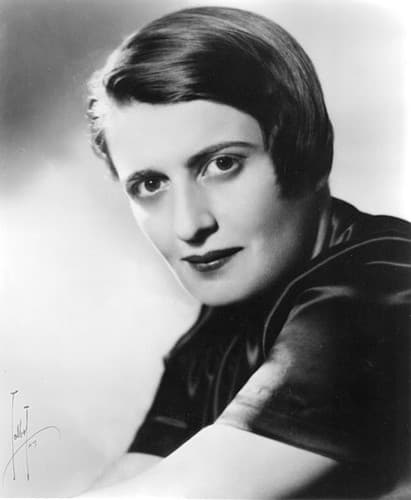
Alice O'Connor, better known by her pen name Ayn Rand, was a Russian-born American writer and philosopher. She is known for her fiction and for developing a philosophical system she named Objectivism. Born and educated in Russia, she moved to the United States in 1926. After two early novels that were initially unsuccessful and two Broadway plays, she achieved fame with her 1943 novel, The Fountainhead. In 1957, Rand published her best-selling work, the novel Atlas Shrugged. Afterward, until her death in 1982, she turned to non-fiction to promote her philosophy, publishing her own periodicals and releasing several collections of essays.

Brett Casper
5.0
Dirk Uffelmann
4.7
Winston S. Churchill
4.5
Chimamanda Ngozi Adichie
4.5
Will Durant
4.4
Thomas Sowell
4.4
W.E.B. Du Bois
4.3

Alan Moore
4.3