“We are not in the business of fighting darkness with darkness. We are in the business of fighting darkness with light.”
— Jack and Amanda discuss their mission and philosophy.

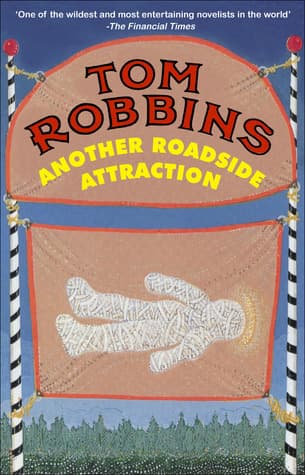
Tom Robbins (1971)
Genre
Literary Fiction / Philosophy
Reading Time
10 hours 45 min
Key Themes
See below
Sign in to track this book
When Jesus's mummified body appears in a roadside zoo, a clairvoyant redefines spirituality with a flea circus, and Western civilization unravels through a psychedelic lens of fertility worship and existential inquiry.
The novel introduces Amanda, a clairvoyant, and her husband John Paul, a former saxophonist, who run a roadside attraction called 'Captain Kendrick's Memorial Hot Dog, Lazarus, and the Amazing Flea Circus' in rural Washington. Their life is already unusual, living with a giant octopus named Norman and performing a flea circus. Their world changes further when a mysterious crate arrives, containing what appears to be the mummified corpse of Jesus Christ. This discovery sets the stage for the central conflict and philosophical discussions, immediately challenging traditional beliefs and introducing an irreverent tone. The couple wonders if it is a hoax or genuine, and what it means for the world.
News of the alleged Christ corpse spreads, attracting a diverse and eccentric group of characters to the roadside attraction. Among them is Marx Marvelous, a flamboyant and philosophical anthropologist who becomes deeply involved in the mystery. There are also members of a secret Catholic order, the 'Last Descendants of the Knights Templar,' who believe the corpse is real and want to protect it or destroy it to maintain their religious truth. These new arrivals bring their own goals, beliefs, and habits, further complicating Amanda and John Paul's strange existence and creating a clash of ideas.
Marx Marvelous, with his mix of academic rigor and bohemian eccentricity, investigates the corpse's origins and authenticity. He brings a scholarly yet open-minded perspective to the mystery, exploring historical texts, theological arguments, and even the esoteric. His inquiries lead him down various paths, challenging both traditional religious dogma and scientific skepticism. Through Marx's perspective, the novel explores deep philosophical questions about faith, history, and the nature of belief, using the corpse to deconstruct established narratives and invite readers to question their own assumptions about reality and spirituality.
The Last Descendants of the Knights Templar, led by their zealous members, become determined to get the corpse. They see its existence and public display as a threat to the foundations of the Catholic Church and Western civilization. Their attempts to infiltrate the attraction and steal or destroy the body create suspense. Their actions highlight the conflict between established religious institutions and the subversive, anarchic spirit of Amanda and John Paul's world, showing the desperate measures some will take to preserve their worldview.
Amanda's clairvoyant abilities help her navigate the unfolding mystery. She has visions and insights that offer glimpses into the corpse's true nature and the intentions of those seeking it. Her unique perspective, free from traditional dogma, allows her to see truths others miss. These insights not only provide information but also emphasize the novel's themes of intuition, alternative ways of knowing, and the limits of purely rational thought. Her visions guide her and John Paul, often contrasting with the rigid beliefs of the Knights Templar and the academic thoughts of Marx Marvelous.
Amidst the theological debates and secret activities, Amanda's flea circus remains a central part of the attraction. More than just entertainment, the flea circus, with its tiny, lively performers, becomes a symbol of life, fertility, and the connection of all beings. Amanda's deep connection to nature and her celebration of sensuality and life contrast with the sterile, dogmatic beliefs of the Knights Templar. The fleas, carefully trained and cared for, represent a different kind of spiritual devotion—one rooted in earthly pleasure and the abundant, chaotic beauty of existence, hinting at a fertility cult in the making.
Tension builds as the Knights Templar make a move to claim the corpse. A confrontation breaks out at the roadside attraction, involving Amanda, John Paul, Marx Marvelous, and the religious order. This scene is a chaotic mix of philosophical debate, physical struggle, and surreal humor, reflecting the novel's genre-bending nature. The climax forces the characters to confront their beliefs and desires, leading to unexpected alliances and betrayals. The fate of the corpse, and what it means for the future of spirituality and human understanding, hangs in the balance during this encounter.
The corpse's identity is revealed not as a simple verification or debunking, but as something more complex and subversive. The truth, when it comes out, challenges the religious zealots, the scientific rationalists, and even the protagonists' initial understandings. The revelation is meant to shake the foundations of established belief systems, suggesting that truth is multifaceted and often defies simple categorization. This twist captures the novel's core message: reality is more fluid and wondrous than conventional thought allows, and meaning can be found in unexpected places, often outside traditional institutions.
Following the corpse's mystery, Amanda's vision for a new spiritual paradigm, focused on fertility and the celebration of life, begins to take hold. Her flea circus, once a quirky diversion, becomes a symbol of this emerging movement. The novel suggests a shift away from austere, patriarchal religions towards a more earthy, sensual, and inclusive form of spirituality. Amanda embodies this transformation, becoming a high priestess of a new age, where pleasure, nature, and the connection of all living things are revered. This represents a hopeful, though unconventional, vision for humanity's future, tied to the spirit of the 1960s.
After the dramatic events, life at the roadside attraction continues, changed forever. The characters, having faced challenges to their beliefs, move forward with a renewed purpose and a deeper understanding of the world. John Paul and Amanda, along with their companions, embrace their roles in shaping this new, more liberated future. The novel ends with open-ended possibility, suggesting that the journey of questioning, exploring, and celebrating life's absurdities is ongoing. It leaves the reader with a sense that while specific mysteries may be resolved, the larger questions of existence and meaning remain open for continuous exploration and reinterpretation.
The Protagonist
Amanda evolves from simply running a quirky attraction to becoming a central figure in a new spiritual movement, embracing her role as a high priestess of fertility and life.
The Protagonist
John Paul moves from a supportive husband to an active participant in questioning and redefining spiritual beliefs, finding his own path in the new paradigm.
The Supporting
Marx's intellectual journey leads him to question the very foundations of his knowledge, ultimately embracing a more fluid and less dogmatic understanding of truth.
The Supporting
Norman remains a constant, enigmatic presence, symbolizing the enduring mystery and wisdom of the natural world amidst human chaos.
The Antagonist
Father Max remains steadfast in his mission, representing the enduring struggle between traditional dogma and emerging, unconventional beliefs.
The Antagonist
As a collective, their attempts to control the narrative are ultimately thwarted, symbolizing the diminishing power of rigid institutions in the face of evolving consciousness.
The Plot Device/Symbolic
The corpse's identity is ultimately revealed in a way that deconstructs conventional narratives, serving as a symbolic bridge between old and new spiritual understandings.
The novel questions traditional religious beliefs, especially those surrounding Christianity. The discovery of the alleged Christ corpse is the main catalyst, forcing characters and readers to confront the historical and theological implications of such a find. Robbins challenges the sanctity of religious institutions and the fixed nature of 'truth,' suggesting that dogma can be a cage. Through Marx Marvelous's intellectual inquiries and Amanda's intuitive wisdom, the book encourages a re-evaluation of faith, miracles, and the concept of divinity, often with irreverent humor, as seen when the corpse is treated like another roadside attraction.
“What if the Second Coming didn't quite come off as advertised?”
In contrast to the asceticism often linked with traditional religion, the novel champions sensuality, pleasure, and fertility as central to a healthy spiritual life. Amanda embodies this theme, with her connection to nature, her love for her flea circus (a microcosm of teeming life), and her joyful embrace of physical experience. The book suggests that true spirituality is not about denying the body but about embracing its wisdom and the life-giving forces of the universe. This is woven into the narrative through descriptions of food, sex, and the lively, chaotic life at the attraction, leading to the idea of a reborn fertility worship.
“The earth is pregnant, and we are its children.”
Robbins constantly plays with the boundaries of reality, blurring the lines between the ordinary and the miraculous, the historical and the mythical. The central mystery of the corpse's identity explores how individuals create their own truths based on belief, experience, and perception. The novel suggests that reality is subjective and fluid, and that 'truth' is often more complex and paradoxical than simple facts or dogmas. This theme is explored through the conflicting interpretations of the corpse by the various characters, from the Knights Templar's rigid dogma to Marx Marvelous's academic skepticism and Amanda's intuitive insights.
“The truth, like any other commodity, is in the eye of the beholder.”
The characters at the roadside attraction, especially Amanda and John Paul, represent radical individuality and a rejection of societal norms. Their unconventional lifestyle, unusual business, and open-minded approach to life directly oppose the conformity and rigid structures demanded by institutions like the Knights Templar. The novel celebrates eccentricity, personal freedom, and the courage to live authentically, even as an outsider. It champions the individual's right to define their own meaning and happiness, rather than adhering to externally imposed rules, reflecting the counter-cultural spirit of the 1960s.
“When you're out of step with the world, the world is out of step with you.”
The alleged Christ corpse serves as the primary object driving the plot.
The mummified corpse, believed to be Jesus Christ, functions as the central MacGuffin. Its existence, and the mystery surrounding its authenticity, is what propels the narrative forward, drawing various characters with conflicting agendas to the roadside attraction. While its true identity is eventually addressed, the corpse's primary purpose is to instigate the philosophical debates, character interactions, and plot developments, rather than being the sole focus of the story's resolution. It's the catalyst for the exploration of themes rather than an end in itself.
Objects and characters represent larger philosophical and spiritual ideas.
Robbins heavily employs symbolism throughout the novel. The flea circus, for instance, symbolizes teeming life, fertility, and the interconnectedness of all beings, contrasting with the 'dead' dogma of institutional religion. Norman the octopus represents ancient wisdom, the subconscious, and the mysterious depths of nature. The roadside attraction itself symbolizes a liminal space where conventional reality breaks down and new possibilities emerge. These symbols enrich the narrative, allowing Robbins to explore complex themes without resorting to overt didacticism, instead inviting the reader to find deeper meaning.
The narrative follows eccentric characters on a loose, episodic journey.
While not strictly a picaresque novel, 'Another Roadside Attraction' incorporates elements of the genre. The narrative follows a colorful cast of eccentric characters, particularly Amanda, John Paul, and Marx Marvelous, as they navigate a series of unusual and often humorous encounters. The plot is less about a tightly structured quest and more about the journey of discovery, philosophical digressions, and the exploration of various aspects of human nature and belief. This allows for a meandering, free-associative style that reflects the counter-cultural spirit of the book.
The narrator occasionally breaks the fourth wall, commenting on the story or philosophical ideas.
The narrator frequently steps outside the bounds of the story to address the reader directly, offer philosophical asides, or comment on the act of storytelling itself. This metafictional device serves to remind the reader that they are engaging with a constructed narrative, while also allowing Robbins to interject his own sardonic wit and philosophical musings. It breaks down the traditional barrier between author and audience, inviting a more active and critical engagement with the text and its themes, reinforcing the idea that truth is subjective and constructed.
“We are not in the business of fighting darkness with darkness. We are in the business of fighting darkness with light.”
— Jack and Amanda discuss their mission and philosophy.
“Everything is a miracle, and everything is a monster. Everything is a blessing, and everything is a curse.”
— A reflection on the dual nature of existence.
“Reality is a collective hunch.”
— A philosophical musing on the nature of perceived reality.
“There are two kinds of people in the world: those who like their coffee black, and those who are wrong.”
— A humorous, opinionated statement about coffee.
“The only way to get rid of a temptation is to yield to it.”
— A paradoxical thought on human desire.
“What is magic? It is the capacity to make things happen.”
— Clarifying the definition of magic beyond the supernatural.
“The greatest mystery is not that we are here, but that we are not here more often.”
— A contemplative thought on presence and awareness.
“It's never too late to have a happy childhood.”
— A hopeful and whimsical statement about reclaiming joy.
“We're all just walking each other home.”
— A tender reflection on human connection and shared journey.
“The world is a stage, but the play is badly cast.”
— A cynical yet humorous observation on the state of the world.
“Sanity is a madness put to good use.”
— A provocative redefinition of what it means to be sane.
“The secret to happiness is to find something you want more than anything else, and then go after it.”
— A straightforward piece of advice on pursuing fulfillment.
“Every time you masturbate, God kills a kitten.”
— A darkly humorous and absurd statement.
“Our lives are not our own. They are rented, and the rent is due.”
— A reminder of mortality and the transient nature of life.
“The trouble with the world is that the stupid are cocksure and the intelligent are full of doubt.”
— A reflection on the distribution of confidence and intelligence.
Ready to see how well you understood this book? Take our interactive quiz with 10 questions.

Biography coming soon.