BookBrief
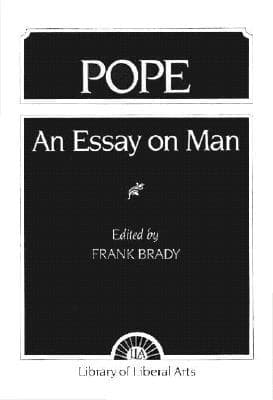
An Essay on Man cover
Archivist's Choice

An Essay on Man

Alexander Pope (1733)

Genre

Philosophy

Reading Time

90 min

Key Themes

See below

Track Your Reading

Sign in to track this book

Alexander Pope's poetic essay explores the universe's order and humanity's place, urging readers to use reason and accept that 'whatever is, is right.'

Core Idea

Alexander Pope's "An Essay on Man" is a philosophical poem that defends God's ways to humanity, arguing that despite imperfections and suffering, the universe has a divine, good order. Pope says humans are in a perfect 'middle state' within the Great Chain of Being, with self-love and reason. When balanced, these guide people toward social harmony and good behavior. His main point is that everything in the cosmic design is good, even if humans don't understand it. True happiness comes not from external things but from living virtuously and understanding one's place in this universal order.
Reading time
90 min
Difficulty
Medium
✓ Read this if...
You are interested in Enlightenment-era philosophy, the problem of evil, the concept of the Great Chain of Being, or a poetic exploration of human nature and divine order. Also if you enjoy structured philosophical arguments presented in verse.
✗ Skip this if...
You prefer prose over poetry for philosophical topics, are looking for a light or modern read, or dislike didactic moralizing. This book is also not for those seeking an atheist or existentialist perspective.

Core idea

The central argument and framework that powers the entire book.

Alexander Pope's "An Essay on Man" is a philosophical poem that defends God's ways to humanity, arguing that despite imperfections and suffering, the universe has a divine, good order. Pope says humans are in a perfect 'middle state' within the Great Chain of Being, with self-love and reason. When balanced, these guide people toward social harmony and good behavior. His main point is that everything in the cosmic design is good, even if humans don't understand it. True happiness comes not from external things but from living virtuously and understanding one's place in this universal order.

At a glance

Reading time

90 min

Difficulty

Medium

Read this if...

You are interested in Enlightenment-era philosophy, the problem of evil, the concept of the Great Chain of Being, or a poetic exploration of human nature and divine order. Also if you enjoy structured philosophical arguments presented in verse.

Skip this if...

You prefer prose over poetry for philosophical topics, are looking for a light or modern read, or dislike didactic moralizing. This book is also not for those seeking an atheist or existentialist perspective.

Key Takeaways

1

The Great Chain of Being

Understanding humanity's fixed, interconnected place in the universe.

Quote

Vast chain of Being! which from God began, / Natures ethereal, human, angel, man, / Beast, bird, fish, insect, what no eye can see, / No glass can reach; from Infinite to thee, / From thee to nothing.

Pope's main idea is the Great Chain of Being, a hierarchy where every creature and thing has a divinely set, fixed place. Humanity is above animals but below angels and God. This is not a ladder to climb but a continuous, connected system. Understanding one's place in this chain helps with contentment and avoids arrogance. Wanting a higher position disrupts creation's harmony and questions divine wisdom. This cosmic order means apparent imperfections are needed for a greater, incomprehensible whole, and human limits prevent full under...

Supporting evidence

The entire poem serves as an exposition of this concept, frequently referencing the 'chain' and humanity's 'middle state' between beast and angel.

Apply this

Cultivate humility by recognizing the limits of human understanding and power. Accept your current circumstances and role, rather than constantly striving for positions or attributes beyond your natural capacity or station. Find contentment in your present state.


great-chain-of-beingcosmic-orderdivine-providence
2

Self-Love and Reason: The Guiding Principles

Two powerful instincts that, when balanced, lead to virtue and happiness.

Quote

Two principles in human nature reign; / Self-love to urge, and reason to restrain.

Pope says that humans have two main, inborn principles: self-love and reason. Self-love is the driving force, the instinct for survival and the pursuit of individual good and pleasure. Reason, on the other hand, is the guiding force, meant to moderate and direct self-love toward proper goals, aligning individual desires with the greater good and divine will. Neither is bad; imbalance is the problem. Uncontrolled self-love leads to vice and chaos, while reason, without self-love, becomes inactive. The ideal human state is when reason e...

Supporting evidence

Pope explicitly states these two principles and dedicates significant portions of Epistle II to their interaction and proper alignment.

Apply this

Practice self-awareness to identify when self-love is becoming excessive or misdirected. Use critical thinking and ethical reasoning to guide your impulses, ensuring your actions benefit not only yourself but also others and align with a broader moral framework. Cultivate virtues like empathy and temperance.

self-lovereasonvirtue-ethicsmoral-philosophy
3

Ignorance is Bliss (for Man)

Human limitations in knowledge are a merciful design, preventing despair.

Quote

Heav'n from all creatures hides the book of Fate, / All but the page prescribed, their present state: / From brutes what men, from men what spirits know: / Or who could suffer Being here below?

Pope suggests that humanity's limited knowledge, especially about the future and the full extent of divine plans, is a kind act from God. If humans knew all their suffering, death, or the full results of their actions, life would be unbearable. This 'ignorance' is not a flaw but necessary for human happiness and the ability to act. It allows for hope, courage, and doing present duties without being paralyzed by future worries or the overwhelming complexity of cosmic design. This limitation highlights the theme of divine wisdom: what s...

Supporting evidence

Pope elaborates on the benefits of limited foresight, suggesting that knowing one's death would make life a misery and that animals are spared human anxieties by their lack of future-oriented thought.

Apply this

Embrace the present moment and focus on what you can control. Avoid excessive worry about the unknown future or what lies beyond your comprehension. Find peace in the idea that some things are mercifully hidden, allowing you to live and act without undue burden. Trust in a larger, benevolent order.

epistemological-limitsdivine-mercyignorancehuman-condition
4

The Universal Cause and Particular Good

Individual 'evils' contribute to a greater, inscrutable good.

Quote

All discord, harmony not understood; / All partial evil, universal good.

This is perhaps Pope's most famous and debated statement: what humans see as 'evil' or 'discord' in the world is just a 'partial evil' that, from God's view, contributes to a 'universal good.' This does not deny suffering or injustice but reframes it within a larger, cosmic design. Humanity's limited view keeps it from seeing the complex web of cause and effect that turns individual misfortunes into necessary parts of a perfect whole. This concept is a form of theological optimism, arguing that God's creation is good and that apparent...

Supporting evidence

The recurring refrain 'Whatever IS, is RIGHT' encapsulates this principle, as does the discussion of natural disasters and human vices as part of a larger plan.

Apply this

When confronted with adversity or what seems like injustice, try to adopt a broader perspective. Instead of dwelling on the immediate 'evil,' consider how it might, however indirectly or incomprehensibly, fit into a larger pattern or serve a purpose beyond your current understanding. Cultivate resilience and faith.

theodicyoptimismdivine-providenceproblem-of-evil
5

Happiness: Not in Riches, Power, or Fame

True contentment stems from virtue and peace of mind, accessible to all.

Quote

Oh sons of earth! attempt ye still to rise, / By arts and labours, to the starry skies? / See, from what causes bliss and woe descend; / How all that’s great and good in Man, must end.

Pope strongly rejects the common human pursuit of happiness through external things like wealth, political power, social status, or intelligence. He argues that these are temporary, often cause more worry, and are ultimately unrelated to true contentment. Real happiness, Pope says, is an inner state from virtue, a clear conscience, and peace of mind. It is available to everyone, from king to peasant, because it depends not on external possessions but on the right balance of self-love and reason. This democratic view of happiness chall...

Supporting evidence

Pope contrasts the 'madness' of pursuing external goods with the simple, internal peace available to the virtuous, citing examples of those who gained power but lost peace.

Apply this

Re-evaluate your priorities. Shift your focus from accumulating external markers of success (wealth, status, material possessions) to cultivating internal virtues like integrity, kindness, and humility. Find joy in simple pleasures and a clear conscience, recognizing that true happiness is independent of external circumstances.

eudaimoniavirtuestoicisminner-peace
6

Passions as Winds, Reason as the Pilot

Passions are essential for action but require rational direction.

Quote

The ruling passion, be it what it will, / The ruling passion conquers reason still.

Pope sees human passions not as inherently bad, but as powerful forces (like winds) necessary for human action and motivation. Without passions, humans would be inactive. However, these passions need the guidance of reason (the pilot) to steer them toward productive and good ends. Unchecked passions lead to vice, destruction, and personal misery. The 'ruling passion' is a strong, often dominant, drive within a person that, if not managed by reason, can override all other considerations. The goal is not to remove passions but to direct...

Supporting evidence

Pope's extensive discussion in Epistle II on the nature of passions, their utility, and their potential for corruption if not governed by reason.

Apply this

Identify your dominant passions and understand their potential for both good and harm. Practice mindfulness and self-control to ensure your passions serve your higher values and goals, rather than dominating your decisions. Develop your rational faculties to effectively 'pilot' your emotional and motivational drives.

passionsreasonself-controlmoral-governance
7

The Social Nature of Man

Individual good is intertwined with the good of society and the universe.

Quote

God loves from whole to parts: but human soul / Must rise from individual to the whole. / Self-love thus push’d to social, to divine, / Gives thee to make thy neighbour’s blessing thine.

Pope emphasizes that humans are social creatures, and their individual well-being is linked to society's well-being and the larger cosmic order. Self-love, when guided by reason, naturally extends beyond the individual to include family, community, nation, and all humanity. This expansion is not giving up self-interest but recognizing that one's own happiness is greatest when contributing to others' happiness. The 'social good' is not separate from the 'individual good' but its highest form. This interconnectedness reflects the univer...

Supporting evidence

Pope illustrates how self-love, when extended, leads to social virtues like friendship, charity, and patriotism, and ultimately to the love of God.

Apply this

Actively seek opportunities to contribute to your community and the well-being of others. Recognize that your personal flourishing is enhanced by the flourishing of those around you. Practice empathy and compassion, understanding that altruism is not just a moral duty but also a path to personal fulfillment.

social-contractaltruisminterconnectednesscommon-good
8

Virtue: The Path to Divine Favor

Living virtuously aligns man with God's will and universal harmony.

Quote

For Modes of Faith, let graceless zealots fight; / His can’t be wrong whose life is in the right: / In Faith and Hope the world will disagree, / But all mankind’s concern is charity.

Pope argues that true devotion and alignment with divine will come not from strict adherence to specific religious rules or rituals, but from practicing universal virtues, especially charity (love for humanity). While 'modes of faith' may differ and cause conflict, the moral correctness of one's life is universally understood and valued by God. Living virtuously – using reason, balancing passions, and acting for others' good – is the most direct way to fulfill one's purpose within the Great Chain of Being. This view promotes a practic...

Supporting evidence

Pope explicitly downplays sectarian quarrels in favor of 'charity' and 'life in the right' as the true measure of faith, particularly in Epistle III and IV.

Apply this

Prioritize ethical conduct and the cultivation of virtues in your daily life, regardless of specific religious affiliations. Focus on actions that demonstrate kindness, integrity, and compassion towards others. Understand that living a morally upright life is a powerful form of spiritual expression.

virtue-ethicscharitymoral-theologyuniversal-morality
9

Man's Middle State: A Perfect Design

Humanity's unique position is a source of strength, not weakness.

Quote

Placed on this isthmus of a middle state, / A being darkly wise, and rudely great: / With too much knowledge for the Sceptic side, / With too much weakness for the Stoic’s pride, / He hangs between; in doubt to act, or rest; / In doubt to deem himself a God, or Beast.

Pope describes humanity as being in a 'middle state' – an 'isthmus' between purely animal and angelic. This is not a tragic flaw, but a perfectly designed position within the Great Chain of Being. Humans have enough reason to understand moral differences but enough passion to act; enough knowledge to question but not so much as to despair. This inherent tension and duality make human life dynamic and purposeful. Wishing for more knowledge (like angels) or less (like beasts) would disrupt the delicate balance designed for man's specifi...

Supporting evidence

Epistle II specifically details this 'middle state,' highlighting the balance of reason and passion, and the inherent paradoxes of human nature.

Apply this

Accept the inherent paradoxes and limitations of being human. Don't strive to be an all-knowing deity or a purely instinctual animal. Find strength and purpose in your unique blend of intellect and emotion. Embrace the journey of navigating moral choices and understanding your place within the larger world.

human-conditionmiddle-stateexistentialismbalance
10

Whatever IS, is RIGHT

A call to trust in divine order, even amidst apparent chaos.

Quote

Submitting to what Heav'n decrees, or sends, / All is to Man, if to himself he friends: / And, but for that, what from the first was well, / In course of things, must needs for ever dwell. / And, spite of Pride, in erring Reason’s spite, / One truth is clear, 'Whatever IS, is RIGHT.'

This famous saying sums up Pope's entire philosophical argument. It is not an endorsement of inaction or a denial of suffering, but a statement of faith in God's creation's ultimate goodness and wisdom. From a human view, much seems wrong, unfair, or chaotic. However, Pope insists that these perceived flaws are part of a larger, perfect, divinely ordered system. Human reason, being limited, cannot fully grasp this cosmic harmony. Therefore, true wisdom lies in humility and acceptance of this divine order, trusting that even apparent e...

Supporting evidence

The repeated phrase and the culmination of the poem's arguments, particularly in Epistle I and IV, pointing to the ultimate perfection of God's plan.

Apply this

Cultivate a profound sense of trust in the universe's inherent order, even when faced with adversity or things you cannot understand. Practice acceptance and let go of the need to control or comprehend every aspect of life. Focus on your own actions and attitude, knowing that your individual 'rightness' contributes to the larger 'rightness' of existence.

optimismtheodicyfatalismdivine-will

Critical analysis

Notable Quotes

Know then thyself, presume not God to scan; The proper study of mankind is Man.

Epistle II, line 1-2. A central theme of the essay, advocating self-knowledge over divine speculation.

Hope springs eternal in the human breast: Man never Is, but always To be blest.

Epistle I, line 95-96. Reflecting on humanity's perpetual optimism and future-oriented desires.

For forms of government let fools contest; Whate'er is best administer'd is best.

Epistle III, line 303-304. Arguing that good governance is more important than the specific structure of government.

All Nature is but Art unknown to thee; All Chance, Direction, which thou canst not see.

Epistle I, line 289-290. Suggesting a divine order behind what appears to be random or natural.

Vice is a monster of so frightful mien, As to be hated needs but to be seen; Yet seen too oft, familiar with her face, We first endure, then pity, then embrace.

Epistle II, line 217-220. Describing the gradual acceptance and normalization of vice.

Heaven from all creatures hides the book of Fate, All but the page prescribed, their present state.

Epistle I, line 77-78. Emphasizing that humans are meant to focus on the present, not the future.

A mighty maze! but not without a plan.

Epistle I, line 6. Describing the complexity of the world, yet affirming an underlying divine order.

What reason weaves, by passion is undone.

Epistle II, line 42. Highlighting the conflict between human reason and passion.

Self-love, the spring of motion, acts the soul; Reason's comparing balance rules the whole.

Epistle II, line 59-60. Illustrating the interplay between self-love as a driving force and reason as a guiding principle.

See through this air, this ocean, and this earth, All matter quick, and bursting into birth.

Epistle I, line 231-232. A vivid description of the vibrancy and constant renewal of nature.

Order is Heav'n's first law; and this confest, Some are, and must be, greater than the rest.

Epistle IV, line 49-50. Affirming a hierarchical order in the universe and society.

In doubt, to deem himself a god, or beast; In doubt, his mind or body to prefer.

Epistle II, line 7-8. Capturing the inherent human struggle with identity and our place in the natural order.

True self-love and social are the same.

Epistle IV, line 396. The concluding idea that individual well-being is intrinsically linked to the well-being of society.

To err is human, to forgive divine.

Epistle II, line 325. A widely quoted aphorism about the nature of human fallibility and divine mercy.

Quiz

Test Your Knowledge

Ready to see how well you understood this book? Take our interactive quiz with 10 questions.

10
Questions
~5
Minutes
?
Best Score

Key Questions (FAQ)

"An Essay on Man" argues for a benevolent and orderly universe created by God, where humans, despite their limitations, occupy their rightful place. It asserts that 'Whatever IS, is RIGHT,' meaning that all perceived evils or imperfections are part of a larger divine plan we cannot fully comprehend.

About the author

Alexander Pope

Alexander Pope was an English poet, translator, and satirist of the Enlightenment era who is considered one of the most prominent English poets of the early 18th century. An exponent of Augustan literature, Pope is best known for his satirical and discursive poetry including The Rape of the Lock, The Dunciad, and An Essay on Criticism, and for his translations of Homer.