BookBrief
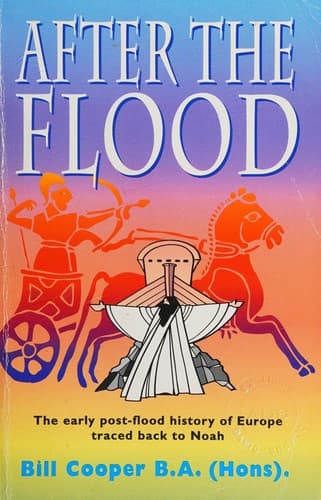
After the Flood cover
Archivist's Choice

After the Flood

Bill Cooper (1995)

Genre

General

Reading Time

480 min

Key Themes

See below

Track Your Reading

Sign in to track this book

Tracing two millennia of forgotten history, 'After the Flood' connects European lineage to Noah's ark through the documented journey of Japheth's descendants.

Core Idea

Bill Cooper's "After the Flood" offers a new look at post-Flood history, stating that biblical timeframes are the only accurate way to understand the origins and movements of early human groups. Cooper traces the family lines from Noah through his sons, especially Japheth. He says these lines link directly to the founding figures of various old cultures across Europe and Asia, which questions common archaeological and historical timelines. He takes apart the 'Ice Age' idea and other popular views, saying they don't fit a literal biblical story. Instead, he suggests a model where the 'Dark Ages' were times of important growth misunderstood by secular historians. The main point is that old myths and king lists, when lined up with biblical time, show a connected history from right after the Deluge, giving a clear choice to standard historical reconstruction.
Reading time
480 min
Difficulty
Hard
✓ Read this if...
You are interested in a deep, biblically-literal reinterpretation of ancient history, specifically challenging conventional timelines and seeking to connect biblical genealogies to the origins of world civilizations.
✗ Skip this if...
You prefer mainstream historical and archaeological consensus, are not open to a literal interpretation of biblical chronology as the primary historical framework, or are looking for light reading.

Core idea

The central argument and framework that powers the entire book.

Bill Cooper's "After the Flood" offers a new look at post-Flood history, stating that biblical timeframes are the only accurate way to understand the origins and movements of early human groups. Cooper traces the family lines from Noah through his sons, especially Japheth. He says these lines link directly to the founding figures of various old cultures across Europe and Asia, which questions common archaeological and historical timelines. He takes apart the 'Ice Age' idea and other popular views, saying they don't fit a literal biblical story. Instead, he suggests a model where the 'Dark Ages' were times of important growth misunderstood by secular historians. The main point is that old myths and king lists, when lined up with biblical time, show a connected history from right after the Deluge, giving a clear choice to standard historical reconstruction.

At a glance

Reading time

480 min

Difficulty

Hard

Read this if...

You are interested in a deep, biblically-literal reinterpretation of ancient history, specifically challenging conventional timelines and seeking to connect biblical genealogies to the origins of world civilizations.

Skip this if...

You prefer mainstream historical and archaeological consensus, are not open to a literal interpretation of biblical chronology as the primary historical framework, or are looking for light reading.

Key Takeaways

1

Unbroken Lineage to Noah

European history isn't just ancient; it's a direct, traceable lineage back to the biblical patriarch Noah.

Quote

European history, far from being a collection of disparate tales, reveals a continuous thread, unbroken, leading directly back to the very first generations after the global deluge.

Cooper's main idea differs greatly from mainstream historical thought: the family lines and early histories of European nations are not just myths or stories but accurate historical records. These can be traced back to Noah's son, Japheth. He says that by comparing old records, king lists, and traditional histories from various European cultures, a steady story appears that matches biblical accounts. This is not about vague hints but specific names, generation lengths, and movement patterns that, when put together, form a clear and su...

Supporting evidence

Cooper extensively cites sources like the 'Annals of Ulster,' Nennius's 'Historia Brittonum,' Geoffrey of Monmouth's 'History of the Kings of Britain,' and various Irish, Scottish, and Germanic sagas, demonstrating how these independent traditions consistently point to Japhethic ancestors.

Apply this

Re-evaluate the concept of 'myth' in ancient histories; consider how foundational narratives, even those seemingly fantastical, might contain kernels of deep historical truth that, when cross-referenced, reveal a coherent past.


japhethic-lineagebiblical-chronologyproto-history
2

The Japhethic Progenitors

Europe's diverse nations share a common ancestral root in Japheth and his sons, whose names resonate in ancient ethnonyms.

Quote

The names of Japheth's sons are not merely biblical curiosities but the very bedrock upon which the ancient ethnonyms and geographical designations of early Europe are built.

Cooper spends much time finding the specific sons of Japheth and tracing their families into the forming nations of Europe. He says that Gomer led to the Cimmerians and Celts, Magog to the Scythians, Madai to the Medes (and further movements), Javan to the Ionians/Greeks, Tubal to the Tibareni and Iberians, Meshech to the Mushki, and Tiras to the Thracians and Etruscans. This is not a guess but a detailed language and historical argument. It shows how old place names, tribe names, and even later national identities have clear sound an...

Supporting evidence

He links Gomer to the Cimmerians (Gimirru in Assyrian texts) and later Celtic migrations, Javan to the Ionian Greeks, and Tubal to the ancient Iberians, citing classical historians and archaeological findings to support these connections.

Apply this

When studying ancient migrations or etymology of place names, consider the potential for deeper, more ancient linguistic and genealogical connections than typically presented in secular historical models.

gomermagogjavancimmeriansscythiansionians
3

Beyond the Ice Age Myth

The conventional Ice Age narrative clashes with historical accounts, suggesting a recent global flood as a more fitting explanation for geological features.

Quote

The pervasive 'Ice Age' paradigm, while entrenched in modern geology, struggles to reconcile itself with the historical records, which instead point to a far more cataclysmic, recent global event.

Cooper looks closely at the common Ice Age theory. He does not dismiss geological evidence but questions its timeline and power to explain things when compared to old historical stories. He says that the idea of a large, long-lasting ice sheet covering much of Europe for tens of thousands of years creates a problem when put next to the fast repopulation and growth suggested by the family lines he traces. Instead, he suggests that many geological features blamed on ice activity could be better explained by what happened right after a g...

Supporting evidence

He discusses the lack of human presence in areas supposedly covered by thick ice sheets for millennia, contrasting it with the relatively swift re-emergence of civilization in these regions according to historical records, and points to evidence of rapid erosion and deposition consistent with catastrophic flooding.

Apply this

Approach scientific paradigms with a critical eye, especially when they conflict with historical records. Explore alternative explanations for geological phenomena that integrate historical and biblical accounts.

ice-age-critiquecatastrophismuniformitarianismpost-flood-geology
4

Synchronizing King Lists

Ancient European king lists, often dismissed as legend, can be harmonized to reveal a consistent, post-Flood chronology.

Quote

By carefully cross-referencing the disparate and often fragmented king lists of ancient Europe, a remarkable pattern of synchronicity emerges, painting a cohesive chronological picture that defies the notion of isolated, mythical tales.

A large part of Cooper's work involves the hard task of comparing and lining up the king lists from various early European cultures — Irish, Scottish, Anglo-Saxon, Welsh, and others. He shows that despite their different locations and cultures, these lists often have similar names, similar generation lengths, and a steady pattern of ancestors that points back to a common, pre-European origin. This detailed comparison is important to his argument. It gives proof for the history of these 'mythical' figures and sets up a time frame that ...

Supporting evidence

Cooper meticulously compares the Irish 'Annals of the Four Masters' with Nennius's 'Historia Brittonum' and other Anglo-Saxon genealogies, highlighting points of convergence and demonstrating how rulers from different regions can be synchronized to a common post-Flood timeline.

Apply this

When confronted with seemingly contradictory historical accounts from different cultures, seek commonalities and underlying structures that might reveal a deeper, shared history rather than dismissing them as mere legend.

ancient-genealogiessynchronistic-historyking-listscomparative-mythology
5

Giants and the Nephilim Legacy

Accounts of giants in ancient European lore are not mere fantasy but echoes of the pre-Flood and early post-Flood Nephilim.

Quote

The persistent tales of giants across European folklore are not simply products of imagination, but a cultural memory, albeit distorted, of the Nephilim and their descendants who roamed the earth in the early post-Flood world.

Cooper looks at the common idea of giants in old European myths and stories, from the Titans of Greek mythology to the Fomorians of Irish lore and the Jotunn of Norse sagas. He says these stories are not made-up but changed memories of the Nephilim, mentioned in Genesis 6, and their families after the Flood. This view connects biblical stories of unusually large people to the wider human experience. It suggests that the memory of these beings stayed in spoken stories and later written histories across various cultures. It questions th...

Supporting evidence

He cites Irish legends of the Fomorians, Greek myths of Titans and Cyclops, and even references from classical authors regarding unusually large human remains, linking them to the biblical Nephilim and the Anakim mentioned in the Old Testament.

Apply this

Consider how seemingly fantastical elements in ancient myths might be distorted historical records. Look for common archetypes and motifs across cultures that could point to shared, deep-time events or phenomena.

nephilimgiants-in-mythologyfomoriansjotunnpre-flood-history
6

The Tower of Babel's Echo

The linguistic diversity of Europe, rather than evolving slowly, reflects a rapid, divinely orchestrated dispersion from Babel.

Quote

The bewildering tapestry of European languages, with its sudden divergences and distinct families, speaks not of slow evolution, but of a rapid, catastrophic linguistic separation, echoing the event at Babel.

Cooper sees the Tower of Babel event not as a small, local event but as a key, global turning point that deeply shaped human settlement and language growth. He says that the fast separation of languages, which puzzles secular language experts, makes perfect sense within a biblical framework of a sudden, divinely caused language confusion. This event, he claims, was the main reason for the first movements out of Mesopotamia, leading to the many language families found in Europe. This questions the slow view of language growth, suggesti...

Supporting evidence

He implicitly references the sheer number and distinctness of early Indo-European language families, arguing that their rapid divergence is better explained by a sudden event like Babel rather than gradual evolutionary processes over vast timescales.

Apply this

When studying historical linguistics, consider the implications of a sudden, divinely orchestrated language diversification event, and how this might explain patterns of language distribution and relatedness.

tower-of-babellinguistic-diversityindo-european-languageslanguage-origins
7

Biblical Chronology as a Master Key

Adhering to a biblical timeline provides a more consistent and coherent framework for understanding ancient history than secular models.

Quote

The biblical chronology, often dismissed as archaic, proves to be the master key, unlocking the complex puzzles of ancient European history and providing a consistent framework where secular models often falter.

A main part of Cooper's method is sticking to a biblical timeline, especially the Ussher/Lightfoot timeline, which places the Flood around 2348 BC and the Creation around 4004 BC. He says this timeline, far from being an old religious belief, gives a very steady and logical framework for understanding when early movements happened, when civilizations grew, and how various old peoples were connected. He argues that secular timelines, with their large and often changing timeframes, often create more problems than they solve. They force ...

Supporting evidence

He consistently uses the biblical timeline to anchor his genealogical and historical comparisons, demonstrating how events and figures across different cultures can be placed within a coherent, relatively short post-Flood period, avoiding the need for vast, empty spans of time.

Apply this

When analyzing ancient history, consider the implications of different chronological frameworks. Explore how a biblical timeline might offer more direct and less speculative explanations for historical phenomena compared to mainstream secular models.

ussher-chronologybiblical-historyhistorical-frameworkancient-chronology
8

The 'Dark Ages' Reimagined

The so-called 'Dark Ages' of early European history are better understood as periods of rapid re-population and cultural formation post-Babel.

Quote

The 'Dark Ages' of Europe are not a void of history, but a vibrant, albeit challenging, period of rapid re-population, cultural diversification, and the laying of foundational identities in the wake of Babel's dispersion.

Cooper questions the common understanding of Europe's early 'Dark Ages,' especially the time right after the spread from Babel. Instead of seeing this as a mysterious empty space or a time of slow, unconnected growth, he reinterprets it as a fast time of repopulation, tribe formation, and the creation of distinct cultural identities by Japheth's families. Within his biblical timeline, there is no room for large, empty thousands of years; instead, the time is marked by quick movement and the start of early nations. This view adds energ...

Supporting evidence

He highlights the relatively swift appearance of distinct tribal groups and early kingdoms in various parts of Europe according to their own historical records, arguing against the need for vast, empty periods of 'darkness' for their development.

Apply this

When encountering 'dark ages' or periods of historical uncertainty, consider how a compressed, biblically informed timeline might offer alternative, more coherent explanations for rapid cultural formation and population growth.

dark-ages-revisitedpost-babel-migrationsearly-european-settlementcultural-formation
9

Myth as Corrupted History

Many ancient European myths are not pure fiction but distorted, embellished accounts of real historical events and figures.

Quote

The myths of ancient Europe, often relegated to the realm of pure fantasy, are in fact valuable, albeit corrupted, historical archives, preserving echoes of real events and the memories of early post-Flood ancestors.

A repeated idea in Cooper's analysis is that old myths, stories, and folklore are not completely baseless made-up tales. Instead, he says they are often highly decorated, symbolic, or changed versions of actual historical events and real people from the early post-Flood time. This approach encourages a careful yet open-minded reading of old stories, looking for the historical 'truth' within the fantasy parts. By removing the layers of poetic freedom and cultural additions, Cooper tries to rebuild the hidden historical realities. He sh...

Supporting evidence

He analyzes the story of Noah and the Flood as a pervasive motif in global flood myths, and connects figures like Atlas or Prometheus to early post-Flood leaders or events, showing how their characteristics align with potential historical roles.

Apply this

When engaging with ancient myths from any culture, practice 'mythological deconstruction' to identify potential historical anchors, common themes, and shared memories that might point to deep, shared historical events.

myth-and-historyeuhemerismfolk-memoryoral-tradition
10

Reclaiming the Biblical Narrative

Cooper's work asserts the Bible's historical accuracy as a foundational text for understanding not just theology, but global history.

Quote

Ultimately, this research is a testament to the profound historical accuracy of the biblical narrative, positioning it not merely as a book of faith, but as the essential framework for unlocking the true history of our world.

The main point from 'After the Flood' is Cooper's strong defense and confirmation of the Bible's historical accuracy. He is not just using the Bible as a reference; he is saying that it is the main story against which all other historical accounts should be judged and understood. By showing how old European histories, king lists, and myths consistently line up with a biblical timeline and family framework, Cooper presents a strong case for the Bible's reliability as a historical document. This questions the secular tendency to put t...

Supporting evidence

The entire book serves as cumulative evidence, with each traced lineage, synchronized king list, and reinterpreted myth contributing to the overall argument for the Bible's historical veracity as the foundational document.

Apply this

Adopt a holistic approach to history, considering the biblical narrative as a legitimate and potentially superior framework for understanding ancient events and human origins, rather than solely relying on secular interpretations.

biblical-accuracyhistorical-reliability-of-biblecreationist-historyfaith-and-history

Critical analysis

Notable Quotes

The greatest trick the Devil ever pulled was convincing the world he didn't exist.

Cooper discusses historical deception and hidden truths.

History is written by the victors, but the truth is often buried with the vanquished.

Reflection on historical narratives and suppressed information.

Freedom is not given; it is taken by those who dare to seek the truth.

Encouragement for independent research and critical thinking.

The flood of misinformation drowns out the whispers of reality.

Commentary on media manipulation and public perception.

In the silence of the archives, the past speaks volumes to those who listen.

Emphasis on studying original documents and primary sources.

A society that fears knowledge is a society destined to repeat its mistakes.

Warning about the dangers of ignorance and censorship.

The chains of conformity are forged in the classrooms of complacency.

Critique of educational systems and indoctrination.

Every lie has a half-life, decaying under the light of scrutiny.

Optimistic view that falsehoods cannot withstand investigation.

To question authority is not rebellion; it is the duty of the informed.

Defense of skepticism and challenging official narratives.

The map of reality is redrawn by those who dare to explore beyond its borders.

Metaphor for expanding understanding through unconventional inquiry.

In the echo chambers of power, dissent is the only true voice.

Observation on political systems and the value of opposition.

The floodwaters of dogma recede to reveal the bedrock of evidence.

Argument for evidence-based conclusions over blind belief.

A single fact can topple an empire of lies, if placed in the right hands.

Highlighting the power of information and its dissemination.

The past is not a prison, but a key to understanding the present.

Encouragement to study history for contemporary insights.

Quiz

Test Your Knowledge

Ready to see how well you understood this book? Take our interactive quiz with 10 questions.

10
Questions
~5
Minutes
?
Best Score

Key Questions (FAQ)

'After the Flood' is a non-fiction book that presents a historical and genealogical argument tracing European history back to the Biblical flood and the descendants of Japheth, one of Noah's sons. It is based on over 25 years of research using contemporary accounts to support its claims.

About the author