BookBrief
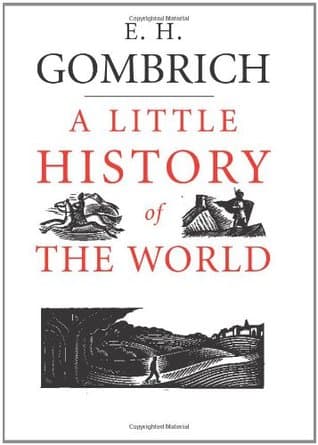
A Little History of the World cover
Archivist's Choice

A Little History of the World

E.H. Gombrich (2022)

Genre

Reference / History / Children's

Reading Time

600 min

Key Themes

See below

Track Your Reading

Sign in to track this book

Gombrich condenses the vast scope of human history, from the Stone Age to the atomic bomb, into forty clear chapters, showing our collective journey, successes, and failures for young readers.

Core Idea

E.H. Gombrich's "A Little History of the World" tells the story of human civilization from the Stone Age to the mid-20th century. It connects different cultures and shows how the human story unfolds over time. The book argues that history is more than just facts; it's a developing story shaped by people and ideas, with societies rising and falling. It aims to build understanding of the past and its lessons for today. Gombrich makes complex history easy to grasp, showing how power changes and how people endure through different times and places.
Reading time
600 min
Difficulty
Easy
✓ Read this if...
You want a highly accessible, engaging, and empathetic overview of world history for a general audience, especially younger readers, that focuses on storytelling rather than dry facts.
✗ Skip this if...
You are looking for an academic, deeply detailed, or critically analytical historical text with extensive footnotes and historiographical debate.

Core idea

The central argument and framework that powers the entire book.

E.H. Gombrich's "A Little History of the World" tells the story of human civilization from the Stone Age to the mid-20th century. It connects different cultures and shows how the human story unfolds over time. The book argues that history is more than just facts; it's a developing story shaped by people and ideas, with societies rising and falling. It aims to build understanding of the past and its lessons for today. Gombrich makes complex history easy to grasp, showing how power changes and how people endure through different times and places.

At a glance

Reading time

600 min

Difficulty

Easy

Read this if...

You want a highly accessible, engaging, and empathetic overview of world history for a general audience, especially younger readers, that focuses on storytelling rather than dry facts.

Skip this if...

You are looking for an academic, deeply detailed, or critically analytical historical text with extensive footnotes and historiographical debate.

Key Takeaways

1

The Human Story Unfolds Chronologically

History is a continuous, interconnected narrative, not just a series of isolated events.

Quote

All history is the history of man.

Gombrich shows history as a continuous flow, focusing on how human civilization developed in order. He shows how each period builds on the last, illustrating the cause-and-effect that drives societal change. This helps readers grasp the broad sweep of human experience, from early hunter-gatherers to the modern world, making different events fit into a clear, understandable journey. It offers a strong alternative to the often fragmented way history is taught, revealing the logic and progress of human efforts.

Supporting evidence

The book's forty chapters are structured chronologically, starting with the Stone Age and progressing through ancient civilizations, the Middle Ages, the Renaissance, and up to the 20th century with the atomic bomb, each chapter naturally flowing into the next.

Apply this

When learning about any historical event, always consider what came before it and what came after. Try to connect it to broader trends and developments rather than viewing it in isolation. Create personal timelines for specific topics to visualize the progression.


chronological-narrativehistorical-continuityhuman-progress
2

Empathy for the Past

Understanding historical figures requires stepping into their shoes and appreciating their context.

Quote

We must try to understand the people of the past, not judge them by our standards.

Gombrich encourages readers to understand people and societies from the past. He avoids judging them by today's standards, instead explaining why people acted as they did within the limits and beliefs of their time. This means acknowledging different moral ideas, scientific knowledge, and social norms without necessarily agreeing with them. By doing this, he helps readers gain a deeper, more nuanced appreciation for history's complexities and prevents simple dismissal of whole eras or cultures. It's about trying to understand, not jus...

Supporting evidence

Gombrich often explains the motivations behind seemingly 'primitive' or 'barbaric' practices in ancient cultures, such as human sacrifice or the rigid social hierarchies of the pharaohs, by contextualizing them within their belief systems and societal needs, rather than just stating them as facts.

Apply this

When encountering a historical event or figure that seems morally questionable by today's standards, pause and research the prevailing beliefs, technologies, and social structures of that specific time. Ask: 'What would it have been like to live then?'

historical-empathycontextual-understandinganachronism
3

The Impermanence of Empires

No civilization, however mighty, lasts forever; rise and fall are constant historical rhythms.

Quote

Empires, like waves, rise and fall, one after another.

A repeated idea in Gombrich's story is how power changes and how empires' glory is temporary. From the Egyptians and Persians to the Romans, Mongols, and later European colonial powers, he details their rise, times of power, and eventual fall or change. This constant shift is a strong reminder of how fragile human creations are and how change is certain. It gives a serious view of grand goals and shows that even the strongest civilizations are affected by time, internal conflicts, and outside pressures.

Supporting evidence

The book explicitly charts the rise and fall of numerous empires: the Assyrians, Babylonians, Persians, Greeks (via Alexander's empire), Romans, the Carolingian Empire, the Mongol Empire, and later the Spanish, French, and British empires, showing how each eventually gave way to new powers or fragmented.

Apply this

Recognize that current geopolitical structures are not permanent. Study the factors that led to the decline of past empires (e.g., overextension, internal corruption, environmental changes) to better understand potential vulnerabilities in contemporary societies.

decline-of-civilizationsimperial-cyclestransience-of-power
4

The Enduring Human Spirit

Despite conflict and catastrophe, humanity consistently demonstrates resilience and creativity.

Quote

Time and again, people have picked themselves up and started anew, building beautiful things.

Even with wars, conquests, and dark times, Gombrich consistently highlights the strength of the human spirit. He celebrates humanity's ability to innovate, create art, think philosophically, and constantly strive to rebuild and improve. From early human cave paintings to the grand cathedrals of the Middle Ages, the scientific discoveries of the Renaissance, and modern technological wonders, he shows how creativity and progress always reappear. This is not naive hope, but an observation of a basic human trait: the ability to overcome h...

Supporting evidence

Gombrich details the flourishing of art and philosophy in Ancient Greece after periods of conflict, the intellectual revival during the Renaissance following the 'Dark Ages,' and the rapid advancements in science and technology even after devastating wars.

Apply this

In times of personal or societal challenge, look to historical examples of resilience and creativity for inspiration. Understand that setbacks are often followed by periods of innovation and rebuilding. Support arts, sciences, and education as manifestations of this enduring spirit.

human-resiliencecreativity-in-historycultural-endurance
5

The Power of Ideas and Beliefs

Religious, philosophical, and scientific ideas are potent forces shaping societies.

Quote

What people believe can change the world more profoundly than any army.

Gombrich repeatedly shows how abstract ideas and belief systems often have more lasting power than military strength or political structures. He traces the deep impact of religions like Judaism, Christianity, and Islam, the philosophical ideas of ancient Greece, and the big changes brought by scientific thought. These intellectual and spiritual currents shaped lives, set laws, inspired art, caused conflicts, and guided civilizations. He argues that understanding these core ideas is essential to understanding what motivated people thro...

Supporting evidence

He explains how the spread of Christianity transformed the Roman Empire, how Islamic scholarship preserved and advanced knowledge during Europe's Middle Ages, and how the scientific method of figures like Galileo and Newton fundamentally altered humanity's understanding of the universe.

Apply this

When analyzing current events, look beyond surface-level political or economic factors to identify the underlying ideologies, belief systems, and philosophical frameworks that are influencing decisions and societal trends. Engage with diverse intellectual traditions.

history-of-ideasimpact-of-religionphilosophical-influencescientific-revolution
6

The Paradox of Progress

Advancement often comes with unforeseen consequences and new forms of conflict.

Quote

Every step forward seems to bring new dangers.

Gombrich does not present history as a straight path of unavoidable progress. While celebrating human achievements, he also notes the downsides of advancement. New technologies, political systems, or philosophical ideas, while solving old problems, often create new ones or worsen existing tensions. The development of stronger weapons, the difficulties of larger empires, or the conflicts from new beliefs constantly remind us that 'progress' often has two sides. This balanced view prevents a simple, overly positive story and encourages ...

Supporting evidence

He discusses how the invention of gunpowder revolutionized warfare, leading to greater destruction; how the expansion of empires, while bringing order, also led to oppression and massive conflicts; and how the atomic bomb, a pinnacle of scientific achievement, introduced the existential threat of global annihilation.

Apply this

Before embracing new technologies or societal changes, critically evaluate their potential negative consequences and ethical implications alongside their benefits. Advocate for thoughtful implementation and regulation to mitigate risks.

unintended-consequencestechnological-dilemmasmoral-progress
7

The Role of Great Individuals

While broad forces shape history, pivotal figures can dramatically alter its course.

Quote

Sometimes, one man's will changes the fate of millions.

Gombrich balances the importance of 'great men' with broader social forces. While recognizing economic, environmental, and cultural trends, he also gives credit to individuals whose genius, ambition, or strong will greatly affected their times. Figures like Alexander the Great, Julius Caesar, Jesus, Muhammad, Charlemagne, Martin Luther, and Napoleon are shown not just as products of their era but as people who caused significant change. Their decisions, insights, and actions, good or bad, often changed the course of history, showing t...

Supporting evidence

He attributes the Hellenistic age to Alexander's conquests, the spread of Christianity to Jesus and his apostles, the unified Frankish kingdom to Charlemagne, and the Reformation to Martin Luther's challenge to the Church.

Apply this

Recognize the potential for individual action to create change, even within larger systems. Study the leadership qualities and decision-making processes of influential historical figures to inform your own approach to challenges and opportunities.

great-man-theoryindividual-agencyleadership-in-history
8

History as a Story, Not a List

Engaging narratives make history accessible and memorable, especially for younger minds.

Quote

I tried to tell a story, not just list a lot of dull facts.

Gombrich's skill is in turning what could be a dry list of dates and names into a compelling story. He uses a conversational, almost fireside-chat style, drawing the reader in with clear descriptions, relatable comparisons, and an engaging story arc. This storytelling approach is key to making complex historical periods and figures understandable and interesting, especially for his young audience. It shows that history is fundamentally about human drama, successes, and failures, and presenting it this way is the most effective way to ...

Supporting evidence

The entire book is written in a highly accessible, conversational style, often addressing the reader directly ('Now, imagine...', 'You will remember...'). He uses anecdotes and vivid imagery to explain complex events, such as describing the Roman Empire as a vast 'spider's web' of roads.

Apply this

When explaining complex information, whether historical or otherwise, strive to frame it as a narrative. Identify the key characters, conflicts, and resolutions to make it more engaging and memorable for your audience.

historical-narrativestorytelling-in-educationaccessible-history
9

The Interconnectedness of Cultures

No civilization develops in isolation; cross-cultural exchange is a constant driver of change.

Quote

People are always learning from each other, even when they are fighting.

Gombrich consistently shows how cultures and civilizations have always interacted. He highlights the constant movement of ideas, technologies, goods, and people across borders, often through trade, migration, or conquest. The Greeks learned from the Egyptians, the Romans from the Greeks, the Islamic world kept and advanced knowledge from both, which later influenced the European Renaissance. This shows that human progress is a group effort, built on previous societies, and that cultural exchange, even during conflict, drives innovatio...

Supporting evidence

He discusses the influence of Egyptian mathematics and astronomy on the Greeks, the Roman adoption of Greek art and philosophy, the transmission of Indian numerals and paper-making technology via the Arab world to Europe, and the global exchanges spurred by the Age of Discovery.

Apply this

Seek out diverse perspectives and learn about different cultures to broaden your understanding and foster innovation. Recognize that many 'original' ideas have roots in cross-cultural exchanges. Support international cooperation and cultural diplomacy.

cultural-exchangeglobal-interconnectednessdiffusion-of-ideas
10

History's Lessons for the Present

Understanding the past provides crucial insights for navigating contemporary challenges.

Quote

To know what has happened is to understand what is happening now.

Though written for younger readers, Gombrich's 'Little History' resonates deeply because it quietly argues that the past is still important. By telling the story of humanity's repeated struggles with power, justice, conflict, and progress, he holds a mirror to our own times. The patterns of human behavior, the rise and fall of ideas, and the results of choices made by leaders and societies are not just in old books. They offer vital lessons for understanding today's political tensions, social movements, and ethical problems. The book ...

Supporting evidence

Gombrich concludes his narrative with the advent of the atomic bomb, leaving the reader with a poignant reflection on humanity's capacity for both creation and destruction, implicitly urging reflection on the future. His constant emphasis on human nature and recurring themes (power, belief, conflict) serves as a continuous parallel to contemporary issues.

Apply this

Actively draw parallels between historical events and current affairs. Use historical precedents to anticipate potential outcomes of present decisions. Advocate for robust historical education as a cornerstone of critical thinking and civic engagement.

historical-relevancelessons-from-historyinformed-citizenship

Critical analysis

Notable Quotes

But for us, there is no going back. We can only go forward. And we have learned something from the past: that the world is always changing, and that we must change with it.

Concluding thoughts on history and progress.

And that is what history is: the story of how people lived in the past, and how they thought and felt, and what they did.

Defining history at the beginning of the book.

For it is always the same story, the story of people wanting to live in peace and happiness, and of others wanting to lord it over them.

Reflecting on recurring human conflicts and desires.

We are still living in the world they made, and we are still struggling with the problems they left behind.

Discussing the lasting impact of past generations.

And so it went on, for thousands and thousands of years, with one discovery leading to another, and one invention making another possible.

Describing the cumulative nature of human innovation.

What do we learn from all this? Only that people are always people, whether they wear animal skins or suits of armour, or modern clothes.

Emphasizing the continuity of human experience across different eras.

They had great ideas and did great things, but they also made terrible mistakes and caused much suffering.

Acknowledging the dual nature of human achievement and error.

And it is astonishing how many truly great people there have been in the world, in all ages and in all countries.

Expressing wonder at the prevalence of remarkable individuals throughout history.

We must try to understand them, not to judge them, for they were like us, only living in a different time.

Advocating for empathy and understanding when studying historical figures.

Every age has its own particular way of seeing the world, and its own particular problems.

Highlighting the unique characteristics of different historical periods.

For history is not just a collection of facts, but a story that helps us understand ourselves and the world we live in.

Explaining the interpretive and self-reflective purpose of history.

And the most important thing is that we should never stop asking questions.

Encouraging curiosity and critical thinking.

The past is like a long dream, from which we can learn much, if we only listen carefully.

Metaphorically describing the lessons available from history.

It is a wonderful thing to be human, and to be able to think and learn and create.

Celebrating the unique capacities of humanity.

Quiz

Test Your Knowledge

Ready to see how well you understood this book? Take our interactive quiz with 10 questions.

10
Questions
~5
Minutes
?
Best Score

Key Questions (FAQ)

'A Little History of the World' by E.H. Gombrich provides a comprehensive yet concise narrative of human history, from the Stone Age to the atomic bomb. It focuses on the broad sweep of mankind's experience, highlighting achievements, frailties, and significant cultural and scientific developments rather than just dates and facts.

About the author