BookBrief
A Journey to the Center of the Earth cover
Archivist's Choice

A Journey to the Center of the Earth

Jules Verne (2011)

Genre

General

Reading Time

180 min

Key Themes

See below

Track Your Reading

Sign in to track this book

Beneath the desolate Icelandic craters, Professor Hardwigg, young Harry, and their stoic guide Hans descend into a subterranean world of prehistoric beasts, ancient civilizations, and geological wonders, hurtling towards the Earth's fiery heart.

Core Idea

Jules Verne's "A Journey to the Center of the Earth" shows humanity's drive to discover the unknown. It suggests that scientific inquiry, while guiding expeditions, often clashes with nature's unpredictable forces. True resilience comes not just from intellect, but from the human spirit's ability to adapt and persevere through primeval wonders and terrors, often swayed by obsessive ambition. The story itself shows how powerful storytelling can be in shaping our understanding and pursuit of the world's greatest mysteries.
Reading time
180 min
Difficulty
Medium
✓ Read this if...
You enjoy classic adventure stories, speculative fiction exploring scientific discovery, or tales of human endurance against overwhelming natural forces. This book is perfect for those who appreciate detailed descriptions of fantastical landscapes and the dynamic between a driven mentor and a more cautious apprentice.
✗ Skip this if...
You prefer modern, fast-paced thrillers with realistic science, or if you dislike Victorian-era prose and more descriptive, less dialogue-driven narratives. If you're looking for deep character development over plot and setting, this might not be for you.

Core idea

The central argument and framework that powers the entire book.

Jules Verne's "A Journey to the Center of the Earth" shows humanity's drive to discover the unknown. It suggests that scientific inquiry, while guiding expeditions, often clashes with nature's unpredictable forces. True resilience comes not just from intellect, but from the human spirit's ability to adapt and persevere through primeval wonders and terrors, often swayed by obsessive ambition. The story itself shows how powerful storytelling can be in shaping our understanding and pursuit of the world's greatest mysteries.

At a glance

Reading time

180 min

Difficulty

Medium

Read this if...

You enjoy classic adventure stories, speculative fiction exploring scientific discovery, or tales of human endurance against overwhelming natural forces. This book is perfect for those who appreciate detailed descriptions of fantastical landscapes and the dynamic between a driven mentor and a more cautious apprentice.

Skip this if...

You prefer modern, fast-paced thrillers with realistic science, or if you dislike Victorian-era prose and more descriptive, less dialogue-driven narratives. If you're looking for deep character development over plot and setting, this might not be for you.

Key Takeaways

1

The Allure of the Unknown

Humanity's inherent drive to explore and conquer the unexplored.

Quote

There are certain things that can only be understood by undertaking the journey yourself.

Verne shows a fundamental human trait: an insatiable curiosity for the unknown. Professor Hardwigg embodies this drive, risking everything based on a cryptic, ancient manuscript. The journey itself, more than the destination, motivates them. This takeaway shows that true understanding often requires direct experience and a willingness to venture beyond the comfortable. The fantastical elements of the journey are a metaphor for pushing the boundaries of scientific inquiry and personal discovery, suggesting that the greatest rewards lie...

Supporting evidence

Professor Hardwigg's unwavering conviction to follow Saknussemm's coded message into the Icelandic volcano, despite the immense dangers and skepticism from others.

Apply this

Embrace intellectual curiosity by actively seeking out new subjects, challenging existing assumptions, and pursuing experiences that push personal boundaries, whether through travel, learning a new skill, or engaging with unfamiliar ideas.

explorationcuriositydiscovery
2

Science as the Compass

Empirical observation and scientific reasoning as essential tools for navigating the impossible.

Quote

Every new discovery is a step forward, however small, in the great march of human knowledge.

Despite the wildly speculative nature of the journey, Verne bases his narrative in the scientific principles of his era. Professor Hardwigg consistently uses geological knowledge, astronomical observations, and physical calculations to guide their descent and survival. This highlights the important role of scientific methodology even when facing the unprecedented. The narrative implies that even when faced with phenomena beyond current understanding, a systematic, evidence-based approach is the most reliable path to progress. It shows...

Supporting evidence

Hardwigg's use of a chronometer to determine their longitude, his understanding of rock formations to predict their path, and his calculations regarding the Earth's internal heat.

Apply this

Approach challenges with a methodical, data-driven mindset. Break down complex problems into smaller, analyzable parts, and rely on verifiable information rather than speculation or intuition alone.

scientific-methodgeologyempirical-evidence
3

The Resilience of the Human Spirit

Overcoming extreme adversity through resourcefulness and sheer will.

Quote

We were not men to be deterred by a few difficulties.

The journey is a relentless series of life-threatening challenges: thirst, hunger, getting lost, claustrophobia, violent storms, and encounters with prehistoric creatures. Yet, the trio perseveres. This takeaway shows the incredible adaptability and endurance of humans when pushed to their limits. Their survival is not just luck but a result of their ingenuity—finding water sources, building rafts, and maintaining hope. Verne celebrates the spirit that allows individuals to confront overwhelming obstacles and emerge, if not unscathed,...

Supporting evidence

Their desperate search for water, the construction of a raft to cross the subterranean sea, and their continued descent despite repeated setbacks and near-death experiences.

Apply this

Cultivate mental fortitude by embracing challenges as opportunities for growth. Practice problem-solving under pressure, develop contingency plans, and maintain a positive outlook even when circumstances seem dire.

resilienceperseverancesurvival
4

The Beauty and Terror of the Primeval

Confronting the awe-inspiring and terrifying remnants of Earth's ancient past.

Quote

The past came to life before our very eyes, monstrous and magnificent.

Verne's vision of the Earth's interior is a tableau of prehistoric life and landscapes. From colossal fungi forests to living fossils like ichthyosaurs and plesiosaurs, the explorers witness a world untouched by human history. This evokes wonder at the Earth's deep past and its evolutionary grandeur. However, this beauty is intertwined with terror, as these ancient creatures are dangerous and indifferent to human life. The encounter with primeval forces makes the characters, and the reader, confront humanity's relative insignificance ...

Supporting evidence

The descriptions of the vast subterranean sea teeming with prehistoric marine reptiles, the giant fungi forests, and the discovery of a preserved human skeleton from an earlier epoch.

Apply this

Foster a deeper appreciation for natural history and ecology. Recognize the delicate balance of ecosystems and humanity's impact, understanding that the Earth's past holds lessons for its future.

paleontologyprehistorybiodiversity
5

The Mentor-Apprentice Dynamic

The transfer of knowledge and the growth spurred by challenging mentorship.

Quote

I was but a satellite revolving around my master's powerful intellect.

The relationship between Professor Hardwigg and his nephew Harry is central to the narrative. Hardwigg, the brilliant but often oblivious scholar, pushes Harry far beyond his comfort zone. Harry, initially timid and somewhat reluctant, grows immensely throughout the ordeal, developing courage, resourcefulness, and a deeper appreciation for scientific inquiry. This dynamic shows the power of mentorship, where an experienced guide can ignite potential in a mentee, even if the methods are unconventional or demanding. Harry's transformati...

Supporting evidence

Harry's initial fear and skepticism contrasting with his later active participation in problem-solving, his growing understanding of geology, and his unwavering loyalty to his uncle despite the dangers.

Apply this

Seek out mentors who challenge you and provide opportunities for hands-on learning. As a mentor, create an environment for growth, allowing mentees to take calculated risks and learn from their experiences.

mentorshipeducationpersonal-growth
6

The Perils of Obsession

When relentless pursuit of a goal blinds one to reason and safety.

Quote

My uncle, with his usual impetuosity, saw only the goal, never the obstacles.

Professor Hardwigg's drive, while admirable for its scientific curiosity, often borders on reckless obsession. His single-minded pursuit of the Earth's center frequently puts himself and his companions in extreme peril, sometimes disregarding practical concerns or basic safety. This takeaway is a cautionary note: while passion is vital for discovery, unbridled obsession can lead to dangerous tunnel vision, ignoring valid risks and the well-being of others. It highlights the importance of balancing ambition with prudence and self-aware...

Supporting evidence

Hardwigg's refusal to turn back even when water supplies ran critically low, his insistence on continuing the descent despite perilous conditions, and his occasional disregard for Harry's fears.

Apply this

When pursuing ambitious goals, regularly pause to assess risks, consider alternative approaches, and solicit feedback from trusted individuals. Ensure that passion is tempered with responsibility and ethical considerations.

obsessionrisk-assessmentethics
7

The Power of the Narrative

How stories, even ancient ones, can ignite incredible journeys.

Quote

It was a document, a precious, unique document, which had fallen into my hands!

The entire adventure depends on a single, ancient, coded manuscript discovered by Professor Hardwigg. This document, attributed to an Icelandic alchemist, sparks their extraordinary voyage. This takeaway shows the lasting power of stories and historical accounts, even fragmented or cryptic ones, to inspire and shape human endeavors. It suggests that knowledge passed down through generations, regardless of its form, can hold immense value and provoke profound actions. The narrative itself shows the human desire to decipher and follow t...

Supporting evidence

The initial discovery of Saknussemm's coded parchment within an old book, which directly leads to the professor's decision to embark on the journey.

Apply this

Engage with historical texts, cultural narratives, and personal stories to draw inspiration and learn from past experiences. Recognize that even seemingly obscure information can hold keys to future understanding or action.

storytellinghistoryinspiration
8

Nature's Unpredictability and Majesty

The humbling experience of confronting the Earth's raw, untamed forces.

Quote

We were at the mercy of the elements, mere specks in the vastness of the Earth.

Beneath the Earth's surface, the explorers face natural phenomena far beyond human control: volcanic eruptions, subterranean storms, and the vast, unpredictable forces of geology. This takeaway highlights humanity's vulnerability when confronted with nature's raw power. While the characters use science to navigate, they are ultimately subject to the Earth's will. The immense scale of the underground world, with its colossal sea and towering caverns, instills awe and humility, reminding us that despite our technological advancements, w...

Supporting evidence

The violent underground storm on the subterranean sea, the volcanic eruption that propels them back to the surface, and the ever-present danger of rockfalls and extreme temperatures.

Apply this

Cultivate respect for natural environments and their inherent power. Develop preparedness strategies for natural disasters and advocate for sustainable practices that acknowledge humanity's place within ecological systems.

natural-forcesgeologyenvironmentalism
9

The Thrill of the 'First'

The profound impact of being the first to witness or achieve something extraordinary.

Quote

No human foot had ever trod these paths before us.

A significant driving force throughout the journey is the knowledge that they are venturing into truly uncharted territory, becoming the first humans to witness these subterranean wonders. This 'first' status gives their discoveries immense significance and fuels their determination. The thrill of being a pioneer, of seeing something no one else has seen, is a powerful motivator for exploration and scientific endeavor. It speaks to a deep human desire for originality and the unique satisfaction from breaking new ground, whether in phy...

Supporting evidence

The repeated exclamations of wonder and the sense of historical importance felt by the characters as they encounter previously unseen landscapes, creatures, and geological formations.

Apply this

Seek opportunities for innovation and creativity in your own field or interests. Embrace the challenge of tackling problems that haven't been solved before, or approaching existing problems from a novel perspective.

innovationpioneeringoriginality

Critical analysis

Notable Quotes

As long as the heart beats, as long as the flesh has feelings, I will never admit that a given phenomenon is impossible.

Professor Lidenbrock's unwavering scientific determination.

What a journey! What a wonderful journey!

Axel's recurring exclamation as he reflects on their incredible adventure.

The sea, whose bottom is never fathomed, is an image of the human mind.

A philosophical reflection on the unknown depths.

Science, my lad, is made up of errors, but of errors that it is good to commit, for they lead little by little to the truth.

Professor Lidenbrock instructing Axel on the nature of scientific discovery.

There are times when I am inclined to think that the greatest discoveries are made by accident.

Axel's observation on serendipitous findings during their expedition.

Who knows what dangers we have escaped!

A reflection after surviving a perilous situation.

The earth has not yielded all her secrets.

A broader statement about the continuing mysteries of the planet.

He had the faculty of seeing in everything an occasion for a scientific observation.

Describing Professor Lidenbrock's relentless scientific curiosity.

To the centre of the earth!

The ultimate goal and driving force of their expedition.

I will not give up so long as I have a breath in my body.

Professor Lidenbrock's declaration of perseverance.

The unexpected is always happening.

A realization about the unpredictable nature of their journey.

It is a grand thing to be a discoverer.

A reflection on the satisfaction and importance of exploration.

What a terrible thirst consumed me!

Axel's personal struggle with the harsh conditions of the journey.

Our adventures were far from being at an end.

A narrative statement hinting at further challenges and discoveries.

Quiz

Test Your Knowledge

Ready to see how well you understood this book? Take our interactive quiz with 10 questions.

10
Questions
~5
Minutes
?
Best Score

Key Questions (FAQ)

Jules Verne's 'A Journey to the Center of the Earth' follows Professor Otto Lidenbrock, his nephew Axel, and their guide Hans as they descend into a volcanic tube in Iceland, believing it leads to the Earth's core. They encounter prehistoric creatures, vast underground oceans, and incredible natural wonders, facing numerous perils on their extraordinary expedition.

About the author

Jules Verne

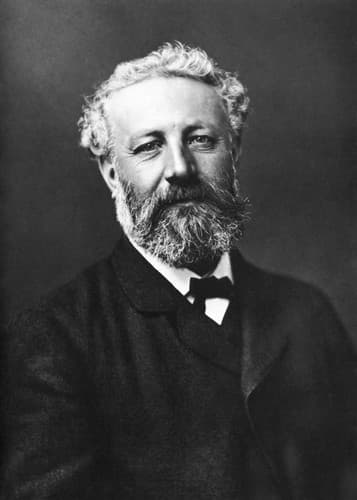
Jules Gabriel Verne was a French novelist, poet, and playwright. His collaboration with the publisher Pierre-Jules Hetzel led to the creation of the Voyages extraordinaires, a series of bestselling adventure novels including Journey to the Center of the Earth (1864), Twenty Thousand Leagues Under the Seas (1870), and Around the World in Eighty Days (1872). His novels, always well documented, are generally set in the second half of the 19th century, taking into account the technological advances of the time.