BookBrief
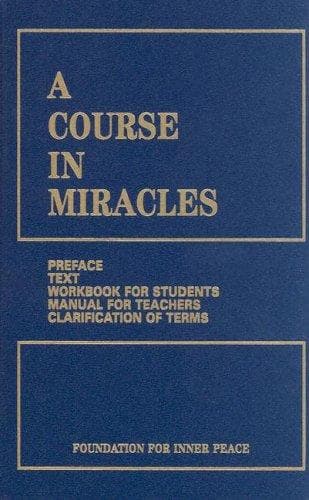
A Course in Miracles: TEXT / WORKBOOK / MANUAL FOR TEACHERS cover
Archivist's Choice

A Course in Miracles: TEXT / WORKBOOK / MANUAL FOR TEACHERS

Genre

General

Reading Time

100+ hours (it's a multi-volume text for dedicated study)

Key Themes

See below

Track Your Reading

Sign in to track this book

This spiritual self-study course guides readers to undo the ego's thought system through daily lessons and practical application, revealing the inherent presence of love and the illusion of separation.

Core Idea

A Course in Miracles (ACIM) presents a comprehensive spiritual thought system centered on the radical idea that the physical world and all its perceived problems, including sin, guilt, and fear, are ultimately an illusion stemming from a single, mistaken belief in separation from God. The Course asserts that our true nature is spirit, eternally united with our Creator, and that the 'problem' is not sin but a misperception that can be corrected through the practice of true forgiveness. This forgiveness is not about pardoning someone for a wrong they committed, but about recognizing that there was no sin to begin with, and that what we perceived as an attack was merely a call for love. By choosing to see through the lens of the Holy Spirit, our inner guide, instead of the ego, we can undo the illusion of separation and return to a state of inner peace and remembrance of our inherent Oneness.
Reading time
100+ hours (it's a multi-volume text for dedicated study)
Difficulty
Hard
✓ Read this if...
You are seeking a profound spiritual transformation, are open to radical reinterpretation of Christian terminology, want to understand the nature of reality and illusion, and are committed to a daily practice of mind training for inner peace.
✗ Skip this if...
You are looking for a traditional religious text, are uncomfortable with challenging conventional theological concepts, or prefer a less abstract and more prescriptive spiritual guide with concrete rules and rituals.

Core idea

The central argument and framework that powers the entire book.

A Course in Miracles (ACIM) presents a comprehensive spiritual thought system centered on the radical idea that the physical world and all its perceived problems, including sin, guilt, and fear, are ultimately an illusion stemming from a single, mistaken belief in separation from God. The Course asserts that our true nature is spirit, eternally united with our Creator, and that the 'problem' is not sin but a misperception that can be corrected through the practice of true forgiveness. This forgiveness is not about pardoning someone for a wrong they committed, but about recognizing that there was no sin to begin with, and that what we perceived as an attack was merely a call for love. By choosing to see through the lens of the Holy Spirit, our inner guide, instead of the ego, we can undo the illusion of separation and return to a state of inner peace and remembrance of our inherent Oneness.

At a glance

Reading time

100+ hours (it's a multi-volume text for dedicated study)

Difficulty

Hard

Read this if...

You are seeking a profound spiritual transformation, are open to radical reinterpretation of Christian terminology, want to understand the nature of reality and illusion, and are committed to a daily practice of mind training for inner peace.

Skip this if...

You are looking for a traditional religious text, are uncomfortable with challenging conventional theological concepts, or prefer a less abstract and more prescriptive spiritual guide with concrete rules and rituals.

Key Takeaways

1

The Illusion of Separation

Our perception of being separate from God and each other is the root of fear and conflict.

Quote

The separation is not a fact, but a belief.

A central tenet of A Course in Miracles (ACIM) is that the universe we perceive, with its divisions and conflicts, is an illusion stemming from a primordial 'tiny mad idea' of separation from our Creator, God. This belief in separation gave rise to the ego, a thought system built on fear, guilt, and the constant need for self-preservation. The world, as we experience it, is merely a projection of this internal state of mind. Recognizing the illusory nature of separation is the first step towards undoing the ego and returning to our tr...

Supporting evidence

The entire metaphysical framework of ACIM, particularly the Text, elaborates on the origin and nature of the separation and its consequences.

Apply this

Practice observing your reactions to perceived differences and conflicts, recognizing them as manifestations of a deeper belief in separation rather than objective realities.


egoseparationillusion
2

Forgiveness as the Path to Peace

True forgiveness means seeing past the ego's illusions to recognize the innocence in others and ourselves.

Quote

Forgiveness recognizes what you thought your brother did to you has not occurred.

ACIM defines forgiveness not as condoning wrongdoing, but as realizing that what we perceive as an offense never truly happened in reality, only within the dream of the ego. It's a process of letting go of judgment and recognizing the shared innocence and Christ-Mind in everyone. When we forgive, we are not just forgiving another; we are forgiving ourselves for having projected our own guilt onto them. This undoes the ego's thought system and allows us to experience inner peace. Holding onto grievances keeps us tethered to the illusio...

Supporting evidence

The Workbook for Students contains 365 lessons, many of which are dedicated to practicing different facets of forgiveness and letting go of grievances.

Apply this

When you feel anger or resentment, consciously choose to see the situation through the 'eyes of Christ,' asking for help to perceive the underlying innocence.

forgivenessatonementguilt
3

The Holy Spirit: Inner Guide

The Holy Spirit serves as our internal guide, offering a different interpretation of the world than the ego.

Quote

The Holy Spirit is the Voice for God.

Within each of us resides the Holy Spirit, a manifestation of the Atonement principle and a direct communication link to God. The Holy Spirit is not an external entity but an internal part of our mind that remembers our true nature and offers a corrective thought system to the ego's illusions. It provides guidance, wisdom, and a pathway back to peace through its gentle interpretations of our experiences. Unlike the ego, which thrives on fear and judgment, the Holy Spirit speaks only of love, forgiveness, and unity. Learning to listen ...

Supporting evidence

The Text frequently refers to the Holy Spirit as the 'Voice for God' and the 'Answer' to the ego's problems, detailing its function and role in salvation.

Apply this

Before making decisions or reacting to situations, pause and ask for the Holy Spirit's guidance, allowing a moment of quiet reflection for an alternative perspective.

holy-spiritatonementguidance
4

Miracles as Shifts in Perception

Miracles are not supernatural events but shifts in perception from fear to love.

Quote

A miracle is a shift in perception from fear to love.

ACIM redefines 'miracles' from extraordinary physical occurrences to profound changes in perception. A miracle is essentially a shift from perceiving with the ego's fearful judgment to seeing with the Holy Spirit's loving understanding. It’s a moment when we choose to see past the illusion of attack and instead recognize the underlying innocence and love. This internal shift then transforms our experience of the external world, bringing peace where there was conflict, and healing where there was sickness. Miracles are natural expressi...

Supporting evidence

The 'Manual for Teachers' specifically defines miracles and their characteristics, emphasizing their perceptual nature.

Apply this

When facing a challenging situation, consciously ask for a miracle, understanding that you are asking for a shift in your own perception of the event.

miraclesperceptionhealing
5

The World as a Classroom

The physical world and our relationships within it serve as a classroom for learning forgiveness and transcending the ego.

Quote

The world is a classroom, and its chief purpose is to teach you that you are not of the world.

The world, with all its apparent challenges and difficulties, is presented in ACIM as a divinely orchestrated classroom. Its purpose is not to punish us, but to provide opportunities for learning and practicing forgiveness. Every relationship, every interaction, and every perceived problem is an opportunity to choose love over fear, and to undo the ego's thought system. We are meant to engage with the world, but not to be 'of' it, meaning we should not identify with its illusions. By using the world as a learning ground for spiritual ...

Supporting evidence

The Text frequently refers to the world as a 'dream,' a 'school,' or a 'classroom' designed for learning the lessons of forgiveness.

Apply this

Instead of blaming external circumstances, view challenges as opportunities to practice forgiveness and shift your perception.

worldclassroomrelationships
6

You Are Not Your Body

Our true identity is spirit, not the physical body, which is merely a temporary vehicle for learning.

Quote

You are not a body. You are free.

A fundamental teaching of ACIM is that our true Self is pure spirit, created in the likeness of God, and therefore eternal, changeless, and whole. The body, on the other hand, is a temporary illusion, a vehicle the ego uses to reinforce the idea of separation and limitation. Identifying with the body leads to fear of death, sickness, and aging, and fosters a sense of vulnerability. By recognizing that we are spirit, we transcend these limitations and reclaim our inherent freedom and invulnerability. The body is to be used lovingly by ...

Supporting evidence

Numerous lessons in the Workbook for Students guide the student to identify with spirit rather than the body, such as 'I am not a body. I am free. For I am still as God created me.'

Apply this

When experiencing physical discomfort or fear related to the body, affirm your true identity as spirit, asking the Holy Spirit to guide your perception.

bodyspiritidentity
7

The Real World vs. The Illusory World

There is a 'real world' perceived through the Holy Spirit, which is a state of grace and peace, beyond the ego's illusions.

Quote

The real world is merely the beginning of the return to reality.

ACIM distinguishes between the 'illusory world' we typically perceive through the ego's lens of fear and separation, and the 'real world.' The real world is not a physical place but a state of mind, a purified perception where we see the underlying innocence and unity in everything, having forgiven the world's illusions. It's a stepping stone back to full awareness of Heaven. In the real world, the purpose of all relationships and events is seen as healing and forgiveness. It's a world where the Holy Spirit's purpose is fulfilled, and...

Supporting evidence

The Text extensively describes the 'real world' as the outcome of complete forgiveness and the Holy Spirit's vision.

Apply this

Actively seek to perceive the world and others through a lens of love and forgiveness, understanding that this is how you glimpse the 'real world.'

real-worldillusionheaven
8

Atonement: Correction of the Error

Atonement is the undoing of the belief in separation, restoring our awareness of unity with God.

Quote

The Atonement is the only defense that cannot be used for attack.

The principle of Atonement in ACIM refers to the correction of the 'tiny mad idea' of separation from God. It is the plan for undoing the ego and restoring our awareness of our true, unified Self. Jesus is presented as the symbol of the Atonement, demonstrating perfect love and forgiveness, and showing us the way back to God. Atonement is not about being punished for sins, but about recognizing that sin (the belief in separation) never truly occurred. It's a process of healing the mind by accepting the Holy Spirit's interpretation of ...

Supporting evidence

The concept of Atonement is introduced early in the Text and is consistently reinforced as the core mechanism of salvation throughout the entire Course.

Apply this

When you feel guilty or judgmental, consciously invoke the principle of Atonement, asking the Holy Spirit to correct your perception and remind you of your innocence.

atonementsalvationcorrection
9

Teaching and Learning Are One

To truly learn a principle, one must teach it, as teaching reinforces the lesson in the teacher's mind.

Quote

To teach is to demonstrate. If you teach love, you are demonstrating love.

ACIM emphasizes that teaching and learning are fundamentally the same process. When we teach, we are simultaneously reinforcing the lesson within ourselves. To teach love and forgiveness to others is to actively practice and internalize these principles. This is why the 'Manual for Teachers' is such an integral part of the Course; it outlines the characteristics and responsibilities of those who choose to embody and extend the teachings. Every interaction becomes an opportunity to teach (and thus learn) forgiveness, peace, and love. T...

Supporting evidence

The 'Manual for Teachers' explicitly details the role of a Teacher of God and the reciprocal relationship between teaching and learning.

Apply this

Consciously try to exemplify the principles of love and forgiveness in your daily interactions, recognizing that by doing so, you deepen your own understanding.

teachinglearningdemonstration
10

Ultimate Goal: Return to God

The ultimate purpose of the Course is to lead us back to the awareness of our eternal unity with God.

Quote

This Course will lead to knowledge, but knowledge itself is beyond the scope of the Course.

The entire journey of A Course in Miracles is designed to systematically undo the ego's thought system and guide the student back to the awareness of their true Self, which is eternally one with God. While the Course itself operates within the realm of perception, its ultimate aim is to transcend perception entirely and lead to the experience of 'knowledge' – a direct, non-conceptual awareness of God's Presence. This return to God means the complete cessation of the dream of separation, fear, and suffering, and the full remembrance of...

Supporting evidence

The conclusion of the Text and many Workbook lessons point towards the ultimate goal of transcending the world and returning to God's peace.

Apply this

Maintain a conscious awareness that all your spiritual practices and efforts are ultimately guiding you towards a deeper connection with your Source.

heavenknowledgeunity

Critical analysis

Notable Quotes

Nothing real can be threatened. Nothing unreal exists. Herein lies the peace of God.

Introduction, Text

The Holy Spirit is the Answer to every problem that you think you have.

Text, Chapter 14, Section II, Paragraph 1

I am upset because I see something that is not there.

Workbook, Lesson 5

Forgiveness recognizes what you thought your brother did to you has not occurred.

Manual for Teachers, Section 1, Paragraph 1

My mind is preoccupied with past thoughts.

Workbook, Lesson 8

The ego is a tiny, mad idea.

Text, Chapter 18, Section VI, Paragraph 2

I am never upset for the reason I think.

Workbook, Lesson 4

The world you see has nothing to do with reality.

Text, Chapter 13, Section V, Paragraph 3

Miracles are natural. When they do not occur, something has gone wrong.

Text, Chapter 1, Section I, Paragraph 1

There is no order of difficulty in miracles.

Text, Chapter 1, Section I, Paragraph 4

My mind is part of God's. I am holy.

Workbook, Lesson 97

Sickness is a defense against the truth.

Text, Chapter 27, Section II, Paragraph 1

The quiet of today will bring a peace so deep and still that you will never be upset again.

Workbook, Lesson 129

You are at home in God, dreaming of exile but perfectly at home.

Text, Chapter 10, Section I, Paragraph 2

Quiz

Test Your Knowledge

Ready to see how well you understood this book? Take our interactive quiz with 10 questions.

10
Questions
~5
Minutes
?
Best Score

Key Questions (FAQ)

A Course in Miracles is a spiritual self-study program presented as a set of three books: the Text, the Workbook for Students, and the Manual for Teachers. It offers a unique spiritual philosophy focused on forgiveness as the path to inner peace and the recognition of our true, unified nature.

About the author

Author information is not available yet.