BookBrief
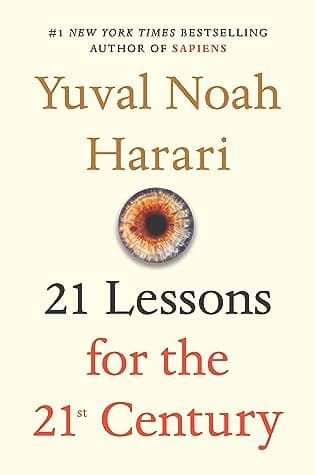
21 Lessons for the 21st Century cover
Archivist's Choice

21 Lessons for the 21st Century

Yuval Noah Harari (2020)

Genre

Politics / History / Technology / Science / Philosophy

Reading Time

372 min

Key Themes

See below

Track Your Reading

Sign in to track this book

Yuval Noah Harari offers 21 urgent lessons to help humanity navigate the present and prepare for an uncertain future marked by AI, fake news, and global upheaval.

Core Idea

Yuval Noah Harari explores pressing challenges facing humanity in the 21st century, from AI and biotechnology to climate change and nuclear war. He examines how these global issues erode liberal democracy, create new inequality, and force us to re-evaluate truth, justice, and identity. The book urges readers to confront our rapidly changing world and to cultivate critical thinking and self-awareness.
Reading time
372 min
Difficulty
Medium
✓ Read this if...
You are interested in the philosophical, political, and social implications of current global trends and technological advancements, and want to understand the challenges humanity faces in the coming decades.
✗ Skip this if...
You are looking for practical, actionable solutions to specific problems, or prefer a less speculative and more optimistic outlook on the future.

Core idea

The central argument and framework that powers the entire book.

Yuval Noah Harari explores pressing challenges facing humanity in the 21st century, from AI and biotechnology to climate change and nuclear war. He examines how these global issues erode liberal democracy, create new inequality, and force us to re-evaluate truth, justice, and identity. The book urges readers to confront our rapidly changing world and to cultivate critical thinking and self-awareness.

At a glance

Reading time

372 min

Difficulty

Medium

Read this if...

You are interested in the philosophical, political, and social implications of current global trends and technological advancements, and want to understand the challenges humanity faces in the coming decades.

Skip this if...

You are looking for practical, actionable solutions to specific problems, or prefer a less speculative and more optimistic outlook on the future.

Key Takeaways

1

The Data Religion is Here

Algorithms know you better than you know yourself, challenging the core of human free will.

Quote

As algorithms learn to understand and manipulate human emotions better than we ourselves can, they will increasingly make decisions for us, whether about what to study, whom to marry, or for whom to vote.

Harari argues that the rise of Big Data and AI is creating a new 'data religion' where algorithms become the ultimate authority. Our personal data, collected and analyzed, allows systems to predict and even influence our choices with great accuracy. This challenges the idea of individual free will, suggesting our decisions might be less about unique consciousness and more about biochemical algorithms that external algorithms can understand. As these systems improve, they will subtly guide our lives, raising ethical questions about aut...

Supporting evidence

Harari cites examples of personalized advertising and political campaigns that leverage psychographic data to target individuals with highly effective, tailored messages, demonstrating how algorithms already influence our choices in subtle but powerful ways.

Apply this

Cultivate a deep skepticism towards 'convenient' recommendations and personalized content. Actively seek out diverse information sources that challenge your existing viewpoints, rather than relying on algorithms that reinforce them. Engage in practices that foster self-awareness to better distinguish between genuine desires and algorithmically induced ones.


big-dataartificial-intelligencefree-willdata-religionalgorithms
2

The Meaningless of Work

Automation threatens not just jobs, but the very purpose and dignity many derive from labor.

Quote

What will humans do once algorithms and robots can do everything better?

Harari predicts a future where AI and robotics will replace many human jobs, not just in manual labor but also in cognitive tasks. The challenge is not just unemployment, but 'unemployability' – a situation where many people lack the skills for an automated economy. This raises the possibility of a 'useless class,' not exploited, but simply unneeded. The social and psychological effects are huge, as work often provides identity, community, and purpose. Governments and societies must consider how to provide meaning and dignity in a pos...

Supporting evidence

Harari points to the rapid advancements in fields like self-driving cars and diagnostic AI, which are already demonstrating superior performance to humans in specific, complex tasks, foreshadowing widespread job displacement.

Apply this

Prioritize lifelong learning and adaptability, focusing on uniquely human skills like creativity, emotional intelligence, and critical thinking that are harder for AI to replicate. Advocate for policies like universal basic income and invest in social structures that provide meaning beyond traditional employment.

automationunemploymentuniversal-basic-incomefuture-of-workmeaning-of-life
3

The Post-Truth Era

In an age of information overload, distinguishing fact from fiction becomes a critical survival skill.

Quote

If you want to control people, you don't need to send soldiers to their homes. You just need to control their stories.

Harari argues that we live in a 'post-truth' era where facts are often less important than appeals to emotion and personal belief. The digital revolution, while making information accessible, has also created echo chambers and made it easier for false stories and 'fake news' to spread quickly. This harms shared understanding and rational discussion, making collective problem-solving very difficult. The challenge is not just identifying lies, but recognizing how our own biases and group loyalties make us open to stories that confirm ou...

Supporting evidence

Harari references the spread of conspiracy theories and politically motivated misinformation campaigns, particularly during elections and referendums, demonstrating how easily populations can be swayed by emotionally resonant, though factually dubious, stories.

Apply this

Actively practice 'information hygiene': vet sources, cross-reference facts, and be wary of emotionally charged content. Cultivate intellectual humility and be open to changing your mind when presented with compelling evidence, even if it contradicts your existing beliefs. Engage in constructive dialogue rather than simply consuming reinforcing narratives.

fake-newspost-truthmisinformationcritical-thinkingmedia-literacy
4

Global Challenges, Local Politics

Humanity faces planetary threats, but our political systems remain stubbornly nationalistic.

Quote

Humankind is currently facing unprecedented global problems, from nuclear war and ecological collapse to technological disruption and the rise of a global 'useless class.' But our political systems are still organized on a national basis.

Harari highlights the problem of global threats (climate change, nuclear war, pandemics, AI regulation) clashing with the national focus of our political institutions. Nations are primarily concerned with their own citizens, often at the expense of global cooperation. This 'global problems, local politics' dilemma prevents effective solutions to issues that cross borders. The book asks us to think beyond national loyalties and develop a sense of global responsibility, acknowledging that humanity's fate is connected, regardless of nati...

Supporting evidence

The inadequate global response to climate change, despite scientific consensus, serves as a prime example of national interests overriding collective human survival. Similarly, the fragmented response to global pandemics like COVID-19 highlights the limitations of purely national approaches.

Apply this

Support and advocate for international cooperation and organizations. Engage in political discourse that emphasizes global solidarity and long-term planetary well-being over narrow nationalistic interests. Recognize your own biases and tendencies towards 'us vs. them' thinking, and actively work to broaden your perspective.

global-governanceclimate-changenationalisminternational-cooperationhumanity
5

The Crisis of Liberalism

The foundational narratives of liberal democracy are struggling to address 21st-century realities.

Quote

For decades, the liberal story provided a convincing answer to the question 'What is happening in the world?' But in the early 21st century, this story is crumbling.

Harari observes that the liberal narrative, which championed individual freedom, free markets, and democratic institutions, has lost much of its power. It struggles to provide good answers to the challenges of technological change, economic inequality, and cultural division. Populist movements on both the left and right use these weaknesses, offering simpler, often divisive, stories. The problem is not necessarily a failure of liberal values themselves, but the inability of the established liberal framework to adapt and offer a vision...

Supporting evidence

The rise of populist leaders in various democracies, Brexit, and the increasing political polarization in many Western nations serve as Harari's evidence for the current crisis of the liberal order.

Apply this

Engage critically with political narratives, questioning assumptions and seeking nuanced understanding beyond simplistic slogans. Support reforms that aim to make democratic institutions more resilient and responsive to contemporary challenges. Understand that solutions require collaboration across ideological divides.

liberal-democracypopulismpolitical-polarizationfree-marketsindividual-freedom
6

The Illusion of Choice

Big Data's power to predict and manipulate our preferences erodes genuine personal freedom.

Quote

The algorithms will get to know you so well that they could predict your desires and manipulate your feelings, and you would never know it.

This point builds on 'The Data Religion is Here.' Harari explains how the great predictive power of algorithms, fueled by our data, creates an illusion of choice. We might feel we are making independent decisions, but in reality, our preferences, desires, and even emotions are increasingly shaped by sophisticated AI. This is not open force but a subtle, widespread form of control that operates below our conscious awareness. The danger is not just losing freedom, but losing the ability to recognize when it's being taken away, as our 'c...

Supporting evidence

Harari references social media feeds and online shopping recommendations, which are designed to keep users engaged and spending by presenting content and products that align perfectly with their predicted interests, often without the user realizing the extent of this algorithmic curation.

Apply this

Practice digital minimalism and periodically disconnect from platforms designed for constant engagement. Actively seek out experiences and information that are not algorithmically curated. Engage in critical self-reflection about the origins of your desires and choices, questioning if they are truly your own or influenced by external forces.

algorithmic-controlpersonal-freedomconsumerismprivacydigital-literacy
7

Education for Uncertainty

Traditional education is obsolete; we must teach adaptability and mental flexibility for an unpredictable future.

Quote

In a world deluged by irrelevant information, clarity is power. Censorship works not by blocking the flow of information, but by flooding people with misinformation and distractions.

Harari argues that current educational systems, designed for a more stable industrial era, are not ready for the 21st century. Memorization and teaching specific facts are becoming outdated as information is instantly accessible. Instead, education must focus on developing mental flexibility, critical thinking, creativity, and emotional intelligence. The most important skill for the future is the ability to learn, unlearn, and relearn throughout life, as knowledge and job markets will constantly change. The goal is to prepare children...

Supporting evidence

Harari contrasts the information scarcity of past eras with today's information overload, highlighting that the challenge is no longer access to knowledge, but processing and making sense of it, underscoring the need for different educational priorities.

Apply this

Prioritize skills over specific knowledge: foster critical thinking, problem-solving, creativity, and emotional intelligence in children. Encourage a lifelong learning mindset, embracing new technologies and ideas. Teach media literacy and the ability to discern reliable information from noise.

future-of-educationlifelong-learningcritical-thinkingadaptabilitymental-flexibility
8

The Meaning of Suffering

Finding meaning in suffering is a uniquely human response that AI cannot replicate, offering a path to resilience.

Quote

Suffering is not just suffering. It is also a source of meaning. If you can find meaning in your suffering, you can endure almost anything.

Among the big stories of technology and politics, Harari explores the personal realm of meaning and suffering. He suggests that while AI might ease physical pain, it cannot create meaning from it. The human ability to find purpose, growth, and even beauty in hardship is a deep part of our consciousness that algorithms cannot copy. This ability to create stories around our experiences, even painful ones, offers a unique form of strength and a source of meaning that will remain distinctly human, even as other parts of our lives become a...

Supporting evidence

Harari implicitly references existentialist philosophy and the human tendency across cultures to create stories and rituals around loss and hardship, transforming mere pain into a meaningful experience.

Apply this

Cultivate mindfulness and self-awareness to better understand your own experiences and reactions. Practice introspection to find personal meaning in challenging situations, rather than simply avoiding or suppressing discomfort. Engage in practices that foster empathy and connection with others, recognizing shared human experiences.

meaning-of-lifesufferingresiliencehuman-consciousnessmindfulness
9

Know Thyself

In a world of external noise and algorithmic influence, inner clarity is the ultimate power.

Quote

In such a world, the last thing a teacher needs to give her pupils is more information. They already have too much of it. Instead, people need the ability to make sense of information, to tell the difference between what is important and what is unimportant, and above all, to see the big picture.

Harari concludes that the most important advice for the 21st century is the ancient saying 'know thyself.' With external authorities, stories, and even our own internal experiences increasingly open to algorithmic manipulation, understanding our true selves is essential. This is not just about looking inward, but about developing a deep awareness of our biases, weaknesses, and the subtle ways we are influenced. In a world full of information and external pressures, the ability to tell our authentic thoughts and desires from external i...

Supporting evidence

Harari's entire framework of algorithmic control and the 'data religion' points to the need for individuals to develop a stronger internal compass, as external guidance becomes increasingly suspect.

Apply this

Dedicate time to practices that cultivate self-awareness, such as meditation, journaling, or reflective walks. Regularly question your own assumptions and motivations. Seek feedback from trusted individuals who can offer an objective perspective. Prioritize inner clarity over external validation or information overload.

self-awarenessintrospectionmindfulnessauthenticitypersonal-growth

Critical analysis

Notable Quotes

In a world deluged by irrelevant information, clarity is power.

Introduction, discussing the challenge of understanding the present.

Humans think in stories rather than in facts, numbers, or equations, and the simpler the story, the better.

Chapter on Post-Truth, explaining the appeal of narratives.

We are now acquiring the power to re-engineer life, and we are not ready for it.

Chapter on Technology, discussing the ethical implications of biotech.

The greatest danger facing liberals is not fascism or communism, but irrelevance.

Chapter on Liberalism, critiquing its current challenges.

If you want to know the truth about the universe, about the meaning of life, and about your own identity, the best place to start is by observing suffering.

Chapter on Meditation, linking suffering to self-discovery.

The algorithms are watching you right now. They are watching where you go, what you buy, who you meet. Soon they will be watching what you feel.

Chapter on Data Colonialism, highlighting surveillance and AI.

When you don't know what to do, don't do anything. Just observe. Just understand.

Chapter on Meditation, advocating for mindfulness and observation.

Never underestimate human stupidity. Both individually and collectively, humans are quite capable of holding on to patently false beliefs, of pursuing futile endeavours, and of harming themselves and others.

Chapter on God, discussing human irrationality.

Dataism declares that the universe consists of data flows, and the value of any phenomenon or entity is determined by its contribution to data processing.

Chapter on Dataism, introducing the new ideology.

The future of humanity will not be decided in parliament, in the battlefield or in the courtroom. It will be decided in the laboratory.

Chapter on Technology, emphasizing the role of scientific advancements.

We are far better at wielding power than at handling happiness.

Chapter on God, reflecting on human priorities and well-being.

In a world that is increasingly interconnected and complex, the ability to zoom out and see the big picture is more crucial than ever.

Introduction, advocating for a broader perspective.

The greatest challenges facing humanity are global, but our political systems are still national.

Chapter on Nationalism, discussing the mismatch between problems and solutions.

The most important thing for you to know is yourself. Not your Facebook profile, not your Instagram feed, but your actual self.

Chapter on Meditation, encouraging introspection over digital identity.

Quiz

Test Your Knowledge

Ready to see how well you understood this book? Take our interactive quiz with 10 questions.

10
Questions
~5
Minutes
?
Best Score

Key Questions (FAQ)

The book focuses on navigating the most pressing issues of the present day, from technological advancements and political polarization to the rise of fake news, offering insights and questions for surviving in a rapidly changing world.

About the author