BookBrief
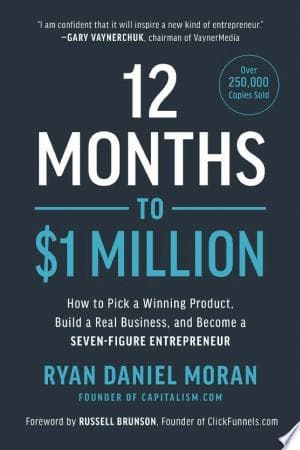
12 Months to $1 Million cover
Archivist's Choice

12 Months to $1 Million

Ryan Daniel Moran (2020)

Genre

General

Reading Time

240 min

Key Themes

See below

Track Your Reading

Sign in to track this book

Transform a product idea into a million-dollar business in 12 months with this direct guide to strategic execution and growth.

Core Idea

"12 Months to $1 Million" offers entrepreneurs a year-long plan to build an e-commerce business that generates $1 million in annual revenue. The book argues that by focusing on product-market fit, quick validation, targeted advertising, and clear profit goals, a single-product business can achieve significant financial success rapidly. It prioritizes practical action, speed, and a strategic framework over traditional business planning, positioning the entrepreneur as the main driver of growth through testing and scaling.
Reading time
240 min
Difficulty
Medium
✓ Read this if...
You are an aspiring or early-stage e-commerce entrepreneur looking for a structured, actionable plan to build a million-dollar business within a year, focusing on direct-to-consumer physical products.
✗ Skip this if...
You are looking for a deep dive into advanced business strategy, venture capital funding, or complex organizational development, or if you are not interested in the e-commerce physical product space.

Core idea

The central argument and framework that powers the entire book.

"12 Months to $1 Million" offers entrepreneurs a year-long plan to build an e-commerce business that generates $1 million in annual revenue. The book argues that by focusing on product-market fit, quick validation, targeted advertising, and clear profit goals, a single-product business can achieve significant financial success rapidly. It prioritizes practical action, speed, and a strategic framework over traditional business planning, positioning the entrepreneur as the main driver of growth through testing and scaling.

At a glance

Reading time

240 min

Difficulty

Medium

Read this if...

You are an aspiring or early-stage e-commerce entrepreneur looking for a structured, actionable plan to build a million-dollar business within a year, focusing on direct-to-consumer physical products.

Skip this if...

You are looking for a deep dive into advanced business strategy, venture capital funding, or complex organizational development, or if you are not interested in the e-commerce physical product space.

Key Takeaways

1

The Million-Dollar Blueprint

A structured, year-long journey to a seven-figure business.

Quote

This one-year plan will guide you through the three stages to your first $1 million: The Grind (Months 0-4), The Growth (Months 5-8), and The Gold (Months 9-12).

Moran states that building a million-dollar business in a year is a repeatable process if entrepreneurs follow a specific, phased roadmap. The book divides the journey into three 4-month stages: 'The Grind,' for product validation and initial sales; 'The Growth,' for scaling sales through advertising; and 'The Gold,' for product expansion and consistent high sales. This structure clarifies the startup phase, offering clear goals and steps for each period. It highlights that success comes from disciplined execution of a proven system, ...

Supporting evidence

The book's entire premise is built upon this three-stage, 12-month framework, which Moran has refined through his work with hundreds of entrepreneurs at Capitalism.com, many of whom have successfully crossed the seven-figure mark.

Apply this

Entrepreneurs should meticulously plan their first 12 months, aligning their activities with the Grind, Growth, and Gold stages. Create specific KPIs for each stage, such as 'first sale by Month 4' or '25 sales/day by Month 8,' to maintain focus and track progress against the proven roadmap.


startup-roadmapbusiness-phased-approachmillion-dollar-framework
2

The Grind: Validate and Launch

Months 0-4: Focus on identifying a winning product and securing initial sales.

Quote

This step-by-step plan will help you identify a winning product idea, target customers that are guaranteed to buy, secure funding, and take your first sale within your first four months.

The first four months are key for building a strong base. Moran stresses validating a product before investing much. This means finding a clear market need, researching competitors, and, importantly, finding customers who are 'guaranteed to buy'—those with an urgent problem your product solves. The aim is to launch with a high chance of success, shown by early customer commitment. This stage also covers getting initial funding, from personal savings to small loans, and ends with the first sale. It is about proving the concept and ma...

Supporting evidence

Moran's methodology emphasizes a lean startup approach during 'The Grind,' where entrepreneurs are encouraged to test assumptions about their product and market through pre-sales, surveys, and small-scale validation before committing to large inventory orders or extensive marketing campaigns.

Apply this

Before investing heavily, conduct thorough market research to identify a niche with clear demand. Create a Minimum Viable Product (MVP) or conduct pre-sales to validate your idea directly with potential customers. Aim to secure your first paying customer within the first 120 days to prove market viability.

product-validationlean-startupfirst-salemarket-research
3

The Growth: Scale with Advertising

Months 5-8: Leverage effective advertising to reach 25 sales per day.

Quote

Once you're in business, you will discover how to use cheap and effective advertising strategies to get your product to at least 25 sales per day, so you can prove you have a profitable business.

With a validated product and initial sales, 'The Growth' phase is about scaling. Moran suggests 'cheap and effective' advertising, noting that large budgets are not needed for significant progress. The focus here is on finding advertising channels that provide a positive return on investment (ROI) and steadily increasing daily sales. Reaching 25 sales per day is a key milestone, showing the business's profitability and ability to grow. This stage requires a data-driven approach, continuously testing and improving ad campaigns to maxim...

Supporting evidence

Moran's training at Capitalism.com likely provides specific examples of entrepreneurs who scaled using targeted social media ads, email marketing, or influencer collaborations that were cost-effective in their early stages, focusing on ROI over raw spend.

Apply this

Implement and rigorously test various low-cost digital advertising strategies (e.g., Facebook Ads, Google Ads, influencer marketing for your niche). Track your Cost Per Acquisition (CPA) and customer Lifetime Value (LTV) diligently. Scale up campaigns that demonstrate a clear positive ROI until you consistently hit 25 sales per day.

digital-advertisingsales-scalingroi-marketingcustomer-acquisition
4

The Gold: Expand and Dominate

Months 9-12: Establish a product line and achieve 100+ sales per day.

Quote

It's time to establish a series of products available for sale, until you are averaging at least 100 sales per day, getting you closer to the million-dollar mark every single day.

The final stage, 'The Gold,' brings the million-dollar goal into view. This phase moves from a single product to building a line of related products. By offering multiple items, businesses can increase average order value (AOV) and customer lifetime value (LTV), speeding up revenue growth. Achieving 100 sales per day is the new goal, indicating a strong, high-volume operation. This stage requires strategic thought about product development, inventory, and possibly expanding into new markets or distribution. It is about using initial s...

Supporting evidence

Many successful e-commerce businesses achieve significant growth by expanding their product catalog to offer upsells, downsells, and cross-sells to existing customers, a strategy Moran likely champions in this stage.

Apply this

Analyze your current customer base for additional needs or complementary products. Develop and launch 2-3 new products that enhance your existing offering. Optimize your sales funnels to encourage multiple purchases and aim for a consistent daily sales volume of 100 or more.

product-line-expansionaverage-order-valuecustomer-lifetime-valuehigh-volume-sales
5

Grit Over Glamour

Success demands commitment, hard work, and resilience, not 'easy paths'.

Quote

The truth is that building a real, profitable, sustainable business requires thousands of hours of commitment, grit, and hard work.

Moran directly challenges the idea of 'easy paths to success' in business. He clearly states that building a million-dollar business in a year is very difficult, needing huge commitment, resilience, and hard work. This is not a passive income plan; it is a demanding, full-time effort. The book serves as a guide for those ready to put in the 'thousands of hours' needed, recognizing the chaotic and stressful nature of the journey. This message sets realistic expectations, filtering out those looking for shortcuts and attracting individu...

Supporting evidence

The book explicitly states that 'more than half of new businesses close within six years of opening, and fewer than 5 percent will ever earn more than $1 million annually,' highlighting the difficulty and the need for extraordinary effort to overcome these odds.

Apply this

Cultivate a strong work ethic and mental resilience. Understand that setbacks are inevitable and view them as learning opportunities. Be prepared to dedicate significant time and energy, treating your business as a marathon, not a sprint, despite the accelerated timeline.

entrepreneurial-gritstartup-resiliencehard-work-ethicrealistic-expectations
6

Product-Market Fit is Paramount

Identify winning products and target customers 'guaranteed to buy'.

Quote

This step-by-step plan will help you identify a winning product idea, target customers that are guaranteed to buy...

A main part of Moran's strategy, especially in 'The Grind' phase, is the constant pursuit of product-market fit. He insists on finding a 'winning product idea' and, importantly, 'customers that are guaranteed to buy.' This means deeply understanding customer problems and offering a solution that powerfully motivates immediate purchase. It is not about creating something and hoping it sells; it is about finding an existing, urgent need and making a solution specifically for it. This focus lowers risk and boosts the chances of quick ini...

Supporting evidence

The emphasis on identifying 'guaranteed to buy' customers suggests a strong validation process, possibly involving surveys, pre-orders, or analyzing existing market demand for similar solutions with identified deficiencies.

Apply this

Before developing a full product, conduct extensive customer interviews and market surveys. Look for problems people are actively trying to solve and are willing to pay for. Create a minimal viable offer to test demand directly, ensuring your product truly solves a pressing problem for a specific audience.

product-market-fitcustomer-needsproblem-solution-fitmarket-demand
7

Decision Velocity Trumps Perfection

Make quick decisions and get products to market rapidly.

Quote

By cutting out the noise and providing a clear and proven plan, this roadmap helps even brand-new entrepreneurs make decisions quickly, get their product up for sale, and launch it to a crowd that is ready and waiting to buy.

Moran's framework supports 'decision velocity' – the ability to make quick, informed choices and act on them. In the fast 12-month timeline, there is no time for overthinking or endless pursuit of perfection. The clear roadmap helps 'cut out the noise,' letting entrepreneurs bypass common obstacles and move straight to action. Getting the product 'up for sale' quickly, even if it is not perfect, allows for real-world feedback and improvements, which is more valuable than theoretical planning. This agile approach is necessary for meeti...

Supporting evidence

The entire structure of the book, with its stage-by-stage, month-by-month breakdown, is designed to reduce decision fatigue and accelerate action, pushing entrepreneurs to launch and iterate quickly.

Apply this

Embrace an 'imperfect action' mindset. Set strict deadlines for decision-making and product launches. Prioritize getting your product into customers' hands to gather feedback, rather than striving for a flawless launch. Use the book's framework to guide quick, confident choices.

decision-making-speedagile-startupminimum-viable-productaction-bias
8

Profitability Over Vanity Metrics

Focus on proven sales and profitable advertising strategies.

Quote

...prove you have a profitable business.

The book's focus on achieving specific daily sales targets (25 sales/day, then 100 sales/day) is a direct call to prioritize profit and real results over 'vanity metrics' like website traffic or social media followers. Moran's approach is based on proving the business model through actual sales and profitable advertising. If advertising does not generate a positive return, it is not 'effective.' This practical focus ensures that every action directly helps the bottom line, moving the entrepreneur toward the million-dollar goal by buil...

Supporting evidence

The phrase 'prove you have a profitable business' explicitly states the core objective of the Growth stage, linking sales targets directly to financial viability.

Apply this

Relentlessly track key financial metrics: profit margins, customer acquisition cost (CAC), and customer lifetime value (LTV). Avoid getting sidetracked by metrics that don't directly impact revenue or profit. Ensure every marketing dollar spent generates a measurable positive return.

profit-firstbusiness-metricsreturn-on-investmentsustainable-business
9

The Exit is an Option, Not the Only Goal

Build a sellable asset, even if you choose to keep it.

Quote

He's seen more than 100 entrepreneurs cross the seven-figure barrier, many of whom go on to sell their businesses.

While the main goal is a million-dollar business, Moran subtly introduces the idea of building a sellable asset. The fact that many entrepreneurs he has helped go on to sell their businesses shows an important strategic point: designing a business from the start to be valuable to a potential buyer. This means creating clear processes, varied revenue streams, and a strong brand, rather than a business that depends entirely on the founder. Even if an entrepreneur chooses not to sell, building a sellable business ensures it is strong, ...

Supporting evidence

The mention of entrepreneurs selling their businesses after achieving the seven-figure mark suggests that the methodology inherently builds transferable value, not just personal income.

Apply this

From day one, document your processes, build a strong brand identity, and consider how your business would operate without your constant direct involvement. Focus on creating systems and assets that are attractive to a potential buyer, even if selling is a long-term option rather than an immediate goal.

business-valuationexit-strategyscalable-businessasset-building
10

Mastering Your Own Destiny

Achieve financial independence and the power to 'call your own shots'.

Quote

If you have the guts to complete it, you will be the proud owner of a million-dollar business and be in a position to call your own shots for life.

Beyond the financial goal, Moran emphasizes the ultimate reward of this demanding journey: true entrepreneurial freedom. Reaching the million-dollar mark is not just about money; it is about gaining the ability to 'call your own shots for life.' This means financial independence and control that allows entrepreneurs to set their terms, follow passions, and live life as they choose. This is the inner drive that fuels the 'chaotic, stressful, and rewarding year,' promising a future free from external employers or financial limits.

Supporting evidence

The concluding sentence of the summary clearly articulates this promise of autonomy and self-determination as the ultimate outcome of the 12-month journey.

Apply this

Keep your 'why' at the forefront of your mind throughout the challenging year. Visualize the freedom and control you will gain by achieving your million-dollar goal. Use this vision as a powerful motivator to push through obstacles and maintain consistent effort.

entrepreneurial-freedomfinancial-independenceautonomyself-determination

Critical analysis

Notable Quotes

The only way to build a real business is to sell a physical product online.

Introducing the core premise of the book.

Your first product should be something you can launch quickly, validate demand for, and scale.

Advising on initial product selection for new entrepreneurs.

Traffic is not the problem. Conversion is the problem.

Highlighting a common misconception among online business owners.

The real money is made on the backend, not the first sale.

Explaining the importance of customer lifetime value and upsells.

Don't just sell a product; sell a solution to a problem.

Emphasizing problem-solving as a core aspect of product positioning.

The fastest way to $1 million is often through a highly focused niche.

Advocating for specialization rather than broad appeal initially.

Your business should serve you, not the other way around.

Discussing the importance of lifestyle and freedom in entrepreneurship.

Most people quit right before they're about to have a breakthrough.

Encouraging persistence and resilience in the face of challenges.

If you want to go fast, go alone. If you want to go far, go together.

Addressing the role of team building and outsourcing for scaling.

The goal is not to be busy, but to be productive.

Distinguishing between activity and results in business operations.

Success leaves clues. Find someone who has done what you want to do and model them.

Promoting the idea of learning from successful mentors and strategies.

You don't need a massive budget to start. You need resourcefulness.

Dispelling the myth that large capital is necessary for beginning an e-commerce business.

The biggest risk is not taking any risk at all.

Encouraging action and overcoming fear of failure.

Build an asset, not a job.

Differentiating between creating a scalable business and self-employment.

Quiz

Test Your Knowledge

Ready to see how well you understood this book? Take our interactive quiz with 10 questions.

10
Questions
~5
Minutes
?
Best Score

Key Questions (FAQ)

'12 Months to $1 Million' is a non-fiction book by Ryan Daniel Moran that provides a detailed roadmap for aspiring entrepreneurs to build a seven-figure business in one year or less. It condenses the startup phase into a fast-paced, proven formula to help new entrepreneurs achieve significant financial success.

About the author