BookBrief
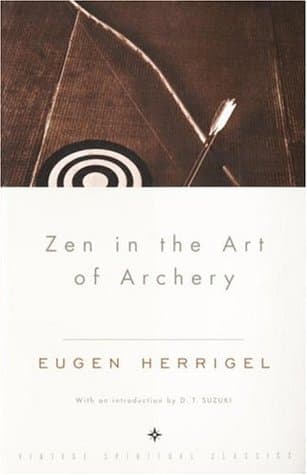
Zen in the Art of Archery cover
Archivist's Choice

Zen in the Art of Archery

Eugen Herrigel (1948)

Genre

Psychology / Spirituality / Philosophy

Reading Time

90 min

Key Themes

See below

Track Your Reading

Sign in to track this book

A Western philosophy professor spends six years learning Japanese archery, finding that true mastery is not about hitting the target, but about spiritual surrender to achieve Zen.

Core Idea

Eugen Herrigel's "Zen in the Art of Archery" says that true mastery in any art, especially those from Eastern spiritual traditions like Japanese archery (Kyudo), goes beyond just being good at the technical parts. The main idea is that the goal is not to hit the target by trying hard, but to reach a state of spontaneous action where the archer is one with the act of shooting. This "Way of No-Way" needs a person to empty themselves, letting go of intention, fear, and self-consciousness, allowing a deeper, unconscious wisdom to guide the action. The book shows the difficult journey of a Western mind trying to understand this idea. It says that true skill comes from spiritual discipline, patience, and giving oneself over to the process, showing that the art is a way to enlightenment.
Reading time
90 min
Difficulty
Medium
✓ Read this if...
You are interested in the philosophical and spiritual underpinnings of Eastern arts, seeking a deeper understanding of mindfulness, flow states, or how to transcend ego in pursuit of mastery.
✗ Skip this if...
You are looking for a practical guide to archery technique, a quick self-help book, or prefer a direct, logical approach to skill acquisition without spiritual or philosophical detours.

Core idea

The central argument and framework that powers the entire book.

Eugen Herrigel's "Zen in the Art of Archery" says that true mastery in any art, especially those from Eastern spiritual traditions like Japanese archery (Kyudo), goes beyond just being good at the technical parts. The main idea is that the goal is not to hit the target by trying hard, but to reach a state of spontaneous action where the archer is one with the act of shooting. This "Way of No-Way" needs a person to empty themselves, letting go of intention, fear, and self-consciousness, allowing a deeper, unconscious wisdom to guide the action. The book shows the difficult journey of a Western mind trying to understand this idea. It says that true skill comes from spiritual discipline, patience, and giving oneself over to the process, showing that the art is a way to enlightenment.

At a glance

Reading time

90 min

Difficulty

Medium

Read this if...

You are interested in the philosophical and spiritual underpinnings of Eastern arts, seeking a deeper understanding of mindfulness, flow states, or how to transcend ego in pursuit of mastery.

Skip this if...

You are looking for a practical guide to archery technique, a quick self-help book, or prefer a direct, logical approach to skill acquisition without spiritual or philosophical detours.

Key Takeaways

1

The Way of No-Way

True mastery emerges from surrendering conscious control and rational thought.

Quote

The right art is purposeless, aimless! The more you struggle to attain the goal, the farther you will be from it.

Herrigel found that the Western focus on conscious effort, planning, and getting a specific result actually stops true mastery in Zen arts. He learned that to 'hit the target' was not about aiming better, but about stopping aiming at all. This involves a paradox: the student must use great discipline to reach a point where conscious effort is completely dropped. This 'purposelessness' is not laziness but a state where action flows naturally from an integrated mind and body, free from intention or ego. The goal is not the target, but t...

Supporting evidence

Herrigel's early struggles to consciously correct his shots, only to be met with the Master's frustration and the instruction that he was trying too hard, using his intellect rather than letting go. The Master's insistence that the student must 'wait' for the shot to release itself.

Apply this

In any skill, identify areas where overthinking or excessive conscious control might be impeding flow. Practice letting go of the outcome and focusing purely on the process, trusting that with sufficient preparation, the desired result will emerge naturally. Cultivate patience and non-striving.

wu-weinon-strivingflow-state
2

Beyond Technique: Art as Spiritual Discipline

The true purpose of Zen arts is not skill acquisition but spiritual transformation.

Quote

It is not a sport, not child's play, not a pastime; it is a serious and profound spiritual discipline.

Herrigel quickly learned that Japanese archery, unlike Western archery, was not mainly about hitting a physical target. It was about perfecting the self. The act of shooting an arrow reflects one's inner state. Every posture, breath, and release helps to build presence, discipline, and, in the end, enlightenment. The Master was not teaching him how to shoot, but how to become a different person through shooting. This changes 'art' from just a performance or product to a lifelong process of self-improvement, where the medium is a tool ...

Supporting evidence

The Master's repeated dismissal of Herrigel's concern for hitting the target, instead focusing on the 'right spirit' and the 'right tension.' The Master's statement that the arrow shoots itself, implying the archer's role is to become an empty vessel.

Apply this

Approach personal development or skill-building not just as a means to an end, but as a path to inner growth. Ask: 'How does this practice transform me?' rather than just 'What can I achieve with this?' Apply this mindset to hobbies, work, or even daily routines.

spiritual-disciplineself-cultivationmeditation-in-action
3

The Imperative of Letting Go

Achieving mastery requires abandoning the ego's desire for control and success.

Quote

The archer ceases to be conscious of himself as the one who draws the bow and takes aim, and equally of the target as something standing over against him.

One of Herrigel's hardest lessons was the need to 'let go' – not just of the arrow, but of his conscious self, his intentions, and his desire to succeed. The Master asked for a state where the archer becomes one with the bow, arrow, and target, removing the perceived divisions between them. This dissolving of the ego's control allows the shot to 'shoot itself.' Western thought values individual action and control, making this surrender very hard. Yet, it is the way to real spontaneity and effortless action in Zen.

Supporting evidence

Herrigel's frustration with the Master's elusive instructions like 'It shoots itself' and 'You must wait for it,' which defied his logical attempts to understand and execute. His eventual breakthrough came only after profound exhaustion and mental surrender.

Apply this

In moments of high pressure or creative blocks, practice releasing the need for a specific outcome. Engage in activities without judgment or expectation, allowing for spontaneity. Recognize when your ego's desire for control is hindering your performance.

ego-dissolutionsurrendernon-duality
4

Patience as the Path

True learning is a slow, iterative process requiring immense patience and trust.

Quote

You must learn to wait properly. The great art of waiting for the right moment.

Herrigel's six-year journey shows the clear difference between Western impatience for quick results and the Zen focus on deep, unhurried development. The Master rarely gave direct instructions, instead guiding Herrigel with subtle corrections and mysterious statements, making him learn the lessons over years. This long period of practice, often without clear progress, needed great patience and strong trust in the Master and the process. It shows that some deep changes cannot be rushed or understood intellectually, but must happen natu...

Supporting evidence

The Master's refusal to explain 'how' to release the arrow, instead simply repeating 'It shoots itself' for years. Herrigel's initial despair at the lack of measurable progress and the immense time investment required for seemingly simple actions.

Apply this

Embrace long-term projects and learning curves, resisting the urge for instant gratification. Practice mindfulness and meditation to cultivate patience. Trust that consistent, dedicated effort, even without immediate results, is building foundational change.

deliberate-practicelong-term-masterymindfulness
5

The Unspeakable Truth

Some profound truths cannot be conveyed through words but must be experienced.

Quote

The Master's business is not to explain things, but to enable his pupils to experience them.

A repeated idea is that language cannot describe the deepest parts of Zen. The Master's instructions were often confusing, metaphorical, or seemed to make no sense to Herrigel's logical Western mind. He realized that the Master was not holding back information, but understood that some insights could only be gained through direct, lived experience, not intellectual understanding. This shows the limits of purely cognitive learning and the importance of embodied knowledge and intuitive grasp, which go beyond words. The 'secret' is not h...

Supporting evidence

The Master's frequent use of koans or seemingly illogical statements, and his expectation that Herrigel would eventually 'understand' without explicit instruction. The moment Herrigel finally experienced the 'correct' release without knowing how he did it.

Apply this

Recognize the limits of intellectualizing certain experiences. Engage in practices that cultivate direct experience and intuition, such as art, music, or physical disciplines. Trust your gut feelings more often, even when you can't logically explain them.

koanembodied-knowledgeintuition
6

The Invisible Teacher

The true guidance comes not from the external master, but from within the disciplined self.

Quote

The Master is a signpost, not a destination. He points the way, but you must walk it yourself.

While Herrigel relies much on his Master, the book subtly shows that the true teacher is the discipline itself, and the inner change it encourages. The Master's job is to create the right conditions for learning, to watch, and to offer minimal, often indirect, guidance. He does not give answers but makes the student find them through their own struggle and eventual breakthrough. This emphasizes self-reliance in the deepest way – not independent action, but the growth of inner wisdom that comes from strict practice and careful presence...

Supporting evidence

The Master often leaving Herrigel to practice alone for extended periods, only offering a few words upon his return. The Master's consistent refusal to give direct 'how-to' instructions, pushing Herrigel to find the way himself.

Apply this

Seek mentors and teachers, but understand their role is to guide, not to spoon-feed. Take ownership of your learning journey, actively seeking internal insights rather than passively waiting for external instructions. Develop an inner critic and guide through consistent self-reflection.

inner-guidanceself-reliancedisciple
7

Breath as the Foundation

Conscious breathing is the anchor for presence and the key to integrating mind and body.

Quote

He who has learned to breathe correctly has learned to live correctly.

Through his training, Herrigel is always brought back to the importance of breath. It is not just a body function but a deliberate act that connects the physical body to the mental state. The Master teaches specific breathing techniques – deep, rhythmic, abdominal breathing – to create stillness, focus, and a sense of being grounded. Correct breathing is the base for all other parts of the art, allowing the archer to reach a state of calm focus and to use energy well. It is the most direct way to unify the fragmented self.

Supporting evidence

The Master's early and consistent emphasis on proper breathing, often correcting Herrigel's shallow or irregular breath before addressing any other aspect of his technique. The direct link drawn between the quality of breath and the quality of the shot.

Apply this

Integrate conscious breathing practices into your daily routine. Use deep, abdominal breathing to manage stress, improve focus, and prepare for challenging tasks. Recognize breath as a powerful tool for self-regulation and presence.

pranayamamindful-breathingsomatic-awareness
8

The Great Release

The ultimate act of mastery is an effortless, spontaneous release born from unified being.

Quote

The archer is no longer himself, but is completely dissolved in the action of shooting.

The 'release' of the arrow is the peak of the archery process and the ultimate example for Zen. It is not a conscious decision, but an event that 'happens' when the archer has reached a state of complete unity with the bow, arrow, and target. This state, often called 'no-mind' or 'empty mind,' allows the arrow to fly with perfect naturalness and power, without doubt, fear, or conscious intention. It is the result of years of discipline, a moment of deep spontaneity where the 'self' disappears and the art performs itself.

Supporting evidence

Herrigel's description of his first 'correct' shot, where he felt as if the bowstring simply 'cut through his thumb' and the arrow released itself, without any conscious effort or decision on his part.

Apply this

Strive for moments of 'flow' in your activities, where you are completely absorbed and the action feels effortless. Practice deep focus and presence to reduce self-consciousness during performance. Trust your training to take over when the moment of action arrives.

flow-statespontaneityno-mind
9

Beyond Dualities: Unity of Opposites

Zen transcends the Western tendency to separate mind/body, subject/object, effort/effortlessness.

Quote

The archer must become one with the bow, the arrow, and the target.

Herrigel's journey is a challenge to the basic divisions in Western thought: mind versus body, subject versus object, effort versus relaxation. The Master constantly pushed him to go beyond these divisions, to experience the unity of all elements in the act of archery. The 'correct' shot is not about the archer acting on the bow or the target, but about a complete event where all elements merge into one seamless process. This non-dualistic view is central to Zen, showing that perceived separations are often mental constructs rather th...

Supporting evidence

The Master's cryptic statements about the archer and the target not being separate, and the bow and arrow becoming extensions of the archer's being. Herrigel's struggle to reconcile the need for effort with the instruction to let go.

Apply this

In your own life, look for areas where you create artificial separations (e.g., work/play, mind/body). Practice integrating these aspects, seeing how they influence each other. Cultivate a holistic perspective in problem-solving and self-awareness.

non-dualityholismintegration

Critical analysis

Notable Quotes

The archer ceases to be conscious of himself as the one who is engaged in hitting the bull's-eye which confronts him. This state of unconscious is realized only when, completely empty and rid of the self, he becomes one with the perfecting of his technical skill.

Describing the state of mind required for true mastery in archery.

The right art is purposeless, aimless! The more obstinately you try to learn how to shoot the arrow for the sake of hitting the goal, the less you will succeed.

Explaining the paradox of effort and detachment in achieving skill.

It is necessary for the archer to become, in spite of himself, an unmoved center. Then comes the supreme and ultimate miracle: art becomes 'artless', shooting becomes not-shooting, a shooting without bow and arrow.

Discussing the transformation of action into effortless being.

The instructor's business is not to show the way itself, but to enable the pupil to get the feel of this way to the goal by adapting it to his individual peculiarities.

On the role of the teacher in guiding without imposing.

You must learn to wait properly. Waiting means not to wait for anything in particular.

Advice on cultivating patience and presence.

The shot will only go smoothly when it takes the archer himself by surprise.

Emphasizing spontaneity and lack of conscious control.

The more you try to make the shot, the more you will miss the mark.

Highlighting the counterintuitive nature of effort in mastery.

The archer aims at himself—and yet not at himself, hits himself—and yet not himself.

Describing the paradoxical unity of archer and target.

It is not a matter of indifference how the bow is strung, how the arrow is nocked, how the bow is drawn, how the shot is released.

Stressing the importance of precise, mindful technique.

The archer must become, in spite of himself, an unmoved center.

On achieving inner stillness amidst action.

The art of archery is not a sport, but a ritual.

Distinguishing the practice from mere physical activity.

The instructor said: 'You have described only the outward process. What is essential is the inward process.'

Correcting the author's focus on external mechanics over inner state.

The shot is like a ripe fruit falling from the tree.

Using metaphor to describe effortless, natural action.

The right shot at the right moment does not come because you do not let go of yourself.

On the need to surrender the ego for perfect timing.

The more you concentrate on breathing, the more the shot will happen by itself.

Linking breath control to spontaneous action.

Quiz

Test Your Knowledge

Ready to see how well you understood this book? Take our interactive quiz with 10 questions.

10
Questions
~5
Minutes
?
Best Score

Key Questions (FAQ)

It's Eugen Herrigel's account of his six-year journey learning archery from Japanese Zen masters, exploring how the discipline serves as a path to Zen—achieving balance between body and mind through the abandonment of self.

About the author