“For it is not by words but by deeds that we are judged.”
— Deianira reflecting on the actions of Heracles.


Sign in to track this book
Deianira tries to win back Heracles's love with a supposed charm, but it turns out to be a poison that kills them both.
Deianira, Heracles's wife, expresses her difficult life, marked by constant fear and worry over her husband's dangerous work and long absences. She remembers her terrifying courtship with the river-god Achelous, from whom Heracles saved her. Now, Heracles has been gone for fifteen months, and Deianira is full of dread. She tells the Chorus of Trachinian women about a prophecy Heracles received: either he will die on this trip, or he will return home and live the rest of his life in peace. This prophecy increases her anxiety, as the time for its fulfillment is near.
Deianira's son, Hyllus, enters, having searched for his father. He scolds his mother for her despair, revealing that Heracles is alive and well, having conquered Oechalia. He also mentions that Heracles is preparing to offer sacrifices to Zeus at Cenaeum before returning home. Soon after, the herald Lichas arrives, leading a group of captive women. Lichas confirms Hyllus's report, explaining that Heracles sacked Oechalia to punish its king, Eurytus, for an insult. He assures Deianira that Heracles is sending these women as war prizes and will soon follow.
Deianira greets Lichas and the captive women. Her attention goes to one young woman, Iole, who stays silent and tearful, refusing to speak. Deianira feels pity for the girl, seeing her noble bearing. The Chorus, however, notices Iole's great beauty and hints at a deeper reason for her sadness. Deianira's initial compassion slowly turns to suspicion, as she begins to question the true nature of Heracles's conquest and the importance of this particular captive.
A servant, who had come with Lichas, privately tells Deianira that Lichas has been lying. He overheard Lichas telling others that Heracles did not sack Oechalia because of an insult from Eurytus, but because he wanted Eurytus's daughter, Iole. Eurytus refused to give Iole to Heracles, leading to the war and the city's destruction. The servant insists that Iole is Heracles's beloved, and that Heracles is sending her to Trachis to live with him, as a rival to Deianira. This news shatters Deianira's initial relief and starts her jealousy.
With the servant's information, Deianira confronts Lichas. She gently but firmly pressures him, appealing to his honesty and his knowledge of Heracles. Lichas, at first resistant and trying to stick to his made-up story, eventually breaks under Deianira's steady questioning and her direct statement of the truth. He confesses that Heracles is indeed deeply in love with Iole and that she is the real reason for the war and her presence in Trachis. Deianira, though heartbroken, stays calm.
Devastated by Lichas's confession but determined to win back her husband's love, Deianira remembers an old gift: a vial of the centaur Nessus's blood. Years ago, after Heracles shot Nessus for trying to assault Deianira, the dying centaur told Deianira to collect his blood, claiming it was a strong love charm that would ensure Heracles would never look at another woman. Nessus told her to smear it on a garment and give it to Heracles if his love ever weakened. Deianira decides to prepare a robe, an offering for Heracles, and secretly smears it with the centaur's blood, believing it will bring back his affection.
Deianira gives the splendid, poisoned robe to Lichas, telling him to deliver it to Heracles as a gift, to be worn during his sacrifices to Zeus. She makes Lichas swear an oath that he will deliver it exactly as instructed. Lichas, unaware of the robe's true nature, readily agrees and leaves for Cenaeum. As Deianira returns home, she sees the remaining centaur's blood she had kept for the charm. When exposed to sunlight, it foams and breaks down, giving off a bad smell and showing its corrosive, deadly nature. This terrifying sign fills Deianira with dread, as she realizes her fatal mistake.
Hyllus returns, frantic and angry, to confront his mother. He describes the horrible scene at Cenaeum: Heracles, wearing the robe, began to suffer terrible pain as the poison from Nessus's blood, activated by the sacrificial fire, ate his flesh. Heracles, writhing in pain, cursed Deianira and ordered Lichas, the unwitting messenger, to be thrown against rocks. Hyllus bitterly blames Deianira for his father's suffering, accusing her of murder. Overwhelmed by guilt and despair, Deianira, without a word, goes into the house and kills herself with a sword, piercing her side.
Heracles is brought back to Trachis on a stretcher, writhing in intense pain, his body destroyed by the poison. He is barely conscious, moaning and cursing his fate and the pain. He calls out for death, regretting his heroic life ending in such a humiliating and painful way. He wants revenge on Deianira, unaware of her suicide. The Chorus and Hyllus see his suffering, understanding the full extent of the tragedy that has happened to their hero.
As Heracles's mind clears for a moment in his agony, he remembers the old prophecy. He recalls that he was meant to die not by a living being, but by someone already dead—which he now realizes refers to Nessus, whose poison has killed him. He also remembers the prophecy that his labors would end here. Accepting his fate, Heracles, despite his pain, gives Hyllus his final instructions. He makes Hyllus swear an oath to carry out his last wishes: to build a funeral pyre on Mount Oeta and burn him alive, ending his suffering, and to marry Iole.
Hyllus is horrified by his father's request to be cremated alive and to marry Iole, the woman indirectly responsible for his mother's death and his father's agony. He protests strongly, finding the demands unnatural and wrong. However, Heracles, in his great suffering, insists, using his fatherly authority and the weight of his dying wish. Faced with his father's firm command and the severity of his pain, Hyllus, though deeply unwilling and conflicted, eventually agrees to fulfill Heracles's final wishes, recognizing his father's inevitable death.
Hyllus, along with Heracles's other sons, prepares to carry out his father's final instructions. The play ends with the somber procession as Heracles is carried away to Mount Oeta for his cremation. The Chorus mourns the tragic events, recognizing fate's cruelty and the great suffering brought upon Heracles's house. The final lines emphasize the unpredictability of the gods' will and the ultimate sorrow of human life, leaving the audience with pity and terror at the hero's downfall and his family's destruction.
The Protagonist/Tragic Heroine
Deianira transforms from a hopeful, anxious wife into a desperate woman who, through a misunderstanding, becomes an unwitting instrument of her husband's death and her own, ultimately choosing suicide over a life of shame.
The Tragic Hero/Antagonist (unwittingly)
Heracles, the invincible hero, is reduced to a suffering, dying man, realizing the futility of his strength against a predetermined fate, and ultimately orchestrating his own death.
The Supporting/Messenger
Hyllus begins as a hopeful son, becomes a furious accuser, and ends as a reluctant executor of his father's painful will, burdened by the tragic events.
The Supporting/Messenger
Lichas, a seemingly innocuous messenger, inadvertently becomes a crucial link in the chain of tragic events, leading to his own brutal, undeserved death.
The Supporting/Commentator
The Chorus witnesses the escalating tragedy, moving from sympathetic concern to despair and ultimately a resigned acceptance of the harshness of fate.
The Supporting/Catalyst
Iole, a silent victim, is transformed from a captive of war to the unwitting cause of two deaths, and eventually, by Heracles's command, the future wife of Hyllus.
The Mentioned/Catalyst
Nessus, through his posthumous trick, achieves revenge against Heracles, fulfilling his dying curse.
The Supporting/Messenger
The servant's brief but pivotal role is to expose the truth, inadvertently setting Deianira on her tragic path.
The play shows how love, mixed with jealousy and possessiveness, can lead to tragic and unexpected results. Deianira's deep love for Heracles, combined with her fear of losing him to Iole, makes her use what she believes is a love charm. This act, born from a desire to save her marriage, ultimately destroys it and both their lives. Heracles's own strong desire for Iole is the first cause, making him destroy Oechalia and bring Iole to Trachis, directly causing Deianira's jealousy. The play suggests that strong emotions, even those seemingly based in love, can cause destruction.
“For the mind of a woman is a swift and terrible thing when once it is gripped by jealousy.”
A main theme is the link between predetermined fate and human choices. Heracles's death is foretold by an oracle, yet it is Deianira's choice to use the centaur's blood, made by her own will (though influenced by desperation), that directly fulfills the prophecy. Nessus's dying trick is an act of revenge, a past event that strongly guides the present. The characters believe they are acting on their own, but their actions match a larger, unavoidable destiny. The play questions how much individuals can escape or change their fated paths, concluding that even heroic efforts are ultimately subject to a higher, often cruel, will.
“Who could have thought that the dead could bring the living to such a pass?”
The play sharply contrasts Heracles's legendary heroism with his painful and undignified death. His great physical strength, which conquered monsters and performed impossible tasks, is useless against the internal torment of the poison. This challenges the idea of a hero as invincible, showing that even the greatest heroes can suffer pain and a tragic end. His final moments are not glorious but filled with curses and a desperate plea for death, showing the weakness of even the most powerful individuals to fate and bodily pain. The play redefines heroism, showing its limits.
“And now, after all my toils, this is the end of me, this is the victory I have won!”
Deception, both on purpose and by accident, drives the tragedy. Nessus's dying lie about the 'love charm' is the most important. Lichas's initial lies about Iole's presence further increase Deianira's suspicions and desperation. Importantly, Deianira herself misunderstands the centaur's blood, believing it to be a harmless charm rather than a deadly poison. These layers of false information and misunderstanding stop characters from understanding the true results of their actions, leading them to destruction. The play emphasizes how easily truth can be hidden and how deadly such misunderstandings can be.
“Alas, my poor heart! I am undone, wretched woman that I am! I have unwittingly brought destruction upon my husband!”
A seemingly benevolent love charm that is actually a deadly, delayed-action poison.
This is the central plot device. Given to Deianira by the dying centaur Nessus, who falsely claims it will ensure Heracles's fidelity, the blood is in fact a potent poison, mixed with the venom of the Hydra from Heracles's own arrows. It functions as a classic example of dramatic irony and foreshadowing. Deianira's use of it is a desperate attempt to regain her husband's love, but it directly leads to his agonizing death and her own. It embodies the theme of deception and the destructive power of past events, as a long-dormant instrument of revenge.
Divine pronouncements that foretell Heracles's ultimate fate.
The prophecy from Dodona, known to Deianira, states that Heracles will either die on his current expedition or live out his life in peace. This creates suspense and heightens the sense of impending doom. Later, Heracles recalls another prophecy that he would die not by a living hand but by someone dead, which he realizes refers to Nessus. The oracle serves to underscore the theme of fate, suggesting that certain events are predetermined and that human actions, even when seemingly free, often serve to fulfill a divine plan. It also provides a moment of tragic recognition for Heracles.
Characters whose reports and revelations drive the plot forward and expose critical information.
Lichas initially serves as a messenger, bringing news of Heracles and the captive women. His deliberate deception about Iole's role, however, is crucial. The unnamed servant then acts as a counter-messenger, revealing Lichas's lies to Deianira, which directly prompts her to confront Lichas and, subsequently, to use the 'love charm'. Later, Hyllus functions as a messenger, delivering the horrific news of Heracles's suffering. These messengers are vital for conveying information across the stage and advancing the plot, often inadvertently triggering significant turns in the tragedy.
The captive princess's refusal to speak, highlighting her symbolic role and increasing suspense.
Iole remains completely silent throughout her appearances. This silence is a powerful plot device. It emphasizes her status as a victim and a prize, stripped of her voice and agency. For Deianira, Iole's silence is initially a source of pity, then of deepening suspicion, and finally confirmation of Heracles's betrayal. Her inability or refusal to speak amplifies the emotional impact of her presence, making her a symbolic representation of the disruptive force of erotic love and the passive catalyst for the ensuing tragedy, without ever uttering a single word.
“For it is not by words but by deeds that we are judged.”
— Deianira reflecting on the actions of Heracles.
“There is a saying among men, that you can know a man only when you see how he bears himself in misfortune.”
— The Chorus commenting on the trials faced by mortals.
“For no one loves what is not his own.”
— Deianira's lament about Heracles' new love, Iole.
“How can I, a woman, strive against so great a power?”
— Deianira feeling helpless against Heracles' will and fate.
“O Zeus, what sorrow you have sent upon this house!”
— The Chorus expressing grief at the unfolding tragedy.
“For what is to come, no one can foresee.”
— The Chorus on the uncertainty of the future.
“It is a fearful thing to be a woman, and to have a man whose heart is ever wandering.”
— Deianira's pain over Heracles' infidelity.
“The gods give us joy and sorrow in turn.”
— The Chorus acknowledging the cyclical nature of life's experiences.
“For a man who has lost his senses does not know what he does.”
— Hyllus describing Heracles' madness due to the poisoned robe.
“The dead are free from all suffering.”
— Hyllus reflecting on death as an escape from pain.
“No man is happy until he is dead.”
— The Chorus reiterating a common Greek tragic theme.
“It is not right to speak ill of the dead.”
— Hyllus's reluctance to condemn his dying father, Heracles.
“What has been done cannot be undone.”
— The Chorus on the irreversibility of tragic events.
“Even the greatest strength can be brought low by a small thing.”
— The irony of Heracles, the mighty hero, being undone by a woman and a poisoned robe.
Ready to see how well you understood this book? Take our interactive quiz with 10 questions.
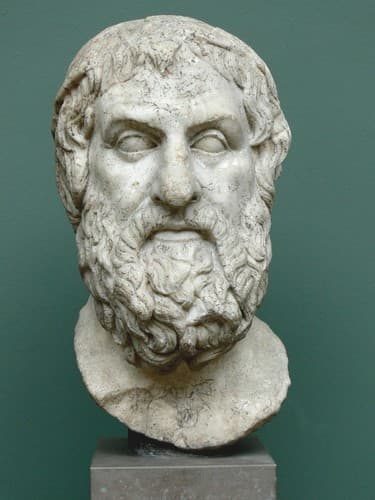
Sophocles was an ancient Greek tragedian, known as one of three from whom at least one play has survived in full. His first plays were written later than, or contemporary with, those of Aeschylus; and earlier than, or contemporary with, those of Euripides. Sophocles wrote over 120 plays, but only seven have survived in a complete form: Ajax, Antigone, Women of Trachis, Oedipus Rex, Electra, Philoctetes and Oedipus at Colonus. For almost fifty years, Sophocles was the most celebrated playwright in the dramatic competitions of the city-state of Athens which took place during the religious festivals of the Lenaea and the Dionysia. He competed in thirty competitions, won twenty-four, and was never judged lower than second place. Aeschylus won thirteen competitions, and was sometimes defeated by Sophocles; Euripides won four.