BookBrief
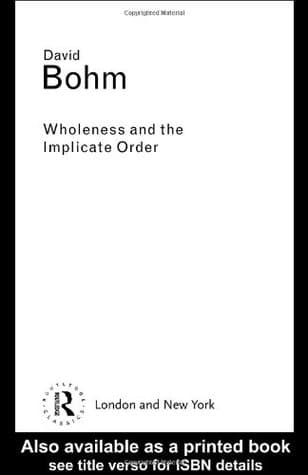
Wholeness and the Implicate Order cover
Archivist's Choice

Wholeness and the Implicate Order

David Bohm (1980)

Genre

Psychology / Spirituality / Science / Philosophy

Reading Time

10-15 hours

Key Themes

See below

Track Your Reading

Sign in to track this book

David Bohm's "Wholeness and the Implicate Order" introduces a quantum theory where the universe, consciousness, and reality emerge from an indivisible, flowing whole, changing how we see existence.

Core Idea

David Bohm's "Wholeness and the Implicate Order" suggests that the universe, at its most basic level, is an undivided, flowing whole—the 'implicate order.' From this, all distinct objects and events (the 'explicate order') appear and disappear. This idea challenges older scientific and philosophical views that break things into parts. Bohm argues that the apparent separation of things is just a surface feature of a deeper, connected reality. He extends this idea beyond physics to consciousness and thought, proposing that our fragmented way of thinking reflects and maintains the perceived brokenness of the world, making it harder to grasp the underlying unity. The book proposes a new way of seeing the world. It says that true understanding means seeing the universe as a continuous process where everything relates to everything else. Bohm introduces the 'rheomode,' a new language form meant to describe processes and relationships instead of static things. This language helps overcome the limits of our current thought patterns and better understand the implicate order. The main idea is that recognizing and living by this fundamental wholeness is key to solving the deep problems of fragmentation in both science and society.
Reading time
10-15 hours
Difficulty
Hard
✓ Read this if...
You are a serious student of quantum mechanics, philosophy of mind, or systems theory, seeking a profound, unified theory of reality that transcends traditional disciplinary boundaries, or if you are grappling with the philosophical implications of modern physics for consciousness and the nature of existence.
✗ Skip this if...
You are looking for a light introduction to quantum physics, practical self-help, or a quick read without substantial intellectual effort. This book is dense, highly conceptual, and requires a willingness to engage with abstract philosophical and scientific arguments.

Core idea

The central argument and framework that powers the entire book.

David Bohm's "Wholeness and the Implicate Order" suggests that the universe, at its most basic level, is an undivided, flowing whole—the 'implicate order.' From this, all distinct objects and events (the 'explicate order') appear and disappear. This idea challenges older scientific and philosophical views that break things into parts. Bohm argues that the apparent separation of things is just a surface feature of a deeper, connected reality. He extends this idea beyond physics to consciousness and thought, proposing that our fragmented way of thinking reflects and maintains the perceived brokenness of the world, making it harder to grasp the underlying unity.

The book proposes a new way of seeing the world. It says that true understanding means seeing the universe as a continuous process where everything relates to everything else. Bohm introduces the 'rheomode,' a new language form meant to describe processes and relationships instead of static things. This language helps overcome the limits of our current thought patterns and better understand the implicate order. The main idea is that recognizing and living by this fundamental wholeness is key to solving the deep problems of fragmentation in both science and society.

At a glance

Reading time

10-15 hours

Difficulty

Hard

Read this if...

You are a serious student of quantum mechanics, philosophy of mind, or systems theory, seeking a profound, unified theory of reality that transcends traditional disciplinary boundaries, or if you are grappling with the philosophical implications of modern physics for consciousness and the nature of existence.

Skip this if...

You are looking for a light introduction to quantum physics, practical self-help, or a quick read without substantial intellectual effort. This book is dense, highly conceptual, and requires a willingness to engage with abstract philosophical and scientific arguments.

Key Takeaways

1

The Implicate Order: Unseen Wholeness

Reality is fundamentally an undivided, flowing whole, not a collection of separate parts.

Quote

The new form of insight can be summarized in the proposition that the general ordering of the universe is an implicate order, or an enfolded order, contained within the explicit, or explicate, order.

Bohm introduces the 'implicate order' as a new way to think about the universe, moving away from the old mechanical view. He says that what we see as separate objects and events (the 'explicate order') are just visible forms of a deeper reality where everything is connected. Imagine a hologram: each piece of the film holds information about the whole image. Similarly, in the implicate order, information about the entire universe is folded into every part of space and time. This challenges our everyday understanding and scientific mode...

Supporting evidence

Bohm uses the analogy of a hologram, where each part contains the information of the whole, and also the example of ink dropped into a viscous fluid and then stirred (enfolding) and unstirred (unfolding) to illustrate the dynamic interplay between the implicate and explicate orders.

Apply this

Cultivate a 'holistic perception' by recognizing the interconnectedness in seemingly separate events or objects. Instead of isolating problems, consider the broader system they are part of. Practice mindfulness to observe the flow and interdependencies in your environment and thoughts.

implicate-orderexplicate-orderwholenessholographic-universe
2

Quantum Physics Demands Wholeness

Quantum phenomena like non-locality are not anomalies but evidence of the universe's fundamental interconnectedness.

Quote

The quantum theory indicates that the analysis of the world into separately existing parts, with at most external relationships between them, is not valid.

Bohm states that quantum physics, especially non-locality (entanglement), cannot be fully explained by a mechanical, reductionist worldview. The instant connection between entangled particles, no matter the distance, suggests they are not truly separate. Instead, they are expressions of an underlying, undivided whole. This 'quantum wholeness' means reality is not made of independent particles interacting locally, but from a deeper, non-local field of information and energy where everything is linked. The old idea of distinct, interact...

Supporting evidence

The phenomenon of quantum entanglement, where two particles remain connected and influence each other instantaneously even when separated by vast distances, is cited as a primary example challenging classical notions of locality and separability.

Apply this

Approach complex problems by looking for hidden connections and systemic influences rather than isolated causes. Recognize that your actions, however small, are part of a larger interconnected web and can have far-reaching, non-local effects.

quantum-mechanicsnon-localityentanglementquantum-wholeness
3

Thought as a Fragmenting Force

Our prevailing modes of thought, based on fragmentation, prevent us from perceiving the universe's true wholeness.

Quote

The general fragmentation of thought is then projected into the world, thereby contributing to the actual fragmentation of the world.

Bohm argues that human thought, especially scientific thought, has historically focused on analysis, division, and categorization. While useful, this 'fragmentary' way of thinking keeps us from seeing the universe's underlying unity. We create artificial boundaries and distinctions, not just in how we understand the physical world, but also in our social and psychological lives. This fragmented thinking, Bohm believes, is not just a mistake; it is a deep habit that causes real-world problems like conflict, alienation, and environmenta...

Supporting evidence

Bohm points to the historical development of scientific disciplines, each focusing on a narrow slice of reality, and the resulting inability to integrate these separate understandings into a coherent whole. He also highlights societal divisions and conflicts as manifestations of fragmented thought.

Apply this

Become aware of how your own thinking tends to categorize, label, and separate. Practice 'unconditional perception' by observing without immediately applying conceptual frameworks. Challenge assumptions that promote division or isolation in your personal and professional life.

fragmentation-of-thoughtperceptionholistic-thinkingmind-body-problem
4

The Rheomode: A Language of Flow

To grasp wholeness, we need a language that emphasizes process, relationship, and flux, not static 'things'.

Quote

The content of the rheomode is thus the general movement of the universe, which is the ground of all existence.

Recognizing that traditional language, which focuses on nouns (static objects) and verbs (actions by objects), has limits, Bohm proposes a 'rheomode' of language. This new way of speaking would prioritize verbs and participles, emphasizing processes and relationships rather than fixed things. For example, instead of 'the river is flowing,' one might say 'the water is 'rivering'.' This change in language structure would help us see and describe reality as a continuous, undivided flow, where everything is constantly 'flowing' and 'unfol...

Supporting evidence

Bohm offers specific examples of how words could be modified in the rheomode, such as replacing 'it is raining' with 'raining' or 'the table is hard' with 'the table is 'harding'.' He connects this to ancient languages that had more process-oriented structures.

Apply this

Experiment with describing situations and observations using more verbs and fewer nouns. Focus on the dynamic interplay and relationships between things rather than just their static attributes. For instance, instead of 'I have a problem,' try 'probleming is occurring.'

rheomodelanguage-of-flowprocess-philosophydynamic-perception
5

Consciousness as an Implicate Process

Consciousness is not separate from matter but an enfolded aspect of the universe's fundamental wholeness.

Quote

Consciousness is then seen to be a particular manifestation of the implicate order, which is ultimately the ground of all reality.

Bohm rejects the traditional separation of mind and matter. Instead, he suggests that consciousness is not just a product of complex brains or a separate spiritual entity. It is a subtler, more folded aspect of the implicate order itself. Just as the explicate order unfolds from the implicate, so does our conscious experience. This means consciousness is fundamentally connected to the entire universe, not limited to individual brains. Our thoughts, feelings, and perceptions are part of the same dynamic flow that makes up physical real...

Supporting evidence

Bohm connects the 'meaning' and 'information' inherent in thought to the 'information' enfolded in the implicate order. He suggests that the brain is a specialized organ for 'unfolding' and 'refolding' this implicate information, much like a radio receiver processes signals from a broader field.

Apply this

Recognize that your consciousness is not isolated but deeply connected to the world around you. Practice introspection to observe the flow of your thoughts and feelings, seeing them as processes rather than fixed entities. Explore practices that aim to expand awareness beyond the individual self.

consciousnessmind-matter-unityuniversal-mindimplicate-consciousness
6

The Undivided Universe: No Parts, Only Aspects

The universe is not composed of 'parts' but is an undivided whole where everything is an 'aspect' of the larger reality.

Quote

The notion of a 'part' is shown to be inadequate, and is replaced by the notion of 'aspect', which is always an aspect of the whole.

Bohm challenges the deep-seated habit of seeing the world as a collection of separate 'parts' that interact. He argues that this 'particulate' view is an illusion, a result of our fragmented thinking. Instead, he proposes that the universe is an 'undivided whole.' What we see as 'parts' are simply different 'aspects' or views of the same underlying reality. Think of a ripple in a pond: it's not a separate thing but an aspect of the pond's overall movement. This distinction is important because it fundamentally changes how we approach ...

Supporting evidence

Bohm uses the analogy of a current in a river. We might identify a 'part' of the current, but it's fundamentally inseparable from the entire river's flow. Similarly, a 'thought' is not a separate entity but an aspect of the overall stream of consciousness.

Apply this

When faced with a complex situation, resist the urge to immediately break it down into isolated parts. Instead, try to see how each component is an 'aspect' of the larger system. Consider the impact of changes to one 'aspect' on the entire 'whole'.

undivided-wholenessaspects-of-realitysystemic-thinkingholistic-paradigm
7

Dialogue as a Path to Wholeness

True dialogue, where assumptions are suspended, can reveal shared meaning and overcome fragmented thinking.

Quote

The purpose of a dialogue is to enable the participants to observe the process of thought itself, and to see how this process is continually creating and recreating the world.

Bohm believed that the fragmentation in our thought patterns extends to our communication, leading to misunderstanding and conflict. He proposed 'dialogue' not as a debate or discussion to reach agreement, but as a specific process where participants collectively set aside their assumptions and observe the flow of thought itself. The goal is to create a shared pool of meaning, where individual biases and fragmented views disappear, allowing a more holistic understanding to emerge. This process aims to access a collective intelligence ...

Supporting evidence

Bohm co-led numerous dialogue sessions, often with J. Krishnamurti, where participants were encouraged to listen deeply, suspend judgment, and observe the collective thought process without trying to 'win' an argument or even agree.

Apply this

Practice genuine dialogue by actively listening without forming a rebuttal, suspending your own assumptions, and observing the collective flow of ideas in group settings. Focus on understanding the underlying meanings rather than just the surface words.

dialoguecollective-intelligencesuspension-of-assumptionsshared-meaning
8

Order and Disorder: Relative Perspectives

Order and disorder are not absolute states but relative descriptions dependent on our chosen frame of reference.

Quote

What is order from one point of view may be disorder from another.

Bohm argues that how we see order and disorder depends greatly on our ideas and the scale at which we observe things. What looks like 'disorder' at one level (e.g., the chaotic movement of individual molecules in a gas) can be seen as 'order' at a higher level (e.g., the statistical rules governing gas pressure and temperature). This applies to the implicate order, where what seems like random changes in the explicate order might be highly ordered patterns folded within the deeper reality. This idea encourages us to question our fixed...

Supporting evidence

Bohm uses the example of a crumpled piece of paper. From one perspective, it's disordered. If we understand the process of crumpling, the folds themselves follow a certain order. He also references the seemingly random motion of Brownian particles, which is ordered by statistical laws.

Apply this

When encountering what seems chaotic or disordered, try to shift your perspective or zoom out to a larger context. Look for underlying patterns or principles that might reveal a different kind of order. Reframe 'failure' not as disorder but as a necessary part of a learning process.

order-disorderrelativity-of-perceptionframes-of-referenceemergent-order
9

The Flow of Meaning: Beyond Causality

Meaning is not imposed but arises from the dynamic flow of the implicate order, challenging linear causality.

Quote

Meaning is not 'in' things, but is rather a movement of the whole.

Traditional science often seeks direct cause-and-effect relationships. Bohm, however, suggests that in the implicate order, meaning and information are not just passed from one point to another; they are part of the overall dynamic flow. It's more like a symphony, where the meaning comes from the entire piece unfolding, not just individual notes. This 'flow of meaning' implies a more subtle, non-local form of causality, where the 'whole' influences the 'parts' as much as the parts influence the whole. Understanding this requires movin...

Supporting evidence

Bohm discusses how the meaning of a word or phrase is not contained in individual letters or sounds but arises from their context and the dynamic process of communication. He extends this to the universe, where the 'meaning' of physical phenomena is part of the larger implicate flow.

Apply this

Instead of always searching for a single cause for an effect, explore the broader context and interconnected factors that contribute to a situation. Consider how meaning is co-created in interactions rather than being a fixed property of objects or statements.

flow-of-meaningnon-linear-causalityholistic-meaninginformation-field

Critical analysis

Notable Quotes

The new form of insight can be summarized in the sentence: 'The one is in the many, and the many are in the one.'

Introducing the concept of wholeness and interconnectedness, challenging fragmentation.

The notion that the world is made of a set of separately existing things is an illusion.

Critiquing the prevalent fragmented view of reality in science and everyday thought.

Thought is a system, and if you don't know you are in it, you are its prisoner.

Highlighting the pervasive and often unconscious influence of thought on perception and reality.

The implicate order is a new order of reality which is essentially undivided, flowing movement.

Defining the core concept of the implicate order as a deeper, more fundamental reality.

What is primary is the undivided flowing movement of the whole, and the 'things' that appear to us are only relatively independent sub-totalities within this whole, and their relative independence is a product of our way of looking.

Explaining how seemingly separate objects arise from the underlying implicate order.

Our ordinary ways of thinking, imagining, perceiving, and acting are for the most part fragmented.

Pointing out the pervasive nature of fragmentation in human experience.

Meaning is not something that is given to us, but something that we create.

Emphasizing the active role of human consciousness in constructing meaning.

The attempt to live in fragments leads to a kind of general confusion, which is now to be seen in every phase of our lives.

Warning about the detrimental effects of a fragmented worldview on society and individuals.

The 'holomovement' is the ground of all existence.

Introducing the term 'holomovement' to describe the dynamic, undivided whole.

The manifest world is a projection from the implicate order.

Describing the relationship between the visible, explicit world and the hidden, implicate order.

Truth is a pathless land, and you cannot approach it by any path whatsoever, by any religion, by any sect.

Advocating for direct insight beyond established systems, often attributed to Jiddu Krishnamurti, a significant influence on Bohm.

To be able to perceive the whole, we must be able to suspend our habitual modes of thought.

Suggesting a prerequisite for understanding the implicate order and achieving wholeness.

Communication is a process of creating common meaning.

Discussing the nature of effective communication and shared understanding.

We are faced with the fact that we have to understand a world that is not made of parts, but is an indivisible whole.

Summarizing the fundamental challenge and paradigm shift proposed by the book.

Quiz

Test Your Knowledge

Ready to see how well you understood this book? Take our interactive quiz with 10 questions.

10
Questions
~5
Minutes
?
Best Score

Key Questions (FAQ)

The book proposes a revolutionary view of reality where the universe is an 'unbroken whole,' challenging the idea of separate, independent parts. Bohm introduces the concepts of the 'implicate order' (a hidden, underlying order) and the 'explicate order' (the manifest reality we perceive).

About the author

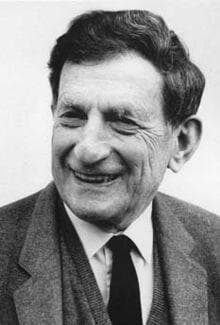
David Bohm

David Bohm was a renowned theoretical physicist and philosopher, best known for his groundbreaking work on quantum mechanics and his concept of the 'implicate order.' His influential books, including 'Wholeness and the Implicate Order' and 'Unfolding Meaning,' explore the interconnectedness of consciousness and the universe, making significant contributions to both physics and philosophy.