“The one fact that all of us have to face is that we are going to die.”
— Frazier discussing the ultimate reality and its implications for life's design.

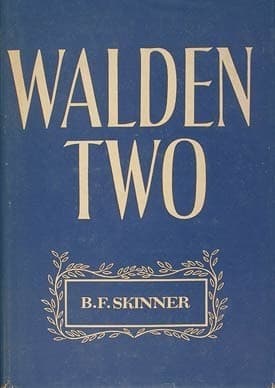
B.F. Skinner (2010)
Genre
Psychology / Science Fiction / Philosophy
Reading Time
8 hours
Key Themes
See below
Sign in to track this book
Explore a controversial 1948 American utopia where science engineers away human problems, sparking a debate that continues today.
“The one fact that all of us have to face is that we are going to die.”
— Frazier discussing the ultimate reality and its implications for life's design.
“Walden Two is a community in which a way of life has been designed. We have had to discover the laws which govern human behavior and then put those laws into practice.”
— Frazier explaining the foundational principle of Walden Two's social engineering.
“That's the only difference between us and the people who are not going to leave.”
— Frazier contrasting the commitment of Walden Two members with outsiders.
“The world is suffering from a bad case of the wrong people in the right places.”
— Frazier critiquing traditional society's leadership and structure.
“It's the only way to get rid of the great men—to get rid of the need for them.”
— Frazier advocating for a system that doesn't rely on individual heroes or leaders.
“We are not interested in the freedom to make choices, but in the freedom from having to make choices.”
— Frazier explaining Walden Two's approach to decision-making and individual burden.
“The good life is not something to be earned, but something to be designed.”
— Frazier presenting a core tenet of Walden Two's philosophy on well-being.
“We can't have a science of human behavior if we don't admit that behavior is determined.”
— Frazier articulating the deterministic view of human behavior central to behaviorism.
“A man is free when he can do what he wants to do.”
— Frazier offering a definition of freedom from a behavioral perspective.
“The only way to create a better world is to create better people.”
— Frazier emphasizing the role of individual improvement in societal progress.
“We are applying a science of behavior to the design of a culture.”
— Frazier succinctly summarizing the ambitious project of Walden Two.
“We have chosen the good life, not the life of freedom.”
— Frazier distinguishing Walden Two's priorities from traditional notions of liberty.
“It's not enough to be right; you have to be effective.”
— Frazier highlighting the pragmatic approach of Walden Two in achieving its goals.
“There are no heroes in Walden Two. There are only managers and planners.”
— Frazier underscoring the communal and systematic nature of Walden Two's leadership.
“What is the good life? It is health, a minimum of unpleasant labor, and a chance to make the best use of one's talents.”
— Frazier providing a practical definition of the 'good life' sought in Walden Two.
Ready to see how well you understood this book? Take our interactive quiz with 10 questions.

B.F. Skinner was a renowned American psychologist, behaviorist, and philosopher. His seminal works, including "Walden Two" and "Beyond Freedom and Dignity," explored his theories of operant conditioning and radical behaviorism. Skinner's influential ideas significantly impacted psychology, education, and social engineering, proposing a society structured around principles of behavioral control.

Rhonda Byrne
4.3

Menno Henselmans
4.3

Sylvia Plath
4.3

Elliot Aronson
4.3
Joseph Campbell
4.3

Erich Fromm
4.3

Irvin D. Yalom
4.2

Lucy Strange
4.2