BookBrief
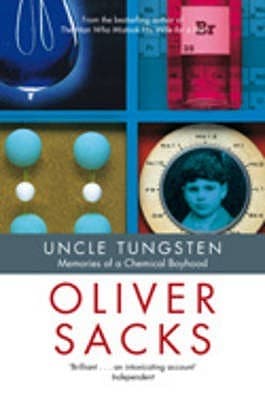
Uncle Tungsten cover
Archivist's Choice

Uncle Tungsten

Oliver Sacks (2001)

Genre

Psychology / Biography / Memoir / History / Science

Reading Time

9-12 hours

Key Themes

See below

Track Your Reading

Sign in to track this book

In wartime England, a young Oliver Sacks, surrounded by a science-steeped family and finding solace amidst an unhappy boarding school, embarks on a lifelong adventure fueled by the "smell, the beauty, the mystery of chemistry."

Core Idea

Oliver Sacks's 'Uncle Tungsten' is a memoir that traces his early years and the influence of science on his developing mind. It shows how hands-on engagement with chemistry and the physical world, supported by an eccentric family and his own curiosity, was not just an academic pursuit but a way of experiencing and understanding life. This provided intellectual comfort and a unique sensory world through which he navigated childhood and prepared for his later scientific and medical career. The book highlights the almost magical appeal of elements and experiments, showing how these early interests shaped his view of the universe and the human condition.
Reading time
9-12 hours
Difficulty
Medium
✓ Read this if...
You are fascinated by the origins of a brilliant scientific mind, enjoy historical context woven into personal narrative, or appreciate the beauty and wonder of early chemistry and scientific discovery.
✗ Skip this if...
You prefer practical self-help, fast-paced thrillers, or have little interest in the history of science or detailed personal memoirs.

Core idea

The central argument and framework that powers the entire book.

Oliver Sacks's 'Uncle Tungsten' is a memoir that traces his early years and the influence of science on his developing mind. It shows how hands-on engagement with chemistry and the physical world, supported by an eccentric family and his own curiosity, was not just an academic pursuit but a way of experiencing and understanding life. This provided intellectual comfort and a unique sensory world through which he navigated childhood and prepared for his later scientific and medical career. The book highlights the almost magical appeal of elements and experiments, showing how these early interests shaped his view of the universe and the human condition.

At a glance

Reading time

9-12 hours

Difficulty

Medium

Read this if...

You are fascinated by the origins of a brilliant scientific mind, enjoy historical context woven into personal narrative, or appreciate the beauty and wonder of early chemistry and scientific discovery.

Skip this if...

You prefer practical self-help, fast-paced thrillers, or have little interest in the history of science or detailed personal memoirs.

Key Takeaways

1

The Alchemical Hearth of Family

Early exposure to a scientific milieu profoundly shapes intellectual development.

Quote

My family was, in effect, my first laboratory, a place where I was exposed to the wonders of chemistry and the scientific method long before I encountered them in school.

Sacks's early years were spent in a unique family environment where science was a daily part of life. His parents were physicians, and his relatives included engineers, chemists, and physicists. This constant exposure to scientific talk, experiments, and natural curiosity provided a strong foundation. He did not just learn science; he lived it, from the smells of his mother's lab to dinner table discussions. This early immersion led to an intuitive understanding and a deep, internal drive for scientific inquiry that went beyond formal...

Supporting evidence

Sacks recounts countless anecdotes: his mother's 'smell laboratory' for diagnosing diseases, his Uncle Dave's electrical experiments, and the general atmosphere where scientific questions were commonplace and encouraged, like the family's discussions about the properties of various elements.

Apply this

Parents and educators should strive to create environments where curiosity is celebrated and scientific exploration is integrated into everyday life, rather than confined to formal lessons. Encourage hands-on experimentation, question-asking, and open discussion about natural phenomena.

early-childhood-developmentscientific-literacyfamilial-influence
2

The Lure of the Elements

Elemental chemistry offers a tangible, almost poetic entry point into scientific understanding.

Quote

The elements spoke to me, each with its own character, its own history, its own place in the grand scheme of things.

Sacks's interest in the periodic table and elements like tungsten, osmium, and bismuth was more than intellectual; it was an almost mystical connection. He saw each element as a distinct personality, with its own properties, history, and story. This personification made chemistry tangible and engaging for a young boy. His detailed descriptions of their appearance, density, reactivity, and discovery show how direct, sensory engagement with matter helped him understand complex chemical principles. It highlights how the concrete world ca...

Supporting evidence

His detailed descriptions of handling pure tungsten, its density and resistance to heat, the beauty of bismuth crystals, and the dangerous allure of radioactive elements like radium, all highlight this direct, sensory engagement.

Apply this

When introducing scientific concepts, particularly to younger learners, emphasize the observable, tangible aspects first. Encourage hands-on interaction with materials and foster a sense of wonder about their unique properties and histories. Connect scientific facts to compelling stories.

chemistry-educationsensory-learningperiodic-table
3

Solace in Solitude and Science

For an emotionally bereft child, scientific exploration can provide profound comfort and meaning.

Quote

Chemistry, in particular, was a refuge, a world I could enter completely, a world where the laws were clear and the outcomes predictable, unlike the bewildering uncertainties of human life.

Sacks's boarding school experience, marked by neglect and bullying, was traumatic. In this lonely and unhappy period, science, especially chemistry, became his refuge. Unlike the arbitrary cruelties of human interactions, the laws of chemistry were consistent, logical, and offered order and control. His makeshift laboratory became a private world where he could experiment, discover, and find comfort in the predictable elegance of chemical reactions. This shows how intellectual pursuits can be a strong coping mechanism and a source of ...

Supporting evidence

His vivid accounts of setting up a rudimentary laboratory in the school shed, conducting experiments, and losing himself for hours in chemical reactions, all while enduring the harsh realities of boarding school life.

Apply this

Recognize the potential of academic or scientific pursuits as a source of emotional resilience and meaning, especially for individuals facing personal difficulties. Foster environments where deep, solitary exploration is valued and supported, providing a space for intellectual and emotional refuge.

childhood-traumacoping-mechanismsintellectual-refuge
4

The Mentorship of Eccentrics

Unconventional mentors can ignite passion and unconventional thinking.

Quote

My Uncle Tungsten, my mother, my chemistry master at school – each, in their own way, was an eccentric who opened up new worlds for me.

Sacks met several unconventional, yet influential, people during his childhood. 'Uncle Tungsten' (Uncle Dave) was a practical inventor and industrialist who introduced him to the tangible world of metals and manufacturing. His mother, a surgeon, encouraged his clinical curiosity. Even his eccentric chemistry teacher, Mr. Davies, despite his quirks, instilled a deep love for the subject. These individuals, often working outside normal teaching methods, provided not just information but a particular way of seeing the world – a mix of cu...

Supporting evidence

The vivid portrait of Uncle Dave, with his factory full of glowing metals and his practical wisdom, and the detailed descriptions of Mr. Davies's dramatic chemistry lessons, even if sometimes chaotic, are prime examples.

Apply this

Seek out mentors who possess genuine passion and unique perspectives, even if they don't fit traditional molds. For educators, embrace and leverage your own unique enthusiasms and unconventional teaching methods to inspire students beyond rote memorization.

mentorshipunconventional-educationintellectual-inspiration
5

The Sensory Tapestry of Science

Science is not just intellectual; it's a rich, multi-sensory experience that deepens understanding.

Quote

The smells, the sounds, the colors, the feel of different substances – these were as much a part of chemistry as any formula or equation.

Sacks's story is full of sensory details: the pungent smell of hydrogen sulfide, the shimmering beauty of bismuth crystals, the satisfying weight of lead, the crackle of static electricity, the distinct 'metallic' taste of some compounds. For him, science was never a dry, abstract pursuit from textbooks. It was a lively, direct engagement with the material world. This focus on sensory experience shows how direct interaction with phenomena – seeing, touching, smelling, sometimes even tasting (though often ill-advised!) – can lead to a ...

Supporting evidence

His descriptions of the 'smell laboratory' his mother ran, the dangerous but alluring smells of various chemicals he experimented with, and the visual beauty of different elements in their pure forms.

Apply this

In science education, prioritize hands-on experiments and direct observation. Encourage students to describe phenomena using all their senses, rather than just intellectualizing. Create opportunities for sensory engagement with scientific concepts.

sensory-learningscientific-observationexperiential-education
6

The Peril and Power of Experimentation

True scientific discovery often involves risk, failure, and the thrill of the unknown.

Quote

One learned by doing, by trying, by sometimes failing spectacularly, and sometimes by making a small, unexpected discovery.

Sacks's unsupervised, often dangerous, chemical experiments in his youth show a key aspect of scientific inquiry: the need for hands-on, often messy, experimentation. He describes near-explosions, noxious fumes, and other hazardous incidents. These, while alarming, were central to his learning. These 'failures' and risky efforts taught him about substance properties in a way no textbook could. They instilled respect for chemical forces and a deep understanding of cause and effect. This highlights that true scientific learning is not a...

Supporting evidence

His accounts of making hydrogen sulfide, creating dangerous explosive compounds, and nearly gassing himself with chlorine are vivid illustrations of this hands-on, often perilous, learning.

Apply this

While safety is paramount, educators should find ways to integrate genuine, open-ended experimentation into curricula, allowing for a degree of controlled risk and the learning that comes from unforeseen results. Emphasize the iterative nature of scientific progress, including trial and error.

scientific-methodrisk-takingexperimental-learning
7

Historical Context Enriches Science

Understanding the history of scientific discovery makes the subject more human and compelling.

Quote

Every element, every compound, every theory had a story behind it, a human drama of discovery, error, and eventual triumph.

Sacks's story is deeply connected to the history of chemistry and physics. He does not just present scientific facts; he tells the stories of the scientists who discovered them, their struggles, rivalries, and breakthroughs. From Mendeleev's periodic table to the Curies' work with radium, these historical narratives bring science to life. By understanding the human effort, the intellectual leaps, and the societal contexts behind scientific advancements, Sacks shows that science is a dynamic, evolving human effort, not a static collect...

Supporting evidence

His detailed discussions of the discovery of various elements, the evolution of atomic theory, and the biographies of key figures like Humphry Davy, Marie Curie, and Dmitri Mendeleev.

Apply this

Integrate the history of science into teaching and learning. Present scientific concepts within their historical context, highlighting the human stories, challenges, and serendipitous moments that led to their discovery. This adds depth, narrative, and relatability.

history-of-sciencescientific-biographycontextual-learning
8

The Transition from Chemistry to Biology

Early passions, while intense, can evolve into new, yet related, intellectual pursuits.

Quote

As I grew older, my fascination with the inanimate world of chemistry began to merge with a growing curiosity about the animate world, the chemistry of life itself.

While 'Uncle Tungsten' mainly covers Sacks's early interest in chemistry, it hints at his later path towards medicine and neurology. His detailed observations of chemical reactions and elemental properties laid a foundation for understanding the complex biological processes of the human body. The book shows how his initial, almost 'alchemical' interest in matter gradually grew into an interest in the 'chemistry of life' – biochemistry, physiology, and ultimately, the workings of the brain. This transition illustrates that intellectual...

Supporting evidence

Sacks describes his growing interest in the chemistry of the body, his medical studies, and how his foundational understanding of elements informed his later understanding of biological systems.

Apply this

Encourage interdisciplinary thinking and recognize that intense early passions can serve as foundational stepping stones for future, broader intellectual explorations. Highlight the connections between seemingly disparate scientific fields.

interdisciplinary-scienceintellectual-evolutionbiochemistry
9

The Power of the 'Aha!' Moment

Moments of sudden insight are crucial for deep learning and fostering intellectual joy.

Quote

There is a special joy, a unique excitement, when one suddenly understands something that was previously obscure, when a pattern reveals itself.

Sacks describes the deep satisfaction and intellectual joy from moments of sudden understanding, the 'aha!' experiences where complex concepts become clear or a hidden pattern is revealed. Whether it was grasping the logic of the periodic table, understanding a chemical reaction, or seeing the beauty in a crystal structure, these epiphanies were motivating. This emphasizes that learning is not just about collecting facts but about making connections and achieving true comprehension. These moments of insight reinforce learning, fueling...

Supporting evidence

His description of finally understanding the underlying structure and predictive power of the periodic table, and the sudden clarity that came from observing certain chemical reactions, are examples.

Apply this

Design learning experiences that facilitate 'aha!' moments by providing opportunities for exploration, problem-solving, and guided discovery rather than just rote memorization. Encourage reflection on these moments of insight.

cognitive-insightlearning-theoryintellectual-joy

Critical analysis

Notable Quotes

The feeling of wonder, of being awed by something beautiful and mysterious, is one of the most profound emotions a human being can experience.

Reflecting on his childhood fascination with chemistry and the natural world.

For me, the world of chemistry was not just a collection of facts and formulas, but a living, breathing landscape of transformations and possibilities.

Describing his early passion for chemistry and how he perceived it.

My Uncle Tungsten, as I called him in my mind, was a man of metals, of industry, of practicality, but also, in his own way, a poet of the elements.

Introducing his uncle, Dave, who owned a light-bulb factory and influenced his early interest in chemistry.

The periodic table, I came to realize, was not just a convenient arrangement of elements but a profound statement about the order and structure of the universe.

Discovering the elegance and significance of the periodic table.

There is a special joy in making something with your own hands, in seeing the raw materials transform under your touch into something new and useful.

Discussing his early experiments and the satisfaction of practical creation.

One starts, I think, with a sense of wonder, with curiosity, with an urge to explore and to understand.

On the fundamental motivations behind scientific inquiry.

The elements, I felt, were not dead things, but alive, each with its own character, its own history, its own story to tell.

Personifying the chemical elements and his deep connection to them.

To understand the world, one must not only observe it but also interact with it, experiment with it, and sometimes even play with it.

Emphasizing the active and playful nature of scientific discovery.

My childhood was full of metals and minerals, acids and alkalis, Bunsen burners and retorts – a universe in miniature, waiting to be explored.

Recalling the rich scientific environment of his childhood home.

The greatest discoveries are often made by those who are not afraid to ask 'What if?' and to follow where their curiosity leads them, no matter how unconventional the path.

Reflecting on the nature of scientific discovery and the importance of curiosity.

It was not just the beauty of the experiments that captivated me, but the underlying laws, the principles that governed all these transformations.

Distinguishing between the surface allure of experiments and the deeper understanding of scientific laws.

Every element had its own story, its own history, its own place in the grand narrative of the universe.

Further emphasizing the narrative quality he found in the elements and their properties.

The magic of science lies not in its ability to defy nature, but in its power to reveal nature's profound and intricate workings.

Articulating his view on the true 'magic' of scientific understanding.

I was a boy with a passion, a boy who lived in a world of metals, and I was discovering, little by little, the vast, intricate architecture of the material world.

Summarizing his youthful scientific journey and growing understanding of the physical world.

Quiz

Test Your Knowledge

Ready to see how well you understood this book? Take our interactive quiz with 10 questions.

10
Questions
~5
Minutes
?
Best Score

Key Questions (FAQ)

'Uncle Tungsten' is a memoir by Oliver Sacks, chronicling his childhood in wartime England, his family's influence on his early fascination with chemistry, and his development of intellectual curiosity during his boarding school years. It portrays the formative experiences that shaped his extraordinary mind.

About the author