“Fifteen men on the dead man’s chest— Yoh-ho-ho, and a bottle of rum!”
— The song sung by Billy Bones, introducing the pirate theme.

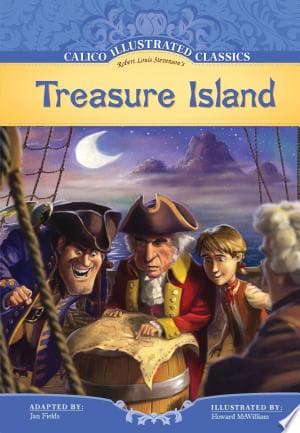
Robert Louis Stevenson (1998)
Genre
General
Reading Time
230 min
Key Themes
See below
Sign in to track this book
A young cabin boy joins a perilous quest for buried pirate gold, facing the cunning Long John Silver on a remote, treasure-filled island.
Young Jim Hawkins helps his mother run the 'Admiral Benbow' inn on the English coast. Their peaceful life changes with the arrival of Billy Bones, a rough, rum-loving old seaman. Bones carries a large sea-chest and often warns Jim to watch for 'a one-legged man.' He pays Jim to keep an eye out for other sailors, clearly afraid of being found. Bones often drinks too much, scaring locals with his sea songs and temper. One day, a sinister seaman named Black Dog arrives and confronts Bones. They fight with swords, and Bones wins, but he then has a stroke. This event pulls Jim into a dangerous world of pirates and buried treasure.
After his first stroke, Billy Bones is confined to bed, his health worsening. Despite the doctor's warnings, he continues to drink rum. A blind, terrifying pirate named Pew arrives at the 'Admiral Benbow' demanding to see Bones. Pew gives him the 'black spot,' a pirate summons meaning imminent death. Bones is horrified, knowing he has only hours left. As Pew leaves, Bones has a fatal stroke and dies. Jim, seeing this, realizes the danger they are in. He remembers Bones's constant fear and his warning about the sea-chest. Jim and his mother, fearing Pew's return, decide to open the chest to get money Bones owed them.
Jim and his mother carefully open Billy Bones's sea-chest. They find coins from different countries, a quadrant, a silver bar, and a sealed packet. As they count the money owed for Bones's stay, they hear approaching footsteps—Pew and his pirate crew are returning. Jim's mother faints from fear, but Jim quickly grabs the sealed packet, thinking it the most valuable item. He then flees the inn, hiding under a bridge, just as Pew and his men search the 'Admiral Benbow' for the packet. The pirates are angry when they find nothing, and their search is stopped by revenue officers, forcing them to scatter.
After the revenue officers chase off the pirates, Jim takes the packet to Dr. Livesey, the local physician, and Squire Trelawney, a wealthy landowner, who are dining together. Jim explains what happened at the inn and presents the packet. They open it to find a logbook detailing Captain Flint's voyages and, more importantly, a detailed map of an island marked with three red crosses, showing where Flint's buried treasure is. Trelawney, very excited, immediately decides to prepare a ship and go on a treasure hunt. Dr. Livesey, more careful, warns Trelawney to be quiet about their plans, but the squire's excitement is hard to control, setting the stage for their dangerous voyage.
Squire Trelawney, ignoring Dr. Livesey's warnings, quickly gets ready for the voyage. He buys a schooner called the 'Hispaniola' and hires a crew. In Bristol, he meets Long John Silver, a one-legged man and former sea cook who now runs a tavern called 'The Spy-glass.' Silver, charming and seemingly proper, says he served under Captain Flint and offers to help Trelawney find a reliable crew. Trelawney, impressed by Silver's knowledge and apparent loyalty, hires him as the ship's cook and lets Silver recruit several other men. Jim, excited to be part of the adventure, looks forward to meeting Silver, unaware of Silver's hidden secret.
The 'Hispaniola' sails for Treasure Island. The first days of the trip are quiet, and Jim finds Long John Silver interesting, as he seems to be a kind and helpful mentor. However, Jim's curiosity leads him to hide in an apple barrel one evening, where he overhears Silver talking with several other crewmen. To his horror, Jim discovers that Silver is a known pirate leader and that many of the crew are Flint's old hands. Silver reveals their plan to wait until the treasure is found, then kill the captain and the loyal crew, and take the treasure for themselves. Jim is terrified but manages to slip away to warn Dr. Livesey and Captain Smollett.
After learning of the mutiny plot, Captain Smollett, Dr. Livesey, and Squire Trelawney immediately begin to plan their defense. The 'Hispaniola' finally reaches Treasure Island, a wild, heavily wooded place. Silver, pretending to obey, suggests that the men go ashore for a break, a move meant to get the loyal crew off the ship. Captain Smollett, aware of the danger, agrees but sends only the mutineers ashore, while the loyalists stay on board. Jim, wanting to see the island, secretly joins one of the shore parties. Soon after, the first shots are fired, marking the start of open fighting between the loyal crew and the pirates.
During the first fight on the island, Jim finds himself separated from the loyal crew. He sees Silver brutally kill a loyal seaman. Fleeing through the dense woods, Jim finds a wild-looking man in rags. This man introduces himself as Ben Gunn, a former member of Flint's crew marooned on the island three years prior by his shipmates after failing to find the treasure. Ben Gunn, driven half-mad by loneliness and a desire for cheese, offers his knowledge of the island and his help to Jim and his friends in exchange for passage home and a share of the treasure. Jim, seeing an unexpected ally, agrees to take Ben Gunn to meet Dr. Livesey.
Meanwhile, Captain Smollett, Dr. Livesey, and Squire Trelawney, with the remaining loyal crew, move supplies from the 'Hispaniola' to an old stockade Flint had fortified years ago. They set up a defense, preparing for the pirate attack. Silver, now openly leading the mutineers, approaches the stockade under a flag of truce, trying to negotiate the surrender of the map and the treasure. Captain Smollett refuses, leading to a fierce attack by the pirates. Despite being outnumbered, the loyal crew, helped by their fortified position and better weapons, successfully stop the first attack, though Captain Smollett is wounded.
Feeling restless and independent, Jim decides to go on a solo mission. He finds Ben Gunn's small coracle, a hide boat, and uses it to paddle out to the 'Hispaniola,' which the pirates no longer guard. His plan is to cut the ship loose and stop the pirates from using it to escape. He succeeds in cutting the anchor cable, and the 'Hispaniola' drifts away. On board, Jim finds the pirate Israel Hands, who is badly wounded and drunk. A struggle follows, ending with Hands trying to stab Jim. Jim shoots Hands with his pistols, and Hands falls overboard and drowns. Jim takes control of the ship, now master of the 'Hispaniola.'
Jim, tired but victorious, steers the 'Hispaniola' back to a safe cove. He then goes back to the stockade, expecting to be praised. To his surprise, he finds the stockade occupied not by his friends, but by Long John Silver and the few remaining pirates who had switched sides. Silver, having used Dr. Livesey's temporary absence (as he was searching for Ben Gunn), had taken control of the fort. Jim is immediately captured, and Silver, though angry at first, sees a chance to use Jim as a hostage to bargain with the doctor and the squire. This again shows Silver's cunning and ability to adapt in tough situations.
Dr. Livesey eventually returns to the stockade and, seeing Jim captive, negotiates with Silver for Jim's safety. Silver, now with the map, forces Jim and the remaining pirates on a difficult trek across the island to the spot marked 'X' on Flint's map. The journey is full of tension and fear, as the pirates are increasingly rebellious and suspicious of Silver. When they finally reach the treasure site, they see a horrifying sight: the treasure chest has already been dug up, and the large pit is empty. The pirates are furious, realizing they have been outsmarted. Just as they are about to turn on Silver, musket fire erupts from the trees, scattering the pirates.
The musket fire comes from Dr. Livesey, Ben Gunn, and Squire Trelawney, who have positioned themselves well. Ben Gunn then reveals his secret: during his three years marooned on the island, he had carefully searched for and found Captain Flint's treasure himself, digging it up and moving it to his cave. He had been living off it for some time, slowly bringing it to a more secure location. This explains the empty pit and completely turns the situation in favor of Jim and his friends. Silver, seeing his last chance at the treasure disappear, quickly changes sides again, claiming he was always loyal to the 'gentlemen' and offering his help against the remaining pirates.
With Ben Gunn's revelation, the remaining pirates are disheartened and easily defeated. The loyal crew, now reunited and with the treasure, loads the vast amounts of gold and silver onto the 'Hispaniola.' They decide to leave the few surviving pirates, including the two who had been with Silver, marooned on the island with some supplies, judging them too dangerous to take back. Jim, Dr. Livesey, Squire Trelawney, and Ben Gunn, along with the few remaining loyal crew members, sail from Treasure Island, leaving behind the dangers and the memories of Captain Flint. The ship is now full of a huge fortune, and the journey home begins.
The voyage home is long but mostly quiet. The 'Hispaniola' stops at a port in Spanish America to get more crew. During this stop, Long John Silver, always clever, manages to escape in the dark, taking with him a small bag of gold coins he had secretly gotten. Jim is not surprised, recognizing Silver's great resourcefulness. The remaining heroes arrive back in England, very wealthy. Jim, though rich, is forever changed by the adventure, especially by the memory of Silver. The treasure is divided, and each person finds their own way to use their new fortune, but the excitement and terror of Treasure Island stay in Jim's memory.
The Protagonist
Jim transforms from an innocent innkeeper's son into a seasoned adventurer who has faced death and mutiny, gaining maturity and self-reliance.
The Antagonist
Silver consistently shifts allegiances and survives through cunning, demonstrating his unwavering commitment to self-preservation above all else.
The Supporting
Dr. Livesey maintains his steadfast wisdom and courage, serving as the moral and practical anchor for the loyal party throughout the perilous journey.
The Supporting
Trelawney learns the dangers of his own impulsiveness and boasts, becoming a more cautious and effective member of the loyal party.
The Supporting
Smollett's professional integrity and leadership are tested and proven, solidifying his role as a crucial figure for survival.
The Supporting
Ben Gunn's isolation and madness are resolved through his alliance with Jim, leading to his return to society and a reward for his crucial help.
The Supporting
Bones's past catches up to him, leading to his death and the revelation of the treasure map, setting the main plot in motion.
The Mentioned
Pew's pursuit of the map leads to Billy Bones's death and his own demise, solidifying the threat of the pirates.
The Mentioned
Flint's legacy, particularly his buried treasure, continues to drive the narrative long after his death.
Greed is the main reason for most characters' actions, driving both good adventurers and cruel pirates. The promise of Captain Flint's treasure corrupts even seemingly good men, as seen in Squire Trelawney's initial recklessness and Long John Silver's mutiny. The pirates' endless desire for gold leads to violence, betrayal, and their eventual downfall, as they turn on each other. Even Jim, though brave, is drawn into the adventure by the promise of wealth. The treasure itself represents this corrupting influence, bringing out the best and worst in people. The novel suggests that while wealth can be a reward for courage, seeking it often shows the darker parts of human nature, as shown by the constant betrayal among the pirates.
“''I've seen too much of the sea to be in love with it.''”
The story is about Jim Hawkins growing up, changing from an innocent innkeeper's son into a self-reliant and morally aware young man. Jim is forced into a dangerous adult world, making life-or-death decisions on his own. His experiences with figures like Billy Bones and Long John Silver show him the complexities of human nature, where good and bad are often mixed. He learns to trust his instincts, tell true allies from false friends, and take responsibility for his actions, such as his solo mission to reclaim the 'Hispaniola.' His journey is one of great growth, where he gains important experience and a tougher understanding of the world, moving past his sheltered life at the 'Admiral Benbow.'
“''I was so pleased with my success that I took a double quantity of rum and was soon dead drunk.''”
While there is a clear difference between the loyal 'gentlemen' and the murderous pirates, the novel also explores the gray areas within these groups. Long John Silver is the main example, showing both charming guidance and cruel villainy. His complex relationship with Jim blurs the lines, making him an interesting antagonist who is not entirely evil. The loyal crew, while generally 'good,' also use violence and make questionable decisions, such as marooning the remaining pirates. The story suggests that surviving in a brutal world often requires hard choices, and that even 'good' men can be driven to harsh actions, while 'evil' men can have admirable qualities like courage and intelligence. This ambiguity adds depth to the characters and the story.
“''There was a dreadful bloom of yellow fever on board, and they died like flies.''”
At its heart, 'Treasure Island' is a classic adventure story, offering readers an escape into a world of daring acts, exotic places, and exciting swashbuckling. The story is driven by the excitement of the unknown, the search for a legendary treasure, and the constant threat of danger. Jim's journey from his ordinary life at the inn to the high seas and a mysterious island embodies the spirit of escape. The clear descriptions of the island, the sea voyages, and the pirate encounters spark the reader's imagination, providing an experience of great adventure. This theme celebrates the human desire for excitement, discovery, and the challenge of overcoming extraordinary obstacles, even with significant peril.
“''I believe we are all about to become very rich.''”
The catalyst for the entire adventure.
The map of Treasure Island, with its distinctive 'X' marks, is the central MacGuffin of the story. It is the object that drives the plot, ignites the imaginations of the characters, and sets them on their perilous journey. Discovered by Jim Hawkins in Billy Bones's sea-chest, the map represents untold riches and adventure. Its existence is the sole reason for the expedition and the subsequent conflict between the loyal crew and the pirates. The map's details, including Flint's cryptic notes, are crucial for advancing the plot and creating suspense, as characters interpret its clues and race to its marked locations.
Provides an intimate and immediate perspective on the unfolding events.
The story is primarily told through the eyes of young Jim Hawkins, offering a subjective and often naive but ultimately reliable account of the events. This narrative choice immerses the reader directly into Jim's experiences, allowing them to witness his fears, excitement, and moral dilemmas firsthand. Jim's perspective heightens the sense of adventure and danger, as the reader experiences the world of pirates and treasure through his evolving understanding. It also allows for dramatic irony when Jim overhears vital information, such as Silver's mutinous plot, creating tension and suspense.
A pirate summons and death warrant.
The 'black spot' is a powerful symbol of pirate justice and impending doom. It is a small piece of paper, blackened on one side, delivered to a pirate as a formal accusation or a death sentence. In the novel, it is delivered to Billy Bones by Blind Pew, signaling his imminent demise. This device immediately establishes the brutal and superstitious world of pirates and foreshadows the violence that will follow. It acts as a clear warning and a dramatic trigger, accelerating the plot by forcing Jim to act after Bones's death.
A seemingly innocuous object that becomes crucial for plot exposition.
The apple barrel serves as a clever narrative device that allows Jim Hawkins to overhear Long John Silver's mutinous plans without being detected. While hiding in the barrel, Jim inadvertently becomes privy to the entire conspiracy, including Silver's true identity and the pirates' intentions to seize the treasure and murder the loyal crew. This scene is a pivotal moment, shifting the narrative from innocent adventure to treacherous conflict. It's a classic example of dramatic irony and a highly effective way to reveal crucial plot information to both the protagonist and the reader, propelling the story towards confrontation.
“Fifteen men on the dead man’s chest— Yoh-ho-ho, and a bottle of rum!”
— The song sung by Billy Bones, introducing the pirate theme.
“I’ve seen a many a brave man, but never one that was a match for Billy Bones.”
— Dr. Livesey's assessment of Billy Bones's character.
“If you are not back by noon, Captain, I’ll take it as a sign that you are a pirate, and I’ll have you hanged.”
— Dr. Livesey to Captain Smollett during a heated argument.
“I’m a plain man, I am, and I don’t like to be told I’m wrong.”
— Captain Smollett's declaration of his personality.
“He was a man of about fifty, and he had lost his left leg, and he was as strong as a horse.”
— Jim Hawkins's first description of Long John Silver.
“I’ve always been a good man to my word, and I’ll be a good man to my word now.”
— Long John Silver trying to reassure Jim Hawkins of his intentions.
“Drink and the devil had done for the rest.”
— Jim Hawkins reflecting on the fate of some of the pirates.
“You can’t make a man go straight who’s been crooked for fifty year.”
— Long John Silver's cynical view on human nature and change.
“Dead men don’t bite.”
— A chilling observation by Long John Silver regarding fallen comrades.
“I’m a poor, lost lamb, I am, and I want to go home.”
— Ben Gunn's lament after being marooned for years.
“One good turn deserves another.”
— A common saying used by various characters, highlighting reciprocity.
“There was a great deal of good in him, and a great deal of bad, as in most of us.”
— Jim Hawkins's final reflection on Long John Silver's complex character.
“And the rest of the treasure is still there, for me to find.”
— Jim Hawkins's closing thought, hinting at the enduring allure of adventure.
“I was about to learn the truth of the old saying, that the best laid schemes o’ mice and men gang aft a-gley.”
— Jim Hawkins reflecting on the unpredictable nature of their journey.
Ready to see how well you understood this book? Take our interactive quiz with 10 questions.
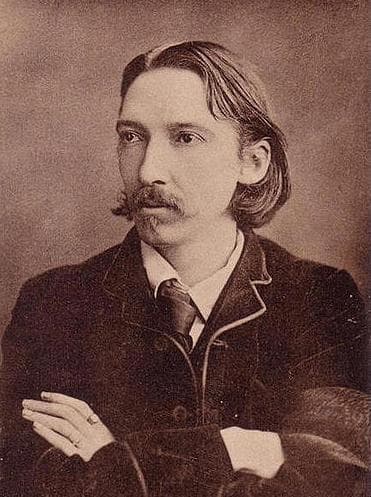
Robert Louis Stevenson was a Scottish novelist, essayist, poet and travel writer. He is best known for works such as Treasure Island, Strange Case of Dr Jekyll and Mr Hyde, Kidnapped and A Child's Garden of Verses.