“Strength through discipline. Strength through community. Strength through action.”
— The three mottos of The Wave, introduced by Ben Ross.

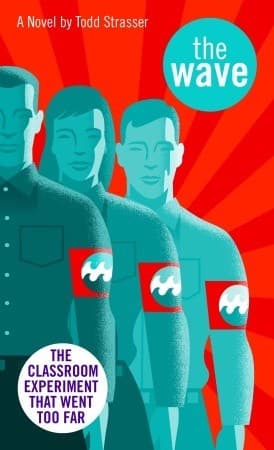
Todd Strasser (1981)
Genre
Psychology / Historical Fiction / Young Adult
Reading Time
120 min
Key Themes
See below
Sign in to track this book
When a history teacher's experiment to demonstrate the appeal of fascism becomes a school-wide movement, two students must expose the danger of unquestioning conformity before it consumes them.
Ben Ross, a history teacher at Gordon High, shows his class a documentary about the Holocaust. The film, with its images of concentration camps and suffering, deeply disturbs his students. Afterward, students like Robert Billings, often an outcast, express confusion and anger about how Germans could have claimed ignorance or allowed such events. Amy Smith, Laurie Saunders' best friend, wonders why no one resisted. Ben struggles to answer these questions, feeling he cannot fully explain the collective inaction. This plants the seed for his upcoming experiment.
The next day, Ben Ross decides to conduct an experiment to help his students understand how easily people can adopt a totalitarian movement. He starts by introducing strict classroom discipline. He tells students to sit up straight with feet flat on the floor and to answer questions directly, standing by their desks when speaking. The students are initially surprised and a bit awkward, but they respond well to the structure. Even quiet Robert Billings responds positively. Ben feels a surge of power and control he has not felt before, finding the experiment more engaging than he expected.
Ben Ross continues his experiment by introducing the second motto of The Wave: 'Strength Through Community.' He explains that working together and supporting each other will make them stronger. He shows this by having the class chant the motto in unison, which creates a powerful, almost hypnotic effect. Robert Billings, typically withdrawn, embraces this new sense of belonging with enthusiasm. He finds a place where he feels accepted and equal. Other students, like David Collins, Laurie's boyfriend and a football player, are also drawn into the collective energy and purpose, feeling a unity they had not experienced in class before.
To strengthen the group's identity, Ben Ross designs a symbol for The Wave: a circle with a wave in the middle. He also creates a unique salute, a cupped hand raised to the shoulder, which only members of The Wave can use. He explains that this salute shows their commitment to 'Strength Through Discipline' and 'Strength Through Community.' The students quickly adopt both the symbol and the salute, feeling a stronger bond and exclusivity. Robert Billings, in particular, feels immense pride in performing the salute, gaining a sense of belonging and importance he has always lacked.
The Wave quickly spreads beyond Mr. Ross's history class. Students from other classes, curious about the discipline and unity among Wave members, start asking how to join. Ben Ross, surprised by the rapid growth, holds a rally in the school quad during lunch. There, he officially introduces The Wave to the entire student body. He explains the principles of 'Strength Through Discipline' and 'Strength Through Community' and demonstrates the salute. The rally receives overwhelming enthusiasm. Hundreds of students eagerly join, turning The Wave into a school-wide phenomenon, much to the initial excitement of many, including David Collins.
Laurie Saunders, editor of The Gordon Grapevine, starts to feel uneasy about The Wave. She notices that individuality is suppressed, and students who do not join are excluded. Her best friend, Amy Smith, and even her boyfriend, David Collins, are fully involved in the movement, making Laurie feel isolated. She sees her classmates becoming less critical and more focused on conforming. At a Grapevine staff meeting, some students express concerns about The Wave's intensity, but others, like Alex Cooper, argue it is harmless. Laurie's discomfort grows as she observes the increasing conformity and exclusion.
Laurie and her Grapevine staff decide to investigate The Wave's negative aspects. They collect anonymous statements from students who feel intimidated, excluded, or even physically harassed for not joining. They also report on a Jewish student beaten by Wave members for not saluting. The Grapevine publishes an editorial detailing these incidents, highlighting the loss of individuality and the rise of intolerance in the school. This article causes a stir, making many students question The Wave's true nature and leading to a confrontation between Laurie and David.
After the Grapevine article is published, David Collins confronts Laurie, accusing her of trying to sabotage The Wave. He argues she is just jealous because she is no longer special. Their argument escalates, and David, consumed by The Wave's ideology, shoves Laurie to the ground. The shock of his own violence, and Laurie's fear, immediately brings David to his senses. He realizes how much The Wave has warped his judgment and behavior. This incident is a turning point for David; he understands Laurie's concerns and decides they must stop the movement together.
David Collins, now aware of The Wave's destructive potential, rushes to Laurie's house. Together, they go to Ben Ross's home to confront him. They explain The Wave's negative impact on students and the school, recounting instances of bullying, exclusion, and suppressed individuality. Initially, Ben is defensive, still caught up in the power he feels. But as Laurie and David passionately state their concerns, and David describes his violent outburst, Ben begins to see the experiment through their eyes. He admits it has gotten out of control and agrees to end it.
Ben Ross announces an emergency Wave rally for all members, promising a major announcement and the introduction of their national leader. The entire school auditorium is packed with enthusiastic Wave members, all performing the salute and chanting slogans. Ben builds suspense, explaining that The Wave is a nationwide movement and their leader will soon appear. He projects an image of Adolf Hitler onto the screen, revealing the true, chilling nature of the movement they had so eagerly embraced. The students are stunned into silence, facing the horrifying reality of their participation in a pseudo-fascist movement.
As the image of Hitler fades, Ben Ross explains the experiment's purpose: to show them how easily people can be manipulated into a totalitarian movement, like in Nazi Germany. The students are initially silent, then a wave of shock, shame, and confusion washes over them. Many look down, unable to meet Ben's gaze. Robert Billings, who found his identity in The Wave, is particularly devastated, crying uncontrollably. Ben comforts him, acknowledging the pain and confusion but emphasizing the lesson learned. The Wave is officially dissolved, leaving the students to grapple with the implications of their participation.
The Protagonist
Ben starts as an idealistic teacher, becomes captivated by his own power, and ultimately realizes the dangerous implications of his experiment, leading him to dismantle it.
The Protagonist
Laurie starts as a popular student who observes The Wave's rise, becomes its primary antagonist, and ultimately plays a crucial role in its downfall.
The Protagonist
David initially embraces The Wave for its promise of unity and discipline, becomes aggressive in its defense, but then experiences a profound realization that leads him to help dismantle it.
The Supporting
Robert transforms from an alienated outcast to a deeply integrated member of The Wave, only to be utterly devastated when the movement is dissolved.
The Supporting
Amy's initial enthusiasm for The Wave creates a rift with her best friend, Laurie, as she embraces the conformity and equality it offers.
The Supporting
Christy observes The Wave's progression from an outside perspective, expressing increasing concern to Ben about its ethical implications and the negative changes in his behavior.
The Mentioned
No specific arc, serves as a contrast.
The Supporting
Principal Owens moves from cautious support of Ben's experiment to demanding its cessation due to growing concerns about its negative impact.
The main theme explores how easily individuals give up their freedom and critical thinking for a powerful group identity. The Wave shows how the desire for belonging, discipline, and shared purpose can override individual conscience. Students like David and Robert, initially drawn to unity, quickly become uncritical followers, excluding those who do not conform. The rapid spread of the salute and the unquestioning adoption of slogans illustrate how quickly an ideology can take root when critical thought is suppressed, drawing frightening parallels with historical totalitarian movements.
“''Strength Through Discipline. Strength Through Community. Strength Through Action.' The Wave was becoming more than just a class experiment; it was a movement. And no one wanted to be left out.”
The novel examines how power affects both leaders and followers. Ben Ross, initially planning a simple experiment, becomes increasingly captivated by the control he has and the respect he gets as The Wave's leader. Students, especially those like Robert who felt powerless, are drawn to the sense of collective power and clear hierarchy. The ease with which students obey and the excitement of being part of something 'special' highlight how the promise of power, even in a simulated environment, can corrupt judgment and encourage submission to authority, regardless of its ethics.
“He found himself enjoying the power, enjoying the feeling of the students' eyes on him, their instant obedience.”
A core theme addresses the initial question of the Holocaust: how could individuals claim ignorance or innocence? The Wave illustrates that collective guilt often results from individual inaction and failing to question authority. Laurie Saunders shows individual responsibility by actively resisting and exposing the movement. David's realization after his violent outburst highlights personal accountability for actions within a group. The experiment forces students to confront their own involvement, showing that 'just following orders' or remaining silent is a form of participation in harmful systems.
“You all said that you would never have let such a thing happen. Well, you proved yourselves wrong.”
The rapid rise and acceptance of The Wave in a seemingly democratic high school show how fragile democratic values are. Concepts like freedom of speech, individuality, and critical thinking are quickly replaced by discipline, conformity, and a sense of belonging. The exclusion of non-members and the suppression of the Grapevine's critical reporting demonstrate how easily democratic principles can be undermined when group pressure and an authoritarian structure take hold. The experiment serves as a warning about the constant vigilance needed to uphold democratic ideals.
“The Grapevine was supposed to be a free newspaper, but lately it wasn't. It was The Wave's newspaper.”
The entire Wave movement serves as an extended metaphor for the rise of totalitarianism.
Ben Ross's 'experiment' is not just a classroom activity; it's a direct, immersive metaphor for the historical rise of movements like Nazism. By having the students experience the allure of discipline, community, and action firsthand, the novel illustrates the psychological mechanisms that enable such movements. The progression from simple rules to a distinct identity, and then to the suppression of dissent, directly mirrors the historical events the students initially struggled to comprehend, making the abstract concept of collective complicity tangible and impactful.
Serves as the voice of dissent and critical journalism within the school.
The Gordon Grapevine, the school newspaper edited by Laurie Saunders, functions as a crucial plot device by providing an independent platform for questioning and exposing The Wave. It represents the power of free press and critical inquiry in challenging an oppressive system. Its reporting on the negative impacts of The Wave, including bullying and the suppression of individuality, directly catalyzes the turning point where David and other students begin to question the movement, ultimately leading to its downfall. It highlights the importance of an informed and critical media in a democratic society.
Highlights the appeal of group identity to the vulnerable and marginalized.
Robert Billings' dramatic transformation from an outcast to a fervent, confident member of The Wave is a powerful plot device. His character arc illustrates the profound psychological appeal of belonging and purpose for individuals who feel marginalized or invisible. By showing how The Wave provides him with an identity and acceptance he previously lacked, the novel underscores why such movements can gain traction, particularly among those seeking validation. His ultimate devastation at the experiment's end emphasizes the personal cost when that identity is suddenly stripped away, making the human impact of the experiment deeply personal.
Symbols that create immediate group cohesion and reinforce ideology.
The Wave's distinct salute and its three core slogans ('Strength Through Discipline,' 'Strength Through Community,' 'Strength Through Action') are crucial plot devices for establishing and reinforcing the movement's identity and ideology. The repetitive chanting and the exclusive use of the salute quickly create a strong sense of unity, belonging, and shared purpose among members. These simple, memorable elements bypass critical thought, fostering an unthinking adherence to the group's principles and making it easy for new members to assimilate, demonstrating how symbols can be manipulated to foster conformity.
“Strength through discipline. Strength through community. Strength through action.”
— The three mottos of The Wave, introduced by Ben Ross.
“It's like we're all part of something. Something important.”
— Laurie Saunders observing the initial enthusiasm for The Wave.
“What does being a good German have to do with being a good human being?”
— Laurie's mother questioning the historical context of the Nazi era.
“How can you say that no one would have followed Hitler? If you look at the film, you can see they were not all crazy fanatics. They were people like you and me.”
— Ben Ross explaining the appeal of Nazism to his students.
“You mean we have to salute you every time we see you?”
— A student asking Ben Ross about the expectations of The Wave.
“This is a social experiment. Nothing more.”
— Ben Ross trying to reassure himself and others about The Wave's purpose.
“All of a sudden, I didn't have to worry about clothes or popularity or grades, I was just part of the Wave. And it felt good.”
— Robert Billings reflecting on the positive aspects of The Wave for him.
“Don't you see what's happening? We're all becoming the same.”
— Laurie Saunders expressing her growing concern about The Wave.
“You can't let your personal feelings get in the way of what's good for the group.”
— A Wave member chastising Laurie for her dissenting views.
“It's not just a game anymore, Ben. It's dangerous.”
— Christy Ross, Ben's wife, warning him about the escalating situation.
“I'm scared, Laurie. I'm really scared.”
— David Collins admitting his fear to Laurie as The Wave intensifies.
“There is no leader! There is no Wave!”
— Ben Ross revealing the truth to the assembled students at the rally.
“He taught us a lesson we'll never forget.”
— A student's reflection after The Wave experiment concludes.
“How could you let it go so far?”
— A student's question to Ben Ross after the experiment ends.
Ready to see how well you understood this book? Take our interactive quiz with 10 questions.

Biography coming soon.

Rhonda Byrne
4.3

Menno Henselmans
4.3

Elliot Aronson
4.3

Sylvia Plath
4.3

Joseph Campbell
4.3

Erich Fromm
4.3

Irvin D. Yalom
4.2

Lucy Strange
4.2