“O, what a thing of naught is man, when he forgets the gods!”
— Hecuba laments the fate of Troy and her family, reflecting on human pride.


Euripides (2005)
Genre
General
Reading Time
130 min
Key Themes
See below
Sign in to track this book
In the ruins of Troy, captive royal women, stripped of their city and men, are divided as war prizes, their pain showing the brutal cost of victory.
The play opens on the ruined plains of Troy. Poseidon, god of the sea, sees the destruction and mourns his once-favored city. He reveals that the Achaean (Greek) ships are ready to sail, having already divided the captive Trojan women among their leaders. Athena, previously a strong supporter of the Achaeans, appears and expresses anger at their disrespectful behavior, especially Ajax the Lesser's rape of Cassandra in her temple. She proposes that she and Poseidon punish the Achaean fleet with terrible storms during their journey home. This divine opening sets a somber, warning tone for the human tragedy that follows.
Hecuba, the former Queen of Troy, wakes from a restless sleep among the rubble. She is completely devastated, crawling on all fours, mourning her lost husband Priam, her sons, and her city. Her grief is deep and complete as she tries to understand the scale of the disaster. She calls on the Trojan women, her fellow captives, to join her in mourning. Her lament sets the emotional center of the play, showing the overwhelming sorrow and despair in the lives of the defeated. She accepts her new reality as a slave, stripped of all dignity, and anticipates the horrors awaiting her and her people.
The Chorus, made up of the captive Trojan women, enters and joins Hecuba in her lament. They share her pain and express their fears about their unknown future. They have heard rumors of the division of spoils and expect to be separated from their loved ones and taken to foreign lands as slaves. Each woman imagines her possible fate, wondering who her new master might be and where she will go. Their shared sorrow and worry increase Hecuba's personal grief, creating a strong image of widespread suffering. They say they wish for death to escape their unbearable fate, showing their deep despair.
Talthybius, the Greek herald, arrives to tell Hecuba and the women their individual fates. Hecuba is assigned to Odysseus, a particularly cruel blow. Cassandra, Priam's prophetess daughter, is given to Agamemnon, the Achaean commander. Cassandra, though thought mad, enters in a frantic state, celebrating her forced marriage. She foretells the tragic deaths awaiting Agamemnon and his family when they return to Argos, and predicts her own death with him. She also praises the Trojan war dead, saying their suffering in Troy was more honorable than the shameful deaths awaiting the Achaeans. Her prophecies offer a glimpse of future revenge, though it comes at a high cost.
Andromache, Hector's widow, is brought in, holding her young son, Astyanax. She mourns Hector's death and Troy's destruction, expressing her deep sorrow at being enslaved by Neoptolemus, Achilles' son, the man who killed her husband. Talthybius then delivers terrible news: the Achaean council has decided that Astyanax must be thrown from the walls of Troy. This is to prevent him from growing up and seeking revenge for his father. Andromache's cries of despair are heartbreaking as she pleads for her son's life, but Talthybius is firm. This scene shows the brutal logic of war and how the defeated are completely dehumanized, sacrificing an innocent child for perceived future safety.
After Astyanax is forcibly taken from his mother, Talthybius later returns, carrying the boy's lifeless body. He tells Hecuba that the Achaeans have carried out their cruel order. The sight of her grandson's broken body is another crushing blow to Hecuba, already overwhelmed by grief. She cradles the child, mourning his innocent death and the Greeks' barbarity. Hecuba then prepares Astyanax for a makeshift burial, using Hector's shield as his coffin. This scene is a strong criticism of war's savagery, showing how it destroys the innocent and continues a cycle of suffering, leaving only sorrow and despair.
Menelaus, the Spartan king, finally arrives, not to mourn, but to claim Helen, the cause of the entire war. He plans to take her back to Sparta and kill her there. Helen, surprisingly, appears adorned and tries to justify her actions, blaming the gods and Paris for her abduction. Hecuba, however, strongly refutes Helen's claims, accusing her of vanity and betrayal, and urging Menelaus to kill her immediately to prevent further harm. Menelaus remains conflicted, torn between his desire for revenge and Helen's manipulative charm. This encounter shows the moral uncertainty and destructive power of beauty, even amid deep suffering.
Despite Hecuba's strong arguments and pleas for Helen's immediate execution, Menelaus decides to take Helen back to Sparta alive. He cites the need for a public trial and execution in her homeland, though his lingering attraction to her is clear. Hecuba warns him about Helen's seductive power and advises him to guard her closely on the voyage. Helen, always manipulative, continues to plead her innocence and tries to ensure her safety, even as she is led away. Her departure leaves Hecuba and the remaining Trojan women with a sense of frustrated justice and the bitter realization that the person who caused their suffering might escape true punishment.
Talthybius returns with Greek soldiers, carrying torches. He announces that the Achaeans are setting fire to the last remaining structures of Troy, effectively erasing the city. The smoke and flames rising from the city walls are a clear visual of the Trojans' complete defeat. Hecuba watches in horror as her beloved city burns, her last hope of any physical remnant of her past life vanishing. This act of deliberate destruction symbolizes the finality of their loss and the brutal triumph of the victors, leaving the Trojan women with only ashes and memories.
As fires consume Troy, Hecuba and the Chorus of Trojan women offer a final, heartbreaking lament for their fallen city, their dead loved ones, and their shattered lives. Hecuba tries to throw herself into the flames, wanting to die with her city, but Talthybius restrains her. They are then forcibly led away towards the Achaean ships, their voices full of despair and resignation. The play ends with the women being dragged from their homeland, their future uncertain and grim, emphasizing the lasting tragedy of war and the deep suffering inflicted on the innocent defeated. Their final cries reflect the irreversible loss of their identity and nation.
The Protagonist
From a revered queen, Hecuba descends into the depths of despair and slavery, becoming a symbol of enduring suffering and a voice against the brutal consequences of war.
The Supporting
Cassandra remains steadfast in her prophetic abilities, offering a chilling glimpse into the future doom of the Achaeans, even as she accepts her own tragic fate.
The Supporting
Andromache endures the ultimate loss of her husband and child, representing the destruction of family and innocence in war, and is forced into a new life of servitude.
The Antagonist
Helen largely remains static, continuing her manipulative ways even in the face of her impending judgment, though her fate is left ambiguously uncertain.
The Supporting
Menelaus struggles with his desire for vengeance against Helen, ultimately succumbing to her manipulative charm and deferring her punishment.
The Supporting
Talthybius remains a dutiful herald, but his discomfort with the Achaean cruelties reveals a glimmer of human empathy amidst the brutality of war.
The Mentioned
Poseidon's role is primarily expository, setting the stage for divine retribution against the Achaeans.
The Mentioned
Athena shifts her allegiance from the Achaeans to plan their destruction, demonstrating the consequences of impiety.
The most common theme is the suffering caused by war, especially for the innocent and defeated. Euripides focuses on the physical and mental devastation, removing any sense of glory or heroism. Hecuba's deep sorrow for her lost family and city, Andromache's despair over Astyanax's murder, and the Chorus's collective fear of enslavement all clearly show the human cost. The burning of Troy at the play's end is a visual symbol for total destruction, emphasizing that war leaves only ashes and despair. The play suggests that victory comes at a high moral price, making the victors almost as sad as the vanquished.
“What land will receive me as a slave? What home? Where shall I go, a poor old woman, the wretched shadow of a corpse?”
The play shows how war robs the defeated of their dignity, identity, and humanity. The Trojan women, once queens and noblewomen, become mere war prizes, divided like property among their conquerors. Hecuba, the once-proud queen, is forced to crawl and mourn her fate as a slave. Andromache, a loyal wife and mother, is torn from her son, who is then brutally murdered as a 'precaution.' Their individual identities are replaced by their status as 'Trojan women,' objects to be owned and used. This theme highlights the moral decline in conquest and the psychological harm of being treated as less than human.
“Oh, what a slave I am! What a thing of nothing! The city is gone, my children gone, my husband gone. I am nothing!”
While the immediate suffering is human, the play opens with Poseidon and Athena planning divine punishment against the Achaeans for their disrespect and sacrilege during the sack of Troy. Cassandra's prophecies also foretell the tragic fates awaiting Agamemnon and other Greek heroes when they return. This theme suggests that while people inflict suffering on each other, the gods ultimately hold the scales of justice, even if their justice is slow and often brutal. It implies that victory gained through arrogance and disrespect for the sacred will lead to divine punishment, offering a glimmer of cosmic balance amid the human tragedy.
“Fools, who sack the temples of the gods and tombs of the dead, soon they will suffer the same fate!”
The cycle of violence and revenge is a central concern. The Trojan War itself was an act of revenge, and the Achaeans' brutal treatment of the Trojans continues this cycle. Astyanax's murder, justified as preventing future revenge, ironically ensures that the memory of injustice will last. Even the gods' planned punishment against the Achaeans, while providing a sense of cosmic justice, does not ease the immediate suffering of the Trojan women. The play questions the effectiveness and morality of endless revenge, suggesting that it only leads to more pain and destruction for everyone involved, victor and vanquished alike.
“Oh, you Greeks, how barbarous you are! For the sake of one woman, you have destroyed so many lives.”
Helen embodies this theme. Her beauty starts the entire war, yet she uses it to manipulate and deceive even in defeat. She tries to justify her actions and persuade Menelaus not to kill her, showing the lasting power of her charm. Hecuba's strong condemnation of Helen highlights the destructive nature of unchecked beauty and superficiality when separated from morality. The play suggests that beauty can be a dangerous force, capable of causing immense suffering and blinding people to truth and justice, even leading to a war that devastates a whole civilization.
“Look at her! She has come here, radiant, to show off her beauty. May the gods destroy her, and all her kind!”
Opening scene featuring gods discussing the plot.
The play begins with Poseidon and Athena conversing, setting the stage by revealing the gods' perspective on the aftermath of the Trojan War and their plans for retribution against the Achaeans. This device establishes the larger cosmic context for the human tragedy, foreshadowing the difficult returns the Greek heroes will face. It also highlights the theme of divine justice and the fickle nature of the gods, who can shift allegiances and exact punishment for human hubris, even from their former favorites.
Group of Trojan women who comment on the action.
The Chorus of Trojan women serves as the collective voice of the defeated, amplifying Hecuba's personal grief and expressing the widespread terror and despair of enslavement. They provide emotional commentary, react to the unfolding events, and offer laments that underscore the play's themes of suffering and loss. Their presence reinforces the idea of shared trauma and allows Euripides to explore the psychological impact of war on an entire community, rather than just individual characters. They represent the voiceless victims of conflict.
A character delivering news of offstage events.
Talthybius, the Greek herald, acts as the messenger, delivering crucial and often devastating news to the Trojan women. He announces their assignments to Greek masters and, most tragically, the decree for Astyanax's execution and later returns with the child's body. This device allows Euripides to convey brutal and shocking events that occur offstage, intensifying their emotional impact through the characters' reactions. Talthybius's role also provides a glimpse into the Achaean perspective, albeit through a figure who occasionally expresses discomfort with his duties.
Extended expressions of grief and sorrow.
Lamentation is a dominant device throughout the play, employed by Hecuba, Andromache, and the Chorus. These extended poetic expressions of grief, sorrow, and despair are central to the play's emotional core. They serve to highlight the profound losses suffered by the Trojan women – their city, husbands, children, and freedom. The laments are not merely expressions of sadness but also acts of defiance, allowing the women to articulate their pain and condemn their oppressors, even in their powerlessness. They underscore the tragic beauty and enduring humanity of the suffering characters.
Foreshadowing of future events.
Cassandra, the prophetess, uses her gift to foretell the tragic fates awaiting Agamemnon and the Achaeans upon their return home, as well as her own impending death. Despite being dismissed as mad, her prophecies are accurate and serve to inject a sense of future retribution into the overwhelming present suffering. This device provides a measure of dark comfort to the Trojan women, suggesting that the victors will not escape divine justice. It also adds a layer of dramatic irony, as the audience is aware of the doom awaiting the seemingly triumphant Greeks.
“O, what a thing of naught is man, when he forgets the gods!”
— Hecuba laments the fate of Troy and her family, reflecting on human pride.
“He who is happy is not wise, if he believes that he will always be so.”
— Hecuba, after the fall of Troy, reflects on the fleeting nature of happiness and fortune.
“There is no evil which cannot be endured by man; for he is born to suffer.”
— Hecuba, in the depths of her despair, acknowledges the human capacity for enduring suffering.
“Oh, ye Hellenes, ye invent new cruelties!”
— Cassandra speaks of the Greeks' innovations in brutality, particularly their treatment of Trojan women.
“The gods have overturned everything, turning it upside down, so that men may learn to humble themselves.”
— Hecuba interprets the destruction of Troy as a lesson from the gods to humanity.
“For a man to die is no shame, but to live in shame is a shame.”
— Andromache considers death preferable to a life of slavery and dishonor.
“A city taken is a city dead.”
— Hecuba mourns the complete destruction and loss of Troy, more than just its physical fall.
“There is no joy in life when hope is gone.”
— Hecuba expresses her utter despair as all her hopes are extinguished.
“How many evils does war bring upon mortals!”
— The chorus reflects on the widespread devastation and suffering caused by war.
“They call us barbarians, but we are more civilized than they.”
— Hecuba, reacting to the Greeks' cruelty, challenges their self-proclaimed moral superiority.
“No one is happy until his life is ended and he is free from pain.”
— Hecuba's final thoughts on happiness, suggesting it can only truly be found in death.
“I will not weep for my lot, but for the city.”
— Hecuba expresses a profound selflessness, prioritizing the loss of her city over her personal sorrows.
“It is the gods who have brought these sorrows upon us.”
— The chorus and characters frequently attribute their misfortunes to divine intervention.
“Do you think that I am afraid of death, when I have seen such things?”
— Andromache, having witnessed unspeakable horrors, has lost all fear of her own demise.
Ready to see how well you understood this book? Take our interactive quiz with 10 questions.
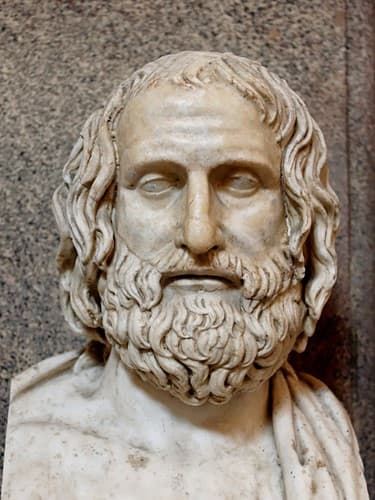
Euripides was a tragedian of classical Athens. Along with Aeschylus and Sophocles, he is one of the three ancient Greek tragedians for whom any plays have survived in full. Some ancient scholars attributed ninety-five plays to him, but the Suda says it was ninety-two at most. Of these, eighteen or nineteen have survived more or less complete. There are many fragments of most of his other plays. More of his plays have survived intact than those of Aeschylus and Sophocles together, partly because his popularity grew as theirs declined—he became, in the Hellenistic Age, a cornerstone of ancient literary education, along with Homer, Demosthenes, and Menander.