“Sometimes you have to let go of what you think you should be to become what you are.”
— Anakin grappling with his identity and the Jedi path.

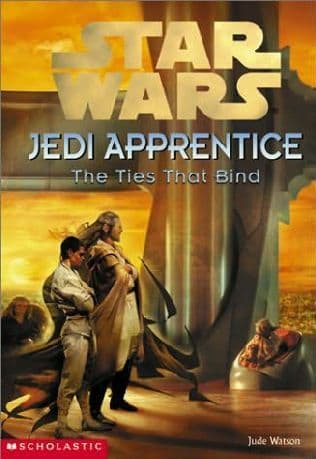
Jude Watson (2001)
Genre
General
Reading Time
90 min
Key Themes
See below
Sign in to track this book
Against the Jedi Council's orders, Qui-Gon Jinn and Tahl return to the unstable planet Apsolon to rescue kidnapped daughters and face the breakdown of a past mission's peace, challenging their bond.
Six years after helping Apsolon establish a free government with Pax Thig as its first leader, Jedi Master Qui-Gon Jinn and his former partner, Master Tahl, are called back to the planet. The peace they helped build has ended with Pax Thig's death and the kidnapping of his two young daughters, Lena and Pella. The Jedi Council is hesitant to get involved, but Qui-Gon feels a personal duty due to his past work, and Tahl has a strong connection to the planet. They arrive on Apsolon with Qui-Gon's apprentice, Obi-Wan Kenobi, to investigate the growing crisis, immediately sensing the shift from a hopeful society to one gripped by fear.
Upon arrival, Qui-Gon, Tahl, and Obi-Wan investigate Lena and Pella's abduction. They learn the planet is split into two groups: the Progressives, who support Pax Thig's vision, and the Traditionalists, who want to return to older customs. Suspicion falls on the Traditionalists, especially their leader, Xantos. The Jedi find a cryptic message from the kidnappers, hinting at a deeper plot than a simple power grab. Tahl, still affected by her past on Apsolon, becomes more emotionally involved in the search, often clashing with Qui-Gon's more distant approach. Obi-Wan watches the complex relationship between his Master and Tahl.
Qui-Gon and Tahl confront Xantos, the Traditionalist leader, for information about the kidnapping. Xantos, a stern figure, denies involvement in Pax Thig's death or his daughters' abduction. He dislikes the current government, but his reasons seem more about cultural preservation than violent overthrow. Xantos reveals that the Traditionalists felt ignored by Pax Thig's changes and that many Apsolonian traditions were disappearing. He provides no direct leads to the girls, but his insights into the political mood suggest the motive for the crimes might be more complex than a power struggle between the two main groups.
Through careful investigation, Obi-Wan finds a subtle clue left by the kidnappers – a symbol from an old Apsolonian legend. This symbol points them to the Whispering Caves, a sacred and dangerous place known for its unstable ground and hidden rooms. Going after this lead is risky, as the caves are unstable and seen as taboo by many Apsolonians. Tahl's urgency to find the girls grows, pushing her to take more risks. Qui-Gon understands her drive but tries to calm her impulsiveness, reminding her of their Jedi training and the need for caution. The journey into the caves tests the Jedi team physically and emotionally.
The Jedi team enters the Whispering Caves, a maze of tunnels with shifting ground, narrow passages, and confusing echoes. Tahl's knowledge of Apsolonian stories helps them through otherwise impassable sections. However, they soon find the caves are not just naturally dangerous; they have been rigged with traps, showing the kidnappers expected pursuit. The traps confirm their suspicion that the abductors are well-prepared and understand the Apsolonian landscape. Tension rises as they navigate the treacherous environment, with Lena and Pella's fate uncertain.
Deep inside the Whispering Caves, the Jedi find Lena and Pella. The situation takes a shocking turn. They learn that Lena, the older daughter, was not a victim but planned her own kidnapping and her father's death. She reveals her true goal: to avenge her mother, who she believed Pax Thig betrayed during his rise to power. Lena, driven by a strong sense of unfairness and a distorted view of her family's history, manipulated the situation to destabilize Apsolon and expose what she saw as her father's hypocrisy. This news deeply affects Qui-Gon and Tahl, challenging their understanding of the events and what justice means.
Lena explains her plan, which includes avenging her mother and taking control of Apsolon. She says she found an old, forgotten prophecy she believed justified her claim to leadership. She planned to fulfill it by staging the kidnapping and showing the flaws of her father's democratic system. Her actions came from deep resentment and a wish to restore what she saw as the right order, even if it meant tearing Apsolon apart. Lena's cold determination and willingness to sacrifice her own sister, Pella, to reach her goals shock the Jedi, especially Tahl, who struggles to accept this manipulative youth is the innocent child she once knew.
Tahl, who had bonded with Lena and Pella during her previous mission on Apsolon, struggles greatly with Lena's betrayal. Her emotional distress clouds her judgment, making it hard for her to accept Lena's actions and respond with Jedi detachment. Qui-Gon, while understanding Tahl's pain, guides her back to her Jedi principles, reminding her of the greater good and the need to prevent more harm to Apsolon. This emotional conflict between Qui-Gon and Tahl shows how their deep personal connection sometimes conflicts with their duties. Obi-Wan observes this, learning about the challenges of staying objective when facing personal ties.
A tense confrontation happens between the Jedi and Lena. Lena, using her knowledge of the caves and her belief in the prophecy, tries to escape and carry out the final parts of her plan. However, Pella, her younger sister, stops her. Pella, used as a pawn in Lena's scheme, bravely confronts her sister, begging her to stop her destructive path. Pella's words, full of love and a desire for peace, break through Lena's tough exterior, causing her to hesitate. This moment of sibling connection becomes the turning point, showing the remaining humanity within Lena despite her actions.
Lena is caught, and her plan is stopped. The immediate crisis on Apsolon ends, but the planet faces the hard task of healing and rebuilding trust. The news of Lena's actions shocks Apsolonian society, forcing them to confront the complexities of their new democracy and the deep-seated resentments that still existed. Qui-Gon and Tahl reflect on the mission, acknowledging the painful lessons learned about how easily peace can break and how strong personal grudges can be. While the mission is a success, the emotional cost to Tahl is clear, and both Masters are left with questions about true justice and the long-term impact of their involvement on Apsolon.
The Protagonist
Qui-Gon's arc reinforces his commitment to following his intuition, even when it conflicts with the Council, and highlights the strength and strain of his bond with Tahl.
The Protagonist/Supporting
Tahl grapples with her personal attachments and the pain of betrayal, ultimately reaffirming her commitment to Jedi principles despite her emotional struggles.
The Supporting
Obi-Wan matures by observing the emotional and ethical dilemmas faced by his Masters, deepening his understanding of the Force and human nature.
The Antagonist
Lena's arc is one of misguided vengeance, culminating in a moment of hesitation due to her sister's plea, hinting at a glimmer of her former self.
The Supporting
Pella's arc showcases her innocence and the unexpected power of her love and desperation to appeal to her sister's humanity.
The Mentioned
N/A (already deceased)
The Supporting
Xantos's role remains largely static, serving to represent a legitimate, albeit opposing, political viewpoint.
The story explores how easily peace and a new democracy can be broken by unresolved grudges and personal revenge. Six years after Qui-Gon and Tahl helped create a free Apsolon, the death of its leader, Pax Thig, throws the planet back into chaos. Lena's actions show that even stable societies can hold deep resentments, fueled by past injustices and different views of history. The struggle to rebuild trust and prevent further division highlights the ongoing effort needed to keep peace, even after conflict seems over. The tensions between Progressives and Traditionalists show that political change does not remove all disagreement.
“Peace is not an absence of war, it is a virtue, a state of mind, a disposition for benevolence, confidence, justice.”
This theme is mainly shown through Tahl's emotional struggle. Her deep personal connection to Apsolon, and to Lena and Pella, makes it very hard for her to stay detached when Lena is revealed as the enemy. Her pain and confusion threaten to cloud her judgment and harm the mission. Qui-Gon, while also personally invested, acts as a more detached contrast, constantly reminding Tahl of their Jedi principles. The story examines the conflict between the Jedi ideal of emotional disengagement and the human experience of forming deep bonds, especially when those bonds are tested by betrayal. It emphasizes the great discipline needed to follow the Jedi Code in such situations.
“Your feelings are clouding your judgment, Tahl. We must see clearly, for Apsolon's sake.”
Lena's entire motive is a desire for revenge for her mother, whom she believes her father, Pax Thig, wronged. Her actions show how a desire for justice can turn into a destructive quest for revenge, leading to more suffering and chaos. The story contrasts Lena's vengeful path with the Jedi's search for true justice and balance. Pella's plea to Lena, driven by love and a wish to stop the violence, introduces the idea of forgiveness and breaking free from the past. The story questions whether true justice can come from violent retribution, suggesting it often continues the very suffering it tries to end.
“Revenge is a hollow victory, Lena. It consumes you and leaves nothing but ashes.”
The story touches on how power, or the desire for it, can corrupt, and how history can be used to justify destructive acts. Lena's belief in an old prophecy, twisted to support her claim to leadership and her violent actions, is an example of this. She uses historical grievances and a distorted view of her father's past to manipulate Apsolon's political situation. This shows how people can use cultural myths and historical events for their own goals, causing widespread instability. The Jedi must uncover these layers of manipulation to find the truth and restore a more balanced understanding of Apsolon's past and future.
“A prophecy is a guide, not a chain. It can be interpreted in many ways, for good or ill.”
Lena's initial portrayal as a victim misleads the Jedi and the reader
This device functions by presenting Lena, one of Pax Thig's kidnapped daughters, as a helpless victim for a significant portion of the story. This misdirection serves to heighten the eventual reveal that she is the true mastermind behind her father's assassination and her own abduction. It creates a powerful shock for both the characters, especially Tahl, and the reader, challenging their initial assumptions and deepening the narrative's complexity. This device emphasizes the theme of appearances being deceiving and the difficulty of discerning truth, particularly when emotions are involved.
A mysterious prophecy used to drive Lena's actions and justify her claim
The ancient Apsolonian prophecy serves as a MacGuffin, a plot device that is central to Lena's motivation and scheme but whose specific details are less important than its function in driving the narrative. Lena believes this prophecy legitimizes her claim to leadership and justifies her violent actions. It provides her with a framework for her vengeance and a means to manipulate others. Its existence allows the story to explore themes of destiny, interpretation, and the dangers of fanaticism, without needing to delve deeply into its historical accuracy or magical properties.
Qui-Gon and Tahl's past involvement on Apsolon creates deep personal investment
The fact that Qui-Gon and Tahl were instrumental in establishing Apsolon's free government six years prior creates a strong personal stake for both Jedi Masters. This device elevates the conflict beyond a typical Jedi mission, infusing it with emotional resonance and a sense of responsibility. For Tahl, this personal connection is particularly intense due to her close bond with the children, making her emotional struggle a central element of the story. This personal stake justifies their involvement against the Council's wishes and magnifies the impact of Lena's betrayal on them.
A dangerous, ancient location that serves as both a hiding place and a challenge
The Whispering Caves act as a treacherous environment, a classic plot device that provides both a physical challenge for the protagonists and a symbolic setting for the story's climax. Its natural dangers—shifting ground, hidden passages—are compounded by Lena's intentional traps. This environment not only tests the Jedi's physical prowess and Force abilities but also forces them to rely on Tahl's deep knowledge of Apsolonian lore. The caves symbolize the hidden dangers and complexities lurking beneath Apsolon's surface, mirroring the hidden truths and betrayals within its political landscape.
“Sometimes you have to let go of what you think you should be to become what you are.”
— Anakin grappling with his identity and the Jedi path.
“Fear leads to anger, anger leads to hate, hate leads to suffering.”
— Yoda's famous teaching, reiterated to Obi-Wan and Anakin.
“The Force is not a weapon. It is a tool. A guide. A friend.”
— Obi-Wan trying to teach Anakin the true nature of the Force.
“There are some things you cannot change, no matter how hard you try. And some things you should not.”
— Qui-Gon's wisdom, recalled by Obi-Wan.
“Trust your instincts, Anakin. They will serve you well.”
— Obi-Wan encouraging Anakin to rely on his natural abilities.
“A Jedi's strength comes from the Force, not from the size of their muscles.”
— Yoda reminding younglings (and Anakin) about true strength.
“Sometimes the greatest victories are not won with a lightsaber, but with a word.”
— Obi-Wan reflecting on the power of diplomacy.
“The past is a lesson, not a life sentence.”
— Anakin struggling with his past on Tatooine.
“Even in the darkest of times, hope endures.”
— A general reflection on the struggle against the Separatists.
“A true Jedi protects life, not takes it unnecessarily.”
— Obi-Wan cautioning Anakin against excessive force.
“The greatest challenge is not facing your enemy, but facing yourself.”
— Anakin's internal struggles with his emotions and power.
“Loyalty is a strength, but blind loyalty can be a weakness.”
— Obi-Wan considering Anakin's devotion.
“To truly understand, you must sometimes step outside of your own perspective.”
— Yoda urging a broader viewpoint.
“The path of a Jedi is not easy, but it is worth it.”
— Obi-Wan reflecting on the sacrifices required.
Ready to see how well you understood this book? Take our interactive quiz with 10 questions.

Biography coming soon.