BookBrief
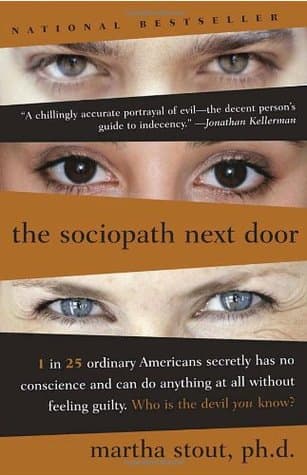
The Sociopath Next Door cover
Archivist's Choice

The Sociopath Next Door

Martha Stout (2005)

Genre

Psychology / Science

Reading Time

240 min

Key Themes

See below

Track Your Reading

Sign in to track this book

Learn how to spot the charming, conscience-less 4% of the population (everyday sociopaths) and protect yourself from their manipulation.

Core Idea

Martha Stout says about 4% of people are sociopaths, meaning they have no conscience. Without internal moral guidance, they can manipulate, deceive, and harm others without guilt. They often seem charming and normal. The book describes how sociopathy appears, from an inability to form real connections to a constant need for control. It also gives practical advice for identifying and protecting yourself from these common, but often unseen, people.
Reading time
240 min
Difficulty
Medium
✓ Read this if...
You want to understand the psychological underpinnings of individuals without a conscience and learn practical strategies for identifying and protecting yourself from them in personal and professional relationships.
✗ Skip this if...
You are looking for a clinical textbook on antisocial personality disorder or prefer not to engage with potentially unsettling descriptions of human behavior.

Core idea

The central argument and framework that powers the entire book.

Martha Stout says about 4% of people are sociopaths, meaning they have no conscience. Without internal moral guidance, they can manipulate, deceive, and harm others without guilt. They often seem charming and normal. The book describes how sociopathy appears, from an inability to form real connections to a constant need for control. It also gives practical advice for identifying and protecting yourself from these common, but often unseen, people.

At a glance

Reading time

240 min

Difficulty

Medium

Read this if...

You want to understand the psychological underpinnings of individuals without a conscience and learn practical strategies for identifying and protecting yourself from them in personal and professional relationships.

Skip this if...

You are looking for a clinical textbook on antisocial personality disorder or prefer not to engage with potentially unsettling descriptions of human behavior.

Key Takeaways

1

The 4% Rule: They Walk Among Us

Sociopathy is surprisingly common and often goes undetected in everyday life.

Quote

A shocking 4 percent of ordinary people—one in twenty-five—has an often undetected mental disorder, the chief symptom of which is that that person possesses no conscience.

Stout corrects the idea that sociopaths are only violent criminals. She says one in twenty-five ordinary people lacks a conscience. This means sociopaths are not just in prisons; they are in our workplaces, neighborhoods, and even families. They can blend in and seem 'normal,' which makes them dangerous. Their lack of empathy and remorse often goes unnoticed until their manipulative actions become clear. This number of sociopaths means we need to think differently about how we see and interact with others, being aware instead of trust...

Supporting evidence

The core statistical claim of 4% prevalence, based on psychological research and clinical observation, indicating that sociopathy is far more common in the general population than previously assumed.

Apply this

Adopt a healthy skepticism in new relationships, especially when someone seems 'too good to be true.' Observe actions over words, and be wary of individuals who consistently disregard social norms or the feelings of others without apparent guilt.


prevalence-sociopathyundetected-disorderlack-conscience
2

The Absence of Conscience

The defining characteristic of a sociopath is the complete inability to feel guilt, shame, or remorse.

Quote

He or she has no ability whatsoever to feel shame, guilt, or remorse. One in twenty-five everyday Americans, therefore, is secretly a sociopath.

Unlike most people who feel bad when they break moral rules, sociopaths feel nothing. This basic difference means their actions are not limited by an inner moral sense. They can lie, cheat, steal, and harm others without any emotional cost. This makes them very good at manipulation. This absence of conscience is not a choice; it is a brain difference. This explains their often confusing and cruel behavior. Understanding this difference helps us stop expecting them to act with our morals.

Supporting evidence

Stout's clinical definition of sociopathy, emphasizing the complete lack of internal ethical and emotional brakes (guilt, shame, remorse) as the primary diagnostic criterion.

Apply this

When someone consistently demonstrates a lack of accountability or genuine regret for harmful actions, even after being confronted, consider that they may not possess the capacity for remorse. Do not expect them to change based on appeals to their conscience.

consciencelessremorselessnessmoral-void
3

The Charismatic Facade

Sociopaths often possess a captivating charm that masks their true nature.

Quote

One of their chief characteristics is a kind of glow or charisma that makes sociopaths more charming or interesting than the other people around them.

Sociopaths often have a captivating quality; they might be more spontaneous, intense, complex, or even 'sexier' than others. This charm is a strong tool for manipulation, attracting people and making them easy to influence. They are skilled at faking emotions and social graces, creating an appealing but false image. This 'glow' makes them hard to identify and leaves others easily fooled. Victims often excuse their alarming behavior or blame themselves. It is a planned act, designed to disarm and control.

Supporting evidence

Descriptions of sociopaths appearing 'more charming,' 'spontaneous,' 'intense,' or 'sexier' than others, which serves as a deceptive mask.

Apply this

Be wary of individuals whose charm feels excessive or lacks depth upon closer inspection. If someone's personality seems too perfect, or if their magnetism feels unsettlingly intense, it might be a red flag. Prioritize consistent, ethical behavior over superficial charm.

sociopathic-charmmanipulative-charismadeceptive-glow
4

Inability to Love

Despite their charm, sociopaths are fundamentally incapable of genuine love or attachment.

Quote

Fundamentally, sociopaths are different because they cannot love. Sociopaths learn early on to show sham emotion, but underneath they are indifferent to others’ suffering.

While sociopaths can imitate affection and deep emotional connection, they cannot feel real love. They understand what love is and can act lovingly, but they do not experience the strong emotional bond that defines it for most people. Their relationships are about getting what they want, like control, excitement, or resources. This emotional lack means they do not care about the suffering they cause, seeing others as things to use. Knowing this basic inability is important for anyone in a relationship with a sociopath, as it explains ...

Supporting evidence

Stout's assertion that sociopaths 'cannot love' and only 'show sham emotion,' being 'indifferent to others’ suffering.'

Apply this

Look for consistency in expressions of love and empathy, especially during challenging times. If a partner's 'love' feels conditional, or if they are consistently absent emotionally during your distress, question the authenticity of their feelings.

sham-emotionincapacity-loveemotional-indifference
5

The Dominance Drive

Sociopaths are driven by a primal need for power, control, and the thrill of winning.

Quote

They live to dominate and thrill to win.

Beyond lacking a conscience, sociopaths have a strong need to dominate. They get great satisfaction from controlling others, manipulating situations, and winning, often at someone else's expense. This is not just ambition; it is a core psychological need that drives their manipulative actions. The 'thrill to win' is a strong motivator, often more important than any logical or ethical thoughts. Understanding this drive helps explain their constant pursuit of power and their willingness to use anyone. For them, every interaction is a ga...

Supporting evidence

The direct statement that sociopaths 'live to dominate and thrill to win,' highlighting their core motivational forces.

Apply this

Be wary of individuals who consistently seek to control conversations, decisions, or the actions of others, especially through subtle or overt intimidation. If someone treats every interaction as a competition, it's a significant red flag.

power-drivecontrol-maniathrill-winning
6

Question Authority, Suspect Flattery

Critical thinking and skepticism are essential defenses against sociopathic manipulation.

Quote

To arm us against the sociopath, Dr. Stout teaches us to question authority, suspect flattery, and beware the pity play.

Stout gives practical advice for protecting yourself: never blindly trust authority figures, especially those who demand complete loyalty. Sociopaths often get into positions of power, so it is important to carefully judge their commands. Also, too much flattery should make you suspicious; it is a common way to disarm someone and gain favor. These strategies are meant to bypass rational thought and use emotional weaknesses. By being skeptical and thinking carefully about why someone is trying to persuade you, you can better spot and r...

Supporting evidence

Stout's explicit advice: 'question authority, suspect flattery, and beware the pity play' as key defensive strategies.

Apply this

When someone in a position of authority makes unreasonable demands or uses emotional appeals rather than logic, pause and evaluate their true motives. If someone showers you with excessive compliments, consider their agenda before accepting their words at face value.

skepticismcritical-thinkinganti-flattery
7

Beware the Pity Play

Sociopaths skillfully use victimhood to manipulate and exploit others.

Quote

To arm us against the sociopath, Dr. Stout teaches us to question authority, suspect flattery, and beware the pity play.

One of the most sneaky tactics sociopaths use is the 'pity play.' They expertly create stories of being a victim, making themselves seem helpless, wronged, or suffering to get sympathy and help. This emotional manipulation uses others' empathy, pulling them into a trap where they are expected to give help, resources, or forgiveness. Once they get what they want, the sociopath drops the victim act, often leaving the helper confused and used. Recognizing this pattern helps you avoid getting caught in their manipulative web.

Supporting evidence

Stout's warning to 'beware the pity play' as a common sociopathic tactic.

Apply this

If someone consistently presents themselves as a victim in every situation, especially when their own actions are questionable, or if their stories of hardship seem designed to elicit specific help, proceed with extreme caution. Offer support that empowers, rather than enables, and don't allow yourself to be guilt-tripped into unreasonable favors.

victim-mentalityemotional-manipulationguilt-tripping
8

Do Not Join the Game

The most effective defense against a sociopath is to disengage entirely.

Quote

Above all, she writes, when a sociopath is beckoning, do not join the game. It is the ruthless versus the rest of us...

Stout's main advice is to refuse to deal with a sociopath on their terms. Trying to outsmart them, reason with them, or appeal to their non-existent conscience is useless. Their game is about manipulation and control, and by playing, you become a pawn. The only way to win is not to play. This often means ending relationships, setting clear limits, and refusing to react to their provocations. It is a hard but necessary step to protect your mental and emotional health, knowing that some fights cannot be won in normal ways.

Supporting evidence

The strong injunction: 'when a sociopath is beckoning, do not join the game' and the framing of the conflict as 'the ruthless versus the rest of us.'

Apply this

If you identify a sociopath in your life, minimize contact as much as possible. If complete disengagement isn't feasible (e.g., a colleague), establish strict professional boundaries, document interactions, and refuse to engage in personal or emotional discussions. Do not try to 'fix' them or seek their approval.

disengagementboundary-settingno-contact
9

Trust Your Gut

Your intuition often signals the presence of a sociopath before conscious recognition.

Quote

Part of the urgency in reading The Sociopath Next Door is the moment when we suddenly recognize that someone we know—someone we worked for, or were involved with, or voted for—is a sociopath.

Often, before we can logically identify a sociopath, our subconscious notices odd things and warning signs. A constant feeling of unease, a sense that something is wrong, or repeated bad feelings after talking to someone can be early signs. Stout suggests many people have a 'gut feeling' about certain individuals but ignore it because of the sociopath's charm or their own wish to see the best in people. Learning to trust these inner warnings is a key self-protection skill. It allows for early detection and protective action before ser...

Supporting evidence

The emphasis on the 'moment when we suddenly recognize' a sociopath, implying a prior, perhaps subconscious, unease that finally crystallizes into conscious understanding.

Apply this

Pay attention to persistent feelings of discomfort, anxiety, or confusion after interacting with certain individuals. If your gut repeatedly tells you something is off, even without concrete evidence, take that feeling seriously and observe their behavior more closely.

gut-feelingintuitionred-flags
10

Living in a World with Sociopaths

Awareness of sociopathy is not about paranoia, but about informed self-protection.

Quote

It is the ruthless versus the rest of us, and The Sociopath Next Door will show you how to recognize and defeat the devil you know.

The book's main goal is not to create fear, but to give readers the information they need for self-defense. Knowing that 4% of people lack a conscience changes how you see human nature and social interactions. It is about understanding that some people are fundamentally different and operate by different rules. This awareness helps you make informed decisions, set proper boundaries, and protect yourself from being used. It makes sense of confusing or hurtful experiences, providing clarity and helping people live more safely in a world...

Supporting evidence

The overall stated goal of the book: to 'arm us against the sociopath' and 'show you how to recognize and defeat the devil you know,' implying a practical, defensive approach.

Apply this

Integrate the understanding of sociopathy into your worldview without becoming cynical. Use it as a lens to critically evaluate relationships and situations, focusing on protecting your well-being rather than attempting to 'cure' or 'change' a sociopath.

informed-awarenessself-protectionnavigating-sociopathy

Critical analysis

Notable Quotes

The only thing that sociopaths have in common with other people is that they are human.

Introducing the core nature of sociopathy.

Conscience is a still small voice that tells us not to do things that are wrong.

Defining conscience as a key differentiator.

If you are dealing with a sociopath, you are dealing with someone who has no conscience.

Highlighting the fundamental absence of conscience in sociopaths.

The most dangerous people are those who have no conscience and are charming.

Warning about the deceptive nature of some sociopaths.

Three percent of the population are sociopaths. That means one in twenty-five people.

Stating the prevalence of sociopathy in society.

The best protection against a sociopath is to recognize one.

Emphasizing awareness as a defense mechanism.

Sociopaths are not crazy. They are rational, intelligent, and often quite successful.

Dispelling misconceptions about sociopaths' mental state.

The greatest myth about sociopaths is that they are always violent.

Correcting a common misunderstanding about sociopathic behavior.

Guilt is a feeling that sociopaths do not experience.

Explaining another absent emotion in sociopaths.

If you feel manipulated, you probably are.

Encouraging trust in one's own instincts when dealing with suspect behavior.

The sociopath's primary goal is always to get what they want, regardless of the cost to others.

Describing the self-serving nature of sociopathic motivation.

Do not argue with a sociopath. You cannot win, because they do not play by the same rules.

Advising against confrontation due to the lack of shared moral ground.

The sociopath's world is one of constant strategizing and pretense.

Illustrating the performative and calculated existence of a sociopath.

To a sociopath, other people are merely objects to be used.

Highlighting the dehumanizing perspective sociopaths have towards others.

The absence of conscience is not a lack of empathy; it is a fundamental difference in how one relates to the world.

Clarifying the distinction between lack of empathy and lack of conscience.

Quiz

Test Your Knowledge

Ready to see how well you understood this book? Take our interactive quiz with 10 questions.

10
Questions
~5
Minutes
?
Best Score

Key Questions (FAQ)

According to Martha Stout in 'The Sociopath Next Door,' a sociopath is an ordinary person who lacks a conscience, meaning they cannot feel shame, guilt, or remorse. This mental disorder affects a surprising 4 percent of the population, often going undetected in everyday individuals.

About the author