“A plain without a tree, a river without a name, and cattle driven by a man who might have been the last of men.”
— Describing the stark, unheroic landscape on the shield.

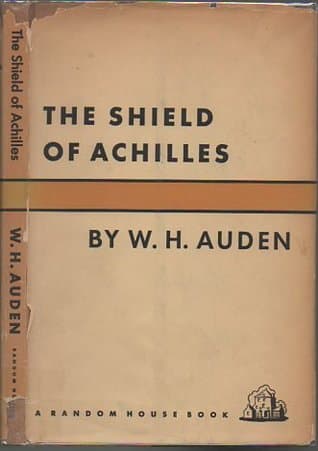
W.H. Auden (1954)
Genre
General
Reading Time
30 min
Key Themes
See below
Sign in to track this book
Auden reinterprets Homer's epic shield, turning it into a chilling picture of modern human indifference, suffering, and the absence of divine presence in a post-war world.
The poem opens with the goddess Thetis watching Hephaestos, the lame god, forge a new shield for her son, Achilles. She expects to see traditional heroic images: vineyards, dancing, sacrifices, sailing ships, and a city at peace, all showing a glorious, ordered world. However, as Hephaestos works, the shield shows a different, modern scene. Instead of pastoral beauty, she sees a 'stretch of nothing but barbed wire,' a 'ragged gap' and 'three pale figures were marching away,' a scene without natural beauty or heroic effort. This first stanza sets the poem's tone, comparing Thetis's classical expectations with the grim realities on the shield.
Thetis looks at the first panel of the shield, where she expects scenes of the 'wine-dark sea' or 'athletic glory.' Instead, she sees a 'blank' and 'unsmelted ore' that becomes a 'barren' and 'weed-choked' landscape. This scene has a 'barbed wire' fence, a 'ragged gap,' and 'three pale figures' marching away into the distance. There are no 'vines nor olive trees,' no 'ships' nor 'sacrifices,' only emptiness and a bleak, military-industrial setting. This imagery sharply contrasts with the lively, life-affirming scenes in Homer's account of Achilles' shield, showing a major change in heroism and human experience.
Thetis then looks for a 'city where the living gathered,' expecting a lively community with 'weddings and feasts' and 'justice in the market-place.' Instead, she finds a city where 'an artificial wilderness of wires and concrete' dominates. It is a place where 'thousands' of 'unemphatic' faces look 'to the sky,' not in prayer or celebration, but in passive observation. A 'loudspeaker's voice' dictates 'abstracted dogma,' controlling the people. There are no 'altars' or 'priests,' no 'sacrifices' or 'justice,' only a cold, impersonal order enforced by an unseen power. This picture criticizes modern totalitarian states and the dehumanization of the individual.
Searching for 'ritual pieties' and 'sacrificial victims' as described in ancient myths, Thetis expects to see a 'bull for a gift' or 'girls with pitcher-laden heads.' Instead, the shield shows a 'weed-choked' landscape where a 'ragged urchin' is being tormented by a 'ring of onlookers.' These onlookers are 'bored and indifferent,' watching the boy's suffering without helping or showing empathy. The boy, 'naked in the scorching sun,' is 'mocked' and 'tormented,' his cries unheard and ignored. This scene reflects the casual cruelty and moral apathy in modern society, where suffering is often a spectacle rather than a call to action, and shows the loss of community responsibility.
Throughout her observation, Thetis is struck by the complete absence of divine presence or intervention on the shield. In Homer's epic, the gods often interact with mortals and influence events. On this new shield, however, there are no 'gods or heroes,' no 'nymphs' or 'satyrs,' no 'olympian games' or 'divine judgments.' The world shown is entirely human, driven by human actions and human suffering, without any higher power to guide, punish, or redeem. This absence points to a secularized world where humanity is left to itself, facing its own created horrors without mythological comfort or divine justice.
The bleakness of the shield's images is not just a comment on the modern world but also reflects on Achilles' own fate. Thetis, who knows her son is destined for a short but glorious life, sees on the shield a world where glory itself is absent. The scenes of 'barbed wire' and 'unemphatic faces' and 'mocked' children offer no place for a traditional hero. The shield, meant to protect Achilles, shows a world where his heroic virtues might be meaningless or even destructive. It hints that the kind of heroism Achilles embodies is outdated in a world defined by anonymous suffering and systemic oppression, rather than individual combat and noble deeds.
A central theme is the loss of meaning and myth in the modern era. Thetis's memories of the classical world—'vineyards,' 'dancers,' 'sacrifices,' 'priests,' 'justice'—show a world with spiritual and cultural importance, where human actions had clear moral and cosmic meaning. The shield, however, shows a world stripped of these layers. It is a world of 'wires and concrete,' 'abstracted dogma,' and 'indifferent' crowds, where suffering is ordinary and heroism is irrelevant. This contrast highlights Auden's sadness for a lost sense of purpose and the decline of the grand stories that once gave human life meaning.
The images of 'barbed wire' and 'marching figures' on the shield strongly suggest the landscape of modern warfare, especially the trench warfare of World War I and the concentration camps of World War II. Unlike the individual combat of ancient heroes, modern conflict has anonymous masses, technological barriers, and systematic dehumanization. The 'ragged gap' and 'three pale figures' suggest a landscape of escape or forced movement, without the individual heroism or personal glory linked to Achilles' era. This portrayal criticizes the industrialized nature of war, where individual power is lost within vast, destructive systems.
A repeated idea is the impassivity of crowds watching suffering. In the city scene, 'thousands' of 'unemphatic faces' look 'to the sky,' passively receiving 'abstracted dogma.' More clearly, when the 'ragged urchin' is tormented, a 'ring of onlookers' is 'bored and indifferent,' their lack of empathy a chilling condemnation of modern society. This shows a moral paralysis where individuals are unwilling or unable to act against injustice or cruelty, preferring to remain detached. This collective apathy adds to the bleakness, suggesting a breakdown of community responsibility and human connection.
Hephaestos, the divine smith, acts as the artist in the poem, his creation showing a truth that Thetis, representing the classical view, struggles to understand. While Thetis expects a shield reflecting heroic ideals and mythical beauty, Hephaestos creates a stark, unromanticized vision of a modern, post-war world. His art is not about glorifying the past but about confronting the harsh present. He is 'the lame god' who 'hammered on the shield,' methodically and dispassionately bringing to life a world defined by 'barbed wire,' 'concrete,' and 'abstracted dogma,' forcing Thetis and the reader to acknowledge a new, unsettling reality.
The poem ends with Thetis observing the finished shield, its grim images clear. She is left with deep despair, realizing that the world shown offers no place for her heroic son, Achilles, or the values he represents. The shield shows a world 'without a sign of hope,' where 'unemphatic faces' and 'abstracted dogma' have replaced 'athletic glory' and 'ritual pieties.' Thetis weeps, not just for Achilles' coming death, but for a world that has lost its way, a world where suffering is meaningless and heroism obsolete. The shield becomes a symbol of the modern condition, bleak and without traditional comfort.
The Supporting
Thetis begins with classical expectations and ends in despair, realizing the irrelevance of traditional heroism in the modern world.
The Mentioned
Achilles' arc is implied; the shield suggests his traditional heroism is obsolete in the modern world.
The Supporting
Hephaestos's character is static; he is a detached creator whose craft reveals an unsettling truth.
The Mentioned
Their collective arc is one of sustained passivity and indifference, embodying the moral decay of the modern world.
The Mentioned
The urchin's arc is one of unalleviated suffering, symbolizing the bleakness of the world.
The poem contrasts the glorious, myth-filled world of classical Greece with the bleak, secularized reality of the 20th century. Thetis expects to see images of heroic deeds, divine intervention, and a world with spiritual meaning, but Hephaestos's shield shows a world where individual heroism is meaningless against systemic oppression and impersonal suffering. The absence of gods, rituals, and justice highlights a deep loss of grand stories and moral structures that once gave human life purpose. Achilles, the ultimate hero, is outdated by a world of 'barbed wire' and 'abstracted dogma.'
“A plain without a feature, bare and brown, / No blade of grass, no sign of neighborhood, / Nothing to eat and nowhere to sit down, / Yet, congregated on its blankness, stood / An unintelligible multitude.”
A main theme is the alienation and dehumanization in modern society. The shield shows 'thousands' of 'unemphatic faces' in a city of 'wires and concrete,' passively receiving 'abstracted dogma.' Individuals become anonymous units, their identities lost in an oppressive, impersonal system. The torment of the 'ragged urchin' by 'bored and indifferent' onlookers further emphasizes a breakdown of human connection and empathy. This reflects Auden's post-World War II concern with totalitarianism, industrialization, and the loss of individual importance in mass society.
“A ragged urchin, naked in the scorching sun, / Stood in the middle of a ring of onlookers. / The circle of their faces was not pale, / But blank and unconcerned, as if they knew / The future of the boy, but did not care.”
The images of 'barbed wire,' 'ragged gaps,' and 'pale figures marching away' strongly suggest the impersonal and devastating nature of 20th-century warfare and its aftermath. Unlike the glorious individual combat of Achilles' time, modern conflict has technological barriers, mass movements, and widespread, anonymous suffering. The suffering on the shield—whether the tormented child or the oppressed city dwellers—is often ordinary, unheroic, and unhelped, showing a world where pain is common and empathy is rare. This contrasts with the classical idea of suffering as potentially redemptive or heroic.
“Barbed wire enclosed an artificial wilderness / And a ragged gap where three pale figures were marching away; / And behind them an open empty sky / That was not the sky of Greece, nor of the wine-dark sea / But a grey, unmeaning, modern sky.”
Hephaestos, the divine smith, is the artist figure in the poem. His creation of the shield, which goes against Thetis's expectations, suggests that the true artist's role is not to glorify a romanticized past or provide comforting illusions, but to show the harsh realities of the present, however grim. Despite Thetis's desire for beauty and heroism, Hephaestos directly portrays a world of desolation, oppression, and indifference. This reflects Auden's own artistic goal, which often involved confronting the moral and political worries of his time rather than escaping into aestheticism.
“The thin-lipped armorer, / Hephaestos, hobbled away, / Thetis of the shining feet / Looked at the shield and wept at what she saw.”
The poem contrasts Thetis's expectation of a city with 'justice in the market-place' and 'ritual pieties' with the grim reality on the shield, where 'no altars' stand, and a 'loudspeaker's voice' dictates 'abstracted dogma.' There is no divine judgment, no community responsibility, and no empathy for suffering. The torment of the 'ragged urchin' goes unpunished and unaddressed, while the city's inhabitants are controlled by an unseen, authoritarian force. This highlights a deep loss of moral order, where ethical frameworks have collapsed, and justice is absent, replaced by indifference and control.
“She looked for the women and the men in their houses, / For the young men with their dances and their songs, / For the altars where the priests performed their rites, / But the city was an artificial wilderness of wires and concrete.”
A vivid description of a work of art, used to convey thematic meaning.
Ekphrasis is the central plot device, as the entire poem is a detailed description of the images forged onto Achilles' shield. Auden uses this device to directly reference and subvert Homer's original ekphrasis in the 'Iliad.' By having Thetis observe the creation of a shield that depicts a bleak, modern, post-World War II landscape instead of the vibrant, mythic scenes of Homer, Auden creates a powerful contrast between classical ideals and contemporary reality. The detailed descriptions of barbed wire, concrete cities, and indifferent crowds allow the poem to explore themes of dehumanization, the decline of heroism, and the loss of moral order through a visual medium.
Direct or indirect references to other literary works, especially Homer's 'Iliad'.
The poem is built upon a profound allusion to Homer's 'Iliad,' specifically Book 18, where Hephaestos forges a magnificent shield for Achilles, depicting a world full of life, myth, and human activity. Auden's poem directly references this classical text by having Thetis anticipate similar scenes. However, the actual imagery on the shield is a stark negation of Homer's vision, creating a powerful intertextual dialogue. This device allows Auden to comment on the vast historical and cultural chasm between the classical world and the modern era, highlighting what has been lost or corrupted over time.
The placement of contrasting elements side-by-side to highlight their differences.
Auden heavily employs juxtaposition throughout the poem. The most prominent example is the constant contrast between Thetis's classical expectations (vineyards, dances, sacrifices, justice, gods) and the grim, modern reality depicted on the shield (barbed wire, concrete, indifferent crowds, abstracted dogma, absence of gods). This device serves to underscore the radical shift in human experience and values between the ancient world and the 20th century. By placing these opposing images and ideas in direct opposition, Auden emphasizes the bleakness of the modern condition and the profound loss of meaning and beauty.
A contrast between expectation and reality, often with a critical or sardonic tone.
Irony is pervasive in 'The Shield of Achilles.' The central irony lies in a shield, traditionally a symbol of protection and heroic glory, being forged to depict a world devoid of both. Thetis expects a shield befitting a great hero, but receives one that portrays a world where heroism is meaningless and suffering is mundane. The imagery itself is ironic: a 'city where the living gathered' is an 'artificial wilderness,' and a scene meant to show 'ritual pieties' instead shows the torment of a child. This ironic subversion of expectations highlights Auden's critique of the modern world's moral and spiritual decay.
“A plain without a tree, a river without a name, and cattle driven by a man who might have been the last of men.”
— Describing the stark, unheroic landscape on the shield.
“He looked over his shoulder for the historic crests of lions and eagles, but saw only a weed-choked field.”
— Thetis observing the shield's lack of traditional heroic imagery.
“The mass and majesty of this world, all that carries weight and always weighs the same.”
— Thetis's initial expectation of what the shield should depict.
“A world of ordinary streets, ordinary doors, and ordinary people leading ordinary lives.”
— The mundane, human-scale scenes depicted on the shield.
“That girls are raped, that two boys knife a third, were axioms to him, who’d never heard of any world where promises were kept, or one could weep because another wept.”
— Describing the casual cruelty and lack of empathy in the modern world shown on the shield.
“The thin-lipped armorer, Hephaestos, hobbled away, the beautiful forge no longer burning.”
— The creator of the shield, representing the end of traditional myth-making.
“A white flower on the white sheet, and no one there to see.”
— A small, unnoticed detail on the shield, hinting at forgotten beauty.
“And the whole sky was a blank, and the whole earth was a blank.”
— The overwhelming emptiness and lack of meaning in the depicted world.
“All that a child's fancy could conceive, of heroes, gods, and monsters, was not there.”
— Thetis's disappointment that the shield lacks traditional epic elements.
“The unmentionable odour of death offends the living.”
— A stark reminder of mortality and its impact.
“A world where every act was arbitrary, where there was no law or reason, no hope or fear.”
— The chaotic and meaningless nature of the modern world on the shield.
“And the voice of the announcer was a voice without a body.”
— The impersonal and dehumanizing nature of modern communication.
“No blade of grass, no sign of life, just endless, featureless grey.”
— The barren and desolate landscape that dominates the shield's imagery.
“Thetis of the shining feet, who knew Zeus's will, but could not change it.”
— The goddess's powerlessness in the face of fate and modern reality.
Ready to see how well you understood this book? Take our interactive quiz with 10 questions.

Biography coming soon.