BookBrief
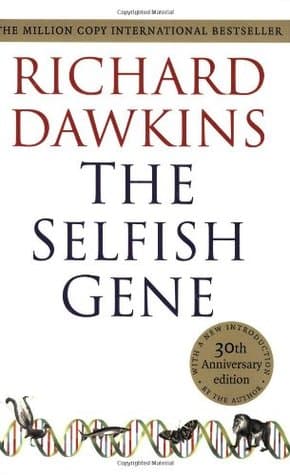
The Selfish Gene cover
Archivist's Choice

The Selfish Gene

Richard Dawkins (1976)

Genre

Psychology / Science / Philosophy

Reading Time

720 min

Key Themes

See below

Track Your Reading

Sign in to track this book

Dawkins reframes evolution, saying organisms, including humans, are survival machines built by self-replicating genes and ideas striving for their own spread.

Core Idea

Richard Dawkins says genes, not individual organisms or groups, are the basic unit of selection in evolution. Organisms are 'survival machines' or 'vehicles' built by genes for their own replication. Altruistic behaviors, often confusing from an individual perspective, are explained as ways genes ensure their survival, often through kin selection or reciprocal altruism among unrelated individuals. This gene-centered view says evolution is best understood as genes competing to maximize their representation in the gene pool, which leads to the development of complex adaptations and behaviors in organisms. The book also introduces 'memes' as cultural replicators, suggesting a similar evolutionary process for ideas and cultural traits.
Reading time
720 min
Difficulty
Medium
✓ Read this if...
You are interested in understanding evolution from a gene-centric perspective, exploring the biological basis of altruism and other behaviors, and challenging anthropocentric views of life. This book is also excellent for those curious about the origins of evolutionary thought and the concept of cultural evolution (memes).
✗ Skip this if...
You are looking for a book on individual psychology, humanistic philosophy, or a detailed guide to genetics at a molecular level. If you find the idea of genes as the primary drivers of life deeply unappealing or deterministic without further philosophical exploration, this might not be for you.

Core idea

The central argument and framework that powers the entire book.

Richard Dawkins says genes, not individual organisms or groups, are the basic unit of selection in evolution. Organisms are 'survival machines' or 'vehicles' built by genes for their own replication. Altruistic behaviors, often confusing from an individual perspective, are explained as ways genes ensure their survival, often through kin selection or reciprocal altruism among unrelated individuals. This gene-centered view says evolution is best understood as genes competing to maximize their representation in the gene pool, which leads to the development of complex adaptations and behaviors in organisms. The book also introduces 'memes' as cultural replicators, suggesting a similar evolutionary process for ideas and cultural traits.

At a glance

Reading time

720 min

Difficulty

Medium

Read this if...

You are interested in understanding evolution from a gene-centric perspective, exploring the biological basis of altruism and other behaviors, and challenging anthropocentric views of life. This book is also excellent for those curious about the origins of evolutionary thought and the concept of cultural evolution (memes).

Skip this if...

You are looking for a book on individual psychology, humanistic philosophy, or a detailed guide to genetics at a molecular level. If you find the idea of genes as the primary drivers of life deeply unappealing or deterministic without further philosophical exploration, this might not be for you.

Key Takeaways

1

Genes, Not Organisms, Are the Primary Unit of Selection

Evolution operates at the level of the gene, with organisms serving as temporary vehicles.

Quote

We are survival machines – robot vehicles blindly programmed to preserve the selfish molecules known as genes.

Dawkins changes the perspective on evolution, saying that the gene, not the individual organism or species, is the basic unit of natural selection. Organisms are 'survival machines' or 'vehicles' built and maintained by genes to ensure their own spread. This gene-centered view explains seemingly altruistic behaviors in nature, as these actions, when seen from a genetic self-interest point of view, often help copies of the same gene in relatives. This new way of thinking provides a strong way to explain many complex biological phenomen...

Supporting evidence

The concept of 'survival machines' and the argument that organisms are temporary vessels for immortal genes, which are the true replicators. This is a foundational premise throughout the book.

Apply this

When observing biological phenomena, consider how a particular trait or behavior might enhance the survival and replication of the genes responsible for it, rather than solely focusing on the individual organism's fitness.


gene-centric-viewunit-of-selectionreplicatorsurvival-machine
2

Altruism as a Strategy for Gene Survival

Benevolent acts often serve the 'selfish' interest of genes, particularly among kin.

Quote

Any gene that tries to tell a body how to maximize the survival of copies of itself is, by definition, a selfish gene.

Dawkins addresses the evolutionary puzzle of altruism, where individuals seem to sacrifice their own well-being for others. He explains this through 'kin selection,' suggesting that an individual's genes are more likely to survive if their relatives (who share many of the same genes) also survive and reproduce. So, an act of self-sacrifice for a close relative can actually be a very effective, though indirect, way for a gene to continue itself. The amount of altruism can often be predicted by the 'coefficient of relatedness' – the cha...

Supporting evidence

The example of worker bees (sterile females) sacrificing themselves for the queen, explained by their high degree of relatedness due to haplodiploidy, ensuring the propagation of shared genes.

Apply this

Analyze seemingly selfless human behaviors (e.g., parental care, sibling support) through the lens of genetic relatedness, recognizing the underlying genetic imperative for shared gene propagation.

kin-selectionaltruismcoefficient-of-relatednessinclusive-fitness
3

The Immortal Replicator and Mortal Vehicles

Genes are potentially immortal, while the organisms they inhabit are transient 'vehicles.'

Quote

We are temporary vehicles for the genes, and our death is programmed to make way for new vehicles carrying the same immortal genes.

A main difference Dawkins makes is between the replicator (the gene) and the vehicle (the organism). Genes are long-lived, potentially immortal entities that are copied and passed down through generations. Organisms, in contrast, are mortal and can be replaced. They are machines built by genes to help their own replication. This perspective helps explain why organisms age and die; once an organism has reproduced and served its purpose in spreading its genes, its continued existence offers less benefit to the genes, and new, more adapt...

Supporting evidence

The analogy of genes as 'immortal coils' that survive across vast spans of time, contrasted with the finite lifespan of individual bodies (survival machines).

Apply this

Reflect on human mortality not as an ultimate end, but as a programmed obsolescence within a larger, ongoing genetic lineage. This can offer a different perspective on life's purpose beyond individual survival.

replicatorvehicleimmortal-geneprogrammed-death
4

Evolutionarily Stable Strategies (ESS)

Behaviors and traits persist if they cannot be outcompeted by alternative strategies.

Quote

An ESS is a strategy which, if adopted by a population, cannot be bettered by an alternative strategy.

Dawkins introduces John Maynard Smith's concept of the Evolutionarily Stable Strategy (ESS), a useful tool for understanding how social behaviors evolve. An ESS is a strategy that, once adopted by a population, cannot be successfully taken over by any other strategy. It is a stable balance where any change is harmful. This concept goes beyond simple 'survival of the fittest individual' to explain how complex behavioral patterns, like aggression levels, cooperation, or sex ratios, can appear and last within a population. It shows that ...

Supporting evidence

The 'Hawk-Dove game' as a classic example of an ESS, illustrating how a mixed strategy of aggression and retreat can be more stable than pure aggression or pure passivity in a population.

Apply this

Analyze human social dynamics (e.g., negotiation tactics, cooperative projects, competitive markets) by identifying the 'strategies' involved and considering which ones are 'evolutionarily stable' in a given context, resisting disruption.

evolutionarily-stable-strategygame-theoryhawk-dove-gamebehavioral-ecology
5

The Extended Phenotype

Genes can influence the world beyond the organism's body, building external structures.

Quote

The phenotypic effect of a gene is not necessarily restricted to the individual body in which it resides.

Dawkins expands the concept of the phenotype beyond an organism's physical body to include all effects a gene has on the environment. This 'extended phenotype' includes structures like a beaver's dam, a bird's nest, or a caddisfly larva's stone case. These external constructions are as much a manifestation of the genes as an animal's fur color or limb structure, and they can be just as subject to natural selection. This challenges the traditional view that the organism's body is the only expression of its genes, suggesting that genes'...

Supporting evidence

The caddisfly larva's case built of stones, or a beaver's dam, are presented as examples of gene expression extending beyond the organism's skin, directly manipulated by the genes for survival and reproduction.

Apply this

Consider human artifacts and structures (e.g., architecture, tools, technology) not just as products of culture, but as potential 'extended phenotypes' of human genes, influencing our environment in ways that enhance survival and reproduction.

extended-phenotypephenotypegene-expression-externalenvironmental-manipulation
6

Memes: Cultural Replicators

Ideas, customs, and trends replicate and evolve within human culture.

Quote

A meme is a unit of cultural transmission, or a unit of imitation. Examples of memes are tunes, ideas, catch-phrases, clothes fashions, ways of making pots or of building arches.

In a new conceptual step, Dawkins introduces the 'meme' as a cultural equivalent to the gene. Memes are units of cultural information – ideas, beliefs, fashions, melodies, skills – that replicate by spreading from mind to mind. Just as genes compete for survival in the gene pool, memes compete for space in our minds and culture. They evolve through processes like natural selection, with some memes being more 'fit' (catchy, useful, persuasive) and spreading widely, while others disappear. This concept provides a way to understand cultu...

Supporting evidence

Examples like religious beliefs, popular tunes, or fashion trends are presented as memes that spread and evolve through imitation and cultural transmission.

Apply this

Analyze the spread of information, trends, and ideologies in society (especially online) through the lens of memetics, understanding what makes certain ideas 'contagious' and successful in replicating.

memecultural-evolutioncultural-transmissionmemetics
7

The Prisoner's Dilemma and Reciprocal Altruism

Cooperation can evolve even among non-kin if there's a prospect of future reciprocation.

Quote

It is not difficult to show that, even for purely selfish genes, it can be to their advantage to program individual organisms to be altruistic towards each other, provided certain conditions are met.

Dawkins explores how 'reciprocal altruism' can evolve, even between unrelated individuals. This concept, often shown by the 'Prisoner's Dilemma' game theory model, suggests that cooperation can appear and last if individuals interact repeatedly and can remember past behaviors. If an individual helps another expecting help in return later, and if 'cheaters' (those who accept help but do not reciprocate) are punished or excluded, then altruistic behavior can be a stable evolutionary strategy. This extends the explanation of altruism bey...

Supporting evidence

The example of 'Tit-for-Tat' strategy in the iterated Prisoner's Dilemma, showing how simple rules can lead to the emergence and stability of cooperation.

Apply this

In group projects or community efforts, foster an environment of transparent, repeated interactions and clear consequences for non-cooperation to encourage reciprocal altruism and collective success.

prisoner's-dilemmareciprocal-altruismgame-theorycooperation
8

The Battle of the Sexes: Conflicting Genetic Interests

Male and female reproductive strategies often diverge due to differing parental investment.

Quote

The fundamental asymmetry between the sexes is that the female typically invests more in each offspring than the male.

Dawkins points out the conflict of interest between males and females in reproduction, which comes from the basic difference in parental investment. Females typically invest more resources (larger gametes, gestation, lactation), meaning their reproductive success is limited by available resources. Males, with smaller gametes, are often limited by access to fertile females. This difference drives different evolutionary strategies: females are often pickier about mates, looking for quality and commitment, while males may benefit from ha...

Supporting evidence

The contrast between the large, nutrient-rich egg (female investment) and the tiny, mobile sperm (male investment), leading to different optimal reproductive strategies.

Apply this

Understand the evolutionary roots of gender differences in reproductive behaviors and preferences, allowing for a more nuanced perspective on human relationship dynamics and societal norms.

sexual-selectionparental-investmentbattle-of-the-sexesreproductive-strategies
9

Escaping Genetic Determinism Through Consciousness

Despite being 'survival machines,' humans possess the capacity to rebel against genetic programming.

Quote

We, alone on Earth, can rebel against the tyranny of the selfish replicators.

While presenting a deterministic view of genes as the ultimate drivers of life, Dawkins offers a strong point for humans: our unique ability for consciousness, foresight, and culture (memes) allows us to potentially go beyond or even act against our genetic programming. Unlike other animals, we can understand how we exist and choose to act against our 'selfish' genetic impulses, for example, by using birth control, being altruistic towards non-kin, or conserving the environment. This offers a hopeful and empowering conclusion, suggest...

Supporting evidence

The ability of humans to consciously choose to limit reproduction (e.g., contraception) or to engage in widespread altruism towards unrelated individuals or even other species, which goes against direct genetic self-interest.

Apply this

Embrace the responsibility and freedom that comes with understanding our genetic predispositions. Consciously choose behaviors that align with our values, even if they contradict deep-seated biological urges, fostering a more ethical and sustainable future.

free-willgenetic-determinismconsciousnesshuman-exceptionalism
10

The Blind Watchmaker: No Grand Design

Evolution proceeds through incremental, non-random selection of random variation, without a conscious designer.

Quote

Natural selection, the blind watchmaker, is a process that builds intricate machinery out of simple elements, without foresight or design.

Though not explicitly named in 'The Selfish Gene' but a core idea in it (and later expanded in 'The Blind Watchmaker'), Dawkins says that the complexity and apparent 'design' in nature come not from a divine creator, but from the combined effect of natural selection acting on random genetic mutations over long periods. This 'blind watchmaker' metaphor shows that while the results of evolution can be very complex and highly adapted, the process itself is mechanical and without conscious intent or foresight. It is a strong argument agai...

Supporting evidence

The entire gene-centric argument, which explains complex adaptations as the result of genes optimizing their own survival and reproduction, without invoking a higher purpose or designer.

Apply this

Adopt a scientific, evidence-based approach to understanding complex systems, recognizing that intricate outcomes can emerge from simple, repeated processes without requiring an intelligent designer.

blind-watchmakernatural-selectionevolutionary-processcomplexity-without-design

Critical analysis

Notable Quotes

We are survival machines—robot vehicles blindly programmed to preserve the selfish molecules known as genes.

A foundational statement introducing the central thesis of the book.

Any gene that tries to do better than its all-important rival, its allele, by killing or sterilizing it, is automatically penalised.

Discussing the competitive nature of alleles within a gene pool.

Let us try to teach generosity and altruism, because we are born selfish.

A moral and philosophical reflection on human nature despite the biological imperative of selfishness.

The gene is the unit of selection.

Emphasizing the gene, not the individual or group, as the primary beneficiary and driver of natural selection.

A meme is a unit of cultural transmission, or a unit of imitation.

Introducing the concept of 'memes' as cultural analogues to genes.

An animal is a gene's way of making another gene.

A concise and provocative rephrasing of the gene-centric view of life.

The world is populated by stable things. A stable thing is a collection of atoms that is permanent enough or common enough to deserve a name.

Discussing the fundamental nature of stability and existence in the universe, leading to the origin of life.

We are machines built by our genes to carry out their instructions.

Reinforcing the idea of organisms as mere vehicles for genetic propagation.

If a gene is to survive, it must be immortal.

Explaining the concept of gene immortality through replication across generations.

The successful gene is not necessarily one that results in a successful individual, but one that is good at making copies of itself.

Distinguishing between individual success and genetic success in the context of evolution.

The future of the meme is not guaranteed by its truth, but by its infectiousness.

Highlighting how cultural ideas spread, often irrespective of their factual basis.

Genes are master programmers, and they are programming for their own survival.

Describing the active and self-serving role of genes in shaping organisms.

The 'purpose' of life, if there is one, is to perpetuate DNA.

A bold assertion about the ultimate biological drive, seen from a gene's perspective.

Quiz

Test Your Knowledge

Ready to see how well you understood this book? Take our interactive quiz with 10 questions.

10
Questions
~5
Minutes
?
Best Score

Key Questions (FAQ)

The core concept of 'The Selfish Gene' is that evolution should be viewed from the perspective of genes, rather than organisms or species. Genes are the primary units of selection, using individual organisms as 'survival machines' to propagate themselves across generations.

About the author