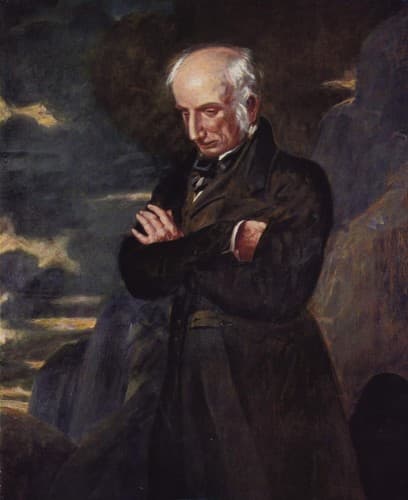
William Wordsworth was an English Romantic poet who, with Samuel Taylor Coleridge, helped to launch the Romantic Age in English literature with their joint publication Lyrical Ballads (1798).

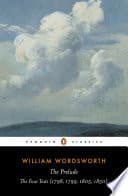
William Wordsworth (1996)
Genre
General
Reading Time
12 Minutes
Key Themes
See below
Sign in to track this book
The poem begins with Wordsworth stating his goal to write a long autobiographical poem. He feels free and happy to start this creative work. He immediately discusses his earliest memories, focusing on how much nature affected his developing mind. He remembers playing outside as a child, often alone, and describes the wonder and sometimes fear inspired by natural things like wind, mountains, and lakes. These early experiences with nature are presented as fundamental, shaping his feelings and preparing him for his poetic career. He describes a 'wise passiveness' and openness to nature, suggesting these early years created a deep connection to the sublime.
Wordsworth continues by describing his school days, including both mischievous moments and strong connections to nature, such as skating on frozen lakes. He then moves to his time at St. John's College, Cambridge. He describes his first impressions of the university as a place with both intellectual stimulation and social distractions. Although he acknowledges the academic setting, he often found himself pulled away from formal studies, preferring solitary thought and feeling separate from his peers' more conventional pursuits. He reflects on the superficiality he saw in some parts of university life, comparing it with the deeper, more authentic experiences he found in nature.
During his Cambridge years, Wordsworth expresses growing disappointment with the strict academic structure and the social superficiality he observes. He feels that the university, while offering intellectual chances, often suppressed genuine emotion and deep thought. He found a visit to the poet Milton's grave more moving than the daily routines of college life. A summer vacation spent back in his native Lake District offered a sharp contrast, renewing his spirit and confirming nature's strong influence on his imagination. These times spent in nature are presented as essential to his poetic growth, offering a purity and depth missing in urban or academic settings.
Wordsworth dedicates a section to how books influenced him, from childhood fables and fairy tales to more serious literature. He reflects on how stories and poetry shaped his imagination, broadening his understanding of the world and human experience. He distinguishes between books that only entertain and those that deeply connect with one's inner self, helping in the 'growth of a poet's mind.' He suggests that while nature is the main teacher, literature powerfully complements it, enriching his emotional range and providing different views on truth and beauty. This section highlights the interaction between direct experience and the knowledge gained from written words.
After his refreshing summer in the countryside, Wordsworth recounts his move to London, a sharp contrast to the natural landscapes he loved. He describes the city as a chaotic, overwhelming sight, a 'motley spectacle' of humanity. The sheer number of people, the noise, the artificiality, and the moral complexities of urban life initially disoriented him. He observes the diverse characters and scenes, from street performers to politicians, with a mix of fascination and detachment. Despite the sensory overload, he tries to find meaning and order within the chaos, recognizing that even in this artificial environment, human nature and its complexities are clearly revealed.
Wordsworth continues his observations of London, expressing a growing sense of isolation and a feeling that the city's constant activity lacks true spiritual depth. He longs for the solitude and deep beauty of nature. This urban experience provides a strong contrast to his later journey to the Alps. His first encounter with the majestic mountains is an overwhelming experience of the sublime, initially leaving him speechless and humbled. He describes the immense scale and power of nature, which deeply connects with his inner self and confirms his belief in a spiritual force that animates creation, offering a strong antidote to the perceived superficiality of city life.
Wordsworth recounts his important first visit to France in 1790, during the early, hopeful phase of the French Revolution. He describes his initial excitement and deep sympathy for the revolutionary ideals of liberty, equality, and fraternity. He witnesses the widespread enthusiasm and hope for a new era of human freedom and justice. He is deeply moved by the sense of shared purpose and the belief that humanity is on the verge of a great change. This period marks a significant political awakening for him, as he embraces the revolutionary spirit with youthful passion, seeing it as a fulfillment of humanity's highest hopes for a more just and rational society.
During his extended stay in France, Wordsworth becomes more deeply involved in the political and intellectual currents of the Revolution. He forms a significant relationship with Annette Vallon, a Frenchwoman, and deals with the complexities of love and commitment amidst political unrest. He engages with radical thinkers and directly witnesses the fervent debates and social changes. His initial idealism is still strong, but he begins to see the emerging tensions and potential for extremism within the revolutionary movement. This period is important for his political education and personal growth, challenging his views and broadening his understanding of human nature and societal change.
As the French Revolution turns into the Reign of Terror, Wordsworth's initial idealism is severely tested. He witnesses the increasing violence, fanaticism, and betrayal of the original revolutionary principles. The executions and widespread repression deeply shock and disappoint him, leading to a serious moral and intellectual crisis. He struggles to reconcile the noble ideals he first embraced with the horrifying realities of the Revolution's excesses. This period marks a turning point, as he questions whether purely rational or political solutions can solve human problems, leading him to seek other sources of truth and meaning, especially in the lasting power of nature and individual consciousness.
Following his disappointment with the French Revolution, Wordsworth experiences a period of deep intellectual and emotional distress. He describes a crisis of faith in human reason and political action, feeling lost and cynical. However, he gradually recovers his spiritual and imaginative health through a renewed appreciation for nature and the healing power of his own imagination. He realizes that true understanding and moral guidance come not only from external events or abstract reason, but from an inner, intuitive connection to nature and the mind's creative ability. This recovery marks a return to his earlier beliefs about nature's spiritual importance.
In the final books, Wordsworth fully explains his mature understanding of imagination as the highest human ability, different from mere fancy or logical reason. He states that imagination is the power that connects humanity to the divine, allowing deep insights into truth and beauty. He reaffirms nature's lasting importance as the main teacher and source of inspiration, working with imagination to shape the poet's mind. The poem ends with a celebration of the poet's role, recognizing his unique ability to see and express the spiritual truths in nature and human experience. He expresses gratitude for his journey and his friendship with Coleridge.
The Protagonist
From a nature-loving child, through a period of political idealism and subsequent disillusionment, to a mature poet who champions the imagination and the spiritual power of nature.
The Supporting (as a pervasive force)
Its role remains constant as a benevolent and powerful force, though the poet's understanding and appreciation of it deepen and evolve over time.
The Supporting
His role remains consistent as an inspiring intellectual and personal confidant to the poet.
The Supporting
Her brief appearance marks a specific romantic interlude in the poet's life, primarily serving to illustrate his personal experiences during his French sojourn.
The Antagonist (as a force of disillusionment)
It transforms from a symbol of hope and progress to a source of profound disillusionment and moral crisis for the poet.
This is the clear central theme, as stated in the poem's subtitle. Wordsworth carefully tracks the development of his poetic awareness from early childhood experiences with nature, through his academic years, his encounters with city life, and his political awakening and subsequent disappointment with the French Revolution. The theme explores how outside experiences and inner thoughts combine to create a unique creative sensibility, ending with the poet's mature understanding of imagination as the supreme human ability. It is a journey of self-discovery, intellectual growth, and spiritual maturity.
“The mind of Man is fram'd even like the breath / And harmony of music. There is a dark / Invisible workmanship that reconciles / Discordant elements, and makes them move / In order, with a regular and settled sway.”
Nature is presented as the poet's main teacher, healer, and spiritual guide. From his earliest memories, nature instills in him a sense of awe, wonder, and moral feeling. It acts as a corrective force, offering comfort and renewal when he is disappointed by human society or political events (like the French Revolution). Wordsworth argues that a deep connection to nature supports spiritual growth, moral clarity, and imaginative insight, providing a stable source of truth and beauty that goes beyond temporary human affairs. It is through nature that he finds his truest self and his poetic calling.
“Dust as we are, the immortal spirit grows / Like harmony in music; there is a dark / Inscrutable workmanship that reconciles / Discordant elements, and makes them move / In order, with a regular and settled sway.”
Wordsworth proposes imagination as the highest human ability, distinct from mere fancy or rational thought. It is the capacity to see deeper truths, to connect with the spiritual essence of the world, and to create meaning. The poem shows how imagination, nourished by nature, allows the poet to go beyond the limits of sensory experience and intellectual analysis. It is presented as a divine spark within the human mind, enabling deep insights and the creation of art. Ultimately, the 'growth of a poet's mind' culminates in the full realization and acceptance of this transformative power.
“Imagination, how art thou cast down, / And in thy place is Reason lord, to rule / The mind, and with a cold and withering hand / All that is lovely in the mind to blast!”
A significant part of the poem is Wordsworth's journey through political and intellectual disappointment, especially after the excesses of the French Revolution. His initial youthful idealism gives way to despair, cynicism, and a crisis of faith in human reason and political action. However, the poem details his gradual recovery from this moral low point, primarily through reconnecting with nature and rediscovering the internal resources of imagination. This theme highlights the resilience of the human spirit and the capacity for renewal, suggesting that deep personal growth often comes from periods of intense struggle and disappointment.
“I had approached, like other youths, the wild / And many-headed Beast; now feeling strong / All that I had endured, and still sustained / By the belief that Man was made for joy.”
The entire poem serves as a first-person account of the poet's life.
The Prelude is fundamentally an autobiographical narrative, told from the first-person perspective of William Wordsworth. This device allows for an intimate exploration of the poet's subjective experiences, thoughts, and feelings. By recounting his own life story, from childhood memories to mature reflections, Wordsworth provides direct access to the 'growth of a poet's mind.' This personal voice lends authenticity and emotional depth, making the philosophical and psychological insights feel grounded in lived experience rather than abstract theory. The narrative structure is chronological but often weaves in digressions and reflections, mirroring the meandering nature of memory and thought.
Direct addresses to nature, imagination, or Coleridge.
Wordsworth frequently employs invocations and apostrophes, directly addressing abstract concepts like Imagination, Nature, or his friend Samuel Taylor Coleridge. This device serves multiple purposes: it elevates the subject matter, imbuing it with a sense of grandeur and spiritual significance; it creates a more intimate and conversational tone, especially when addressing Coleridge as the implicit reader; and it allows the poet to express profound emotions and philosophical insights with heightened rhetorical power. These direct addresses underscore the deeply personal and spiritual nature of Wordsworth's poetic quest.
The poet revisits past experiences to understand their impact on his present self.
Memory and recollection are central plot devices, as the entire poem is an act of looking back and re-evaluating past experiences. Wordsworth meticulously revisits moments from his childhood, youth, and early adulthood, not just to recount them, but to understand their formative influence on his mind and poetic sensibility. This process of recalling and reflecting allows him to trace the trajectory of his intellectual and emotional development, highlighting how seemingly small moments in nature or significant historical events contributed to his mature understanding of himself and the world. Memory is presented not as a passive recall but an active, interpretive process.
Natural elements represent deeper spiritual or psychological states.
Throughout The Prelude, various elements of nature are imbued with symbolic meaning. Mountains, lakes, rivers, winds, and trees are not merely descriptive details but represent profound spiritual forces, moral lessons, or psychological states. For example, the vastness of mountains often symbolizes the sublime and the divine, while the wind can represent an animating spirit. These natural symbols serve to externalize the poet's inner world and to illustrate the deep, almost mystical connection he feels with the natural environment, reinforcing the idea that nature is a living, teaching entity that shapes human consciousness.
Ready to see how well you understood this book? Take our interactive quiz with 10 questions.
William Wordsworth was an English Romantic poet who, with Samuel Taylor Coleridge, helped to launch the Romantic Age in English literature with their joint publication Lyrical Ballads (1798).