BookBrief
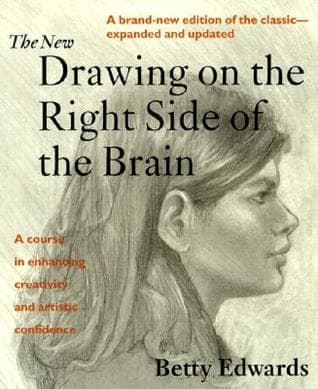
The New Drawing on the Right Side of the Brain cover
Archivist's Choice

The New Drawing on the Right Side of the Brain

Betty Edwards (1999)

Genre

Psychology / Reference / Creativity

Reading Time

360 min

Key Themes

See below

Track Your Reading

Sign in to track this book

Learn to draw by using the often-ignored visual side of your brain, changing how you see the world.

Core Idea

This book says drawing is a skill anyone can learn, not just a few naturally gifted people. It does this by using the brain's right side, which handles visual perception, spatial thinking, and intuition. Traditional schooling often focuses too much on the left brain (logic, language, analysis), neglecting these right-brain abilities. By consciously shifting to a 'R-mode' of perception—focusing on visual information like edges, spaces, relationships, light, and shadows instead of just naming things—people can avoid left-brain interference and use their natural ability to see and draw accurately. The main idea is that drawing is mostly a skill of seeing. Through specific exercises, one can train the brain to see in a way that helps create realistic drawings, which also improves general problem-solving and creative thinking.
Reading time
360 min
Difficulty
Medium
✓ Read this if...
You believe you lack artistic talent and want a structured, psychological approach to learn drawing, or if you're an experienced artist looking to deepen your understanding of visual perception.
✗ Skip this if...
You are looking for a quick 'how-to' guide with minimal theory, or if you primarily draw abstract art and are not interested in realistic representation.

Core idea

The central argument and framework that powers the entire book.

This book says drawing is a skill anyone can learn, not just a few naturally gifted people. It does this by using the brain's right side, which handles visual perception, spatial thinking, and intuition. Traditional schooling often focuses too much on the left brain (logic, language, analysis), neglecting these right-brain abilities. By consciously shifting to a 'R-mode' of perception—focusing on visual information like edges, spaces, relationships, light, and shadows instead of just naming things—people can avoid left-brain interference and use their natural ability to see and draw accurately. The main idea is that drawing is mostly a skill of seeing. Through specific exercises, one can train the brain to see in a way that helps create realistic drawings, which also improves general problem-solving and creative thinking.

At a glance

Reading time

360 min

Difficulty

Medium

Read this if...

You believe you lack artistic talent and want a structured, psychological approach to learn drawing, or if you're an experienced artist looking to deepen your understanding of visual perception.

Skip this if...

You are looking for a quick 'how-to' guide with minimal theory, or if you primarily draw abstract art and are not interested in realistic representation.

Key Takeaways

1

Unlocking the Right Brain

Tap into a different mode of perception for enhanced creativity.

Quote

The right brain 'sees' things as they are, without judgment or labels, a mode of perception essential for drawing.

Edwards says drawing is a skill that can be learned by moving from the left-brain's verbal/analytical mode to the right-brain's visual/perceptual mode. Our school system often favors left-brain functions, which can limit the right brain's ability to process things holistically and non-verbally. By using the right brain, people can get past their inner critic and see the world in a more direct, clear way. This shift is important for art, but also for any task needing new problem-solving, pattern recognition, and intuitive understanding...

Supporting evidence

The core premise is based on Roger W. Sperry's Nobel Prize-winning research on split-brain patients, which demonstrated the specialized functions of the brain's hemispheres. Edwards translates these scientific findings into practical drawing exercises.

Apply this

Practice 'seeing' objects as pure shapes, lines, and values, rather than identifying them with verbal labels. Engage in exercises like drawing upside down or contour drawing to bypass left-brain naming and analysis.


right-brain-thinkinghemispheric-specializationperceptual-shift
2

The Five Basic Skills of Drawing

Master these fundamental skills to draw anything you see.

Quote

Drawing is a teachable skill, based on five fundamental perceptual abilities that can be learned and practiced.

Edwards breaks down drawing into five main skills: seeing edges (line), spaces (negative space), relationships (perspective/proportion), light and shadows (shading), and the whole picture. These are not just drawing techniques; they are basic ways of seeing that apply to many parts of life. By focusing on these separate parts, the big task of 'drawing a person' or 'drawing a landscape' becomes easier. This structured approach makes the art process clear, showing that drawing is about developing specific observation skills, not just na...

Supporting evidence

The entire book is structured around teaching these five skills, with dedicated chapters and exercises for each, such as contour drawing for edges, negative space drawing for spaces, and value scales for lights and shadows.

Apply this

Break down complex visual tasks into these five components. When drawing, consciously observe edges, the shapes of negative spaces, proportional relationships, and areas of light and shadow, rather than the object itself.

perceptual-skillsdrawing-fundamentalsvisual-literacy
3

The Power of Negative Space

Seeing the 'empty' areas reveals the true form of objects.

Quote

To draw a positive shape accurately, it is often easier to focus on the shape of the space around it – the negative space.

One of the book's most important ideas is the focus on negative space. Our left brain tends to focus on 'things' (positive shapes), often making them look distorted. By looking at the shapes of the spaces between and around objects, the right brain can see proportions and relationships more accurately. This technique helps get past old ideas of what an object 'should' look like and instead draw what is actually seen. It is an unusual approach that works well, showing that the 'empty' parts are as informative as the 'filled' parts....

Supporting evidence

The 'Vase-Faces' exercise (Rubin's vase illusion) is a classic example used to illustrate the perception of negative space, forcing the viewer to alternate between seeing two faces and a vase, thereby experiencing the interchangeability of positive and negative forms.

Apply this

When drawing, consciously outline and shade the shapes of the spaces surrounding your subject. Imagine these negative spaces as objects themselves, drawing their contours and internal forms.

negative-spacefigure-ground-perceptionholistic-vision
4

Overcoming Perceptual Blocks

Identify and conquer the 'symbol system' that hinders accurate drawing.

Quote

Our symbol system, while efficient for communication, can become a block to seeing things freshly and accurately when drawing.

As children, we learn a 'symbol system'—simple pictures for common objects (e.g., a stick figure for a person, a house shape with a triangle roof). While useful for quick communication, these symbols become fixed and stop us from truly observing. When we try to draw, the left brain often uses these symbols instead of letting the right brain see the actual visual information. Edwards provides exercises to help break free from relying on symbols, encouraging a return to direct observation. This is a key step in learning to draw accurate...

Supporting evidence

The exercise of drawing a self-portrait or a hand without looking at the paper, then comparing it to a drawing made while observing, vividly demonstrates the difference between drawing from memory/symbols and drawing from direct perception.

Apply this

When you catch yourself drawing a 'symbol' (e.g., a generic eye instead of your specific eye), pause and force yourself to look again at the actual object, focusing on unique details, angles, and relationships.

symbol-systemperceptual-biasesunlearning
5

Drawing as a Problem-Solving Tool

Utilize visual thinking for clarity and innovative solutions.

Quote

The skills of drawing are not just for art; they are powerful tools for seeing, thinking, and problem-solving in any field.

Beyond art, Edwards says the visual skills learned through drawing are useful for problem-solving in business, education, and daily life. The ability to see relationships, analyze parts, and understand the whole is basic to understanding complex issues. Drawing makes you observe details and think spatially in ways that verbal or number analysis alone often misses. It lets you show thoughts, making abstract ideas real and helping communication. By using the five basic drawing skills for non-art challenges, people can find new ways to i...

Supporting evidence

The book includes new sections on applying drawing techniques in business and education, such as using visual mapping or sketching to clarify complex ideas, brainstorm solutions, or communicate strategies more effectively.

Apply this

When faced with a complex problem, try sketching it out. Draw diagrams, flowcharts, or even abstract representations of relationships to gain new insights and identify patterns that might be invisible in text-based analysis.

visual-thinkingdesign-thinkingproblem-solving
6

The Importance of 'P-Mode' Perception

Engage a non-verbal, holistic state for optimal learning and creativity.

Quote

The right-brain mode, or 'P-mode' (Perceptual mode), is characterized by non-verbal, non-linear, and holistic processing, essential for direct apprehension of reality.

Edwards introduces 'P-mode' (Perceptual mode) as the best state for drawing, and also for deep learning and creative insight. This mode is different from the left brain's 'L-mode' (Logical-Verbal mode). P-mode means seeing things as they are, without adding labels, judgments, or past experiences. It is about being aware in the present moment, focusing directly on what you see. This state can be developed through specific drawing exercises, leading to a calmer and more focused mind. The ability to consciously shift into P-mode helps re...

Supporting evidence

Exercises like 'upside-down drawing' are specifically designed to force the brain into P-mode by presenting information in a way that L-mode finds difficult to process, thus allowing the right brain to take over and perceive pure shapes and lines.

Apply this

When feeling overwhelmed or stuck, try an activity that engages P-mode, such as drawing, listening to non-lyrical music, or mindful observation of nature, to shift your mental state and access different perspectives.

p-modemindfulnessflow-state
7

Seeing Edges and Contours

Focus on the boundaries where forms meet to capture accurate lines.

Quote

The perception of edges, the meeting places of two things, is the starting point for all drawing.

The first basic skill is seeing edges. An edge is where two surfaces meet, or where an object ends and the background begins. Edwards stresses contour drawing, a slow, careful process of tracing the edges of an object with your eye and your drawing tool at the same time. This exercise makes you observe intensely and carefully, stopping the left brain from adding its symbols. By carefully following the details of an edge—its bumps, curves, and angles—the artist captures the object's unique look. This practice improves drawing accuracy ...

Supporting evidence

Blind contour drawing (drawing without looking at the paper) and modified contour drawing (looking at the paper only occasionally) are core exercises provided to develop the perception of edges, forcing a direct connection between eye and hand.

Apply this

Before drawing, spend several minutes just observing the contours of your subject. Trace its edges mentally, noting every subtle change in direction and curve, before even putting pencil to paper.

contour-drawingedge-perceptionobservational-skills
8

The Relativity of Proportion and Perspective

Understand that all visual relationships are relative, not absolute.

Quote

All drawing is about relationships: how one part relates to another, and how all parts relate to the whole.

Seeing relationships—including proportion and perspective—is another important skill. Objects are not drawn alone but in relation to everything else in view. Edwards teaches how to accurately judge sizes, angles, and alignments by comparing one part to another. This involves using tools like a pencil to measure relative lengths and angles, training the eye to see true proportions rather than what the left brain thinks it knows about an object's 'true' size. This relational thinking is vital, as it recognizes that perspective changes...

Supporting evidence

Exercises involving sighting with a pencil (holding a pencil at arm's length to measure relative proportions and angles) are central to developing this skill, allowing students to verify their perceptions against objective measurements.

Apply this

When drawing, constantly compare the length of one part to another, the angle of one line to a vertical or horizontal, and the spacing between objects, using your pencil as a measuring tool.

proportionperspectiverelational-thinking
9

Perceiving Lights and Shadows

Translate three-dimensional form into two-dimensional value gradients.

Quote

Light and shadow are not just surface decorations; they are the visual information that reveals the three-dimensional form of an object.

Seeing light and shadows (or values) makes a flat drawing look three-dimensional. Edwards says that shading is not just darkening areas randomly, but accurately observing and showing the gradual changes from light to dark that define form. This means understanding the light source, how it hits an object, and how shadows are cast. Learning to see and draw these subtle value changes requires sustained right-brain attention, as the left brain often tries to simplify or ignore these complexities. Mastering value lets artists create depth,...

Supporting evidence

The 'value scale' exercise, where students create a gradient of tones from pure white to pure black, teaches control over shading and the ability to perceive subtle differences in lightness and darkness.

Apply this

Observe how light falls on your subject, identifying the darkest darks, the lightest lights, and the mid-tones. Create a full range of values in your drawing, paying attention to gradual transitions rather than abrupt changes.

valueshadingform-rendering
10

The Joy of Creative Self-Expression

Drawing is a path to deeper self-understanding and personal growth.

Quote

The act of drawing can become a powerful means of self-expression, a way to communicate what cannot be put into words.

Finally, 'The New Drawing on the Right Side of the Brain' is not just about learning to draw accurately; it is about promoting creativity and personal growth. Edwards highlights that drawing, especially when using the right brain, can be a calming and revealing experience. It allows people to express thoughts, feelings, and perceptions that are hard to put into words. The confidence gained from mastering a difficult skill like drawing often carries over to other parts of life, helping people take on new challenges with a more creative...

Supporting evidence

The book includes sections on using drawing for self-expression and personal insight, encouraging students to draw their dreams, feelings, or abstract concepts after mastering the basic perceptual skills, showing the progression from technical skill to personal meaning.

Apply this

Once comfortable with the basic skills, dedicate time to drawing subjects that hold personal meaning or to freely express abstract ideas and emotions, allowing the drawing process to be a form of self-dialogue.

self-expressioncreativitypersonal-growth

Critical analysis

Notable Quotes

Seeing is a more complex process than most people realize. It is not simply a matter of opening your eyes and letting light stream in.

Introduction to the perceptual nature of drawing.

The R-mode is visual and perceptual, a faculty for seeing things the way they are in the present moment.

Describing the right-brain mode of processing.

The L-mode is verbal, analytic, symbolic, abstract, time-bound, rational, digital, and sequential.

Describing the left-brain mode of processing.

The five basic component skills of drawing are the perception of edges, spaces, relationships, lights and shadows, and the whole (or gestalt).

Outlining the fundamental skills taught in the book.

The main obstacle to seeing clearly is the brain's tendency to rush to identify and label what it sees.

Explaining why adults struggle with drawing what they see.

To draw well, you must be able to shift into the R-mode, which means temporarily quieting the L-mode.

Instructions for accessing the creative state.

The upside-down drawing exercise is a powerful way to trick the L-mode into letting go.

Introducing a key exercise to bypass verbal processing.

Drawing is not just a talent, but a teachable skill based on specific perceptual abilities.

Challenging the common misconception about artistic talent.

You can't draw what you don't see.

Emphasizing the importance of accurate observation.

Negative space is just as important as positive form in defining objects.

Discussing the perception of spaces.

The ability to perceive relationships is perhaps the most advanced of the five basic component skills.

Highlighting the complexity of perceiving proportions and angles.

Every object you draw has a right side and a left side, a top and a bottom, and a middle.

Simplifying the concept of establishing relationships through visual measurement.

Creativity is not some mystical gift, but a function of the brain operating in a specific mode.

Demystifying the concept of creativity.

The act of drawing can be a form of meditation, a way to be fully present in the moment.

Describing the psychological benefits of the drawing process.

Quiz

Test Your Knowledge

Ready to see how well you understood this book? Take our interactive quiz with 10 questions.

10
Questions
~5
Minutes
?
Best Score

Key Questions (FAQ)

The book teaches individuals to access and utilize the right hemisphere of their brain, which is associated with visual, spatial, and intuitive processing, to improve their drawing abilities. It focuses on perceiving objects as they truly are, rather than relying on preconceived notions.

About the author

Betty Edwards was an art educator and author best known for her groundbreaking book, "Drawing on the Right Side of the Brain." This seminal work, first published in 1979 and later updated as "The New Drawing on the Right Side of the Brain," revolutionized art instruction by teaching readers to access their creative potential through understanding perception and the brain's hemispheres. Edwards's methods have inspired millions worldwide to develop their artistic abilities.