BookBrief
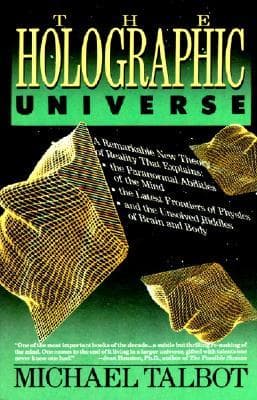
The Holographic Universe cover
Archivist's Choice

The Holographic Universe

Michael Talbot (1991)

Genre

Psychology / Spirituality / Science / Philosophy

Reading Time

6-8 hours

Key Themes

See below

Track Your Reading

Sign in to track this book

Explore a universe where reality is a grand hologram, created by consciousness, explaining quantum physics, telepathy, and mystical experiences.

Core Idea

Michael Talbot's "The Holographic Universe" suggests that reality is a complex illusion—a giant hologram. Based on the work of physicist David Bohm and neurophysiologist Karl Pribram, the book argues that the universe projects from a deeper, fundamental order where information is non-locally distributed, and each part contains the whole. This holographic model offers a new way to understand varied phenomena, from universal interconnectedness to psychic abilities, remote viewing, and spontaneous healing, implying that our consciousness helps shape this holographic reality.
Reading time
6-8 hours
Difficulty
Medium
✓ Read this if...
You are fascinated by the intersection of quantum physics, consciousness, and paranormal phenomena, and are open to a radical reinterpretation of reality.
✗ Skip this if...
You prefer strictly empirical, mainstream scientific explanations and are uncomfortable with speculative theories that challenge conventional materialism.

Core idea

The central argument and framework that powers the entire book.

Michael Talbot's "The Holographic Universe" suggests that reality is a complex illusion—a giant hologram. Based on the work of physicist David Bohm and neurophysiologist Karl Pribram, the book argues that the universe projects from a deeper, fundamental order where information is non-locally distributed, and each part contains the whole. This holographic model offers a new way to understand varied phenomena, from universal interconnectedness to psychic abilities, remote viewing, and spontaneous healing, implying that our consciousness helps shape this holographic reality.

At a glance

Reading time

6-8 hours

Difficulty

Medium

Read this if...

You are fascinated by the intersection of quantum physics, consciousness, and paranormal phenomena, and are open to a radical reinterpretation of reality.

Skip this if...

You prefer strictly empirical, mainstream scientific explanations and are uncomfortable with speculative theories that challenge conventional materialism.

Key Takeaways

1

The Universe as a Giant Hologram

Our reality may be a projection, much like a holographic image.

Quote

Our brains mathematically construct 'hard' reality by interpreting frequencies from a dimension that is primary, and more fundamental than our own.

The central idea of 'The Holographic Universe' is that the physical world we see is not solid, but a holographic projection. Based on the work of physicist David Bohm and neurophysiologist Karl Pribram, Talbot argues that reality, including space and time, is an elaborate illusion. Just as every part of a hologram holds information about the whole, the universe's basic structure may be an interconnected information field. Our brains do not create reality from scratch; they act as decoders, turning an underlying frequency domain into t...

Supporting evidence

David Bohm's 'implicate order' theory, which posits a deeper, enfolded order of reality from which our 'explicate order' unfolds. He also references Karl Pribram's holographic model of the brain, suggesting memories are distributed across the brain as interference patterns, not localized in specific neurons.

Apply this

Question the perceived solidity and separateness of objects and beings. Consider that apparent divisions are constructs of our perception, encouraging a more unified worldview. This can foster empathy and a sense of belonging by recognizing an underlying interconnectedness.


holographyimplicate-orderholographic-brainquantum-physics
2

The Brain as a Holographic Decoder

Our minds don't create reality, but interpret a deeper frequency domain.

Quote

The brain itself is a hologram, interpreting a holographic universe.

Karl Pribram's research, key to Talbot's argument, suggests that the brain itself acts as a holographic device. Instead of storing memories in specific spots, Pribram proposes they are spread throughout the brain in a non-local way, like how every piece of a holographic plate contains the entire image. This model explains how the brain keeps memories even after significant damage, and its large capacity for information storage and quick association. From this view, our perception of reality is not direct sensory input but a decoding p...

Supporting evidence

Pribram's experiments with monkeys, where significant portions of their brains were removed, yet their memories remained largely intact. This challenged the localized memory theories prevalent at the time, pointing instead to a distributed, holographic memory system.

Apply this

Recognize the brain's powerful role as an interpreter rather than a mere receiver. Practice mindfulness and meditation to observe the process of perception, understanding that your 'reality' is a filtered and constructed experience. This can lead to greater control over your internal state.

neurosciencebrain-functionperceptionmemory
3

Non-Locality and Interconnectedness

Everything is fundamentally linked, defying conventional notions of space and time.

Quote

If the universe is organized holographically, then the notion of separateness is an illusion.

A major implication of a holographic universe is the idea of non-locality—that two or more particles can be instantly connected no matter the distance. This phenomenon, predicted by quantum mechanics and proven experimentally, becomes clearer if the universe is an undivided, interconnected whole. In a holographic reality, the 'distance' between objects is a result of our conscious perception, and at a deeper level, everything is linked. This challenges our usual understanding of space and time as fundamental barriers, suggesting they ...

Supporting evidence

The Aspect experiment (1982) which demonstrated quantum entanglement, showing that two photons, once linked, remain connected regardless of distance, with a change to one instantaneously affecting the other. Talbot uses this as a cornerstone for non-local interconnectedness.

Apply this

Cultivate a sense of global consciousness and collective responsibility. Recognize that actions, thoughts, and emotions can have far-reaching, non-local effects. Foster compassion by understanding that our well-being is intrinsically tied to the well-being of others and the planet.

non-localityquantum-entanglementinterconnectednessunity-consciousness
4

Explaining Paranormal Phenomena

Mysterious experiences make sense within a holographic framework.

Quote

The holographic paradigm offers explanations for everything from telepathy to out-of-body experiences, lucid dreams, and even miraculous healings.

The holographic model offers a way to understand phenomena often called paranormal or supernatural. Telepathy, for example, makes more sense if minds are not isolated but 'tuned' into the same underlying holographic field of information. Out-of-body or near-death experiences could be shifts in perception, where consciousness temporarily decodes a different part of holographic reality. Even spontaneous healings might be seen as the body's holographic blueprint being 'reprogrammed' or accessing a more perfect informational state. This p...

Supporting evidence

Talbot cites numerous anecdotal accounts and early parapsychological studies on telepathy, precognition, and remote viewing. He also references experiences of individuals who report out-of-body or near-death experiences, where they describe perceiving reality from a non-physical vantage point.

Apply this

Maintain an open mind towards experiences that defy conventional explanation. Explore practices like lucid dreaming or meditation that aim to expand consciousness, viewing them as ways to 'tune into' different frequencies of the holographic universe. Document and reflect on your own anomalous experiences without immediate dismissal.

parapsychologytelepathyout-of-body-experiencelucid-dreaming
5

Consciousness and Reality Creation

Our minds are not passive observers but active participants in shaping reality.

Quote

We are not just observers, but participants in the ongoing creation of the universe.

If the universe is a hologram and our brains are decoders, then consciousness plays a more active role in shaping reality than previously thought. Talbot suggests that our thoughts, beliefs, and expectations are not just internal states but subtly influence the holographic projection we experience. This aligns with quantum physics observations where observing something affects what is observed. It implies a feedback loop where our consciousness helps 'bring together' possible realities from the underlying frequency domain. This shifts...

Supporting evidence

The observer effect in quantum mechanics, where particles behave differently when observed. While not a direct proof of consciousness creating reality, Talbot extrapolates this principle to suggest a broader role for consciousness in the holographic framework.

Apply this

Practice conscious intention and visualization, understanding that your focus and beliefs may influence your personal holographic reality. Be mindful of your dominant thoughts and emotions, recognizing their potential impact on your experiences and the world around you.

consciousnessobserver-effectreality-creationmind-power
6

The Illusion of Time and Space

Linear time and separate space are constructs, not fundamental realities.

Quote

In a holographic universe, time and space are no longer absolutes, but merely constructs of our perception.

The holographic idea challenges our deep understanding of time and space. If reality is an interconnected frequency domain, then the linear flow of time (past, present, future) and the spatial separation of objects are likely perceptual constructs rather than inherent features of the universe. In the implicate order, all 'moments' and 'locations' might exist together, folded within the whole. Our brains then decode this information sequentially and spatially to create our familiar, navigable reality. This view helps explain phenomena ...

Supporting evidence

Bohm's concept of the 'implicate order' where all information is enfolded and interconnected, suggesting that time and space are part of the 'explicate order' that unfolds from it. He also draws on relativistic physics which demonstrates the malleability of time and space.

Apply this

Challenge your assumptions about the fixed nature of time and space. Engage in practices that encourage 'timeless' awareness, such as deep meditation or flow states, to experience reality beyond linear progression. Consider that past regrets and future anxieties might be less binding than they appear.

time-space-continuumrelativitylinear-timenon-linear-time
7

Healing and the Body's Blueprint

Disease may stem from distortions in the body's holographic informational field.

Quote

If the body's 'holographic blueprint' is distorted, it can manifest as illness. Healing, then, is a process of restoring the correct informational pattern.

Applying the holographic model to biology, Talbot suggests that the human body is not just a collection of cells but also an intricate holographic information field, a 'blueprint' that guides its development and function. Disease, from this view, might come not only from physical pathogens or genes, but from distortions in this underlying energetic blueprint. Healing, then, could involve correcting these informational patterns, perhaps through focused intention, energy work, or even the placebo effect, which becomes more understandabl...

Supporting evidence

The placebo effect, where patients experience real physiological changes based solely on belief in a treatment. Talbot also cites research into biofeedback and various energy healing modalities, suggesting they interact with the body's informational field.

Apply this

Explore holistic healing modalities that address the mind-body connection and energetic fields, not just physical symptoms. Cultivate positive beliefs about your health and well-being, recognizing the potential impact on your body's self-healing capabilities. Practice visualization for health.

holistic-healingplacebo-effectbioenergeticsmind-body-connection
8

The Nature of Consciousness Itself

Consciousness may be a fundamental property of the universe, not an emergent one.

Quote

Consciousness, rather than being a mere epiphenomenon of the brain, may be the very ground of existence in a holographic universe.

The holographic idea elevates consciousness from a mere result of brain activity to a fundamental aspect of reality. If the universe is an interconnected information field, and our brains decode this field, then consciousness might be the 'observer' that turns possibilities into manifest reality. This aligns with spiritual traditions that propose a universal consciousness. It suggests that individual minds are not separate but 'lenses' through which the universal consciousness experiences itself. This implication blurs the lines betwe...

Supporting evidence

Talbot references various mystical traditions and spiritual experiences that describe a unified field of consciousness. He also draws on philosophical arguments that question materialism's ability to fully explain consciousness as a purely physical phenomenon.

Apply this

Engage in practices like meditation or contemplation to explore deeper states of consciousness and experience a sense of unity with the universe. Consider that your individual consciousness is a facet of a larger, universal awareness, fostering a sense of profound connection and purpose.

universal-consciousnessspiritualitynon-dualitycosmic-awareness
9

Beyond Reductionism

The holographic model offers a holistic view, transcending fragmented scientific approaches.

Quote

The holographic model provides a much-needed antidote to the fragmented, reductionist view of reality that has dominated Western science for centuries.

One of 'The Holographic Universe's' main contributions is its challenge to scientific reductionism. For centuries, Western science has tried to understand reality by breaking it into its smallest parts. While effective in many areas, this approach often misses the interconnectedness and emergent properties of complex systems. The holographic idea, in contrast, emphasizes the fundamental unity and wholeness of the universe. It suggests that understanding any part requires understanding its relationship to the whole, advocating for a mo...

Supporting evidence

Talbot critiques the limitations of classical physics and its inability to explain quantum phenomena or consciousness. He contrasts this with the holographic model's capacity to integrate diverse fields of study under a unified framework.

Apply this

Adopt a more holistic perspective in your own learning and problem-solving. Seek connections between seemingly disparate fields of knowledge. Recognize that complex issues often require interdisciplinary solutions, moving beyond narrow, specialized viewpoints.

reductionismholismsystems-theoryinterdisciplinary-approach
10

The Role of Belief and Expectation

Our subjective beliefs are powerful tools for shaping our perceived reality.

Quote

What we believe to be true, has a profound effect on what we perceive to be real.

The holographic universe suggests that our subjective beliefs and expectations directly influence the reality we experience. If reality is an interpretation of frequencies, then our minds, through belief, can 'tune' into certain frequencies and filter out others, shaping our personal holographic projection. This explains the power of the placebo effect, the impact of positive thinking, and why different people can have very different experiences in seemingly identical situations. It highlights the responsibility we have for our inner ...

Supporting evidence

The extensive research on the placebo effect and nocebo effect, where belief (or disbelief) in a treatment can significantly alter physiological outcomes. Talbot also draws on psychological studies demonstrating how expectations influence perception and behavior.

Apply this

Consciously cultivate empowering beliefs and challenge limiting ones. Recognize that your worldview is a powerful filter through which you experience reality. Utilize practices like affirmations and positive self-talk to intentionally shape your internal landscape, knowing it can affect your external experience.

belief-systemplacebo-effectexpectation-biasself-fulfilling-prophecy

Critical analysis

Notable Quotes

Our brains mathematically construct objective reality by interpreting frequencies that are ultimately from another dimension, a deeper order of existence that is beyond space and time.

Introducing the core holographic model of reality and the brain's role.

The universe is a giant hologram, exquisitely detailed and seemingly real, yet ultimately an illusion.

Summarizing the central thesis of the holographic universe.

Consciousness is not a mere epiphenomenon of the brain, but may be primary, and the brain more of a receiver and interpreter of consciousness.

Discussing the role of consciousness in the holographic paradigm.

Each part of a holographic image contains the whole. This is a profound metaphor for the interconnectedness of all things.

Explaining the fundamental principle of holography and its philosophical implications.

Synchronicities are not random coincidences, but meaningful patterns reflecting a deeper, underlying order to the universe.

Exploring Jungian synchronicity within a holographic framework.

The past and the future may not be fixed entities, but rather potential states that are constantly being actualized from a timeless domain.

Challenging conventional notions of time and causality.

Paranormal phenomena, rather than being impossible, may simply be glimpses into the deeper, holographic reality.

Reinterpreting paranormal experiences through the lens of the holographic model.

The 'void' of space is not empty but teeming with information, a vast ocean of potential from which all forms emerge.

Describing the plenum or 'implicate order' as conceived by David Bohm.

Our conventional scientific models are often limited by their reliance on a localized, fragmented view of reality.

Critiquing reductionist science and advocating for a more holistic perspective.

The mind is not confined to the skull but extends into the world, interacting with and shaping reality.

Expanding the concept of mind beyond the physical brain.

Healing, both physical and psychological, often involves tapping into this deeper, integrative level of reality.

Applying the holographic model to understanding healing processes.

Even our memories might not be stored locally in the brain, but accessed from a non-local, holographic field.

Proposing an alternative view of memory storage and retrieval.

The universe doesn't just contain consciousness; it *is* consciousness, in its deepest sense.

Emphasizing the fundamental nature of consciousness in the holographic framework.

If the brain is a hologram, it means that the entire brain is involved in every thought, every memory, every experience.

Explaining the implications of the brain as a holographic system.

Quiz

Test Your Knowledge

Ready to see how well you understood this book? Take our interactive quiz with 10 questions.

10
Questions
~5
Minutes
?
Best Score

Key Questions (FAQ)

The book explores the revolutionary idea, proposed by physicist David Bohm and neurophysiologist Karl Pribram, that the universe itself might be a giant hologram. This means reality as we perceive it could be a projection or construct, rather than fundamentally solid.

About the author