“She used to have a head full of wonder, and thoughts that sparkled in the dark.”
— Describing the girl's initial state before her wonder is lost.

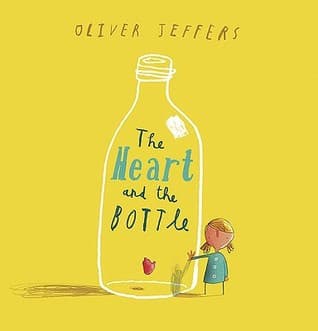
Oliver Jeffers (2010)
Genre
Psychology / Children's / Creativity
Reading Time
5 min
Key Themes
See below
Sign in to track this book
A story about a curious girl who, after a loss, puts her heart in a bottle. She finds the world dims without it and goes on a journey to feel again.
The story starts with a young girl whose life is full of wonder. She does many imaginative things with an older figure, perhaps her father. They look at stars, read, explore the ocean, and share quiet moments. The girl's heart glows, showing her open spirit and connection to the world and her companion. Their shared times are rich with discovery and joy.
One day, the girl finds her companion's chair empty. The book quietly shows a great absence, meaning the older figure is gone. The bright colors and lively scenes from before start to fade, replaced by quiet. The girl looks around but cannot find her companion. This sudden departure changes her life, bringing sadness to her once joyful world. Her glowing heart begins to dim.
Faced with the great emptiness and sadness, the girl decides to protect her heart from more pain. She carefully takes her glowing heart and puts it inside a glass bottle. She then hangs the bottle around her neck. This shows her attempt to hold and keep her feelings safe. This act is a way to cope, to stop her heart from breaking again. While she thinks she is keeping it safe, this also creates a wall between herself and her feelings, and the world.
After putting her heart in the bottle, the girl's world changes a lot. The bright colors and wonder that filled her life disappear. She still tries to do things she once loved, like looking at stars or reading, but without her heart, these feel empty. The spark of curiosity and joy is gone. She looks through a telescope but sees nothing, and reads books without understanding. The bottle around her neck, meant to protect her, also stops her from truly connecting with her surroundings or feeling deeply. Her bright world turns grey.
As time passes, the bottle around the girl's neck, meant to protect her heart, becomes a heavy weight. It slows her down, both really and figuratively. The book shows her struggling to climb stairs, unable to reach high places, and finding it hard to move freely. The bottle stops her from enjoying the simple pleasures she once had. It reminds her of her loss and her self-imposed emotional limits, making her life feel restricted and joyless. This shows the problem with her protective action.
Seeing the emptiness and the weight, the girl tries to get her heart out of the bottle. She tries shaking it, trying to break it, and even trying to fish her heart out with a stick. But none of her attempts work. The bottle, which she herself closed, now seems impossible to open. This part shows how hard it is to undo self-made emotional walls and to reconnect with feelings once they are hidden. Her frustration grows as she cannot get back what she wants.
One day, while the girl sits alone, a young, curious child comes up to her. This child has an open, questioning look, like the girl did when she was younger. The child sees the bottle around the girl's neck and looks at it with pure curiosity, not afraid of the emotional weight it carries. The child's presence brings a new, innocent view into the girl's lonely world, showing a quiet contrast to her guarded state. The meeting is silent but important, suggesting a possible start to change.
The young child, seeing the girl's struggle and the bottled heart, reaches out and, without thinking, pulls the cork from the bottle. This simple, natural act, free from the girl's complex emotional defenses, immediately frees the heart. The girl is surprised, unable to understand how easily the child did what she could not. The child's innocent lack of understanding of 'safekeeping' allows the release. This shows that sometimes, the answer to a hard emotional problem can be simple and come from another person's view.
As her heart is freed, it immediately glows brightly, filling the scene with color. The girl's world, which had been grey and dull, instantly fills with life, wonder, and joy. She feels a deep sense of relief and freedom. The bottle, now empty, falls, no longer a weight. She can engage with the world again, seeing beauty and feeling emotions she had hidden. Her heart's return means her ability to feel, wonder, and connect comes back, letting her fully live again.
With her heart free and her world bright again, the girl, now connected to her feelings and curiosity, turns to the young child. She takes the child's hand, and together they look at the stars through a telescope, just as she used to do with her lost companion. This act shows her healing and her ability to pass on the joy of discovery. The cycle of wonder begins again. It suggests that while loss happens, the ability to feel joy and share it can be regained and passed to others, creating new connections.
The Protagonist
Experiences a profound loss, leading her to suppress her emotions, but eventually finds a way to reclaim her heart and rediscover wonder.
The Protagonist
Struggles with the consequences of emotional suppression, eventually finding release and reconnecting with her true self.
The Supporting
His presence defines the girl's initial world; his absence initiates her journey of emotional suppression and recovery.
The Supporting
Serves as an external force of healing, bringing simplicity and innocence to the Girl's complex emotional struggle.
A main theme is how loss affects people and how they deal with grief. The girl experiences an unexplained loss, leaving an empty chair and a gap in her life. This grief is so strong that she feels she must protect her heart from more pain. The book shows the shock, the emotional withdrawal, and what happens when grief is not dealt with, affecting her ability to live fully. Her journey shows how she comes to terms with loss, not by forgetting, but by finding a way to live with an open heart again.
“One day, the chair was empty.”
Putting her heart in a bottle shows the girl's choice to hide her emotions, especially her openness to pain. While meant as protection, this leads to deep loneliness. Her world turns muted, she loses her sense of wonder, and she struggles to connect with her surroundings. The bottle, at first a guard, becomes a heavy weight, stopping her from living a full life. This theme shows the problem with hiding emotions: it may stop pain, but it also stops joy and real connection.
“But after that, it seemed that more things were empty than before.”
The book shows the change when the girl's heart is let out of the bottle. Her world, once grey, immediately fills with color, and her curiosity and joy return. This theme shows how important an open heart is for experiencing life's beauty. The return of wonder is not just about being happy, but about getting back the ability to be curious, connect, and engage with the world, as seen when she shares the stars with the child.
“And the world around her, which had been dull and grey for so long, was suddenly filled with color again.”
The girl's emotional problem is solved not by hard work but by a simple, innocent act from a child. The child, not weighed down by the girl's past, easily pulls the cork from the bottle. This shows that sometimes, the best answers to hard emotional problems come from unexpected, simple places, often from others' fresh views. It also shows that human connection, even without words, helps break down self-made walls.
“And with a gentle tug, the cork popped out.”
A central metaphor for emotional suppression and protection against pain.
The 'heart in the bottle' is the primary symbolic device. The glowing heart represents the girl's emotions, vulnerability, curiosity, and capacity for wonder. Placing it in a bottle symbolizes her act of emotional suppression and her attempt to protect herself from further pain after a significant loss. The bottle, initially a safeguard, becomes a heavy burden and a barrier, preventing her from experiencing life fully. Its release signifies emotional liberation and the return of her capacity for feeling and joy.
Used to represent emotional state and the presence or absence of wonder.
The use of color is a powerful visual device. Initially, the girl's world is depicted in vibrant, rich colors, symbolizing her open heart and sense of wonder. After she bottles her heart, the illustrations become muted, often grey and desaturated, reflecting her emotional numbness and the loss of joy. When her heart is finally released, the colors flood back into the scenes, signifying the return of her emotions, vitality, and capacity for experiencing the world's beauty. It visually communicates her internal state without words.
A poignant symbol of loss and absence.
The empty chair is a simple yet profound symbol of the initial loss that triggers the girl's emotional journey. It represents the sudden, unexplained absence of her older companion and the void left behind. It communicates the theme of grief without explicit explanation, allowing the reader to infer the significance of the loss. The chair's emptiness is a stark contrast to the earlier scenes of shared warmth and connection, effectively conveying the impact of the companion's departure on the girl's world.
A recurring symbol of curiosity, exploration, and shared connection.
The telescope appears at key moments, symbolizing the girl's (and later, the child's) capacity for wonder and exploration. Initially, it's a tool for shared discovery with her older companion. When her heart is bottled, she looks through it but sees nothing, illustrating her lost sense of curiosity. Its reappearance at the end, used by the girl and the young child together, signifies the restoration of wonder, the ability to connect with the vastness of the world, and the passing on of this joy to a new generation, completing a thematic circle.
“She used to have a head full of wonder, and thoughts that sparkled in the dark.”
— Describing the girl's initial state before her wonder is lost.
“But one day she found something. It was a chair.”
— The turning point where the girl finds the empty chair, signifying loss.
“And from then on, things were different.”
— The immediate aftermath of the girl's discovery of the empty chair.
“She wasn't sure what to do with the feeling, so she put it in a bottle.”
— The girl's initial coping mechanism for her overwhelming emotions.
“And she hung it around her neck.”
— Symbolizing how she carries her suppressed emotions with her.
“It was safer that way.”
— The girl's justification for bottling her heart and wonder.
“She still went to all the places she used to go, but she didn't see them in the same way.”
— Illustrating how her perception of the world changed after bottling her heart.
“Her head was full of facts, but her heart was empty.”
— Highlighting the intellectual but emotionally barren state the girl falls into.
“Until one day, she met a small person.”
— The introduction of a child who attempts to engage with her.
“The small person was full of wonder.”
— Describing the child's inherent curiosity, mirroring the girl's past self.
“But she couldn't remember how to get it out.”
— The girl's struggle to retrieve her bottled heart and wonder.
“The small person knew exactly what to do.”
— The child's intuitive action to break the bottle.
“And just like that, her heart returned to where it belonged.”
— The moment her heart is freed from the bottle and returns to her.
“And her head was full of wonder again.”
— The girl's return to her former state of curiosity and joy.
Ready to see how well you understood this book? Take our interactive quiz with 10 questions.

Biography coming soon.

Rhonda Byrne
4.3

Menno Henselmans
4.3

Sylvia Plath
4.3
Elliot Aronson
4.3
Joseph Campbell
4.3

Erich Fromm
4.3
Irvin D. Yalom
4.2

Lucy Strange
4.2