BookBrief
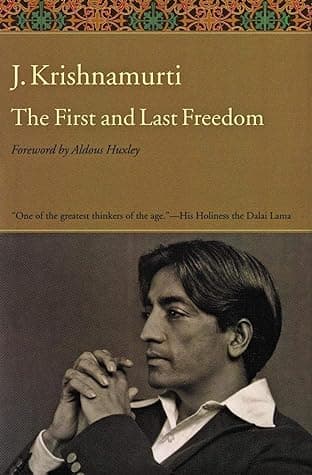
The First and Last Freedom cover
Archivist's Choice

The First and Last Freedom

Jiddu Krishnamurti (1954)

Genre

Psychology / Spirituality / Philosophy / Self-Help

Reading Time

240 min

Key Themes

See below

Track Your Reading

Sign in to track this book

Krishnamurti explores how we can achieve true freedom from suffering by directly examining our thoughts and beliefs.

Core Idea

Jiddu Krishnamurti claims that real freedom and understanding come only when we free our minds from the limits of thought, memory, and our idea of a 'self.' He suggests that human suffering comes from relying on outside authorities, comparing ourselves to others, and constant thinking, which breaks reality into pieces and stops us from seeing things directly. The way to freedom is not through systems, beliefs, or teachers, but through simply being aware of 'what is' in the present. This leads to a deep change in our consciousness and a discovery of truth beyond ideas.
Reading time
240 min
Difficulty
Hard
✓ Read this if...
You are seeking a profound philosophical challenge to your understanding of self, thought, and freedom, and are open to a radical, non-traditional approach to spirituality and psychology.
✗ Skip this if...
You prefer practical, step-by-step self-help advice, are looking for a new belief system to adopt, or find highly abstract, repetitive philosophical inquiry frustrating.

Core idea

The central argument and framework that powers the entire book.

Jiddu Krishnamurti claims that real freedom and understanding come only when we free our minds from the limits of thought, memory, and our idea of a 'self.' He suggests that human suffering comes from relying on outside authorities, comparing ourselves to others, and constant thinking, which breaks reality into pieces and stops us from seeing things directly. The way to freedom is not through systems, beliefs, or teachers, but through simply being aware of 'what is' in the present. This leads to a deep change in our consciousness and a discovery of truth beyond ideas.

At a glance

Reading time

240 min

Difficulty

Hard

Read this if...

You are seeking a profound philosophical challenge to your understanding of self, thought, and freedom, and are open to a radical, non-traditional approach to spirituality and psychology.

Skip this if...

You prefer practical, step-by-step self-help advice, are looking for a new belief system to adopt, or find highly abstract, repetitive philosophical inquiry frustrating.

Key Takeaways

1

The Trap of Thought

Thought, as memory and experience, inherently limits our perception of reality and freedom.

Quote

Thought is never new; it is always the old. The new is beyond the field of thought.

Krishnamurti states that our entire psychological makeup comes from thought, which is a result of memory and past experiences. This creates a cycle where we see the present through the past, stopping us from experiencing anything truly new. Freedom, then, cannot exist within this thought-bound life, because thought itself is never free. It is always conditioned, always a reaction. To understand ourselves and the world, we must observe thought without judging it, seeing its limits and how it builds our sense of self and reality. This o...

Supporting evidence

Krishnamurti repeatedly uses the example of accumulated knowledge and experience, stating that while knowledge is necessary for practical survival, it becomes a hindrance in understanding psychological truth. He challenges the listener to observe their own reactive patterns.

Apply this

Practice choiceless awareness: observe your thoughts, feelings, and reactions throughout the day without labeling, judging, or trying to change them. Simply notice the flow of consciousness. This cultivates a space of observation distinct from the observed.
choiceless-awarenessconditioningself-as-thought
2

The Illusion of the 'I'

The 'I' or the ego is not a fixed entity but a constantly shifting collection of memories, ideas, and experiences.

Quote

The 'I' is the bundle of memories, experiences, words, the whole background that we have acquired.

Krishnamurti breaks down the usual idea of the self. He says the 'I' is not a stable, lasting thing but a changing collection of psychological conditioning. This 'self' comes from thought, built from our past experiences, beliefs, desires, fears, and constantly identifying with these passing things. We hold onto this imagined self, believing it is real, and this holding on causes much suffering. By understanding that the 'I' is just a mental construct, a collection of memories and reactions, we can start to loosen its grip and find a ...

Supporting evidence

Krishnamurti frequently uses the analogy of a river, where the 'I' is not a fixed bank but the ever-flowing water, constantly changing and identifying with its contents. He asks listeners to examine what constitutes their 'I' when stripped of possessions, relationships, and ideas.

Apply this

When you catch yourself saying 'I am angry' or 'I want this,' pause and ask: 'Who is the 'I' that is angry? What is the nature of this 'I' that wants?' This challenges the automatic identification with passing states.

egoself-identityconditioning
3

Freedom from Authority

True freedom arises from rejecting all external and internal authority, including spiritual gurus and self-imposed ideals.

Quote

When you follow somebody, you cease to follow truth.

Krishnamurti's most radical claim is that we absolutely need freedom from all authority, both outside and inside ourselves. He strongly rejects spiritual teachers, gurus, scriptures, and even self-help systems, saying that relying on any outside authority stops real self-discovery. He also criticizes internal authorities: our own ideals, beliefs, and the images we have made for ourselves. These inner structures, born from thought and conditioning, are just as restrictive as outside ones. To be truly free, one must break free from the ...

Supporting evidence

Krishnamurti's own dissolution of the Order of the Star in the East, where he was proclaimed the World Teacher, is the ultimate testament to this principle. He stated, 'I desire no disciples.'

Apply this

Identify one area where you rely on external authority (a guru, a political party, a specific ideology) or internal authority (a rigid moral code, an unexamined ideal). Consciously question its validity and explore if you can approach that area with a fresh, unconditioned mind.

authorityself-reliancetruth
4

The Nature of Fear

Fear is fundamentally a product of thought about the future or the past, not a direct response to the present moment.

Quote

Fear is not something actual, it is the projection of the mind.

Krishnamurti examines fear, showing it not as a basic, unchanging human trait, but as a psychological construct from thought. He argues that fear appears when the mind imagines future dangers or losses, or when it dwells on past hurts and failures. This imagining, this dwelling, is what fear is. In the immediate present, when one is fully aware, fear often disappears because the mind has no room to think 'what if.' The fear of death, for example, is not the fear of dying itself, but the fear of losing what we know, of the unknown, whi...

Supporting evidence

He uses the example of fearing death: it's not the actual moment of dying that is feared, but the thought of losing life, relationships, experiences, or the unknown state after death. This is all an operation of thought.

Apply this

When you feel fear, pause and identify what specific thoughts are generating that fear. Are you thinking about a past failure or a potential future threat? Bring your attention back to the immediate sensory experience of the present moment.

fearpresent-momentthought-projection
5

Suffering and Escape

Suffering persists because we constantly try to escape it rather than truly understanding its origin.

Quote

The very desire to escape from sorrow creates further sorrow.

Krishnamurti offers a challenging view on suffering: it's not the suffering itself that traps us, but our constant attempts to escape it. Whether through distraction, belief systems, entertainment, or spiritual practices meant to numb pain, these escapes stop us from directly facing the cause of our sadness. By running away, we keep the cycle going, never truly understanding suffering. Real freedom from suffering comes not from avoiding it, but from facing it with full attention, observing it without judgment or wanting to change it. ...

Supporting evidence

He points out that people turn to religion, alcohol, relationships, or intellectual pursuits as means of escape from inner turmoil, yet these only offer temporary relief, never a resolution.

Apply this

The next time you experience an unpleasant emotion (sadness, anger, frustration), resist the urge to immediately distract yourself. Instead, sit with the feeling, observe its sensations, and notice the thoughts associated with it without trying to push it away.

sufferingescapeacceptance
6

The Problem of Comparison

Comparison is a destructive mental habit that fuels envy, ambition, and the constant striving for 'more' or 'better.'

Quote

The moment you compare, you are in conflict.

Krishnamurti identifies comparison as a basic psychological barrier to peace and self-understanding. From childhood, we are taught to compare ourselves to others—in intelligence, beauty, wealth, success, or spiritual progress. This constant measuring creates envy, competition, and a lasting feeling of not being enough or being better. It fuels ambition, which he sees not as a positive drive, but as a destructive force that creates division and conflict, both inside and out. Comparison stops us from truly seeing ourselves as we are, be...

Supporting evidence

He often refers to the societal pressure on children to excel, to be 'better' than their peers, which conditions the mind for a lifetime of comparison and dissatisfaction. The pursuit of status and recognition is a direct outcome of this habit.

Apply this

For one day, consciously try to observe every instance where you compare yourself to another person, a past version of yourself, or an ideal. Notice the feeling that arises from this comparison. The goal is just to observe, not to stop, to understand its mechanism.

comparisonambitionenvyself-acceptance
7

Meditation as Choiceless Awareness

True meditation is not a technique or a practice to achieve a state, but a state of choiceless, effortless awareness.

Quote

Meditation is not a means to an end. It is the understanding of the whole process of life.

Krishnamurti radically redefines meditation, removing all ritual, technique, and goal-focused effort. For him, meditation is not something you 'do' for a set time to reach a certain state (like peace or enlightenment). Instead, it is a state of being: a continuous, open awareness of 'what is' in every moment. It is observing thoughts, feelings, sensations, and the outside world completely, without judgment, interpretation, or wanting to change anything. This means there is no 'right' way to meditate, no postures, no mantras, no breath...

Supporting evidence

He critiques all established meditative practices, arguing that any technique, by its very nature, is a product of will and desire, thus reinforcing the 'I' that seeks to achieve something. He contrasts this with simply observing a bird, a flower, or a thought without interference.

Apply this

Instead of setting aside time for formal meditation, try to bring a quality of choiceless awareness to mundane activities: washing dishes, walking, or listening to someone speak. Observe everything without trying to categorize or analyze.

meditationawarenesspresent-momentmindfulness
8

The Urgency of Now

Transformation cannot be gradual or postponed; it must happen instantaneously in the present moment.

Quote

There is no gradual understanding. Understanding is immediate or it is not.

Krishnamurti challenges the common idea that psychological change is a slow, gradual process needing time and effort. He argues that this idea of gradual change itself comes from thought, a way for the mind to delay radical change and keep things as they are. Real insight and freedom, he insists, happen instantly, in the 'now.' If we understand something fully, deeply, and without resistance, that understanding itself immediately ends the old pattern. The idea of 'becoming'—becoming better, more spiritual, more enlightened—is a psycho...

Supporting evidence

He often uses the analogy of seeing a snake: the recognition is instant, and the reaction (jumping back) is immediate, not a gradual process of deciding it's a snake. Similarly, psychological insight should be immediate.

Apply this

When a negative pattern of thought or behavior arises, instead of thinking, 'I need to work on this over time,' try to bring complete, immediate attention to the pattern in that very moment. Can you see its entire mechanism instantly?

transformationpresent-momentgradualismunderstanding
9

Love Beyond Thought

Love, true compassion, is not a sentiment or an idea, but a state of being free from the 'I' and its demands.

Quote

Love is not a thought. Love is not a memory. Love is a state of being when the 'me' is not.

Krishnamurti suggests that our usual idea of love is flawed. It is often confused with desire, attachment, possession, or sentimentality—all products of thought and the 'I.' This kind of 'love' is conditional, based on expectations and fears, and always leads to conflict and sadness. True love, he argues, is something completely different: it is a state of being that comes only when the 'self,' with its demands, comparisons, and divisions, is gone. It is not an emotion that can be grown or practiced, but a natural blossoming that happ...

Supporting evidence

He distinguishes between the 'love' that seeks gratification, possession, or security (which he associates with fear and desire) and a love that is without motive, which he describes as a state of being.

Apply this

Observe your relationships. Are your expressions of love or affection tied to expectations, demands, or fears? Can you interact with someone, even for a brief moment, without the 'me' intervening with its judgments or desires?

lovecompassionattachmentdesireselflessness

Critical analysis

Notable Quotes

It is no measure of health to be well adjusted to a profoundly sick society.

Discussing the nature of sanity and societal norms.

Truth is a pathless land.

Explaining that truth cannot be reached through any organized religion, philosophy, or sect.

Freedom is not a reaction; freedom is not a choice. It is man's 'pretence' that because he has choice he is free.

Examining the nature of true freedom versus perceived freedom through choice.

The greater the will to be free, the less the freedom.

Discussing how the very desire or effort to achieve freedom can be a barrier to it.

When you are listening to something, if you are listening with a purpose, you are not listening.

Highlighting the importance of choiceless awareness and pure observation.

To understand the world, we must understand ourselves.

Emphasizing that internal self-knowledge is the foundation for understanding external reality.

Observation without evaluation is the highest form of intelligence.

Advocating for pure, non-judgmental observation as a path to insight.

The man who is not afraid of the word 'nothing' is on the way to the discovery of himself.

Exploring the concept of emptying the mind to discover true self.

What we are, the world is. If we are greedy, envious, competitive, our society is based on greed, envy, competitiveness.

Explaining the direct relationship between individual psychology and societal structure.

There is no end to becoming, and therefore no freedom. Becoming is the continuity of the 'me'.

Critiquing the endless pursuit of 'becoming' something, which prevents true liberation.

Meditation is not the pursuit of an end. It is the understanding of every thought, every feeling, every mood, every movement of the mind.

Redefining meditation as a process of choiceless awareness, not a goal-oriented practice.

Tradition becomes our security, and when the mind is secure it is in decay.

Highlighting how attachment to tradition can hinder growth and understanding.

To live completely, wholly, every day as if it were a new day, is to die to yesterday.

Emphasizing the importance of living in the present moment, free from the past.

Thought is time. Thought is born of experience and knowledge, which are inseparable from time.

Discussing the nature of thought and its connection to time and memory.

The greatest fear in the world is the opinion of others, and the moment you are unafraid of the crowd you are no longer a sheep, you become a lion roaring.

Encouraging individuals to break free from societal pressures and self-doubt.

Quiz

Test Your Knowledge

Ready to see how well you understood this book? Take our interactive quiz with 10 questions.

10
Questions
~5
Minutes
?
Best Score

Key Questions (FAQ)

The book's core message is that true freedom and understanding arise not from external authority, belief systems, or accumulated knowledge, but from direct self-observation and an awareness of one's own conditioning. It emphasizes the importance of individual inquiry into truth.

About the author