BookBrief
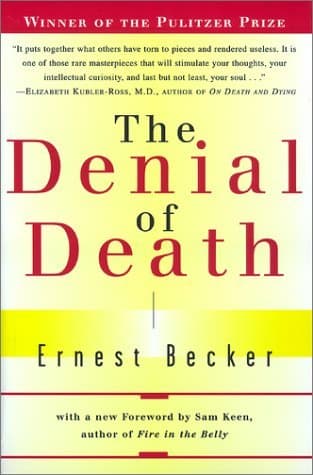
The Denial of Death cover
Archivist's Choice

The Denial of Death

Ernest Becker (1973)

Genre

Psychology / Spirituality / Science / Philosophy

Reading Time

10-15 hours (given its density and the need for contemplation)

Key Themes

See below

Track Your Reading

Sign in to track this book

Ernest Becker's Pulitzer-winning work argues that humanity's deepest motivations, from heroism to madness, are defenses against the terrifying, unacknowledged truth of our own inevitable death.

Core Idea

Ernest Becker's "The Denial of Death" says that the main reason for human behavior is an unconscious, universal fear of death. Humans, who know they will die, create complex 'hero systems' – cultural, psychological, and religious frameworks – to avoid this fear and feel symbolically immortal and important. These hero systems give meaning, value, and a sense of lasting contribution beyond physical death, helping people overcome their biological end. Becker says that much of human effort, creativity, love, neurosis, and even evil comes from these deeply held, often unconscious, attempts to escape the fear of not existing. He combines ideas from psychology, philosophy, and anthropology to show how culture itself is a group project to achieve immortality, and how individual problems often come from failed or insufficient personal hero systems. The book asks readers to face this 'vital lie' and think about what our death means for how we understand ourselves, society, and being human.
Reading time
10-15 hours (given its density and the need for contemplation)
Difficulty
Hard
✓ Read this if...
You are interested in a deep, multidisciplinary exploration of the psychological roots of human motivation, the role of death anxiety in culture and individual behavior, and want a challenging read that synthesizes psychology, philosophy, and spirituality.
✗ Skip this if...
You prefer practical self-help, light reading, or are uncomfortable with dense philosophical and psychological theory that confronts the darker aspects of human existence without offering easy solutions.

Core idea

The central argument and framework that powers the entire book.

Ernest Becker's "The Denial of Death" says that the main reason for human behavior is an unconscious, universal fear of death. Humans, who know they will die, create complex 'hero systems' – cultural, psychological, and religious frameworks – to avoid this fear and feel symbolically immortal and important. These hero systems give meaning, value, and a sense of lasting contribution beyond physical death, helping people overcome their biological end.

Becker says that much of human effort, creativity, love, neurosis, and even evil comes from these deeply held, often unconscious, attempts to escape the fear of not existing. He combines ideas from psychology, philosophy, and anthropology to show how culture itself is a group project to achieve immortality, and how individual problems often come from failed or insufficient personal hero systems. The book asks readers to face this 'vital lie' and think about what our death means for how we understand ourselves, society, and being human.

At a glance

Reading time

10-15 hours (given its density and the need for contemplation)

Difficulty

Hard

Read this if...

You are interested in a deep, multidisciplinary exploration of the psychological roots of human motivation, the role of death anxiety in culture and individual behavior, and want a challenging read that synthesizes psychology, philosophy, and spirituality.

Skip this if...

You prefer practical self-help, light reading, or are uncomfortable with dense philosophical and psychological theory that confronts the darker aspects of human existence without offering easy solutions.

Key Takeaways

1

The Hero System: Our Lifelong Quest for Significance

Humans construct 'hero systems' to feel significant and escape the terror of mortality.

Quote

Man is a creature who cannot stand the fact of his own insignificance.

Becker says that humanity's main drive is not pleasure or power, but the need to feel important and overcome the fear of death. We do this by creating and joining 'hero systems' – culturally accepted beliefs, values, and activities that promise us a form of immortality, whether symbolic (leaving a legacy, becoming famous) or literal (religious afterlife). These systems give meaning, purpose, and self-worth, letting us deny our fragility and end. Our entire psychological makeup is set up to keep these illusions, making us fundamentally...

Supporting evidence

Becker draws on psychological theories, particularly Otto Rank's work on the hero, to illustrate how societies offer pre-fabricated paths to heroism, from religious sainthood to scientific achievement, all designed to give individuals a sense of cosmic importance and permanence.

Apply this

Reflect on your own 'hero system.' What gives your life meaning and a sense of enduring value? Understanding this can reveal the hidden motivations behind your ambitions and fears, and help you consciously choose more authentic paths to significance rather than passively adopting societal ones.

hero-systemsignificanceimmortality-project
2

The Terror of Death: The Repressed Foundation of Human Action

An unconscious fear of death underpins much of human behavior and culture.

Quote

The idea of death, the terror of it, is what drives man to action in the world.

Different from Freudian thought, Becker says that the main human repression is not sexuality, but the fear of death. This 'death anxiety' is too strong for conscious thought, so it is pushed into the unconscious, where it subtly (and not so subtly) shapes our personalities, relationships, and societal structures. Our defenses against this fear appear as our need for self-esteem, our following of cultural rules, and our search for different forms of symbolic immortality. This repression is a 'vital lie,' necessary for our daily lives, ...

Supporting evidence

Becker frequently references the anthropological observation that all cultures, in some form, have rituals, myths, and beliefs designed to cope with or deny death, from elaborate burial rites to promises of an afterlife. He also cites clinical observations of neurotics whose anxieties can often be traced back to an underlying fear of annihilation.

Apply this

Instead of letting an unconscious death terror dictate your choices, acknowledge its presence. Engage in practices like meditation or journaling that allow for a conscious, albeit brief, confrontation with your mortality. This can paradoxically free you to live more fully and authentically.

death-anxietyrepressionvital-lie
3

The Human Paradox: Divine Creativity and Worm-like Fragility

Humans are caught between their aspiration for god-like significance and their undeniable physical mortality.

Quote

Man is a god in ruins.

Becker points out the basic contradiction of human existence: we have great creativity, self-awareness, and the ability for abstract thought, letting us imagine eternity and build complex symbolic worlds. Yet, we are also biological beings, fragile and perishable, eventually destined to decay. This 'dualism' – our spiritual hopes versus our physical reality – creates a constant tension. We want to go beyond our animal nature but are always reminded of it. This tension is the source of much human neurosis and the reason for our various...

Supporting evidence

Becker often refers to the biblical narrative of man being made in God's image, yet also being 'dust,' as a profound articulation of this paradox. He also points to the universal human drive to create art, science, and lasting institutions as attempts to leave a permanent mark on a transient world.

Apply this

Embrace this paradox. Acknowledge your physical limitations and the impermanence of life, but also cultivate your unique creative and intellectual capacities. Living authentically means integrating both your animal body and your symbolic self, rather than denying one for the other.

human-paradoxdualismsymbolic-self
4

Culture as a Collective Immortality Project

Societies provide shared illusions and structures to collectively deny individual mortality.

Quote

Culture is a fabric of illusions that allow man to live without being overwhelmed by the terror of his condition.

Becker says that culture is not just a group of customs, but a grand, group 'immortality project.' It provides the ready-made hero systems, values, and worldviews that people adopt to feel important and safe when faced with death. By following cultural rules, people feel like they belong and are part of a larger, seemingly eternal thing. This shared illusion protects us from the terrifying truth of our isolated death. When cultural systems break down, or when people question their truth, the underlying death anxiety can reappear, lead...

Supporting evidence

The rise and fall of civilizations, the fervor of nationalistic movements, and the rigidity of religious dogmas can all be understood as collective attempts to create and maintain a shared sense of meaning and permanence for their adherents.

Apply this

Critically examine the cultural narratives you inhabit. Are they genuinely enriching, or are they merely serving as comfortable, yet ultimately limiting, defenses against death? Seek out diverse perspectives and engage with ideas that challenge your ingrained assumptions, even if it means confronting uncomfortable truths.

cultural-hero-systemcollective-denialanomie
5

Neurosis: A Failed Immortality Project

Psychological disorders arise from a breakdown in an individual's chosen defense mechanisms against death.

Quote

Neurosis is the attempt to build a solid structure for one's life, but using faulty materials because one is afraid of the truth.

For Becker, neurosis is not mainly about repressed sexual desires, but about a faulty or insufficient 'immortality project.' When a person's chosen hero system – whether it is career success, perfect relationships, or intellectual superiority – does not give a convincing sense of importance and permanence, the repressed death anxiety starts to enter consciousness. This can appear as general anxiety, phobias, depression, or obsessive behaviors, all of which are desperate, often self-defeating, attempts to regain control and meaning in ...

Supporting evidence

Becker reinterprets various psychiatric conditions, like obsessive-compulsive disorder, as attempts to gain ultimate control over one's environment and thus symbolically over one's fate, preventing the intrusion of chaos and death.

Apply this

If you experience persistent anxiety or neurosis, consider what core fears or needs for significance might be driving it. Instead of merely treating symptoms, explore the underlying 'immortality project' that might be failing you. This self-inquiry can lead to more robust and authentic sources of meaning.

neurosisfailed-defensesdeath-anxiety-symptoms
6

The Problem of Evil: Narcissism and the Denial of Others' Heroism

Much human evil stems from the need to invalidate others' immortality projects to validate one's own.

Quote

Man's natural condition is one of anxiety and the need for self-esteem, which often comes at the expense of others.

Becker argues that human narcissism, a deep need for self-importance, comes directly from our death anxiety. To feel uniquely important and immortal, people often need to lessen or even destroy the 'hero systems' of others. If someone else's worldview or way of life challenges our own, it indirectly threatens our chosen path to importance, and thus our defense against death. This can lead to prejudice, blaming others, political oppression, and even genocide, as groups or individuals try to get rid of alternative realities that weaken ...

Supporting evidence

Historical examples of religious wars, ethnic cleansing, and ideological conflicts are presented as tragic manifestations of groups trying to assert the absolute superiority of their own 'hero system' over others, often leading to the dehumanization of the 'other.'

Apply this

Cultivate empathy and perspective-taking. Recognize that others' beliefs and actions, no matter how different from your own, often stem from a similar human need for meaning and significance. Challenge your own tendencies to dismiss or demonize those who hold different views, and seek understanding rather than condemnation.

narcissismevilscapegoatinghero-system-conflict
7

The Finitude of Love: The Burden of the Idealized Other

Romantic love often fails because we burden our partners with the impossible task of providing ultimate meaning and immortality.

Quote

We try to make the love object into a God, on whom we can depend for our total self-validation.

Becker offers a touching analysis of love, suggesting that much of its strength and later disappointment comes from our unconscious attempt to find a 'cosmic hero' in our partner. We project our need for ultimate importance and immortality onto the beloved, expecting them to be our perfect savior, to confirm our existence, and to protect us from the fear of death. This puts an impossible burden on the partner, who is, after all, a finite and flawed human being. When they inevitably do not meet these god-like expectations, disappointme...

Supporting evidence

The common trajectory of romantic relationships, from intense idealization to bitter disappointment, is seen as evidence of this phenomenon. People seek in love the fulfillment of their deepest existential needs, which no single human can provide.

Apply this

In your relationships, practice conscious awareness of your expectations. Are you seeking a partner, or a personal god? Release the unrealistic burden on your loved ones to provide ultimate meaning. Instead, cultivate self-validation and find meaning in broader hero systems, allowing love to be a shared journey rather than a desperate quest for salvation.

romantic-loveidealizationfinitudeburdened-love
8

The Call to Authenticity: Beyond the Vital Lie

True freedom and vitality come from acknowledging mortality and embracing the 'heroism of the absurd.'

Quote

The only way to triumph over the terror of death is to live one's life fully, to risk everything for the sake of experience and self-expression.

While Becker acknowledges that the 'vital lie' is necessary for daily life, he also calls for a form of 'heroism of the absurd.' This means consciously facing the fear of death, recognizing the meaninglessness of the universe from a purely objective view, and yet choosing to create meaning through one's own actions and commitments. It is about going beyond the culturally set hero systems and making a unique path of self-expression and real connection, accepting one's end without giving in to despair. This is not denying death, but inc...

Supporting evidence

Becker draws on existentialist thinkers like Søren Kierkegaard and Albert Camus, who advocated for embracing the absurd and finding meaning through passionate engagement with life, despite its ultimate meaninglessness.

Apply this

Engage in practices that encourage self-reflection and a confrontation with mortality, such as reading philosophy, creating art, or spending time in nature. Identify and pursue your own values and passions, even if they deviate from societal norms. Live with a sense of urgency and appreciation for the present moment, knowing its impermanence.

authenticityheroism-of-the-absurdexistentialismmeaning-creation
9

Religion as the Ultimate Immortality Project (and its Limitations)

Traditional religion offers the most comprehensive defense against death, but can become a source of neurotic rigidity.

Quote

Religion is a cultural system that provides a ready-made hero system, a cosmic drama in which man is the central actor.

Becker views traditional religion as the most powerful and common 'immortality project' ever made. It offers a complete worldview, a cosmic importance, and the promise of literal immortality, providing the strongest defense against death anxiety. By submitting oneself to a divine power and following sacred laws, people feel like they belong to something eternal and infinitely powerful. However, Becker also critiques the neurotic potential of religion. When religious beliefs become rigid, dogmatic, and intolerant, they can lead to spir...

Supporting evidence

The enduring power of faith across millennia and cultures, and its ability to provide comfort and meaning in the face of suffering and death, demonstrates its efficacy as an immortality project. Conversely, historical accounts of religious persecution and fundamentalism illustrate its potential for neurotic rigidity.

Apply this

If you are religious, reflect on whether your faith fosters genuine connection, compassion, and personal growth, or if it primarily serves as a rigid defense mechanism against fear. Seek out spiritual practices that encourage humility, open-mindedness, and a deeper understanding of human vulnerability, rather than simply offering an escape from it.

religionspiritual-prideliteral-immortalitydogmatism
10

The Artist, Genius, and Schizophrenic: Pushing the Boundaries of Reality

These archetypes represent varying degrees of confronting or succumbing to the terror of reality without conventional defenses.

Quote

The genius is the one who has not taken the easy way out, but has continued to face the terror of the world.

Becker explores how certain people deal with the 'vital lie' in unique ways. The artist and genius, by definition, question and challenge established hero systems, daring to create new realities and meanings. They have a greater awareness of the human condition and the fear of death, putting this awareness into deep creative expression. Their 'heroism' is their willingness to face reality without the usual cultural protections. On the other hand, the schizophrenic represents a sad failure to keep these defenses; their internal world c...

Supporting evidence

Becker analyzes the biographies of various artists and thinkers who experienced periods of intense psychological turmoil or alienation, which often preceded or accompanied their most groundbreaking work. He also references clinical studies of schizophrenia as a condition where the individual's protective 'shield' against reality has shattered.

Apply this

Cultivate a 'beginner's mind' and a willingness to question assumptions. Engage with art and ideas that challenge your perception of reality. Understand that creativity often emerges from a confrontation with discomfort and uncertainty. If experiencing mental health challenges, seek professional help to build healthier coping mechanisms rather than letting defenses completely collapse.

artistgeniusschizophreniareality-breakdown

Critical analysis

Notable Quotes

The idea of death, the fear of it, haunts the human animal like nothing else; it is a mainspring of human activity—activity designed largely to avoid the fatality of death, to overcome it by denying in some way that it is the final destiny for man.

Opening lines introducing the central thesis of the book.

Man is literally split in two: he has an awareness of his own splendid uniqueness in that he sticks out of nature with a towering majesty, and yet he goes back into the ground a few feet in order blindly and dumbly to rot and disappear forever.

Describing the fundamental human paradox of self-awareness and mortality.

The irony of man's condition is that the deepest need is to be free of the anxiety of death and annihilation; but it is life itself which awakens it, and so we must shrink from being fully alive.

Discussing how the fear of death paradoxically limits human vitality.

Society itself is a codified hero system, which means that society everywhere is a living myth of the significance of human life, a defiant creation of meaning.

Explaining how cultures function as collective defenses against death anxiety.

To become conscious of what one is doing to earn his feeling of heroism is the main self-analytic problem of life.

A call for self-reflection on one's personal immortality projects.

The neurotic is the one who refuses the loan of life to avoid the debt of death.

A metaphorical description of how neurosis relates to death denial.

The most that any one of us can seem to do is to fashion something—an object or ourselves—and drop it into the confusion, make an offering of it, so to speak, to the life force.

Reflecting on human creativity as a response to mortality.

The terror of death is not that it will come, but that it will come before we have had a chance to make our mark.

Highlighting the anxiety of insignificance in the face of death.

The irony of the human condition is that we are gods with anuses.

A blunt summary of the duality of human existence (spiritual and physical).

The real world is simply too terrible to admit; it tells man that he is a small trembling animal who will decay and die.

Describing the raw, unvarnished reality that humans deny.

Culture is in its most intimate intent a heroic denial of creatureliness.

Arguing that cultural achievements are attempts to transcend physical limitations.

The urge to immortality is not a simple reflex of the death fear but a reaching out for a higher heroism.

Distinguishing between mere fear and the positive drive for significance.

The problem of heroics is the central one of human life, that it goes deeper into human nature than anything else because it is based on organismic narcissism and on the child's need for self-esteem as the condition for his life.

Linking heroism to deep psychological needs from childhood.

Man's freedom is a fabricated freedom, and he pays a price for it. He must at all times defend the utter fragility of his delicately constituted fiction.

Commenting on the precarious nature of human self-created meaning.

Quiz

Test Your Knowledge

Ready to see how well you understood this book? Take our interactive quiz with 10 questions.

10
Questions
~5
Minutes
?
Best Score

Key Questions (FAQ)

The book explores how human behavior and culture are fundamentally shaped by our unconscious fear of mortality. Becker argues that we construct elaborate psychological defenses and cultural systems to deny the reality of death, which drives much of human achievement and conflict.

About the author