“It is a truth universally acknowledged that a single woman in possession of a good fortune must be in want of a husband.”
— A play on Austen's opening line, used to highlight the societal pressures on women, even those with independence.

Genre
General
Reading Time
90 min
Key Themes
See below
Sign in to track this book
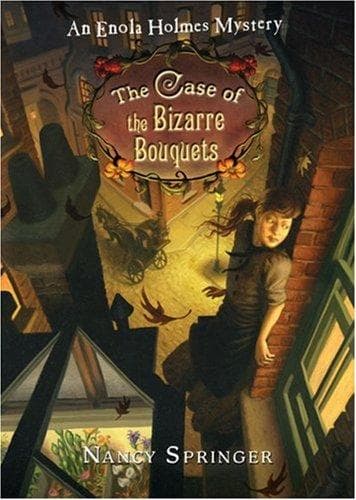
Enola Holmes must navigate the treacherous, flower-laden secrets of Victorian high society to unmask a kidnapper threatening her dearest friend, Lady Cecily.
Enola Holmes, now established in her own discreet lodgings under an assumed identity, finds her independent life interrupted by a peculiar delivery: a bouquet of flowers, each bloom seemingly chosen for a specific, unsettling reason. The arrangement is not merely decorative but a coded message, hinting at distress and a hidden plea. Recognizing the unique language of flowers, a skill cultivated from her mother's eccentric teachings, Enola immediately suspects foul play and a connection to a missing person, setting her on a new investigation that will test her burgeoning detective skills.
The coded bouquet leads Enola to the disappearance of Lady Cecily Alistair, a young woman from a prominent but financially strained family, who was on the verge of an arranged marriage. Lady Cecily, known for her artistic inclinations and independent spirit, was last seen leaving her family estate under mysterious circumstances. Her family, particularly her stern father, Lord Alistair, is reluctant to involve the police, fearing scandal, which immediately raises Enola's suspicions about hidden motives and suppressed information regarding the young lady's vanishing act.
Enola's investigation is complicated by the presence of her brothers. Mycroft Holmes, ever concerned with her societal propriety and determined to send her to finishing school, monitors her activities, while Sherlock Holmes, though less directly involved, casts a long shadow with his reputation. Enola must constantly evade their watchful eyes and the societal constraints they represent, using her wit and disguises to pursue her leads without attracting their direct intervention, all while proving her capabilities as a detective in her own right.
As Enola delves deeper, she meticulously deciphers the various bouquets and floral arrangements she encounters, each one a piece of a larger puzzle. She discovers that Lady Cecily herself was adept at the Victorian language of flowers, using it to communicate her true feelings and circumstances in a world where women's voices were often silenced. These floral clues lead Enola to various locations and individuals connected to Lady Cecily's life, revealing a secret romance and a desperate plan for escape.
Following the floral breadcrumbs, Enola uncovers that Lady Cecily was secretly involved with a young gentleman named Mr. Tarleton, an artist of modest means, making him an unsuitable match in the eyes of her family. Their clandestine meetings and shared passion for art were their only solace. Enola realizes that the disappearance is not an abduction but a planned elopement, orchestrated through floral messages, though something has clearly gone awry, leaving Lady Cecily's fate uncertain and Mr. Tarleton in distress.
Enola discovers that Lord Alistair, Lady Cecily's father, is deeply in debt, making Lady Cecily's arranged marriage to the wealthy Lord Tewksbury of the Basilwether estate not just a matter of social standing but a desperate financial necessity for the family. This revelation explains the family's fervent desire to avoid scandal and their reluctance to involve the police, as any public disgrace would jeopardize the marriage and their financial salvation, adding another layer of complexity to Lady Cecily's motivations.
Enola's investigation eventually leads her to the Basilwether estate, the very place where she had previously crossed paths with Lord Tewksbury. It becomes clear that while Tewksbury was Lady Cecily's intended, he was not her secret lover. Instead, he becomes an unexpected ally. Tewksbury, having grown fond of Enola and possessing his own independent spirit, offers assistance, providing crucial insights into the Alistair family's affairs and helping Enola navigate the intricate social circles of the aristocracy.
The final floral clue directs Enola to a secluded, overgrown conservatory on the Alistair estate, a place Lady Cecily used as her personal sanctuary. Inside, Enola finds Lady Cecily, not abducted, but hiding in a state of advanced pregnancy, having fled her arranged marriage and the societal shame that would accompany her condition. She had been sending coded floral messages to Mr. Tarleton, but a misunderstanding or delay had prevented their reunion, leaving her vulnerable and alone.
Realizing the gravity of Lady Cecily's situation, Enola devises a plan to reunite her with Mr. Tarleton and protect her from societal ruin. She enlists the help of Lord Tewksbury, who, despite being the jilted fiancé, shows genuine concern. Together, they work to discreetly inform Mr. Tarleton, arrange for their safe passage, and manage the delicate situation with the Alistair family, aiming to orchestrate a quiet departure that would preserve Lady Cecily's dignity and the family's fragile reputation.
Enola successfully reunites Lady Cecily and Mr. Tarleton, facilitating their escape to a new life where they can raise their child away from the rigid strictures of Victorian society. While the Alistairs face a different kind of scandal, Enola ensures Lady Cecily's safety and happiness. The case solidifies Enola's reputation as a capable and compassionate detective, further cementing her independence from her brothers and proving her unique approach to solving mysteries, often prioritizing empathy and individual freedom over rigid rules.
The Protagonist, Independent Detective
Enola's arc in this story solidifies her confidence and unique methodology as a detective. She moves from simply solving a mystery to actively facilitating a new life for her client, demonstrating a deeper commitment to justice and individual freedom. She further distances herself from her brothers' influence, proving her ability to operate successfully and independently in a challenging world.
The The Disappearing Noblewoman
Lady Cecily's arc is one of silent rebellion and ultimately, liberation. She moves from being a victim of circumstance to actively choosing her own path, even in the face of immense societal pressure. Her journey culminates in finding freedom and a new beginning with her beloved, away from the constraints of her former life.
The Lady Cecily's Secret Lover
Mr. Tarleton's arc is one of initial confusion and despair, transitioning to renewed hope and ultimately, a new beginning with Lady Cecily. He represents the triumph of love over societal expectations, as he is reunited with his beloved and their child.
The Jilted Fiancé, Unexpected Ally
Tewksbury's arc sees him grow in maturity and expand his understanding of justice beyond societal norms. He moves from being an intended husband to an active supporter of love and individual freedom, even when it means sacrificing his own expected future. He further solidifies his friendship and respect for Enola.
The Lady Cecily's Father
Lord Alistair's arc is one of reluctant acceptance. He is forced to confront the consequences of his rigid expectations and the realities of his daughter's choices, ultimately having to adapt to a new, unexpected future for his family, albeit with a degree of resignation.
This theme explores Enola's ongoing struggle to forge her own path as a detective and an independent woman in a society that seeks to confine her to traditional roles. It also extends to Lady Cecily's desperate attempt to escape an arranged marriage and live a life of her own choosing. Both characters, in their own ways, defy societal expectations and challenge the patriarchal norms of Victorian England, highlighting the universal desire for self-determination and freedom.
“'I am not a maid to be married, nor a sister to be supervised. I am a scientific perditorian, and I shall solve this mystery myself.'”
The novel prominently features the Victorian language of flowers (floriography) as a crucial plot device and a metaphor for suppressed voices. It emphasizes how marginalized individuals, particularly women, found ingenious ways to communicate their true feelings, desires, and plights in a society where direct expression was often forbidden. Enola's skill in deciphering these floral codes underscores the importance of understanding nuanced, non-verbal forms of communication and the hidden truths they can reveal.
“'Every bloom tells a story, if only one knows how to read its silent whispers.'”
This theme is central to both Enola's and Lady Cecily's narratives. It examines the pervasive pressure of societal norms, particularly concerning marriage, class, and gender roles, against the powerful human desire for love, personal freedom, and self-expression. The conflict between these forces drives much of the plot, illustrating the often painful choices individuals were forced to make in order to conform or rebel, and the consequences of both paths.
“'To be born a woman in this age is to be born into a cage, unless one has the wit to fashion her own key.'”
The story delves into how appearances and reputation often mask deeper truths and financial desperation within Victorian society. The Alistair family's concern for public image over their daughter's happiness, and the lengths they go to avoid scandal, highlight the superficiality and hypocrisy that could exist beneath a polished facade. Enola's ability to see beyond these illusions and uncover the reality beneath is a testament to her investigative prowess and critical thinking.
“'Polished veneers often conceal the most alarming cracks beneath.'”
The Coded Messages of Blooms
Floriography is the central plot device, serving as the primary means of communication for Lady Cecily and the key to unraveling her disappearance. Each bouquet and individual flower carries a specific symbolic meaning, allowing Lady Cecily to convey her distress, her love, and her plans without uttering a word. Enola's unique skill in interpreting these floral codes, taught to her by her mother, is essential to the investigation. It's a clever way to integrate historical detail with a cryptic puzzle, highlighting the ingenuity of communication in a restrictive era.
Enola's Tools for Evasion and Investigation
Enola's use of various disguises and pseudonyms (such as 'Dr. Ragostin' or 'Miss Ivy Meshle') is a recurring plot device that allows her to navigate Victorian society undetected, especially from her brothers. These disguises enable her to access different social strata, gather information, and move freely in a world that would otherwise restrict a young woman. They also symbolize her defiance of conventional identity and her embrace of self-reinvention as a means to achieve her goals.
The Classic Whodunit Framework
The disappearance of Lady Cecily Alistair provides the foundational mystery structure for the novel. While initially presented as a typical missing person case, the gradual reveal that she is not abducted but has fled, and for complex personal reasons, subverts the conventional 'whodunit' trope. This framework allows for a multifaceted investigation that delves into family secrets, societal pressures, and the inner life of the 'victim,' ultimately leading to a resolution that is more about liberation than capture.
“It is a truth universally acknowledged that a single woman in possession of a good fortune must be in want of a husband.”
— A play on Austen's opening line, used to highlight the societal pressures on women, even those with independence.
“One cannot be a proper lady and a detective simultaneously. The two roles are diametrically opposed.”
— Enola's internal struggle or an external comment on her unconventional pursuits.
“Bouquets are rarely just bouquets. They are messages, coded and fragrant, for those with the wit to decipher them.”
— Enola's musings on the central mystery involving flowers.
“The greatest disguises are not those that change one's appearance entirely, but those that make one invisible within plain sight.”
— Enola reflecting on her methods of blending in and observing.
“Sometimes, the most peculiar things are simply the truth, inconveniently presented.”
— Enola's approach to seemingly strange clues.
“My brothers believe me to be a child, a fool, or both. They underestimate the power of a woman who refuses to be confined.”
— Enola's frustration with Mycroft and Sherlock's perception of her.
“London holds a thousand secrets, whispered on the wind and hidden in its grimy corners.”
— Enola describing the city as a source of mysteries.
“A lady's reputation is her most fragile possession, easily shattered by a single misplaced word or deed.”
— A comment on the societal constraints and dangers faced by women.
“Logic is a fine tool, but instinct often guides one to the truth when logic is stalled.”
— Enola's approach to solving cases, balancing intellect with intuition.
“Even the most beautiful blooms can conceal the darkest intentions.”
— A direct reference to the bizarre bouquets and the underlying danger.
“To be truly free, one must first free oneself from the expectations of others.”
— Enola's philosophy on personal liberty.
“The language of flowers is potent, a silent conversation for those who understand its grammar.”
— Further elaboration on the importance of floriography in the case.
“Every lock has a key, and every secret, a way to be unearthed.”
— Enola's determined attitude towards solving puzzles.
Ready to see how well you understood this book? Take our interactive quiz with 10 questions.