“Every choice, no matter how small, sends ripples through the fabric of reality.”
— A core philosophical statement about the nature of the butterfly effect.

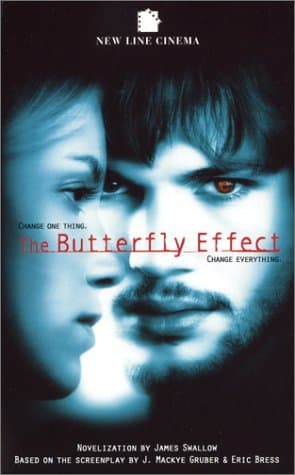
James Swallow (2003)
Genre
Psychology / Fantasy / Science Fiction
Reading Time
8-10 hours
Key Themes
See below
Sign in to track this book
A man's desperate journey through his own past to heal old wounds unravels his present, proving that some butterflies, once disturbed, can only create hurricanes.
Evan Treborn, a college student, has severe memory blackouts and emotional instability, which impacts his relationships, especially with his childhood sweetheart, Kayleigh Miller. He has vague, disturbing recollections of his past but cannot make sense of them. Frustrated by his current struggles and the pain of his loved ones, Evan discovers that by reading entries from his old childhood journals, he can mentally go back in time to inhabit his younger self. This ability lets him influence past events with his adult consciousness. He believes this power can help him fix his and his friends' broken lives, starting with an attempt to retrieve a crucial memory.
Evan's first attempt to alter the past involves the traumatic 'basement incident' where Kayleigh's abusive father, George Miller, forces Evan and Kayleigh to pose for a child pornography video. As his adult self in his childhood body, Evan tries to defy George and protect Kayleigh. He screams for help and tries to fight back, hoping to prevent the abuse. While he stops the specific filming incident, the immediate outcome is not what he expects. Instead of improving Kayleigh's life, his interference leads to George violently attacking Evan's mother, Andrea. This initial change, though seemingly positive in one way, immediately shows the unpredictable and often negative repercussions of altering the past, hinting at the 'butterfly effect'.
After his first intervention, Evan wakes up in a new present-day reality. He finds that Kayleigh, instead of being his college sweetheart, is now a heroin-addicted prostitute, completely estranged from him. His childhood friend, Lenny Kagan, is still traumatized, but their other friend, Tommy Miller (Kayleigh's brother), has become a violent, rage-filled psychopath, now in prison for murder. Evan's attempt to prevent the basement incident inadvertently led to a different, equally devastating set of circumstances for his friends. The direct link between his past action and the present's chaos becomes clear, forcing Evan to realize the instability of time and memory, and the danger of his new ability.
Determined to save Kayleigh and Tommy, Evan travels back to another pivotal moment: when Tommy, as a child, brutally killed a dog by setting it on fire. In this past, Evan, as his adult self, intervenes by grabbing the dog and running, preventing Tommy from committing the act. This intervention, however, has severe, immediate consequences. The dog, frightened, bites Evan, and the incident leads to Tommy being sent away to a strict military-style camp by his father, George, as punishment for his violent tendencies. This change aims to steer Tommy away from violence, but as Evan will soon discover, the universe often rebalances itself, sometimes brutally.
Waking up in the present after preventing the dog incident, Evan finds himself in a seemingly ideal college life. He is a popular fraternity brother, financially stable, and has a bright future. However, the joy is short-lived. He soon learns that Kayleigh, in this timeline, is his girlfriend but suffers from severe depression and ultimately commits suicide by jumping off a bridge. This devastating outcome shows that even when Evan's personal life improves, his interventions often lead to tragic consequences for those he cares about most. The 'perfect' life he created for himself came at the cost of Kayleigh's existence, highlighting the moral dilemma of his actions.
Evan next focuses on Lenny, who has been traumatized in every timeline. He recalls a past event where he, Tommy, and Lenny, as children, played with a homemade bomb that exploded, maiming Lenny. Evan travels back to this moment, determined to prevent Lenny's injury. He tries to stop the explosion by throwing the bomb away, but in his attempt, the bomb explodes in his own hands, causing him to lose both hands. This drastic self-sacrifice, while saving Lenny, leads to an incredibly dark and challenging present for Evan. It proves that even direct intervention with self-harm doesn't guarantee a positive outcome for others.
After the bomb incident, Evan wakes up in the present as a double amputee, confined to a mental institution. His body is scarred, and his mind is fractured from the repeated temporal shifts. In this reality, he is heavily medicated and believed to be delusional due to his claims of time travel. He tries to explain his situation to a doctor, recounting his past interventions and the resulting chaos. The doctor dismisses his story as psychosis. Desperate, Evan manages to get hold of a journal and attempts another jump, hoping to find a path to a better future, despite the immense personal cost.
Evan travels back to a crucial moment where Tommy, fueled by years of abuse and rage, confronts and murders his father, George, in a diner. Evan, as his younger self, tries to intervene and prevent Tommy from committing the murder. In this timeline, Evan attempts to disarm Tommy or distract him. However, Tommy's rage is too deep. Instead of killing George, Tommy turns his knife on Evan, stabbing him repeatedly and killing him in the diner. This brutal outcome shows the futility of Evan's efforts when confronting deeply ingrained psychological damage and the inherent violence of some of his friends' paths.
After experiencing multiple horrific timelines, Evan realizes that his very existence, and his attempts to fix things, are the root cause of everyone's suffering. He concludes that the only way to truly save Kayleigh, Tommy, and Lenny from their tragic fates is to prevent himself from ever being born. He finds a memory of his mother, Andrea, pregnant with him, having a conversation with his father, Jason, in a hospital. This is the moment he chooses for his final, most drastic intervention.
Evan makes his final journey, traveling back to the moment of his own birth. As an infant, he uses his adult consciousness to deliberately strangle himself with his own umbilical cord in the womb, ensuring he is stillborn. This ultimate act of self-sacrifice erases his existence from the timeline, effectively preventing all the subsequent suffering and trauma that his life and his temporal interventions caused. It is a bleak but definitive solution to the chaotic butterfly effect he unleashed.
The film concludes with a montage showing the new, untroubled lives of his friends in a reality where Evan never existed. Kayleigh and Tommy are shown as happy, well-adjusted adults, having grown up without the traumas they experienced in every previous timeline. Lenny is also seen living a normal, healthy life. Evan's sacrifice successfully created a future where his loved ones could thrive, free from the dark influences of George Miller and the chaotic ripples of Evan's time-traveling interventions. The ending is bittersweet, as it confirms the success of his mission but at the cost of his own existence and any memory of him.
The Protagonist
Evan evolves from a victim of his past to an active, albeit destructive, agent of change, ultimately sacrificing his own existence for the well-being of his loved ones.
The Supporting
Kayleigh's arc is less about her own development and more about how Evan's actions dictate her destiny, ultimately achieving peace only through his non-existence.
The Supporting
Tommy's trajectory is consistently dark in most timelines, highlighting the difficulty of changing deeply ingrained psychological patterns, finding peace only through Evan's erasure.
The Supporting
Lenny's arc is defined by his consistent victimization across timelines, emphasizing the pervasive nature of trauma until Evan's ultimate sacrifice liberates him.
The Supporting
Andrea's arc is one of enduring maternal love and concern, consistently trying to understand and help Evan, despite her inability to grasp the true nature of his struggles.
The Antagonist
George remains a consistently malevolent force, his actions precipitating much of the suffering Evan tries to prevent, his fate often intertwined with Tommy's rage.
The Mentioned
Jason's arc is presented as a tragic parallel to Evan's, serving as a warning of the inevitable self-destruction that comes with altering the past.
This is the central theme, showing how even the smallest change in the past can lead to massive, unpredictable, and often devastating alterations in the present. Evan's repeated attempts to 'fix' his friends' lives consistently result in worse outcomes, demonstrating the futility and danger of tampering with causality. For example, preventing Kayleigh's sexual abuse in one timeline leads to her becoming a prostitute in another, and saving Lenny from the bomb results in Evan losing his hands. The film shows how every intervention creates a new, often darker, reality.
“For every action, there is an equal and opposite reaction. Only with this, there is no equal and opposite reaction. There are only consequences.”
The film explores the impact of childhood trauma on adult lives and the psychological mechanisms of repression. Evan's blackouts are a manifestation of his mind's attempt to cope with unbearable memories. His journey is initially driven by a need to recall and understand these repressed events, believing that knowledge will bring healing. The repeated exposure to his past traumas, even as an adult consciousness, further fragments his mind, showing how trauma can persist and even deepen through reliving it, regardless of the intention to change it.
“They say you can never go home again. I say you can, but you'll never be the same.”
The narrative constantly grapples with whether individuals can truly escape their predetermined destinies or if certain tragic events are inevitable. Despite Evan's best efforts and sacrifices, his friends often find themselves in equally dire, though different, circumstances. This suggests a powerful underlying current of fate or a universal equilibrium that resists drastic alteration. Evan's eventual conclusion, that his own existence causes the chaos, leans towards a fatalistic view where some outcomes are inescapable unless the very catalyst for change is removed.
“God doesn't want me to fix it. He wants me to break it.”
Evan's journey culminates in the ultimate act of self-sacrifice. Initially, his interventions are somewhat self-serving, aimed at creating a better life for himself and his loved ones. However, as the consequences escalate, he realizes that the only way to truly save his friends is to erase himself from existence, preventing all the trauma he inadvertently caused. This transformation from a well-intentioned but flawed individual to a selfless martyr shows that true love and protection sometimes demand the greatest personal cost, even one's very being.
“The only way to save the people I love is to erase myself.”
The physical medium through which Evan triggers his time-travel ability.
Evan's childhood journals, home videos, and photographs serve as the literal portals to his past. By reading or viewing these records, his adult consciousness is transported back to the exact moment they were created, inhabiting his younger self. This device grounds the fantastical element in a tangible, relatable action, making his ability feel more like a psychological phenomenon tied to memory and documentation rather than a purely scientific one. It also highlights the power of memory and the past to shape the present.
Evan's symptom of repressed trauma and a narrative tool for revealing information.
Evan's severe memory blackouts serve multiple functions. Initially, they are a symptom of his deep-seated childhood trauma, hinting at the disturbing events he cannot recall. Narratively, they create suspense, as the audience, like Evan, is piecing together the fragmented past. They also explain why Evan doesn't fully remember the 'original' timeline, allowing for the reveal of new, altered realities with each jump. The blackouts underscore the psychological toll of his past and his unique ability.
The consequence of Evan's time travel, creating distinct parallel realities.
Each time Evan alters the past, an entirely new and distinct timeline is created, showcasing a 'multiverse' of possibilities stemming from his interventions. This device is crucial for demonstrating the 'butterfly effect' in action, as Evan witnesses vastly different outcomes for himself and his friends. It allows the film to explore various 'what if' scenarios, highlighting the unpredictable nature of causality and the profound impact of even minor changes, ultimately leading to Evan's conclusion that no single 'perfect' timeline can be achieved through his actions.
The genetic predisposition for Evan's ability, inherited from his father.
The revelation that Evan's father, Jason, possessed the same time-traveling ability and also attempted to prevent his own birth adds a layer of tragic inevitability to Evan's plight. This device suggests that the 'gift' is also a curse, a genetic predisposition to a power that inevitably leads to self-destruction. It foreshadows Evan's ultimate fate and explains the source of his unique ability, grounding it in a familial, almost fated, context rather than a random occurrence.
“Every choice, no matter how small, sends ripples through the fabric of reality.”
— A core philosophical statement about the nature of the butterfly effect.
“The past isn't just prologue; it's a living, breathing entity that can be rewritten.”
— Explaining the protagonist's ability to alter historical events.
“Sometimes, the greatest good comes from the smallest, most unexpected alteration.”
— Highlighting the subtle power of the butterfly effect in positive ways.
“Fear is the mind-killer, but regret is the soul-crippler.”
— A character's reflection on the emotional toll of past mistakes.
“The universe doesn't forget. It just rearranges the pieces.”
— Describing the universe's inherent tendency towards balance even after alterations.
“To truly understand a moment, you must understand all the moments that led to it.”
— A mentor's advice on the importance of historical context.
“Every decision is a gamble, especially when you're playing with causality.”
— A character's internal monologue about the risks of their abilities.
“The future is not set. It's a tapestry woven with threads of possibility.”
— An optimistic view on the malleability of destiny.
“Even the smallest change can unravel a carefully constructed lie.”
— Referring to how minor alterations can expose hidden truths.
“The weight of what could have been is often heavier than the weight of what is.”
— A character grappling with the alternate realities they've glimpsed.
“Sanity is a fragile thing when you remember histories that never happened.”
— The psychological toll of experiencing multiple timelines.
“Sometimes, the only way to save a world is to let a part of it die.”
— A difficult ethical choice faced by a character.
“The greatest power isn't to change the past, but to learn from it.”
— A character's realization about true wisdom and growth.
“A single moment of courage can redefine an entire lifetime.”
— Emphasizing the transformative impact of bravery.
Ready to see how well you understood this book? Take our interactive quiz with 10 questions.
Biography coming soon.

Rhonda Byrne
4.3

Menno Henselmans
4.3

Sylvia Plath
4.3

Elliot Aronson
4.3

Joseph Campbell
4.3

Erich Fromm
4.3

Irvin D. Yalom
4.2

Lucy Strange
4.2