BookBrief
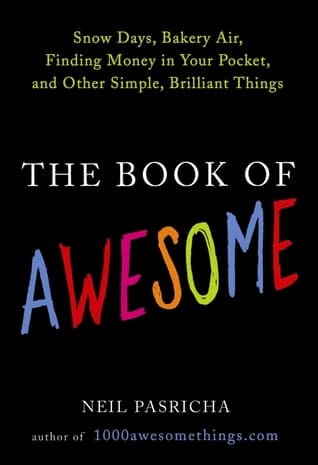
The Book of Awesome cover
Archivist's Choice

The Book of Awesome

Neil Pasricha (2010)

Genre

Psychology

Reading Time

360 min

Key Themes

See below

Track Your Reading

Sign in to track this book

This book is a delightful treasure hunt for the overlooked, everyday joys, reminding us that true happiness often hides in the simple, universally awesome moments of life, like perfectly warm underwear or a string of green lights.

Core Idea

"The Book of Awesome" says that deep happiness does not come from big achievements or possessions. Instead, it comes from noticing and enjoying the many small, often unseen 'awesome' moments in everyday life. By intentionally seeing and celebrating these small moments, like a puzzle piece fitting just right or the smell of rain, people can counter their natural tendency to focus on the negative. This helps them regain a childlike sense of wonder and build a more positive outlook. The book argues that this practice of conscious appreciation is a skill that, when developed, changes how someone sees reality, leading to more joy and contentment.
Reading time
360 min
Difficulty
Easy
✓ Read this if...
You want a simple, uplifting, and actionable way to boost your daily mood and find joy in the ordinary, or if you feel overwhelmed by negativity and are looking for a gentle antidote.
✗ Skip this if...
You are seeking a deep dive into psychological theory, a structured self-help program with complex exercises, or prefer a more critical or analytical approach to happiness.

Core idea

The central argument and framework that powers the entire book.

"The Book of Awesome" says that deep happiness does not come from big achievements or possessions. Instead, it comes from noticing and enjoying the many small, often unseen 'awesome' moments in everyday life. By intentionally seeing and celebrating these small moments, like a puzzle piece fitting just right or the smell of rain, people can counter their natural tendency to focus on the negative. This helps them regain a childlike sense of wonder and build a more positive outlook. The book argues that this practice of conscious appreciation is a skill that, when developed, changes how someone sees reality, leading to more joy and contentment.

At a glance

Reading time

360 min

Difficulty

Easy

Read this if...

You want a simple, uplifting, and actionable way to boost your daily mood and find joy in the ordinary, or if you feel overwhelmed by negativity and are looking for a gentle antidote.

Skip this if...

You are seeking a deep dive into psychological theory, a structured self-help program with complex exercises, or prefer a more critical or analytical approach to happiness.

Key Takeaways

1

The Power of Micro-Moments

Happiness is found in the overlooked, everyday occurrences.

Quote

The Book of Awesome reminds us that the best things in life are free (yes, your grandma was right).

Pasricha champions the idea that true joy does not only come from big achievements or life-changing events. It also comes from many 'micro-moments' that fill our daily lives. These are small, often quick experiences that, when noticed, add a surprising amount of good feeling to our lives. The book says that by purposely focusing on these tiny, perfect instances—like finding a forgotten twenty-dollar bill or the satisfying 'pop' of bubble wrap—we can build a deeper, more consistent sense of well-being. This view challenges the usual se...

Supporting evidence

The entire book is a compendium of these moments: 'Wearing underwear just out of the dryer,' 'Fixing electronics by smacking them,' 'Hitting a bunch of green lights in a row.' Each entry serves as a concrete example of a micro-moment.

Apply this

Start a personal 'Awesome List' in a journal or on your phone. Each day, intentionally record at least three small, awesome things you experienced, no matter how insignificant they seem. This practice trains your brain to notice and appreciate these moments.


mindfulnessgratitudepositive-psychology
2

Reclaiming Childhood Wonder

Rediscover joy by seeing the world through unjaded eyes.

Quote

Read it and you'll remember all the things there are to feel good about.

Pasricha's work encourages us to drop the doubt and tiredness that often come with adulthood and reconnect with the simple, pure wonder of childhood. Children naturally find things interesting in the ordinary—a shiny pebble, a perfectly shaped cloud, the sound of a rustling leaf. The book suggests this ability is not lost, just sleeping, hidden by adult worries and expectations. By pointing out simple pleasures, Pasricha guides us back to a state of mind where the world feels fresh, new, and full of pleasant surprises. It is a call to...

Supporting evidence

The tone and content of the entries often evoke childlike wonder, such as 'Waking up and realizing it's Saturday' or 'Watching The Price Is Right when you're home sick,' which are experiences often associated with childhood or a carefree state.

Apply this

Engage in an activity you loved as a child but haven't done in years (e.g., coloring, building with LEGOs, playing hopscotch). Pay attention to the simple sensory details and the feeling of unburdened enjoyment.

nostalgiaplayfulnessinner-child
3

Counteracting Negativity Bias

Consciously seek out the good to balance the bad.

Quote

Sometimes it's easy to forget the things that make us smile. With a 24/7 news cycle reporting that the polar ice caps are melting... it's tempting to feel that the world is falling apart.

In a world full of bad news, Pasricha's book is a key counter to our natural negativity bias—the psychological fact that humans tend to give more importance to bad experiences than good ones. The constant flow of alarming headlines can easily lead to feelings of sadness and being overwhelmed. By purposely listing and celebrating 'awesome things,' the book provides a strong different story. It does not deny problems exist but states that positive, smile-inducing moments are just as, if not more, common. This conscious act of focusing o...

Supporting evidence

Pasricha explicitly mentions the '24/7 news cycle reporting that the polar ice caps are melting, hurricanes are swirling... and the job market is in a deep freeze' as the context against which the book's message is particularly relevant.

Apply this

Limit your daily consumption of news to a specific, short time block. Immediately after, spend a few minutes reflecting on or writing down three things that went well or made you smile that day, intentionally shifting your mental state.

cognitive-biasmedia-literacyresilience
4

The Universality of Joy

Shared small pleasures connect us across cultures and backgrounds.

Quote

The Book of Awesome is a high five for humanity and a big celebration of life's little moments.

One of the most important points of Pasricha's work is how it shows our shared human experience through these 'awesome things.' While our lives may be very different in big ways, many of the small, specific joys he lists are felt by everyone. The satisfaction of 'peeling a clementine in one long strip' or 'getting the perfect angle for the shower head' crosses borders, cultures, and income levels. This shared appreciation for everyday things creates a sense of common humanity, reminding us that despite our differences, we are all made...

Supporting evidence

The blog's initial success (10 million+ hits) and the book's widespread appeal demonstrate that these specific, seemingly trivial experiences resonate with a very broad audience.

Apply this

Share an 'awesome thing' with a friend or family member today. Pay attention to their reaction; often, these small shared observations can spark connection and lighthearted conversation.

human-connectionempathycollective-consciousness
5

Mindful Appreciation as a Skill

Noticing awesome things is a muscle that can be strengthened.

Quote

Awesome things are all around us—sometimes we just need someone to point them out.

The book is not just a list; it is a guide for mindful appreciation. Pasricha's skill is in 'pointing out' these moments, which trains the reader's attention. He shows that the ability to notice and enjoy these small joys is not something you are born with but a skill you can develop. In a world that often demands our attention for big, urgent matters, learning to pause and acknowledge tiny perfect things—the exact right temperature of a drink, the satisfying click of a well-shut door—is an act of deliberate presence. This practice of...

Supporting evidence

The very structure of the book, presenting one awesome thing after another, acts as a guided meditation on noticing. Each entry is a small exercise in observation.

Apply this

For one week, designate a specific daily activity (e.g., making coffee, walking to your car, eating a meal) and commit to noticing at least one 'awesome' detail about it. Engage all your senses.

awarenesspresent-momentsavoring
6

The Anti-Consumerist Message

True happiness isn't bought; it's found in the free and simple.

Quote

The Book of Awesome reminds us that the best things in life are free (yes, your grandma was right).

In a society constantly told to buy, upgrade, and consume, Pasricha's book offers a refreshing, though subtle, anti-consumerist message. Most of the 'awesome things' listed are completely free, needing no purchase. They are moments of good luck, sensory pleasure, or simple ease—'popping Bubble Wrap,' 'getting called up to the dinner buffet first,' 'waking up and realizing it's Saturday.' This focus on the value of experiences that do not cost money challenges the common idea that more possessions mean more happiness. It suggests that ...

Supporting evidence

The entire list of 'awesome things' consistently features experiences that cost nothing, reinforcing the idea that joy is accessible without financial outlay.

Apply this

Challenge yourself to a 'no-spend' day or weekend. Instead of buying something, focus on finding joy in free activities like walking in nature, reading a library book, or simply observing your surroundings.

frugalityminimalismsimple-living
7

Humor as a Lens for Happiness

Laughter and lightheartedness amplify the perception of joy.

Quote

With laugh-out-loud observations from award-winning comedy writer Neil Pasricha, The Book of Awesome is filled with smile-inducing moments on every page.

Pasricha, a comedy writer, skillfully uses humor to share his message. The entries are not just lists; they are filled with clever observations, relatable situations, and an infectious excitement that makes the reader smile and often laugh. This funny approach is important because it lowers defenses, makes the message easier to understand, and naturally connects joy with laughter. By showing these 'awesome things' in a humorous way, Pasricha demonstrates that happiness does not always have to be a serious, deep pursuit. It can be ligh...

Supporting evidence

The book's description explicitly highlights 'laugh-out-loud observations' and Pasricha's background as a 'comedy writer,' indicating the deliberate use of humor as a core element.

Apply this

When you encounter a small positive moment today, try to find the humor or absurdity in it. Share it with someone using a lighthearted tone, aiming for a shared laugh.

comedypositive-emotionswell-being
8

The Ripple Effect of Appreciation

Acknowledging small joys can shift overall mood and outlook.

Quote

The Book of Awesome reminds us of all the little things that we often overlook but that make us smile.

Reading and understanding Pasricha's ideas has a subtle yet strong effect on one's overall mood and outlook. Each 'awesome thing' is a small positive input, and together, they build up good feelings. By purposely looking for and recognizing these moments, people can gradually train their brains to be more attuned to positive things. This is not about ignoring problems, but about building a stronger mental base of gratitude and joy, which can then help in dealing with challenges with more strength. It shows that consistent, small acts ...

Supporting evidence

The book's promise that 'you'll feel like a kid looking at the world for the first time' and that it will make you 'remember all the things there are to feel good about' points to this transformative effect on outlook.

Apply this

Before bed, mentally review your day and identify at least one 'awesome thing' that happened. This simple practice can help end your day on a positive note and contribute to better sleep.

mood-regulationemotional-intelligencehabit-formation

Critical analysis

Notable Quotes

Awesome is not a lottery ticket. It’s a choice you make, every day, by finding the joy in the small, simple things around you.

Introduction to the concept of finding awesome.

The smell of rain on hot pavement. That’s awesome.

An example of a small, sensory awesome thing.

When you accidentally open a book to the exact page you were looking for.

An example of a lucky, everyday occurrence.

The feeling of fresh sheets on your bed.

An example of a comforting, domestic awesome.

When the person in front of you at the drive-thru pays for your order.

An example of an unexpected act of kindness.

Peeling an orange in one long, continuous strip.

An example of a satisfying, small accomplishment.

That moment when you wake up before your alarm and realize you still have time to sleep.

An example of a moment of unexpected bonus rest.

Finding money in an old coat pocket.

An example of a pleasant, unexpected discovery.

Successfully parallel parking on the first try.

An example of a small, everyday triumph.

The smell of freshly baked bread.

An example of a comforting, nostalgic scent.

When you catch something you dropped before it hits the ground.

An example of quick reflexes saving the day.

Listening to the radio and hearing your favorite song.

An example of a personal, musical delight.

Seeing an old couple holding hands.

An example of a heartwarming observation.

The first sip of coffee in the morning.

An example of a daily ritual bringing pleasure.

When a baby grabs your finger.

An example of a tender, human connection.

Quiz

Test Your Knowledge

Ready to see how well you understood this book? Take our interactive quiz with 10 questions.

10
Questions
~5
Minutes
?
Best Score

Key Questions (FAQ)

'The Book of Awesome' is a celebration of life's small, often overlooked moments that bring joy and make us smile. It compiles hundreds of these simple, universally relatable experiences, reminding readers to appreciate the positive aspects of everyday life.

About the author