“The greatest happiness is to be found in the contemplation of the truth.”
— Fritz's philosophical musings on the nature of happiness and knowledge.

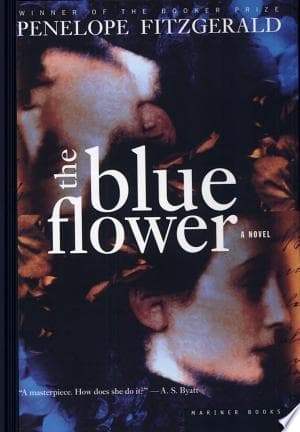
Penelope Fitzgerald (1997)
Genre
General
Reading Time
240 min
Key Themes
See below
Sign in to track this book
In 1794, a bright but rash young poet named Fritz declares his love and intent to marry twelve-year-old Sophie, shocking his family and society by defying all expectations of romance and reason.
The novel begins in 1794 with Friedrich von Hardenberg, known as Fritz, a twenty-two-year-old student, returning to his family home. He is in love and wants his father's permission to get engaged. To his family's surprise, Fritz says his bride-to-be is Sophie von Kühn, a delicate and somewhat sickly twelve-year-old he met during a visit. His family struggles to understand his passionate, almost mystical devotion to such a young, seemingly ordinary child, seeing it as another example of his unusual mind and idealism.
Sophie von Kühn lives with her family in Grüningen, a household that is somewhat provincial and lacks intellectual activity. Sophie is a quiet, often withdrawn child, frequently ill. She is not conventionally beautiful or lively, and her education is basic, focusing more on household skills than intellectual pursuits. Her younger sister, Bernhardina, is more outgoing. Sophie's parents are well-meaning but somewhat overwhelmed. They are initially surprised, then cautiously pleased, by Fritz's attention, recognizing the potential social and financial benefits of such a match, despite Sophie's youth.
The Hardenberg family, including Fritz's father, Baron von Hardenberg, his mother, and his siblings Erasmus and Carl, struggle to accept Fritz's intellectual brilliance alongside his seemingly absurd choice of fiancée. His friend, the philosopher Novalis (a name Fritz later uses), and other intellectual companions are equally puzzled. The engagement challenges late 18th-century social norms, where age differences in marriage were common but usually involved older men marrying younger, more mature women. Fritz's family wonders if Sophie can ever be a true intellectual partner to him, or if his love is purely an idealistic projection.
Despite his unusual engagement, Fritz's intellectual life continues. He studies at the Freiberg Mining Academy under Abraham Gottlob Werner and later at Jena, focusing on philosophy, science, and poetry. He writes often to Sophie, though her letters are simple and childlike. Fritz idealizes Sophie, seeing her not just as a future wife but as a spiritual embodiment of his philosophical ideas—a 'blue flower' representing longing, transcendence, and the connection between the material and the spiritual. He believes her purity and innocence offer a unique insight into the world.
As time passes, Sophie's delicate health worsens. She suffers from frequent fevers, debilitating headaches, and a persistent cough. Doctors of the era cannot diagnose her condition accurately, offering various remedies that provide little relief. Her parents, though concerned, are somewhat resigned to her frail health. Fritz, while deeply worried, remains hopeful and spiritual, believing in her eventual recovery and seeing her suffering through a profound, almost mystical lens, linking it to his own philosophical thoughts on life and death.
Fritz spends more and more time at Sophie's bedside, reading to her, talking to her, and trying to comfort her. He brings her gifts and tries to entertain her with stories. His dedication is constant, even as her condition visibly declines. He consults many doctors and seeks alternative treatments, all without success. The contrast between his intellectual pursuits and the harsh reality of Sophie's physical decline becomes clearer. He feels intense despair and frustration, struggling with medicine's limits and the coming loss of his beloved, whom he has elevated to an almost divine status in his mind.
As Sophie's condition becomes critical, with an abscess forming in her liver, a drastic decision is made to perform surgery. In an era without anesthesia or modern surgical techniques, the operation is incredibly painful for Sophie and her family. Fritz is present, offering what comfort he can. Although there is initially a flicker of hope for recovery, the surgery proves to be a temporary measure. Sophie's health continues to decline quickly in the days and weeks after the procedure, signaling the inevitable end.
On March 19, 1797, at fifteen, Sophie von Kühn dies. Her death plunges Fritz into deep grief. The family mourns her loss, but Fritz's reaction is particularly intense, a mix of spiritual ecstasy and sorrow. He struggles with her absence, yet simultaneously believes her spirit lives on, perhaps even more powerfully, in the spiritual realm. He begins to form his philosophical ideas about the unity of life and death, seeing Sophie's passing not as an end, but as a transformation, a journey into a higher state of being that will greatly influence his later poetic and philosophical works.
Immediately after Sophie's death, Fritz's grief is overwhelming, yet it also sparks his most important intellectual and spiritual development. He spends long hours at her grave, thinking about death, love, and eternity. This period is essential for his ideas of 'Night' as a place of spiritual discovery and the 'Blue Flower' as a symbol of endless longing and the divine. His experience of loss turns his intellectual pursuits into a deeply personal, almost mystical quest, shaping his identity as Novalis, the Romantic poet and philosopher. He begins to write his 'Hymns to the Night,' directly inspired by Sophie's memory.
Despite his intense grief and devotion to Sophie's memory, Fritz's life continues. He later forms new romantic relationships, notably with Julie von Charpentier, a professor's daughter, and later with a young woman named Caroline Just. While these relationships are important, the deep impact of Sophie's love and death remains a core part of his being and his work. Her idealized and spiritualized image continues to inspire him, supporting his understanding of love, eternity, and the mystical connections between the living and the dead. The novel subtly explores the complexities of moving forward while honoring an unforgettable past.
The Protagonist
Fritz transforms from a brilliant but somewhat naive idealist into a profound Romantic poet and philosopher, his grief over Sophie's death catalyzing his deepest insights into life, death, and the spiritual.
The Love interest, catalyst for Fritz's development
Sophie's arc is primarily physical decline, but her role is to catalyze Fritz's spiritual and artistic transformation through her life and death.
The Supporting
The Baron moves from bewilderment and mild disapproval to a grudging acceptance of Fritz's unconventional love, though never fully understanding it.
The Supporting
Her arc involves trying to understand and support her son's unusual path while maintaining her practical outlook.
The Supporting
Erasmus maintains his grounded perspective, providing a contrast to Fritz's idealism.
The Supporting
Carl's arc is static, serving to highlight Fritz's uniqueness within the family.
The Supporting
Bernhardina remains a youthful, healthy presence, contrasting with her sister's decline.
The Mentioned
Werner's role is static, representing a specific intellectual discipline that influences Fritz.
The novel explores how love can go beyond physical reality and lead to spiritual understanding. Fritz's love for Sophie is not based on typical beauty or intelligence but on an idealized vision of purity and innocence. Her youth and frailty, rather than being problems, allow him to project his deepest philosophical desires onto her. Her illness and eventual death do not lessen his love but change it, leading him to see her as a spiritual guide and a key to understanding life and death's unity, as seen in his 'Hymns to the Night,' which his grief directly inspires.
“What is it about a girl of twelve that can take a man of twenty-two by the throat and shake him into a new existence?”
Fritz's character shows the fine line between genius and eccentricity. His family and society struggle to understand his unusual love and intense intellectual pursuits. His brilliance often isolates him, as his friends and relatives find his ideas and passions confusing. The novel suggests that true genius often works outside social norms, finding inspiration and meaning where others do not look. Fritz's ability to combine different fields of knowledge—science, philosophy, poetry—into a clear worldview is presented as a sign of his exceptional mind, even if it makes him seem odd.
“He was, in their eyes, a genius. But a genius, they had long since discovered, was not always convenient.”
A main theme is how personal experience, especially deep grief, can turn into art and philosophical insight. Sophie's illness and death become the reason for Fritz's most important poetic and philosophical works, such as the 'Hymns to the Night.' The novel presents death not as a final end, but as a change or a door to a deeper spiritual reality, especially through Fritz's eyes. His ability to find beauty and meaning in suffering and loss turns his personal tragedy into universal artistic expression, suggesting that art can connect the ordinary and the transcendent.
“Death was not the end, but a deeper beginning. Sophie had not been taken from him, but given to him in a new, more profound way.”
The novel subtly explores the cultural shift from the Age of Enlightenment to the beginning of the Romantic movement. Fritz, as Novalis, is at this turning point. While he rigorously studies science and philosophy, reflecting Enlightenment ideas of reason and empirical knowledge (as seen in his studies with Werner), his ultimate devotion to Sophie and his mystical interpretations of love, nature, and death are deeply Romantic. His focus on emotion, intuition, and individual subjective experience contrasts with his time's prevailing rationalism, making him a figure that represents this intellectual change.
“He understood the mineralogy of the earth, but his heart sought the invisible veins of its spirit.”
A central symbol representing longing, the unattainable, and spiritual transcendence.
The Blue Flower is the most prominent symbol in the novel, originating from Novalis's own writings. In the context of 'The Blue Flower,' it embodies Fritz's idealized love for Sophie, his yearning for the infinite, and the ultimate unity of nature, spirit, and art. It represents the pursuit of the divine, the mystical connection between the earthly and the transcendent, and the Romantic longing for something beyond the tangible world. Sophie, for Fritz, becomes the embodiment of this elusive and perfect 'blue flower,' even in her physical frailty.
Letters between characters, especially Fritz and Sophie, reveal inner thoughts and advance the narrative.
While not entirely an epistolary novel, letters play a significant role in revealing the characters' inner lives and maintaining connections across distances. Fritz's letters to Sophie, though her replies are simple, highlight his idealization of her and his philosophical musings. These letters underscore the intellectual and emotional chasm between them while simultaneously demonstrating Fritz's unwavering devotion. They also provide insight into the social customs and communication methods of the late 18th century, adding to the historical authenticity.
Sophie's recurring illnesses and fragile health subtly hint at her tragic fate.
From her first appearance, Sophie's delicate constitution and frequent ailments – headaches, fevers, coughs – serve as continuous foreshadowing of her eventual death. These early indications create a sense of impending tragedy, making her ultimate demise both inevitable and deeply poignant. This device allows the reader to understand the profound impact her illness has on Fritz's philosophical development, as he grapples with the reality of mortality even as he idealizes her as an eternal spirit.
The social, scientific, and philosophical milieu of late 18th-century Germany shapes character motivations and plot.
The historical setting of late 18th-century Germany is not merely a backdrop but an active force in the narrative. The prevailing Enlightenment thought, the emerging Romantic movement, the state of medical science, and societal expectations around marriage and family all directly influence the characters' choices and reactions. Fritz's intellectual breadth, the family's bewilderment at his engagement, and the limitations of Sophie's medical care are all deeply rooted in this specific historical moment, giving the story a rich, authentic texture and explaining the 'why' behind many events.
“The greatest happiness is to be found in the contemplation of the truth.”
— Fritz's philosophical musings on the nature of happiness and knowledge.
“The world is full of things which are not what they seem.”
— Reflecting on the deceptive appearances of the world and human perception.
“What is love? It is the joy of two souls who understand each other.”
— Fritz pondering the definition and essence of love.
“Every man has his own way of going to heaven.”
— Discussing individual paths to spiritual fulfillment or purpose.
“One must make one's own world, and live in it.”
— Emphasizing the importance of creating one's own reality and values.
“The only true wisdom is in knowing you know nothing.”
— A nod to Socratic paradox, reflecting on the limits of human knowledge.
“To educate a man is to make him more himself.”
— Considering the purpose of education as a means of self-discovery and development.
“Life is a dream, and we are the dreamers.”
— A poetic reflection on the ephemeral and subjective nature of existence.
“The poet is a seer, who sees what others do not.”
— Discussing the unique perceptive abilities and role of a poet.
“There are books which are like keys to unknown chambers of the soul.”
— Highlighting the transformative power of literature and reading.
“It is better to light a single candle than to curse the darkness.”
— An aphorism about taking action and hope in the face of despair.
“The spirit of man is an unconquerable thing.”
— Reflecting on the resilience and enduring nature of the human spirit.
“The greatest journey is the one within.”
— Emphasizing the importance of introspection and self-exploration.
“To understand is to forgive.”
— A profound statement on the connection between comprehension and empathy.
“The heart has its reasons, which reason knows nothing of.”
— A contemplation of the irrational yet powerful influence of emotions and intuition.
Ready to see how well you understood this book? Take our interactive quiz with 10 questions.

Penelope Mary Fitzgerald was a Booker Prize-winning novelist, poet, essayist and biographer from Lincoln, England. In 2008 The Times listed her among "the 50 greatest British writers since 1945". The Observer in 2012 placed her final novel, The Blue Flower, among "the ten best historical novels". A.S. Byatt called her, "Jane Austen’s nearest heir for precision and invention."